
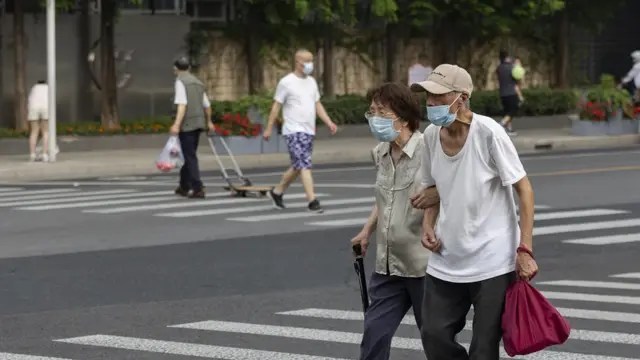
After more than a decade in the making, on September 13 the CCP's National People's Congress abruptly passed the "Decision on Implementing a Gradual Delay of the Statutory Retirement Age." Why would the CCP push this Decision through at such a difficult moment of economic downturn? Because its pension system is now running a shortfall requiring enormous fiscal subsidies, leaving it with no other choice. Let's examine this in detail. 1. China’s Current Pension System There are currently two pension systems in use around the world. One is the pay-as-you-go system, with a history of more than 120 years, under which money is "collected from people currently working to support people currently retired." The other is the individual account system designed by World Bank experts, which, put simply, means "everyone saves for their own retirement," with funds entrusted to institutions to invest in funds, stocks, or wealth-management products to guard against inflation. China's basic pension insurance uses a hybrid model combining social pooling under a pay-as-you-go structure (contributions of 20% of the wage base) with individual accumulation accounts (contributions of 8% of the wage base). In practice, however, because funds in individual accounts have been diverted elsewhere, these accounts are effectively empty, making the system in reality a pure pay-as-you-go scheme. That means pension solvency depends entirely on the ratio between the number of retirees in an aging society (the elderly share of the total population) and the number of people paying into the system. 2. The Surface Cause of Delayed Retirement: The Pension Shortfall and Massive Fiscal Subsidies 2.1 The Pension Shortfall The China Pension Development Report 2016, released at the end of 2016, found that the cumulative recorded balance of individual accounts under basic employee pension insurance (i.e., the "empty accounts," which represent "implicit debt" from the government's perspective) reached 4.7 trillion yuan in 2015. Yet the cumulative balance of the employee pension insurance fund that year was only 3.5 trillion yuan. Subtracting the 4.7 trillion yuan in empty individual accounts from the 3.5 trillion yuan balance leaves an actual shortfall of 1.2 trillion yuan. By the end of 2023, the cumulative balance of basic pension insurance funds for enterprise employees stood at nearly 6 trillion yuan. But once the scale of the "empty accounts" resulting from diverted individual-account funds is subtracted—a figure the CCP has never disclosed—the actual shortfall could well run into the trillions of yuan. According to the China Pension Actuarial Report 2019–2050, published by the Chinese Academy of Social Sciences, the pension fund's balance outlook is far from optimistic: it will peak at 6.99 trillion yuan in 2027, decline year after year thereafter, and be exhausted entirely by 2035. The basic pension insurance fund for urban enterprise employees will start running an annual deficit after 2028, with the shortfall reaching 118.13 billion yuan that year and ballooning a hundredfold to 11.28 trillion yuan by 2050. By that point, the entire basic pension insurance fund will have to be covered by fiscal subsidies—an enormous burden for the CCP. 2.2 Fiscal Subsidies According to Huang Xiaosa of the Pension Management Department of the National Council for Social Security Fund, writing in "Viewing Population Aging Objectively and Responding to It Proactively," aging increases the government's public fiscal spending on basic pensions, retirement benefits, insurance premium subsidies, and healthcare. In 2020 alone, spending on social security and employment increased by 2.34 trillion yuan compared with 2010. The latest Ministry of Finance figures show that in 2023, national general public budget revenue was 21.6784 trillion yuan, while spending on social security and employment reached 3.9883 trillion yuan, up 8.9% year-on-year, of which about 1 trillion yuan was allocated to basic pension insurance subsidies.
3. The Root Cause of Delayed Retirement: The Failed Family Planning Policy and Shifting the Government’s Pension Responsibility onto Society 3.1 The Inhumane Family Planning Policy Caused a Cliff-Edge Population Decline, Ushering In a Rapidly Aging Society According to Wikipedia, in 1982–83, then Minister of Health Qian Xinzhong proposed the policy of "IUD insertion after the first child, sterilization after the second." In 1983 alone, 17.76 million IUD insertions, 16.4 million female sterilizations, 4.26 million male sterilizations, and 14.37 million abortions were carried out. According to the China Health Statistics Yearbook 2010, at least 13 million abortions are officially recorded in China each year—and that is only the CCP's own figure. Data from the U.S. State Department put the number at 23 million abortions per year in China. In other words, the family planning policy in effect from the 1980s until 2015 caused a cliff-edge decline in population, sharply reducing the number of people paying into social security and bringing forward the onset of an aging society. China entered an aging society in 1999, when the population aged 65 and above reached 7% of the total. By 2020, that share had risen to 13.5%, putting China essentially in a deeply aged society, and by 2030 the share of people over 65 will reach 20%, marking entry into a super-aged society. The United Nations projects that this share will continue to rise to 23.9% by 2050. From 2051 to 2100, the country will then settle into a stable phase of severe aging, with the level holding at roughly 31%. When the pension insurance system was established more than twenty years ago, the dependency ratio (the number of working contributors divided by the number of retirees) stood at 5:1. By 2019 it had continuously fallen to 2.65:1 (though the CCP's official figure was 4:1). As population aging accelerates, the ratio is projected to fall to 2:1 by 2027 and to 1.22:1 by 2035. As a result, the number of people drawing pensions keeps rising while the number paying into the system keeps falling. By 2035, not only will the nationwide pension balance be exhausted, but the crisis of "hidden liabilities" in individual accounts will erupt as well. 3.2 The CCP Is Passing the Social Security Debt It Owes the People from the Planned-Economy Era onto Society at Large China first established its pension insurance system in 1996, and it was only gradually extended to cover the whole of society by 2014. The vast majority of people drawing pensions in the 1980s and 1990s were employees of state-owned enterprises (including those laid off or forced into early retirement in 1998), none of whom had ever paid into a pension fund. In theory, the government—through the state treasury—was obligated to support them for life. Xu Shanda, former deputy director of the State Administration of Taxation, explained: "Under the old planned economy, state-owned enterprises supported their workers for life, and there was no need to pay into social security. But that changed [the CCP broke its promise to the people], and the retirees from that era still needed to draw benefits [which should have been the treasury's responsibility, but the government instead dumped the burden onto the social security system]. So the rule became: this later generation not only has to pay into their own social security, but also has to fund the previous generation's." In other words, the CCP shifted the fiscal burden of supporting retirees onto the younger generation now paying into the system. Because of these historical legacy problems combined with population aging, older contributors' individual accounts never accumulated enough, forcing the money in young people's individual accounts to be used to cover current pension payouts. This has left individual accounts empty, created hidden government liabilities, and deepened the CCP's fiscal crisis. 4. Delaying Retirement Has Become the CCP’s Solution for Plugging the Pension Shortfall and Easing the Fiscal Crisis