In recent times, incidents of the CCP pulling books from shelves have kept occurring. A reissued work by Ming-history specialist Chen Wutong, Chongzhen: The Diligent Ruler Who Lost His Empire, was pulled entirely from circulation across mainland China in October 2023 because a comment on its cover—"one blunder after another, the more 'diligently' he ruled, the faster his empire fell"—invited comparisons to Xi Jinping. Chinese cultural scholar Yi Zhongtian's multi-volume A History of China, published years earlier, was likewise ordered off the shelves in November 2023. Even the History of the Qing Dynasty—a project the CCP authorities invested 2 billion yuan in and spent twenty years compiling—failed to pass two years of "political review" and was ultimately shelved indefinitely. Many people lament that the CCP's crackdown on publishing, scholarship, and freedom of speech has grown ever harsher. But most probably do not know that, ever since seizing power in 1949, the CCP has already carried out three massive book-burning campaigns, destroying countless books. Today, let's take a look at these three disasters.
800,000 Tons of Books Go Up in Flames On February 16, 1952, Taiwan's Central Daily News published a report stating: "The Peiping regime is engaged in a massive book-burning campaign aimed at suppressing thought and culture that does not conform closely enough to the ideology dictated by the Soviet dictators in Moscow. At least 1.48 million paperback volumes have been destroyed in Peiping alone, because the CCP's overlords disapproved of their 'ideology, language, and content.' Under another book-burning order, eighty tons of books were completely destroyed. One major publishing house, which had published more than ten thousand titles over fifty years, now finds all but 1,234 of them banned." At the time, in addition to burning books and banning the publication and distribution of certain works—such as Sun Yat-sen's Three Principles of the People—the CCP was also gradually eliminating the free press, replacing the British- and American-published textbooks used by science and engineering students with Soviet versions, and raising a new banner over literature and the arts, declaring that they must "serve proletarian politics." The CCP, then barely two years into power, was already suppressing dissenting voices with all its might—and this, too, was modeled directly on Soviet practice. According to economic historian Li Bozhong's essay "A Global History of Book Burning," after the Soviet Union was established, in order to preserve so-called "socialist purity," it proposed creating a proletarian "vacuum" environment to keep people from being poisoned by harmful ideas. The first step in "purifying the environment" was to burn "politically harmful books," eliminating the corrupting, poisonous influence of "enemies of the people." On June 6, 1922, the Soviet Main Administration for Literary and Publishing Affairs (Glavlit) was formally established and drew up a list of banned books—initially covering only titles unfit for public circulation, but later expanding to include all publications deemed "unfit for the public." The number of books and materials destroyed in this "book-burning" campaign was staggering. Later, between 1938 and 1939, more than 24 million so-called "harmful books" were pulped. Accompanying the book burning was the mass arrest and expulsion of intellectuals by the Soviet Communist Party. In 1922, on Lenin's orders, numerous professors, doctors, and agronomists were exiled to Russia's northern provinces or expelled from the country altogether. Those expelled were forced to sign pledges never to return, on pain of death. The CCP, following this example closely, used its first book-burning campaign after seizing power as an occasion to subject intellectuals to "thought reform," aimed at purging their minds of any lingering sympathy for Western democracy and any remnants of the traditional scholar-gentry spirit. It was only because the CCP was simultaneously embroiled in the Korean War from 1950 to 1953 that it temporarily held off on further purging intellectuals.
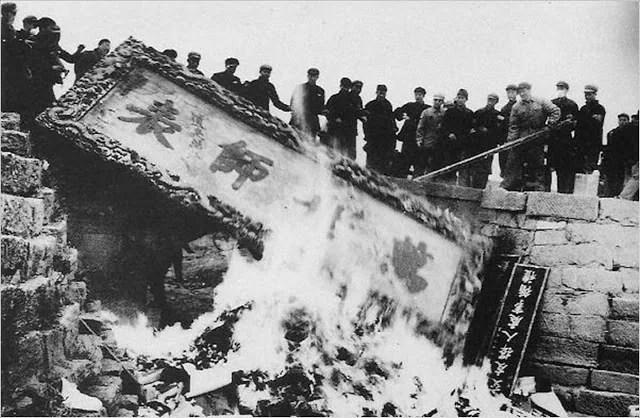
In 1956, enlightened by its intellectuals, Hungary rose up in revolution against Soviet domination and tyranny, only to be crushed by Soviet troops. Taking this as a lesson, Mao Zedong nonetheless launched the "Anti-Rightist" campaign in 1957, branding hundreds of thousands of intellectuals as "rightists." The Cultural Revolution’s Nationwide Book Burning Severs the Transmission of Culture With the outbreak of the "Cultural Revolution," the CCP launched its second large-scale campaign of "book burning." On August 22, 1966, Central People's Broadcasting Station aired, during prime time, news of Beijing's campaign to sweep away the "Four Olds." The so-called "Four Olds" were defined by the CCP as "old ideas, old culture, old customs, and old habits." Under the slogan "Destroy the Four Olds," Red Guards ransacked homes without restraint, and books labeled "feudal (traditional), bourgeois (Western), or revisionist (Soviet)" became one of the main targets of these raids. Moreover, according to "A Global History of Book Burning," even books published between 1949 and 1966 could not escape being "swept away"—with the exception of a few, such as the works of Marx, Lenin, Mao, and Lu Xun—not even popular-science works like One Hundred Thousand Whys were spared. In August and September 1966, the book-burning campaign reached its peak. Red Guards in Beijing staged mass book burnings at Dongdan Stadium, where books were piled up like small mountains. Books, paintings, and calligraphy confiscated from 1,061 households in the Fusuijing area of Xicheng District burned for eight days and eight nights. On August 23, more than two hundred Red Guards from the Beijing Printing School, the No. 8 Girls' Middle School, and other schools burned a large quantity of theatrical costumes—stored at the Confucius Temple by theater companies under the Beijing Municipal Bureau of Culture—in the front courtyard of the temple's main hall, along with books found among them. On the 24th, the home of Liang Shuming, a professor at Peking University, was ransacked; Red Guards carried out and burned in the courtyard generations' worth of books, paintings, calligraphy, and traditional clothing that the Liang family had treasured, including the manuscript and reference materials for the book on Confucianism and Buddhism that Liang was then writing. On the 25th, the home of historian Gu Jiegang was raided, and thousands of letters and thousands of photographs were burned over the course of three days. The writer Shen Congwen was working at the National Museum of Chinese History at the time. A military representative from the Military Control Commission pointed at the books and materials in his office and said, "I'll disinfect these for you—burn them. Do you object?" Shen Congwen, terrified, replied, "I have no objection at all." And so several shelves of precious books, including a Ming-dynasty edition of Stories Old and New, were carried out to the courtyard and burned to ashes. Hong Qiusheng, an expert in mounting paintings and calligraphy known as the "miracle doctor" of antique art restoration, had mounted countless masterpieces in his career, including landscapes by Emperor Huizong of Song, bamboo paintings by Su Dongpo, and works by Wen Zhengming and Tang Bohu. The famous paintings and calligraphy he had spent a lifetime collecting were likewise consumed by fire. Afterward, the old man told people through tears, "Over a hundred jin of paintings and calligraphy—it took so long to burn them all!" These harrowing scenes played out not only in Beijing, but across the entire country.
In Jiayin County, on the Sino-Soviet border in Heilongjiang Province, middle school students stormed the county cultural center, hauled theatrical costumes and books out into the street, and burned them all to ash. The Jiangsu-Zhejiang region, a center of culture and learning, produced most of the famous painters and calligraphers of the five hundred years spanning the Ming and Qing dynasties, and an especially large number of ancient texts survived there—so the destruction wrought by the "Destroy the Four Olds" campaign was especially severe. In the Ningbo area alone, eighty tons of Ming- and Qing-dynasty thread-bound books were pulped. At the Confucius Mansion in Qufu, home to more than two thousand years of uninterrupted cultural heritage, more than 6,000 cultural relics were destroyed between November 9 and December 7, 1966, along with over 2,700 ancient books burned, more than 900 scrolls of paintings and calligraphy, and over 1,000 historical stone steles destroyed—including more than seventy first-class national treasures and over 1,000 rare editions of books. The book burning severed the transmission of traditional Chinese culture. Alongside it, China's cultural elite were devastated—countless people were imprisoned, tortured to death, or had their very spirit broken.