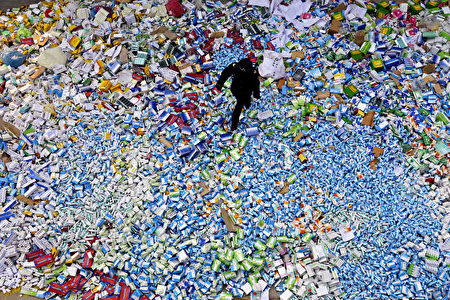
Since the pilot program began in 2019, centralized drug procurement (commonly known as "集採") organized by China's medical insurance authorities has now reached its tenth round. On December 30, 2024, the results of this tenth round were announced: not only did drug prices fall by a "record" margin, but the round also set another record—not a single original, imported brand-name drug was selected. In other words, everything procured was a domestically made generic drug.
What does this mean?
It means it is now a foregone conclusion that original imported drugs will disappear from mainland public hospitals. From now on, ordinary people seeking treatment at public hospitals will almost always be given domestic generics—even if they want to pay out of pocket for an imported drug, it simply will not be available.
As a result, drug prices have clearly come down—but drug quality and efficacy have plummeted right along with them, triggering panic and discontent across society. Complaints and criticism of centrally procured drugs are everywhere online.
How could people not panic and grow angry? Think about it: rich or poor, whatever one's station in life, everyone eventually needs medical treatment. Drugs of poor quality and weak efficacy can, at best, undermine treatment and health, and at worst, endanger life itself.
Sun Liping, a professor at Tsinghua University, bluntly stated that "centrally procured drugs are brewing a storm."
Is that an exaggeration? Not in the least. In the WeChat groups he belongs to, longtime patients—especially those who must take medication year-round—are constantly exchanging drug-related information. Some say a certain medicine can no longer be prescribed under insurance, that a certain hospital no longer stocks it, or that it can't even be bought online anymore. Then the discussion turns to what to do about it. For longtime patients, the answer is fairly clear: stockpile as much as possible. But medicine has an expiration date—how much can anyone really stockpile? Ordinary people are even more at a loss: who knows what illness they might get in the future, or what medicine they might need? There's no way to even begin stockpiling.
Statements from medical professionals only reinforce public concern over centrally procured drugs.
At Shanghai's recent "Two Sessions" meetings, Zheng Minhua, a member of the local Chinese People's Political Consultative Conference and also head of general surgery at Shanghai Ruijin Hospital, said that because centrally procured drugs are so cheap, their quality is unstable, producing phenomena such as "blood pressure that won't come down, anesthesia that won't put you to sleep, and laxatives that don't work." Doctors, he said, feel powerless in the face of patients' complaints and doubts, since they have no choice in the matter, and "there's no channel to even report this up the chain."
Lu Changlin, a member of the Beijing Municipal Political Consultative Conference and chief physician of cardiology at Beijing Chaoyang Hospital, likewise submitted a proposal at a recent Beijing CPPCC meeting stating that centrally procured drugs cause considerable adverse reactions—even allergic reactions in some cases—indicating insufficient drug purity and flawed manufacturing processes.
Based on complaints from internet users, the problems with centrally procured drugs mainly fall into the following categories:
Poor efficacy: Many users report that centrally procured drugs fail to deliver the expected results. Some, for instance, say infection symptoms persisted even after taking certain antibiotics, or that blood pressure and blood sugar levels remained poorly controlled despite taking blood-pressure or diabetes medication.
Adverse reactions: Some users say they experienced adverse reactions after taking centrally procured drugs, including allergic reactions and gastrointestinal discomfort. These reactions not only undermine treatment outcomes but may pose additional health risks.
Inconsistent quality: Some users point out that quality varies between different batches of centrally procured drugs even under the same brand. This inconsistency has left patients questioning both the efficacy and the safety of these drugs.
A wide gap with original brand-name drugs: Some users, after comparing original brand-name drugs with centrally procured generics, say there is a clear difference in efficacy between the two. They believe that although generics are cheaper, the drop in efficacy means they are not actually a good value.
As Professor Sun Liping put it: "At a time when medical science and technology are already highly advanced, it is simply inexcusable that, for all sorts of man-made reasons, people are forced to take drugs that are ineffective or even carry severe side effects, and to use substandard medical products that actually harm the body. Drug prices can be low or high; the cost can be borne by the patient or covered by insurance—but the most basic requirement is that the drug actually works, that it is effective, that it treats the illness. That is the absolute bottom line. I want people to realize what kind of situation this is: if that bottom line is breached, it will trigger an unprecedented crisis of trust in medicine—one that would not merely collapse the insurance system, but the entire medical system itself. This, I would say, is an enormous matter."
Although the problems with centrally procured drugs affect the vast majority of people, the CCP's privileged elite are not among them. They enjoy every manner of medical privilege and would never—could never—be made to use generic or domestic drugs. While they themselves enjoy high-quality, effective imported medicine, they leave ordinary people to make do with inferior, ineffective generics and domestic drugs—clear proof that the health of the people has never truly mattered to them at all.