
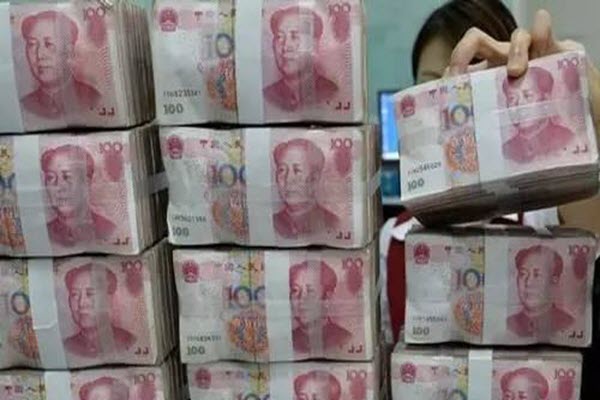
The more the CCP investigates corrupt officials, the more of them turn up, and the more corrupt money keeps accumulating. What do they do with all this money? Corrupt officials rack their brains, using every conceivable trick to hide it—not only stashing it all over the country, but also going to great lengths to hide it abroad.
Here, we take stock of the various methods CCP corrupt officials use to hide money, both at home and abroad.
1. Hidden in a So-Called “Supermarket”
On January 21, 2021, Lai Xiaomin, former chairman of China Huarong Asset Management Co., was sentenced to death in a final ruling by the Tianjin Higher People's Court for accepting bribes totaling over 1.788 billion yuan, embezzling more than 25.13 million yuan, and committing bigamy. Lai was executed on January 29.
Where did Lai Xiaomin hide all this ill-gotten money?
According to CCTV, in order to evade investigation, Lai demanded that bribes be paid in cash. After receiving the money, he would personally drive to a residential unit in Beijing and place the cash into a safe with his own hands, deliberately taking a roundabout route to avoid being followed. Among his close associates who knew about this property, they referred to it only by a code name, calling it the “supermarket.”
After Lai fell from power, the special investigation team searched this property and found 270 million yuan in cash.
Just how much money is 270 million yuan? One creative internet user did the math: a new 100-yuan banknote measures 15.5 by 7.7 centimeters; laid end to end, 270 million yuan in such notes would circle the Earth once (the equator measures 40,000 kilometers), spread flat it would cover the equivalent of 4.5 football fields, stacked up it would reach roughly the height of an 80-story building, it would weigh 3.105 tons, and it would take 70 banknote-counting machines working simultaneously a full hour to count it all.
This 270 million yuan in cash was only part of Lai Xiaomin's ill-gotten gains. He also accepted large quantities of real estate, luxury cars, luxury watches, gold, and calligraphy and paintings, all hidden elsewhere.
2. Hidden in the Basement of a Mansion
On March 15, 2014, Xu Caihou, former member of the CCP Politburo and vice chairman of the Central Military Commission, was placed under investigation on suspicion of serious violations of Party discipline and the law.
On March 15, 2015, CCP authorities announced that Xu Caihou had died of terminal bladder cancer that had metastasized throughout his body, causing multiple organ failure that could not be treated.
According to the cover story “Inside the Raid on National Traitor Xu Caihou” in Issue 32, 2014, of Phoenix Weekly:
On the night of March 15, 2014, investigators from the military procuratorate raided one of Xu Caihou's mansions on Fucheng Road in Beijing. A source close to senior military leadership revealed that the results of the raid stunned even these seasoned investigators: “We had already assumed the rumors of Xu Caihou's corruption circulating in society were serious, and since it had already been more than two years since the Gu Junshan case broke, we figured that even if Xu had engaged in corruption, all his assets would have long since been moved elsewhere, and there would definitely be nothing left in the house.”
But when they opened the basement of Xu's 2,000-square-meter mansion, the investigators were still stunned: cash was piled up everywhere in the basement—US dollars, euros, and yuan—so much that they could not count it by hand and had to weigh it on a scale instead before sealing it up. The cash seized weighed a full ton or more. Some of it was still in bundles that had never even been opened, and the gold, silver, and jewelry throughout the house were beyond counting.
In the storeroom of Xu's mansion, there were also hundreds of kilograms—over one hundred, over two hundred—of Hetian jade, along with piles of precious hardwood items and rare jadeite pieces. Most of the piled-up Hetian jade was still in its raw, unprocessed state, with only a thin outer layer removed from some pieces to reveal the approximate quality of the stone inside. “There were a dozen or so pieces of uncut jade; the seized cash and the jade were stored separately,” the source said, adding that the storeroom also contained various antiques and calligraphy and paintings from the Tang, Song, Yuan, and Ming dynasties. Their owner had evidently never had time to properly organize them—they were simply left scattered about the room.
The property seized from Xu Caihou's mansion was piled up like a mountain; investigators had to call in more than a dozen military trucks on the spot just to haul it all away.
3. Hidden in a Villa Bought for the Purpose
On November 29, 2004, Li Youcan, former deputy director of the Hebei Provincial Department of Foreign Trade and Economic Cooperation, was sentenced to death by the Hebei Higher People's Court for extortion and bribery. Li was executed on April 26, 2006.
The court found that from August 2001 to April 2003, Li Youcan used his position as deputy director of the Hebei Foreign Trade Department and director of the Hebei Mechanical and Electrical Equipment Office, along with his authority over the approval and allocation of automobile import quotas for Hebei Province, to grant 1,249 import car quotas to Ding Ning, general manager of Beijing Senhua Company, in exchange for 47.23 million yuan from Ding. He also demanded a Volkswagen Golf sedan worth 210,000 yuan from Tangshan Jidong Mechanical and Electrical Equipment Company, bringing his total bribes to 47.44 million yuan.
As the money he had taken through corruption kept growing, Li Youcan specifically spent 500,000 yuan to buy a villa in an unremarkable gated community in Beijing, solely for hiding his money. The largest single bribe he ever received was 16.4 million yuan in cash. He packed the cash into 16 suitcases and used his Golf sedan as a cash-transport vehicle, making three separate trips from Hebei to Beijing to move it all.
His greatest pleasure was to spread the cash out in stacks on the floor of the villa, count it over and over, and then “quietly admire it.”
4. Hidden in a False Wall on the Balcony
In July 2023, amid the CCP's anti-corruption campaign in the healthcare sector, Wang Maosheng, former president and Party secretary of Gaozhou People's Hospital in Guangdong Province, was placed under investigation.
In 2013, CCP state media exposed a kickback scandal involving drug procurement at Gaozhou People's Hospital, and both the president and deputy president were removed from their posts and held accountable. Wang Maosheng was transferred in at this critical juncture to serve as the hospital's Party secretary and president.
After taking office, far from learning the lesson of his predecessors, Wang Maosheng accepted even larger kickbacks, ultimately totaling more than 200 million yuan.
According to CCTV, most of Wang's bribe proceeds were held by others on his behalf; those who bribed him purchased multiple properties and storefronts for him in Guangzhou, Zhanjiang, Maoming, and elsewhere, all registered under other people's names. He also had pharmaceutical suppliers deposit part of the money into securities accounts opened in other people's names, which he actually controlled himself.
How did he hide the cash he took? Wang Maosheng had pharmaceutical supplier Li Shaokan fund the purchase of a house for him in Gaozhou, and during the renovation had a hidden compartment specially built into the balcony to hide the money he received, concealed behind a cabinet on the outside.
After Wang's case broke, the special investigation team discovered this hiding place, and all of his ill-gotten gains were confiscated.
5. Hiding Money in Hong Kong
On August 22, 2000, Cheng Kejie, former vice chairman of the Standing Committee of the National People's Congress and former chairman of the Guangxi Zhuang Autonomous Region, was sentenced to death in a final ruling by the Beijing Higher People's Court on charges of bribery, and was executed on September 14.
Cheng Kejie's money was obtained through corruption together with his mistress, Li Ping. They had originally planned to use the money to spend a comfortable retirement together overseas. Feeling that keeping the money in mainland China was unsafe, they decided to hide it in Hong Kong instead.
He and his mistress Li Ping handed over 41.09 million yuan of their bribe proceeds to Hong Kong businessman Zhang Jinghai, asking him to help deposit the money into a Hong Kong bank account, for which Cheng paid Zhang 11.5 million yuan. Cheng also registered a shell company in Hong Kong under Li Ping's name, intending to funnel the money into this shell company's account and ultimately launder it into clean funds that would serve as a retirement nest egg for him and his mistress overseas.
However, a Hong Kong bank noticed irregular fund flows into a certain company's account from Guangxi and reported it to Hong Kong's Joint Financial Intelligence Unit (JFIU). Hong Kong and mainland police launched a joint investigation, and Cheng Kejie's scheme to hide money in Hong Kong was exposed.
6. Hiding Money in Swiss Banks
On August 3, 2019, Professor Jia Kang, a member of the 11th and 12th National Committees of the Chinese People's Political Consultative Conference, former director of the Ministry of Finance's Research Institute for Fiscal Science, and chief economist of the China Academy of New Supply-Side Economics, forwarded a message that read: “Astonishing—Swiss banks have disclosed that 100 Chinese individuals hold combined deposits totaling 7.8 trillion yuan.” After being widely forwarded, the message was quickly deleted.
Whether or not this message was accurate, it is likely that a great many senior CCP officials hide money in Swiss banks.
In 2013, WikiLeaks' “China Cables” disclosed the following information:
First, senior CCP officials hold roughly 5,000 accounts in Swiss banks, two-thirds of which belong to senior officials of the CCP Central Committee. About 150 of the names remain unconfirmed, presumably belonging to family members. Nearly every official at the ministerial level and above, and most Central Committee members, have a share.
Second, Hong Kong is the main channel senior CCP officials use for international money laundering. Beijing makes full use of the legal privileges afforded by Hong Kong's status as a free port, and every faction has its own banks and handlers—meaning that senior CCP officials primarily transfer money to Swiss banks by way of Hong Kong.
Third, after 2002, most CCP officials at the bureau level and even deputy bureau level who worked in Hong Kong—including officials from the Liaison Office, the Hong Kong and Macau Affairs Office, the Taiwan Affairs Office, and the United Front Work Department—hold Swiss bank accounts. Given their limited official income and authority, this money likely comes from bribes tied to overseas interests.
7. Absconding with Stolen Money
According to mainland Chinese media reports, over the three days from the night of August 3 to August 5, 2003, more than 60 government officials attempting to flee the country with passports or travel permits were caught at ports and airports in Beijing, Tianjin, Shanghai, Guangzhou, and elsewhere. Among them were seven deputy bureau-level officials carrying foreign-currency export certificates approved by financial and customs authorities; the official carrying the smallest amount, a trade official, still had 600,000 euros on his person.
In the 24 hours from the night of September 30 to the night of October 1, 2003, 51 corrupt officials were arrested while attempting to flee the country, setting a record for the most corrupt officials caught attempting to flee in a single day.
During the CCP's National Day holiday period in 2003, a total of 115 corrupt officials attempting to flee the country were arrested before they could leave.
Just how many corrupt officials have fled the country? CCP authorities have yet to disclose any exact figures.
A June 2008 research report completed by the Anti-Money Laundering Monitoring and Analysis Center of the People's Bank of China stated that since the mid-1990s, more than 10,000 Party and government cadres, state-owned enterprise executives, and staff of Chinese institutions stationed abroad have fled or gone missing, absconding with as much as 800 billion yuan.
Corrupt officials who flee abroad use at least eight methods to move their assets overseas, including cash smuggling, alternative remittance systems, falsifying current-account transactions, overseas investment, credit card spending, offshore financial centers, direct overseas receipt of funds, and transfers through special contacts abroad.
From 2008 to 2025, another seventeen years have passed. Over these seventeen years, corruption within the CCP has grown ever more severe; the number of corrupt officials fleeing abroad is likely even higher now, and the sums of money hidden overseas likely even larger.
On October 14, 2013, the mainland magazine Caijing published “A Report on China's ‘Naked Officials.’” Spanning more than 20 years, the report compiled 59 cases of fallen “naked officials,” with total sums involved reaching into the billions of yuan.
As early as 2005, Lin Zhe, a National People's Congress delegate and professor at the Central Party School, disclosed that between 1995 and 2005, China produced a total of 1.18 million “naked officials”—equivalent to an average of 40,000 per province.
So-called “naked officials” are those who have sent their wives and children abroad and moved all their money overseas, while they themselves remain in China holding office—waiting for the right moment, or for retirement, before they too flee abroad to “enjoy the good life.”
At 2688 West Mall near UBC in Vancouver, Canada, there stands an apartment building called Promontory, jokingly nicknamed by locals “the officials' tower,” most of whose residents are family members of CCP “naked officials.” A single unit in this building costs at least CAD 1 million to buy, and renting one costs at least CAD 2,000 a month (roughly 12,000 yuan).
In the ten years from 1995 to 2005 alone, the CCP produced 1.18 million naked officials. It is now 2025, twenty more years have passed—how many naked officials does the CCP have now? The authorities have released no figures. But given the trend of the past twelve years under Xi Jinping, during which corruption has only worsened despite his anti-corruption campaign, the number of naked officials is likely even higher.
More than 10,000 corrupt officials who fled the country absconded with as much as 800 billion yuan. How much money have the 1.18 million “naked officials” moved overseas? How much money have all the naked officials combined transferred abroad to date? The figure is likely astronomical.
8. Other Methods of Hiding Money
According to mainland media reports, CCP corrupt officials have devised countless other ways to hide money. Some hide it in bathroom ceilings; some wrap it layer after layer in plastic and hide it in tree hollows, ash piles, rice paddies, or under roof tiles; some hide it in a false compartment under a gas cylinder; some hide it inside cardboard boxes of bottled water; some stuff it inside gutted fish and freeze them in the refrigerator; some hide it in the base frame of screen doors; some wrap it in layers of oiled paper and bury it in the mud of fish ponds; and others hide it in exhaust fans, rice jars, tea tins, treadmills, or holes dug in the ground—there is truly no limit to the ingenuity involved.
Conclusion
Why do CCP corrupt officials hide money everywhere, both at home and abroad?
First, they have so much money they could never spend it all. Second, they have so much money they have no real need to spend it. Third, they fear the CCP itself might come and harvest them like “leeks.” And fourth, and most important, they know full well that the CCP is corrupt to its very core; none of them believe in it any longer, and every one of them is quietly securing an escape route and a fallback plan for themselves.