
I saw a short video in which a mainland Chinese person had 1,500 yuan deposited into his bank account for no apparent reason; before he could even figure out what was happening, 1,200 yuan was transferred right back out. He immediately realized someone had used his account to fake a government poverty-relief disbursement: deposit 1,500 yuan, then withdraw 1,200 of it, leaving 300 yuan behind as hush money.
Some time ago, the central government instructed that poor households be subsidized, without specifying how much money would be allocated or where it would come from. Most people assumed this was just a gesture to placate public opinion, but it turns out local governments actually “did it”—nobody knows where the money came from, but exactly where it went is perfectly clear. Pulling this off required collusion between government and banks, and involved quite a few people along the way, proving that officials are grabbing money even more brazenly now that the country is in crisis.
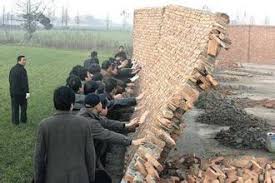
The government is broke down to its very last penny, and in principle officials ought to share its urgent concerns, restrain themselves, and live within its means to keep things running. But the more unstable the government becomes, the greedier its officials get, the more eager they are to “grab quick money”—this is what is meant by everyone giving a falling wall one more push: the government is going to die anyway, but I still have to live on after it does.
Another video showed a peanut farmer whose crop had ripened and was ready to be dug up and sold. Word got out, and swarms of middle-aged women descended on the fields from every direction. These villagers did not wait for him to harvest and then glean the leftover peanuts from the ground—they went ahead and “harvested” the crop themselves before he could. So many people rushed in to grab the peanuts that the farmer could only watch helplessly as an entire year's labor went to waste.
This kind of thing could only happen in communist China. That is what communism means, after all—what's yours is mine. If officials can empty the national treasury, why can't ordinary people grab peanuts? When the government has no morality, the people have no scruples either—those below follow the example set above; it has always been this way.
In yet another video, Honghe TV in Yunnan received a public tip-off that a gang of bandits was robbing people on a highway in the middle of the night. Police responded to the report, and a reporter rode along in the police car to cover the scene live.
When the police car arrived, there were indeed people blocking the road ahead. As the officers got out, the bandits immediately opened fire on them. The officers appeared to be few in number, but the bandits, guilty consciences and all, scattered instantly, leaping down a steep slope beside the road. As officers chased them, the bandits fired several more shots, but two of them were caught on the spot.
From his voice, the reporter sounded very young, his tone panicked; he complained that the police had not provided him with a bulletproof vest, and called himself a “war correspondent”—clearly with no real understanding of what that term means, and with no experience handling breaking emergencies. All of this suggests the video captured a genuine, unstaged event.
At the grassroots level of mainland society, a new phenomenon has begun to emerge: local strongmen taking desperate risks, secretly organizing armed groups to commit crimes. This shows that grassroots crime has already become organized and armed—a step beyond the earlier, more widespread social phenomena of “lying flat,” suicide, or indiscriminate mass violence. Now the people are organized, armed with guns, and even dare to open fire on the police—the very nature of the situation has fundamentally changed.
With mass unemployment across society and people at the bottom facing utter desperation, some able-bodied men who no longer fear death, having run out of options, turn to crime, waiting for the dead of night when the government's reach cannot extend, to make a living through robbery and pillage—driven to it, in the end, by sheer necessity.
Not long ago there were reports of widespread break-ins and burglaries in residential buildings in a certain mainland city, and urban public security is deteriorating generally. As the unemployed population surges, the streets fill with people sleeping rough at night, and those who cannot even secure three meals a day are banding together to commit crimes in order to survive—an inevitable trend. If this continues, wealthy urban residents and the families of officials will lose their basic sense of safety in daily life, forcing them to raise their walls higher, install electrified fencing, and hire armed security guards. Once things reach that point, it is a chaotic age of social disorder.
This also shows that grassroots government control is failing and spiraling out of control—local officials care only about corruption and ignore the hardships of ordinary people's lives, bandits now outnumber police officers, and the police are stretched to exhaustion, leaving gaping holes in public security. The more the government fails, the bolder the people become; wherever there is demand for guns, someone will supply them, and the poor are forming guerrilla-style bands, lying low by day and coming out at night, robbing the rich to help the poor.
Mainland China is vast in territory with a large rural population living in hardship, and officials deceive their superiors while oppressing those below them, creating opportunities for young people who are rebellious by nature and unafraid of death to take dangerous risks. The isolated cases we see today are merely a microcosm of countless major social events yet to come. As the old saying goes, “he who steals a belt buckle is a thief, but he who steals a kingdom becomes a lord”—officials commit corruption and pervert the law while sitting in the halls of power, while thieves who live by the knife's edge risk execution; there could hardly be a greater injustice in the world. Robbing and pillaging is certainly against natural justice, but when the people take up arms against the government's armed forces, there is also a certain legitimacy in the people acting on heaven's behalf to right wrongs.
The rise of local strongmen and outlaws from among the common people is an ominous sign of social disintegration, proof that the government's functions are rapidly eroding, and proof that the CCP's grassroots foundations are crumbling. Grassroots banditry starts out small, but as the government's failures deepen, these secret bands will keep growing in scale, and resistance will shift from economic grievance to political defiance—and that will be the moment the CCP collapses.
There were earlier reports that when China's think tanks warned Xi Jinping about deflation, Xi retorted, “What's so bad about deflation?” This remark has been compared to Emperor Hui of Jin's famous question “Why don't they just eat meat porridge?” (uttered when told the people had no rice to eat), mocking Xi's apparent lack of understanding. Consider that anyone able to speak with Xi directly must be a senior Party or government official—which suggests that whoever leaked this story did so with “ill intent.” If even Xi's own confidants hold him in contempt, one can well imagine how little governing authority he has left.
If even those closest to him behave this way, how much loyalty can local officials—far removed from the capital, where “the mountains are high and the emperor is far away”—possibly still hold for the Party Center and Xi Jinping? The bureaucratic system has lost its cohesion, society as a whole is degenerating, there is no sense of righteousness holding anything together, and the body politic is riddled with tumors and viruses. A regime in this condition has already lost its basic vitality, and how much longer it can hold on needs no elaboration. In 2025, many more major events are still to come.