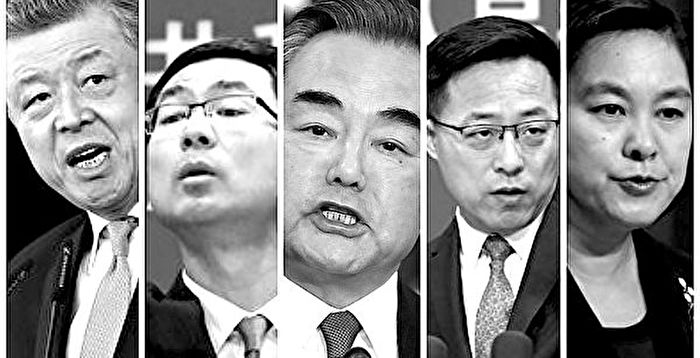
On March 7, during the third session of the 14th National People's Congress, Chinese Foreign Minister Wang Yi held a press conference on “China's Foreign Policy and Foreign Relations.” Aside from spouting a string of empty rhetoric on international issues and offering nothing but “verbal peace” regarding the Russia-Ukraine war, his rambling remarks on U.S.-China and U.S.-Taiwan relations amounted to pouring oil on the fire—utterly unhelpful. His especially sharp accusations and arrogant criticism of the United States can only push U.S.-China relations into an irreconcilable dead end, leaving no room whatsoever for compromise.
I have said before that once President Trump returned to the White House, he would inevitably adopt a “strategy of execution” toward China—achieving this ultimate goal through a path of “slow death, then execution,” passing through a process of “competition, confrontation, and warm war.” The current state of affairs proves that this process is accelerating, and this press conference—ostensibly a briefing, but in reality a rally to “fight America”—proves it especially well.
Wang Yi's ‘Three Distortions' of UN Resolution 2758: Insertion, Word-Twisting, and Usurpation
At the press conference, Wang Yi once again, without so much as a blush or a stammer, distorted UN General Assembly Resolution 2758. Wang claimed that the resolution “thoroughly resolved the question of the representation of the whole of China, including Taiwan, at the United Nations; Taiwan's only designation at the UN is ‘Taiwan Province of China'; Taiwan has never been a country—not in the past, and even less so in the future.” The moment he said this, the U.S. State Department immediately pushed back, accusing China of deliberately abusing and distorting Resolution 2758 as part of a pressure campaign aimed at isolating Taiwan from the international community.
In discussing UN Resolution 2758, Wang Yi deliberately “inserted” the phrase “the whole of China, including Taiwan”—a malicious act of tampering and alteration. In fact, Resolution 2758 addressed only the question of “representatives” of the People's Republic of China (PRC); it contains no mention whatsoever of “sovereignty,” no phrase referring to “the whole of China,” and no phrase “including Taiwan.” In other words, Wang Yi smuggled in the word “including” as a “twisted term” in order to “usurp”—that is, to distort and seize—Taiwan's sovereign status. In short, he used a “textual smuggling operation” to accomplish a “sovereignty smuggling operation.”
As for the claim that “Taiwan's only designation at the UN is ‘Taiwan Province of China'; Taiwan has never been a country—not in the past, and even less so in the future”—this is pure nonsense, sheer fabrication, and utter distortion. The United Nations' designation for Taiwan is simply “Taiwan”; there is no such thing as “Taiwan Province of China” in UN usage. The United Nations is a “union of sovereign states” and has no business addressing the question of “a province of a country.” As for the claim that “Taiwan has never been a country—not in the past, and even less so in the future,” that too is sheer nonsense: Taiwan is where the Republic of China currently resides, and the Republic of China is a country that has already been independent for 124 years—it was independent in the past, and it will remain so in the future!
Finally, Wang Yi issued a harsh threat: “Taiwan belongs to China, and no one should try to interfere; pursuing ‘Taiwan independence' is a dead end.” This is yet another example of twisting logic to intimidate. In reality, Taiwan belongs to the Republic of China, and sovereignty belongs to the entire Taiwanese people—it has never belonged to China. No one is trying to interfere with Taiwan; it is only the CCP that wants to interfere with, encroach upon, suppress, and annex Taiwan! Taiwan has no issue of needing to “declare independence again”—there is only the fact that the Republic of China is already independent, based in Taiwan. If there is any “Taiwan independence issue” at all, it is purely a matter of internal Taiwanese “political discourse,” not a “legal issue” concerning its constitutional system. In reality, it is not Taiwan independence that is a dead end—it is precisely China's confrontation with the United States that is the dead end!
Should the United States Do the Soul-Searching—Or Should China?
Wang Yi actually adopted the tone of a stern schoolmaster, demanding that the United States engage in “soul-searching” over five mistakes, including: What has the United States gained from years of tariff wars and trade wars? Has the trade deficit widened or narrowed? Has the competitiveness of manufacturing risen or fallen? Has inflation improved or worsened? Have ordinary people's lives gotten better or worse?
Regarding Wang Yi's “five points of soul-searching,” I can offer the following honest answers here:
1. The United States has gained, through its tariff war and trade war, a containment of China's expanding ambitions.
2. Although the U.S. trade deficit has not yet narrowed, China's exports to the United States have already declined.
3. U.S. manufacturing has already begun to rebound, thanks to countermeasures against China's low-price dumping, unfair trade practices, and exports of capital and technology.
4. As of now, the U.S. inflation problem has not materialized in any serious way—at the very least, it has not worsened.
5. Whether the lives of the American people have improved is not something China is in any position to comment on; and even if American lives had gotten worse, they would still be far, far better than the lives of the Chinese people!
In reality, these “five points of soul-searching” are exactly the “five points of self-reflection” that China itself should be undertaking, following the old adage: “when action fails to achieve its aim, look within yourself for the cause.”
1. Why has the United States insisted on waging a tariff war and trade war against China? Isn't it because China imposes tariffs on the U.S. at twice the rate, and continues to engage in unfair trade practices against the United States?
2. Why have China's low-price dumping exports to the United States already begun to decline? Why has China's trade surplus with the U.S. already begun shrinking, even though the U.S. trade deficit has not yet narrowed?
3. If China wants to criticize U.S. manufacturing, then how is China's own manufacturing sector doing? Is it thriving—or are factories shutting down and going bankrupt?
4. The United States certainly faces a risk of inflation—but is China's deflation really any safer or smoother?
5. Under the pressure of America's tough policy toward China, have the lives of the Chinese people actually gotten better—or worse?
U.S. Policy Toward China: No Longer Treating China as ‘China'
At the press conference, Wang Yi warned the United States: “No country should fantasize that it can suppress and contain China on one hand while developing good relations with China on the other.” Little does he realize that the United States no longer has any intention of developing good relations with China at all. In other words, all that remains of U.S. policy toward China now is suppression and containment—there is no longer any expectation of developing good relations.
As early as February 20, the U.S. State Department's official “country profile” webpage stopped referring to mainland China as the “People's Republic of China (PRC),” switching instead to the shorter designation “China.” Just before this, the State Department had already deleted language from its Taiwan page stating that the U.S. “does not support Taiwan independence.” The current China page now reads: “Strategic competition is the framework through which the U.S. views its relationship with China.” By comparison, during the Biden administration, this same passage read: “Strategic competition is the framework through which the U.S. views its relationship with the People's Republic of China (PRC).” In addition, the “China” page now explicitly states: “The United States is committed to countering malicious cyberattacks by the Chinese Communist Party (CCP) against the U.S. government,” among other statements.
On another front, according to an internal U.S. State Department document, the United States has now drawn a clear distinction between the “Chinese Communist Party (CCP)” and the “Chinese people.” The U.S. now regards the government in Beijing—not the broad Chinese populace—as its strategic competitor. In other words, the United States has changed its very definition of “China”: the CCP does not represent China, nor does it represent the Chinese people.
In this guidance document concerning China-related terminology, Secretary of State Marco Rubio instructed U.S. embassies and consulates that, when using the broad adjective “Chinese” in a context carrying negative connotations, staff should use more specific descriptions and avoid the word “Chinese” altogether. In addition, Xi Jinping is to be referred to as the Communist Party's “General Secretary,” not as “President.”
The ‘Wolf Warrior Elegy' Will Become a ‘Wolf Warrior Dirge'
At this press conference, aside from complaining and grumbling like a resentful concubine shut away in the deep palace, Wang Yi's tough stance toward the United States and Taiwan did nothing whatsoever to improve China's diplomatic environment—if anything, it further enraged Trump and will only invite even harsher retaliation from the United States.
I call this press conference of Wang Yi's “the final elegy of Wolf Warrior diplomacy.” Very soon, this “Wolf Warrior elegy” is bound to become a “Wolf Warrior dirge.”