
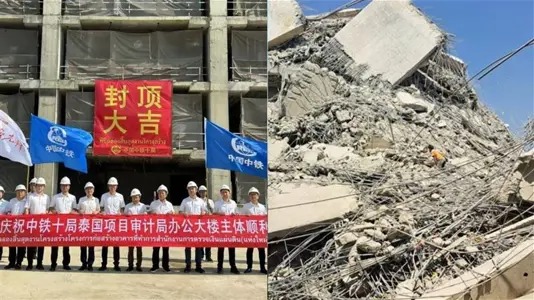
On the afternoon of March 28, a magnitude-7.7 earthquake struck Sagaing, Myanmar.
Rather ironically, in Bangkok, Thailand -- more than a thousand kilometers from the epicenter in Sagaing -- not a single building in the entire city collapsed, with one exception. Even the towering unfinished buildings left over from the Asian financial crisis remained standing.
What was the one exception?
It was the Thailand State Audit Office building, built by China Railway No. 10 Engineering Group (Thailand). As one internet commenter put it, "China Railway achieved a perfect, total collapse. Magnificent!"
According to Thai media reports, the building was 137 meters tall with 30 floors and had already been topped out. Multiple videos circulating online show that within seconds of the Myanmar earthquake, the building rapidly collapsed into a pile of rubble, burying a large number of workers in a horrific scene.
Had the building not collapsed, nothing would have come of it. But its collapse exposed a string of scandals.
First, a scandal over construction quality.
High-rise buildings are generally required to withstand minor earthquakes without damage, remain repairable after moderate earthquakes, and not collapse in major earthquakes. Why did the Thailand State Audit Office building collapse? Obviously the earthquake was a factor. But given that so many buildings in Bangkok didn't collapse and this was the only one that did, it shows its seismic resistance was extremely poor -- far worse than other buildings. Why was its seismic performance so poor? It points to serious quality problems in construction, very likely involving significant corner-cutting or concrete that failed to reach adequate curing strength due to rushed construction schedules. It's no wonder internet commenters mocked this as a case of "tofu-dregs" (shoddy) construction being exported abroad.
The CCP has undertaken numerous large overseas projects in recent years, especially under the Belt and Road Initiative. How many more of them are, like the Thailand State Audit Office building, shoddy "tofu-dreg" projects? Which country will still dare to let CCP state-owned enterprises build its projects after this?
Second, a scandal over false propaganda.
According to reports, when the Thailand State Audit Office building was topped out last April, China Railway No. 10 held a topping-out ceremony and heavily promoted it through the media, calling the building a "business card" for its development in Thailand and touting it as high-quality construction.
A year earlier, when the building was topped out, China Railway No. 10 published a celebratory article on its own official WeChat account titled "Main Structure of Thailand's New State Audit Office Building Successfully Topped Out." The article described in detail the "meticulousness and rigor" of the construction process, including advanced slip-form construction technology, lift-form installation techniques, and fully automatic climbing formwork technology. It even claimed the group had formed a dedicated "technical task force" and vowed to "overcome every construction challenge and ensure the building's safety," with the construction plan reportedly receiving "highly recognized official praise." Now, however, facts have shown that the article's glowing description of the building was nothing but self-congratulatory false propaganda, exposed in an instant by an unexpected earthquake.
Third, a scandal over covering up the truth.
After the building collapsed, China Railway No. 10 rushed to delete its own high-profile celebratory article, "Main Structure of Thailand's New State Audit Office Building Successfully Topped Out," in an attempt to erase traces of its false propaganda.
Afterward, a mainland Chinese self-media account exposed the scandal of China Railway No. 10 deleting its own article -- only for that expose to be deleted by the authorities as well.
In a similar case, on the day the building collapsed, Hu Xijin, former editor-in-chief of the CCP mouthpiece Global Times, posted on Weibo that, judging from videos, the shaking in Bangkok hadn't seemed severe, given the distance from the epicenter, and that "there's an 80 percent chance something was wrong with this collapsed building's quality," adding that "design and quality accountability will probably be pursued." The post was quickly deleted. Internet users commented: "It's gone from the whole internet -- doesn't that tell you something? ... Is Myanmar's tofu-dreg project sensitive too? That can't be right... There isn't a single post about it on Weibo."
"I watched him raise the towering hall, watched him host his honored guests, watched his hall come crashing down..." Because of an earthquake a thousand kilometers away, the Thailand State Audit Office building -- once touted as a "flagship overseas project of China" -- collapsed in an instant. This is not only a slap in the face for its builder, China Railway No. 10, but for the CCP as well.