
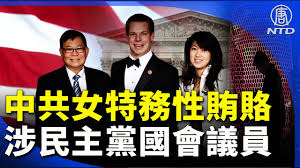
A growing body of evidence shows that the CCP is increasingly relying on sexual bribery in its campaigns of overseas infiltration, and this has triggered unprecedented alarm in the international community. A secret "Red Detachment of Women" program has now come to light.
Amid a new Cold War, the U.S. guards against CCP honey traps
As the U.S. and China wage an intense trade war, political tensions have escalated as well. U.S. media recently disclosed that the U.S. government has imposed a blanket ban on U.S. government personnel stationed in China, their security-clearance-holding family members, and contractors from having romantic relationships with any Chinese citizen.
Although some U.S. agencies already had strict rules governing such intimate relationships, this kind of blanket "no intimate relationships" policy had not been made public since the Cold War. By contrast, it is not unusual for U.S. diplomats posted in other countries to date, or even marry, local residents.
Historically, in 1987, after Soviet spies used honey traps to seduce American servicemen, the U.S. imposed a blanket ban on personnel stationed in the Soviet Union and China from dating or having sexual relationships with local residents. After the Cold War ended, these restrictions were relaxed somewhat.
This latest U.S. move clearly shows that Washington views the CCP regime as its greatest threat. It is stepping up efforts to prevent CCP infiltration and to keep Beijing from using "honeypot" traps or "sexual bait" to obtain American secrets, and it has restored the same level of vigilance once reserved for the former Soviet Union. This in itself is a sign that a new Cold War has begun.
When two nations are in conflict, mutual vigilance and covert attacks are hardly surprising. But the outside world has long underestimated the CCP: true to its communist-bloc heritage, it operates without any bottom line, resorting to tactics that are more base and more insidious. Combined with the rampant sexual bribery that has plagued CCP officialdom and business circles for nearly three decades, this approach is becoming a major threat to the international community.
The U.S. has no choice but to guard against this -- everyone has weaknesses, and the CCP has always exploited them. The book Losing the New China describes the utterly debauched side of Americans in Beijing, where all sense of moral propriety had vanished and women were there for the taking. The book recounts that a July 2002 Xinhua News Agency report noted the establishment of a party branch on Beijing's Sanlitun bar street, made up of bar owners, bodyguards, and prostitutes. The Communist Party had already begun admitting capitalists into its ranks, and this even extended to sex workers who specifically served foreign clients.
The book's author, Ethan Gutmann, argues that the CCP authorities allow foreigners this kind of "freedom" out of considerations of commercial and political advantage.
The Red Detachment of Women Program, 40 Years Ago
Long before it seized power, the CCP spent years running so-called underground operations, accumulating a vast repertoire of schemes and stratagems. Zhou Enlai once boasted that the very term "secret agent" (tewu) "belonged to the CCP," since the party had established a "Special Affairs Section" at a very early stage.
The CCP's use of honey-trap operations has always been planned and premeditated. The CCP crowns its "secret agents" as "heroes," and the female agents who carry out seduction missions are held up as heroes above all.
About thirty years ago, while I was still living in China, I heard a retired senior municipal government official mention that after the Communist Party opened the country's doors in the 1980s, in order to meet the intelligence needs of so-called "reform and opening up," there had been a "Red Detachment of Women" program that trained a corps of female agents intended for deployment overseas.
The Red Detachment of Women is a CCP revolutionary film, shot in 1960 and released in 1961, centered on a company of female Red Army special agents who had once carried out covert operations on Hainan Island.
The CCP's intelligence apparatus traces its origins to the Central Committee's Social Affairs Department during the Yan'an era. In 1983, the CCP merged the entire Central Investigation Department together with the Political Security Bureau of the Ministry of Public Security, parts of the United Front Work Department, and parts of the Commission on Science, Technology and Industry for National Defense, to form the Ministry of State Security.
The retired official did not go into detail about the Red Detachment of Women program at the time. However, sources with knowledge of the matter suggest that the program the CCP prepared in the 1980s likely began, in its early stages, under the pretext of establishing the Ministry of State Security, recruiting from certain universities in Beijing -- particularly foreign language institutes -- since candidates were required to have a "clean" political background. At the time, many children of party cadres joined.
During the Chinese Civil War, many communist spies were planted inside the Nationalist Party, a great many of whom had been recruited since their youth. Modern-day CCP state security agents share this same characteristic of early deployment and deep cover -- agents have long been cultivated through formal higher education, and recruiting them young makes for the most effective camouflage.
Some of the women may have been sent abroad directly, while others were first embedded in various industries within China before later being arranged to go overseas. Many of them subsequently remained abroad, marrying people of standing in different countries -- targets who were, almost without exception, "rising stars" pre-selected by the CCP.
Ye Xuanning (died 2016), the third son of Marshal Ye Jianying and former vice-chairman of the China Association for International Friendly Contact and director of the Liaison Department of the PLA General Political Department, used the cover of the China Kelly Industrial Company to raise funds for the Liaison Department, while also overseeing intelligence work targeting Taiwan. It was widely rumored a few years ago that the overseas network of "three thousand hidden operatives" controlled by Ye Xuanning was handed over in its entirety to Xi Jinping after he came to power. The so-called "three thousand hidden operatives" presumably refers to CCP agents who had been lying in wait overseas for many years -- "three thousand" being only an approximate figure, with the actual number likely exceeding thirty thousand.
At the time, I did not pay much attention to the so-called "Red Detachment of Women" program, since in everyday life in China one rarely encountered concrete examples of it. Later, another source with knowledge of the matter revealed that it had become routine practice for the state security system to select personnel from certain universities. The CCP would initially put them through short-term training -- and once trained, even for a single day, they could never again sever ties with state security for the rest of their lives.
It is not just the Ministry of State Security -- the military's intelligence departments, the Ministry of Foreign Affairs, and above all the United Front Work Department have all been secretly recruiting people over the years, with particular emphasis on the use of women. These, too, should be considered part of the so-called Red Detachment of Women network.
Official-Business Collusion: the "Blue, Gold, and Yellow" Tactics
Over the past two decades, as more and more foreign figures from politics and business have visited China, the CCP has frequently used entrapment tactics -- so that virtually anyone who receives a free trip to China arranged for them has, in effect, no way to escape being set up and controlled. In China, official directives instruct relevant companies to arrange sexual services while secretly filming them; once the visitor returns home, they can then be manipulated. In fact, even the practice of universities arranging "sex-study companions" for foreign exchange students is a covert, marginal version of the same project, aimed at ensuring these foreign students can be used by the CCP in the future.
This is part of what has in recent years come to be called "Blue, Gold, and Yellow" ("blue" referring to cyber surveillance, attacks, and information control; "gold" referring to bribery through money and financial gain; and "yellow" referring to the use of sexual traps and control tactics) -- the essential method being to cater to a target's desires in order to achieve control over them.
As overall social morality has deteriorated, the Red Detachment of Women program has grown increasingly sordid over the past twenty years. During this period, the so-called Red Detachment of Women has become more complex in composition, with more of its missions carried out by women arranged through business enterprises.
A friend of mine in mainland China who serves as the office director of a large private conglomerate told me that their company has a public relations team made up entirely of women. This team is often assigned special missions, whose real purpose is to compromise senior officials in the service of the company's commercial interests. At the same time, once a certain provincial or municipal official has been "handled" this way, any special hosting assignments from the local foreign affairs office or united front department will also be entrusted to that same company.
Evergrande Group founder Hui Ka Yan (Xu Jiayin) maintained an Evergrande song-and-dance troupe made up of beautiful women, and Evergrande's Shenzhen headquarters had a mysterious "42nd floor" that may well have served this same purpose.
The first senior official implicated by the Hui Ka Yan case was likely former Minister of Justice Tang Yijun. On June 15, 2019, the Shenyang municipal government signed a strategic cooperation agreement with Evergrande Group in Shenyang, and Tang Yijun, then deputy party secretary and governor of Liaoning Province, met with Hui Ka Yan. Tang also made a special trip to Shenzhen to visit Evergrande, where he would certainly have been treated to a "performance" by the Evergrande song-and-dance troupe. Afterward, some of Liaoning Province's hosting arrangements would also be arranged to take place in Shenzhen.
Another example: Zhao Jin, son of former Jiangsu provincial party standing committee member Zhao Shaolin, ran several luxury private clubs in Beijing, one of them in the upscale Yuanxitang residential compound. These clubs offered sexual services for various powerful figures to indulge themselves, and all of them were secretly recorded on audio and video as blackmail evidence. According to state media reports, officials who received these "specially supplied" women included former Hebei party secretary Zhou Benshun, former Tianjin police chief Wu Changshun, former Nanjing party secretary Yang Weize, and former Jinan party secretary Wang Min. Before these officials fell from grace, these clubs likely also served as designated venues used by the relevant provincial and municipal governments to entertain distinguished guests.
Caixin also reported on September 20, 2016 that the office of Jiangsu Huangpu Renewable Resources Utilization Co., controlled by Chen Guangbiao -- China's self-styled "most generous philanthropist" -- was housed in a building called the "Nanjing Huangpu Disaster Prevention and Reduction Training Center." According to several people with knowledge of Jiangsu Huangpu's internal operations, the building also contained a luxurious presidential suite reserved for entertaining powerful officials.
A few years back, the most notorious private clubs offering sexual services in China's officialdom were mostly controlled by "princelings" (children of high-ranking officials), with private enterprises serving as fronts. What most people don't realize is that these company-run private clubs also commonly served as venues the government used to entertain special foreign guests.
Some university presidents have also arranged for female students available for "companion services" at short notice, sometimes even under the organizational cover of the party committee or the Communist Youth League.
Officials from the CCP's foreign affairs offices and united front departments maintain designated hosting arrangements with certain companies and universities, with the costs borne by the companies. Such assignments are generally kept confidential, and the young women who participate are rewarded -- given preferential treatment in party admission, employment, and future career advancement -- while those who refuse are treated coldly.
Of course, some of the women available on call are, in fact, ordinary prostitutes, and lists of them are routinely maintained by the companies responsible for entertaining important guests.
Cooperation between foreign affairs and united front departments at every level of government and companies (especially private ones) and universities to provide sexual services to foreign guests is, of course, something that can never be brought into the open. Whenever it is exposed, it is typically handled as a case of corporate bribery; if a senior official is brought down over it, the matter is filed away as a "lifestyle" or "conduct" issue -- such as "improperly frequenting private clubs" -- while the fact that it involved entertaining foreign guests is never mentioned.
The Ever-Present "Honey Trap"
Public reporting shows that, on the international front, the CCP has long cast "honey traps" across the globe -- not only seducing politicians but infiltrating at every level, from junior staffers all the way down to interns.
In the early 2010s, Christine Fang, operating in California as a Chinese exchange student, built ambiguous relationships with a number of American political figures over several years, including then-Democratic Congressman Eric Swalwell, who later became a member of the House Permanent Select Committee on Intelligence. Fang fled back to China after coming to the attention of the FBI.
Former Republic of China (Taiwan) Army Major General Lo Hsien-che, recruited as a communist spy in 2011, was targeted in the first place -- according to assessments -- because the CCP had stolen data from his personal cell phone and learned he had a weakness for women. As a result, while Lo was serving as a military attache in Thailand, the CCP dispatched Li Peiqi, a young and attractive Ministry of State Security division chief, to recruit him.
On another front, in recent years, politicians of every party affiliation from Belt and Road countries such as Thailand and Malaysia, as well as from countries the CCP has courted into severing diplomatic ties with Taiwan, have flocked eagerly to visit China. Without exception, the CCP applies its "Blue, Gold, and Yellow" tactics to all of them. After arranging their trip to China, using women to draw them in is the most convenient step in gaining control over these visitors.
Huawei, the CCP-backed tech giant, recently found itself embroiled in a bribery scandal in Europe, with eight people charged with corruption, money laundering, and participation in a criminal organization. Belgian prosecutors said the corrupt practices had likely been occurring regularly and covertly since 2021, with Huawei using "commercial lobbying" as a cover for bribing members of parliament and officials in various forms.
These bribery practices reportedly included: offering money and other benefits in exchange for parliamentarians' or officials' support for specific political positions or policies; giving high-value gifts, such as lavish dining or paid travel expenses, as a means of currying favor or bribery; and regularly inviting them to recreational events, such as football matches, to build relationships. Prosecutors said Huawei allegedly benefited from these suspected bribery practices.
Huawei claims the company has a zero-tolerance policy toward corruption or other illegal conduct, but this is merely a cover story trotted out after the fact to conceal the truth.
As for the methods of bribery involved, whenever a trip to China is arranged, sexual bribery is virtually guaranteed to be part of it.
The Long Game: Red Detachment of Women Operations
Women hold a distinct advantage in the CCP's overseas infiltration operations; even when a man is running the operation, women are almost always used as instruments. While short-term sexual bribery is common, romantic relationships that culminate in legal marriage represent a long-game mode of operation within the Red Detachment of Women program.
In 2011, Bob Dechert, then a Conservative member of the Canadian Parliament and parliamentary secretary to the foreign minister, publicly apologized for his relationship with a Chinese woman named Shi Rong, who was at the time a Toronto-based correspondent for Xinhua, the CCP's official news agency. After the relationship was exposed, Shi was abruptly recalled to China.
In 2017, a Japanese magazine revealed that at least 50,000 Chinese spies were active in Japan, with members of Japan's Self-Defense Forces serving as targets for seduction by Chinese female agents.
It was reported that Beijing uses its embassy in Tokyo and its consulates-general in Sapporo, Niigata, Nagoya, Osaka, Fukuoka, and Nagasaki as relay bases, assisted by cadres in local Chinatowns, drawing in Chinese exchange students, employees, scholars, cultural figures, restaurant staff, and even bar hostesses and masseuses. Marrying members of Japan's Self-Defense Forces is considered part of this espionage activity: across Japan's Ground, Maritime, and Air Self-Defense Forces, a combined 800 servicemen have married foreign wives, 70 percent of whom are Chinese nationals. The report claimed that large numbers of Chinese female spies are embedded around Japanese Self-Defense Force bases -- some working at karaoke bars linked to China's public security apparatus, others working at supermarkets frequented by their targets, using the moment of a transaction to strike up an acquaintance, then later feigning a chance encounter on a rainy day and approaching servicemen under the pretext of offering to share an umbrella.
The CCP authorities naturally refuse to acknowledge any of this, dismissing it as "gossip." But the actual situation may be even more serious.
On February 27, 2024, two Chinese women suspected of operating an overseas Chinese "police service station" were referred to Japanese prosecutors on fraud charges. One of them, 44-year-old He Lihong (also going by the alias Wu Lixiang), held the titles of "foreign affairs secretary" and "diplomatic advisor" to Japanese Upper House member Shimpei Matsushita, and even carried a pass allowing her access to the Upper House building. Former Prime Minister Fumio Kishida had once called Matsushita "a future star of Japanese politics."
Reporters from the Japanese magazine Shukan Bunshun witnessed Matsushita and He Lihong jointly visiting a Chinese financial backer while carrying gifts. After leaving the backer's home, the two were also seen behaving intimately inside a car. After his relationship with He Lihong deepened, Matsushita became embroiled in a divorce dispute with his wife, who comes from a political family in Miyazaki.
In 2020, German police raided the home and office of Gerhard Sabathil, a former EU ambassador to South Korea, on suspicion that he had been supplying intelligence to the CCP authorities. His live-in girlfriend was a Chinese woman whom he had met after she took up an internship at EU headquarters. Although German prosecutors ultimately dropped the investigation for lack of evidence, the diplomat's relationship with the Chinese woman remains shrouded in suspicion.
Taiwan offers another example: in recent years, politicians, retired generals, businesspeople of every stripe, village chiefs, internet influencers, and even university professors and students who travel to mainland China have all been targets for the CCP. Once in the mainland, many people end up finding a girlfriend or boyfriend, and after returning home, they may in fact have effectively become communist spies.
Of course, the CCP's large-scale pursuit of this evil "Red Detachment of Women" scheme also has negative repercussions for ordinary Chinese nationals living abroad, causing them unnecessary difficulties in their daily lives. For instance, some mainland Chinese spouses in Taiwan were recently deported back to China for promoting "unification by force," leading many people to suspect their backgrounds were not so simple. But it is believed that the vast majority of mainland spouses in Taiwan have no such issues at all.
Regardless, the only way for Chinese people living abroad to clear themselves of the negative image the CCP has imposed on them is to genuinely recognize, from the heart, the evil nature of a CCP rooted in Marxism-Leninism, to reject it utterly, and to answer with concrete action the great era now unfolding to eliminate the CCP worldwide. That, and only that, is what true descendants of the Yan and Yellow Emperors ought to do.