
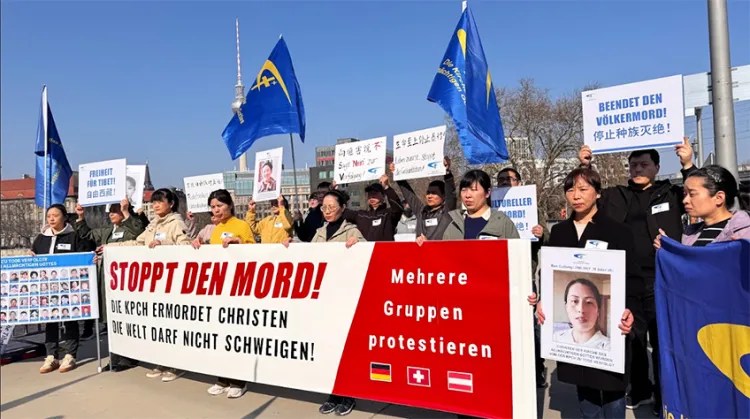
March 10 marks the anniversary of the 1959 Tibetan uprising, in which thousands of Tibetans rose up against China's occupation. Their protest was brutally suppressed, but their call for freedom and justice endures. Representatives of Free Hong Kong, the Association for the Protection of Human Rights and Religion, and Christians from the Church of Almighty God attended the event to show their support for Tibetans' struggle for human rights and freedom. Michael Brand, a member of the German Bundestag and chairman of its Tibet discussion group, attended and spoke at the event. Tenzin Zochbauer, director of the Tibet Initiative Deutschland, led the entire march and protest.
At the start of the rally, Tenzin Zochbauer delivered the opening remarks, emphasizing: "Together we commemorate March 10, 1959, when the Tibetan people took to the streets of Lhasa to voice their anger and resistance against the occupation of Tibet -- thousands lost their lives, and millions had their fates changed forever. Every year on March 10, we here in Berlin come together to make sure Tibet is never forgotten." She also said: "Since this year marks His Holiness the Dalai Lama's ninetieth birthday, that is why we begin with a long-life prayer for His Holiness, praying for his longevity."
After the prayer, Nicole Konig of the Tibet Initiative Deutschland spoke: "Today we commemorate the courage, sacrifice, and dedication of those who fought for their homeland in 1959. Sixty-six years ago today, for the sake of the Dalai Lama and the future of their nation, people took to the streets of Lhasa in peaceful protest. Yet the CCP's subsequent violent crackdown claimed tens of thousands of lives. Still, their courage and spirit of resistance proved to the world that the spirit of the people of Lhasa cannot be crushed. Although the uprising was suppressed and many were forced into exile, the people did not submit -- this was the beginning of a tradition of resistance. We will continue to resist, to stand up, and to cry out for human rights and freedom. The grievances and voices we carry remind us that the fight for justice does not end here -- it will continue to live in our hearts, and we will keep standing for justice."
Next, Wong Toi-yeung, chairman of Free Hong Kong, spoke: "Sixty-six years ago, the brave people of Tibet rose up against the Chinese Communist Party. That courageous uprising was crushed in Lhasa, but the resistance continues. As an activist from Hong Kong, I stand here with you today. Our struggles are connected -- there is no free Hong Kong without a free Tibet. What Tibet has endured for decades has gradually become Hong Kong's reality too: surveillance, political persecution, and identity theft. But we say clearly: we will not stay silent, we will not forget, we will not give up -- even as the Chinese government tries to isolate us through transnational repression. Today, let us show that we stand together, right here."
Li Lan, a representative of the organization for the Protection of Human Rights and Religious Freedom, also spoke at the demonstration: "Over the decades, more than 1.2 million Tibetans have died under persecution, and over a hundred thousand have been forced into exile around the world. The suffering continues to this day: monasteries destroyed, monks and nuns expelled, and a million Tibetan children forcibly separated from their families and placed in boarding schools for forced Sinicization. This annihilation of Tibetan culture and faith is enraging and heartbreaking. Under the CCP's dictatorship, Tibetans, Uyghurs, Hong Kongers, dissidents, and Christians alike have absolutely no human rights or freedom to speak of." She specifically noted: "In October 2024, the CCP carried out a coordinated mass arrest of Church of Almighty God members in Jilin Province -- more than six hundred people were arrested in a single month. Two female Christians who were detained were tortured to death within four days of one another. Police claimed both women died of sudden heart attacks, but on the body of one of them, her face was visibly bruised beyond recognition, her neck appeared twisted as if broken, and one of her legs was also broken. This is how brazenly the CCP lies -- but the blood debt it owes will not be forgotten, not by Christians, not by Tibetans, not by Uyghurs, Hong Kongers, or anyone who has suffered under CCP persecution!"
Michael Brand, a member of the German Bundestag and chairman of its Tibet discussion group, said: "Standing in front of the Chinese Embassy, I am not wearing the colors of the Chinese Communist Party, but the colors of Tibetan Buddhism and its followers. This is a scarf I brought back from my trip to Dharamsala last year, because I believe in Tibetan culture -- a culture with thousands of years of history whose influence extends far beyond Tibet, far beyond the realm of Buddhism, and of course includes His Holiness the Dalai Lama. These values -- freedom, humanity, and the universal value of human rights -- exemplify what Tibetan men and women have contributed to the world. I would like to take this opportunity, in front of the Chinese Embassy in Germany, to make this appeal and demand: end this cruel system. Stop forcing children into boarding schools, taking them from their homes, and stripping them of their language, religion, and culture. This is a culture thousands of years old -- it is not Chinese culture. China's oppression of Tibet has now lasted for decades. But Tibetan culture has existed for thousands of years, which is why I am confident that this culture, and freedom itself, will ultimately prevail. The support and solidarity I express here also represent the Bundestag's Tibet parliamentary group, made up of more than 50 members of the German Bundestag -- men and women from different regions, different political parties, and different religious beliefs. They not only support Tibet, but hope to remain an important dialogue partner for the Tibetan people and other oppressed minorities in China."
During his remarks, Michael Brand displayed a photograph taken in 1989 showing the Dalai Lama standing at what is now the site of the German Bundestag building, gazing toward the Brandenburg Gate. Brand said: "That was 1989 -- the same year the Dalai Lama received the Nobel Peace Prize, and just months before the Berlin Wall fell. I brought this photo back, and I believe it was symbolic at the time, a photo full of hope. In it you can still see the Wall, along with the red flag of the German Democratic Republic and the Soviet flag. In that sense, I think it's clear that what seems impossible today can become reality tomorrow -- this is a symbol of hope. The truth is that freedom will ultimately prevail, and it's important that this longing for freedom be heard -- including through this rally today in Berlin, in many cities across Germany, and around the world. Let us hope that freedom, peace, and human rights will one day apply to Tibet once again."
At the event, Ms. Tenzin Zochbauer noted: "Today, more than 400 cities and regions across Germany once again took part in our 'Raise the Flag for Tibet' campaign, flying the Tibetan flag over town halls, district government buildings, and other structures. Even if it's just for a day, or perhaps only a few hours, it sends a very powerful message of support for Tibetan human rights and freedom."
During the demonstration, Tibetans sang the Tibetan national anthem together and repeatedly chanted slogans such as "Free Tibet," "Tibet belongs to Tibetans," "We want human rights," and "Stop the persecution." A passing train suddenly sounded its horn, a gesture of solidarity from its conductor. According to Voice of Tibet, on March 10, Tibetan associations and support groups from across Europe held a commemoration in The Hague, Netherlands, marking the 66th anniversary of the Tibetan uprising, with thousands of people joining in solidarity. At the same time, Tibetans across Europe held marches in front of the Chinese embassies in their respective countries.