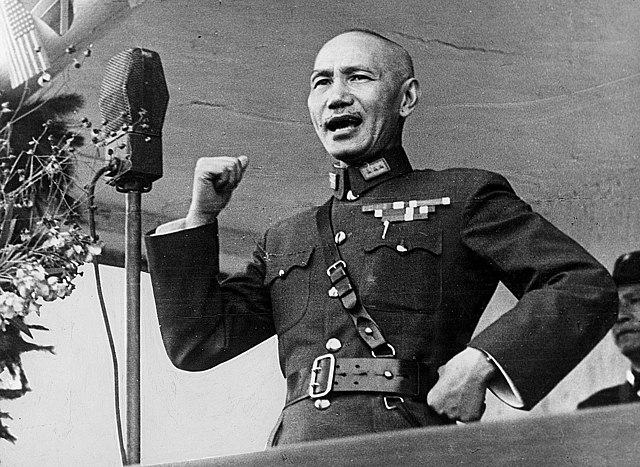
On January 9, 1950, in a radio address to the American people broadcast from New York, Soong Mei-ling said that President Chiang was the first statesman in the world to expose the conspiracy of the Communists, and also the first to take action against communism.
Soong Mei-ling's assessment was not simply a wife's instinctive praise for her husband, but a plain statement of historical fact. Let us examine this point by point below.
I. "President Chiang Was the First Statesman in the World to Expose the Communist Conspiracy"
Looking back at history, Chiang Kai-shek made many incisive statements throughout his life exposing the Communist Party. Today we need only glance at the document he wrote, "Communism Is Mankind's Greatest Enemy," to get a sense of this.
At the opening of this piece, Chiang explained how it came to be written: Dr. Daniel A. Poling had recently written to him, asking him to write a sermon for the Christian Herald, suggesting the theme: "If you were preaching to Americans, what would you say?"
Having gone through the content of the article, this author finds that Chiang's understanding and exposure of the Communist Party was profound and ahead of its time in at least the following five respects. Even read more than half a century later, it remains highly instructive and cautionary.
1. He clearly identified the root of Communism's evil as its atheistic worldview and ideology. This is the fundamental reason for the opposition between Communist states and the free world — normal human society — and the two sides' opposition is irreconcilable. The Communist Party's ambition to rule the world, along with its subversion, expansion, and infiltration, means there is no possibility of peaceful coexistence between the two sides; a life-and-death showdown is inevitable.
Chiang wrote in the article: "Communism's anti-God ideology makes peace between the Communist world and the free world impossible. Marx himself pointed out in the Communist Manifesto that an unbridgeable gulf exists between the Communist world and the free world. He said: 'Communism has no need of eternal truths, and it intends to abolish all religion and morality.' He also said elsewhere: 'Down with God, down with the Church, support Communism, and you will gain everything in the world.'"
2. He clearly pointed out that Communism poses a fatal threat to the free world, with threatening and dismantling the United States as its primary goal.
Chiang said: "In the Communists' grand plan to conquer the world, they regard the United States as their principal enemy, and are determined to belittle, insult, and destroy it. Unless the American people clearly recognize this urgent danger and take the necessary measures to fight or contain it, not only their free way of life, but also Christianity — which occupies such an important place in the life of their whole nation — will be enslaved and buried along with it."
So why does the CCP regard the United States as its primary target enemy? Because the United States is the leader of the free world.
Just how fanatical is the CCP's anti-Americanism? This is plain to see from its slogans. In the 1970s, major Chinese city airports and train stations displayed huge banners reading: "Down with U.S. imperialism and all its running dogs," and "People of the world, unite to overthrow U.S. imperialism and all reactionaries." Even in 1962, when U.S. President Nixon made his first visit to China, Beijing airport still displayed such anti-American banners without change.
Yet regrettably and painfully, every U.S. president from Nixon to Obama pursued policies of compromise or appeasement toward the CCP to varying degrees, understanding little of its schemes.
Fortunately, the 45th and 47th President of the United States, Donald Trump, entering the White House, finally reversed this inverted state of affairs.
On April 9, 2025, President Donald Trump suddenly announced a 90-day suspension of most of his planned "reciprocal" tariffs targeting specific countries — with China excepted. Trump's conspicuous singling out of the CCP as the focus of America's economic and geopolitical anger not only shows that the United States regards China (the CCP) as the primary threat of the 21st century, but also marks another step toward achieving his lifelong goal of fundamentally reshaping the U.S.-China bilateral relationship.
We must say, however, that this step by the United States came far too late, and at far too great a cost. America's clear-eyed understanding of the CCP lags at least half a century behind Chiang Kai-shek's — and has still not reached the level of Chiang's insight.
3. He clearly stated that Communism would inevitably inflict enormous harm on all humanity — harm so severe it would even surpass a great flood. By comparing the two, he implied that the Communist red scourge comes to destroy all mankind. As the Communist Manifesto itself states at its conclusion:
"The Communists disdain to conceal their views and aims. They openly declare that their ends can be attained only by the forcible overthrow of all existing social conditions. Let the ruling classes tremble at a Communist revolution. The proletarians have nothing to lose but their chains. They have a world to win."
Chiang said: "In today's world, there is no problem more serious than the problem of Communism." "Since God created the universe, mankind has never faced a greater calamity than it does today. Compared with the calamity that would be caused by the threat of Communism, even the Great Flood recorded in the Old Testament would seem trivial."
4. He clearly identified the Communist Party's rogue nature of breaking its word.
"If the free world still hopes to seek peace with the Communists, to negotiate disarmament agreements with the aggressor, or believes that once the Communist bandits are admitted to the United Nations they will accept the constraints of international organizations, then this hall of peace will become a den sheltering thieves. Let us not forget that the Lord Jesus once said to his twelve disciples: 'The thief comes only to steal and kill and destroy.'"
As for the Communist Party's rogue nature, let us give a modern example. Twenty-three years ago, when the CCP joined the World Trade Organization (WTO), it pledged to open its markets and abide by the rules of a market economy. In reality, however, the CCP has never honored that pledge. More than two decades later, the CCP continues to use state resources to manipulate the market economy, control strategic industries, and obstruct fair competition.
On April 2, Trump announced reciprocal tariffs on countries around the world. On April 23, U.S. Treasury Secretary Bessent said that more than 100 countries had already applied to negotiate tariffs with the United States, positively responding to Trump's goal of rebalancing global trade and building a more balanced international system. Only the CCP acted like a thug, rushing out to impose "retaliatory tariffs" on the U.S. as fast as it could. The result of going toe-to-toe with the United States was that the two sides raised tariffs on each other to 145% and 125% respectively. At that point, the CCP finally found itself overstretched and backed down.
On April 25, Trump released a significant message through the media saying that he would not remove tariffs on China unless Beijing "gives us something substantial." Asked what such "substance" would look like, Trump replied: "Open up China."
"Open up China, let us go in and do business — that's what we want... to be able to go into China and sell our products, sell our goods. In other words, that's called 'opening up China.'"
The substance of Trump's "opening up China" is, put simply, fair trade. But will the CCP — a "wrecker of the world's trade order" and, true to its rogue nature, an entity for whom "the thief comes only to steal and kill and destroy" — really agree to America's demands?
5. He revealed, in a way that transcended time and space, the underlying reasons behind Communism's frenzied expansion.
First, Chiang used a comparison to illustrate the shocking speed of Communist expansion.
"The speed of Communist expansion is truly astonishing. It took more than 1,900 years to convert 850 million people to the Lord; yet in a mere forty years, half of the world's population has been shut behind the 'Iron Curtain.' In the fifteen years since the end of the Second World War, 800 million people have come to live under Communist enslavement and tyranny. Its pace of aggression is accelerating with each passing day."
Next, Chiang, a devout Christian, quoted Scripture to compare the Communist Party to Satan as a warning to the world: We may quietly ask ourselves whether we have already reached the end of the thousand years spoken of in Revelation chapter 20: "Satan will be released from his prison and will go out to deceive the nations in the four corners of the earth, Gog and Magog, and to gather them for battle; in number they are like the sand on the seashore."
"Bible scholars generally agree that once Satan is released from prison, his power may become extremely great. Communism, as an incarnation of Satan, not only wages war against God but intends to mock Him as well."
This author has also, in an article titled "The Three-Generation 'Family Tree' of the Communist Party — Grandfather, Father, and Son," traced the origins of the Communist Party, clarifying its lineage with the Church of Satan and the Illuminati, and revealing the truth of the Communist Party's status as a "family of devils."
Ranked by generation from top to bottom, the Church of Satan is the Communist Party's "grandfather," the Illuminati is its "father," the Soviet Communist Party is the CCP's "elder brother," and Satan the devil is the object of worship and the evil spirit that rules over them all. "Satan the Devil, then the Church of Satan, then the Illuminati, then the Soviet and Chinese Communist Parties" — one demonic lineage, evil through and through.
II. "President Chiang Was the First Statesman in the World to Take Action Against Communism"
What Soong Mei-ling meant by "President Chiang was the first statesman in the world to take action against communism" is embodied in the "Party Purification" campaign he launched against the Communist Party beginning in 1942.
As for the causes and consequences of the "Party Purification" campaign of that time, General Bai Chongxi, the first Minister of National Defense of the Republic of China, who lived through it firsthand, gave a clear account in an interview in 1952. He recalled:
In 1924, the Kuomintang (KMT) was reorganized, and Sun Yat-sen put forward the policy of "Alliance with Russia, Toleration of the Communists." Externally allying with Russia meant seeking a country that could treat China as an equal and "struggle together" with it. At the time, not clearly understanding the evil nature of Communism and the Communist Party, Sun Yat-sen, hoping for Soviet support, was taken in by the Soviet Communists and resolved to ally with the Soviet Union.
As for the origin of Sun Yat-sen's "Alliance with Russia, Toleration of the Communists" policy, one episode of history must be mentioned: on December 23, 1921, Maring, an executive member of the Communist International, was granted an audience with Sun Yat-sen in Guilin, Guangxi. Maring stayed at Sun's headquarters for nine days, closely examining the Kuomintang. Before Sun, Maring once again displayed his eloquence and won Sun's favor. Sun told Maring that although he did not believe in Marxism, his own thinking shared common ground with Marxism. This meeting laid the groundwork for Sun's later decision to adopt the "Alliance with Russia, Toleration of the Communists" policy.
As the saying goes, "those with good intentions do not come, and those who come do not have good intentions." Maring's entry into Sun Yat-sen's headquarters was in fact a reconnaissance mission. Sun had no idea that this "visit" marked the beginning of an enormous conspiracy. Through this reconnaissance, Maring concluded that Communist Party members, while retaining their party membership, could join the Kuomintang and enter its leadership, thereby rapidly strengthening the Communist Party.
While allying with the Soviet Union externally, Sun Yat-sen internally adopted a policy of "Toleration of the Communists" — that is, allowing Communist Party members to join the Kuomintang in their individual capacity, to jointly promote the Three Principles of the People, hoping to work together with Communist Party members for the national revolution, and to assimilate the Communists, thereby eliminating the hidden danger imperceptibly. After receiving orders from the Soviet Communist Party to "use the Kuomintang's shell to develop its own organization," the CCP had its members join the Kuomintang one after another.
Sun Yat-sen's hopes were well-intentioned, but the evil nature of the Communist Party determined that the consequences of "Toleration of the Communists" would be severe. After joining the Kuomintang in their individual capacity, Communist Party members not only failed to follow Sun Yat-sen's requirement that they "obey discipline and not openly criticize the Kuomintang," but continually expanded their own influence, seizing control of the Kuomintang's propaganda and organizational departments as well as the Whampoa Military Academy. At the same time, they created a divide between left and right factions within the Kuomintang, drawing the line at "pro-Russia, pro-Communist" versus "distant from Russia, anti-Communist," and began a campaign by the left against the right, branding Kuomintang members who were not pro-Russia or pro-Communist as "counter-revolutionaries" until they were expelled from the party. In addition, Communist Party members schemed to seize Kuomintang party power and obstructed Chiang Kai-shek's "Northern Expedition."
The Communist Party's erosion of the Kuomintang provoked dissatisfaction among discerning figures within the KMT, including Chiang Kai-shek. In order to limit the CCP's expansion within the KMT, Chiang used the "Zhongshan Warship Incident" in late March to put forward a proposal to reorganize party affairs, reclaiming some party authority, and decided to proceed with the Northern Expedition. Afterward, following the victory of the Northern Expedition, in response to the "Red Terror" launched by the CCP, Chiang resolutely began the "Party Purification," arresting Communist elements and purging the Communist Party from the Kuomintang.
In the "Party Purification" campaign, Chiang Kai-shek had at least several hundred CCP members and activists executed. That May, the "Horse Day Incident" also occurred in Nanjing, in which more CCP members and pro-Communist sympathizers were arrested and executed, and the CCP-organized general labor unions and peasant self-defense militias were disarmed. For a period thereafter, the Nationalist government arrested and executed CCP members in many places; early CCP leader Li Dazhao and Xia Minghan — the party member repeatedly extolled by the CCP for the line "They can cut off my head, but only if their ideology is real" — were both executed during this period.
The "Party Purification" campaign launched by Chiang Kai-shek marked the beginning of his lifelong undertaking of "taking action against communism." It left an unrivaled, indelible mark in the history of the world's struggle against Communism.
In early 1975, Chiang Kai-shek's health deteriorated sharply; suffering from both myocardial infarction and uremia, he was hospitalized multiple times at Taipei Veterans General Hospital.
One day, after Chiang had fallen into a semi-comatose state at the Zhongxing Guesthouse, an attending physician noticed Chiang murmuring something, though his voice was very faint and his Ningbo accent hard to make out; the physician immediately summoned the duty aide-de-camp, Weng Yuan.
Weng Yuan put his ear close to Chiang's mouth, and after listening carefully for a minute or two, told the physician that the President was saying: "Retake the mainland... rescue our compatriots... retake the mainland... save China... retake the mainland... save China..."
In the early morning of April 5, 1975, Chiang Kai-shek died at the Shilin Residence in Taipei, at the age of 88.
Conclusion
Chiang Kai-shek was the archenemy of the Communist Party — the CCP — and won two world firsts in his lifetime: exposing communism and fighting communism. Even on his deathbed, what he could not let go of was still "retake the mainland..." Perhaps this was his unfinished mission and calling.
In his will, he also left this charge: "After my death, my coffin shall not be buried, but placed facing the direction of Beijing, until the day the two sides of the strait are reunified, when it shall be moved and buried beside the Sun Yat-sen Mausoleum in Nanjing."
Today, as the CCP teeters on the verge of collapse, cries of "Down with the Communist Party" rise one after another, and the CCP regime is certain to be discarded by history before long. The day Generalissimo Chiang's coffin is "moved and buried beside the Sun Yat-sen Mausoleum in Nanjing," laid finally to rest, may truly not be far off.