China's political situation has recently taken a bizarre turn in the eyes of outside observers. On one hand, a large number of CCP leader Xi Jinping's close military allies have been purged or gone missing; on the other, prominent figures outside mainland China who were once considered pro-Beijing — such as Hong Kong's richest man Li Ka-shing and Ho Ching, wife of former Singaporean Prime Minister Lee Hsien Loong — have moved from silent resistance to openly clashing with Xi Jinping.
Li Ka-shing's CK Hutchison Group selling its Panama ports to a U.S.-led consortium, and Ho Ching sharing an anti-Xi article, have both recently become international topics of discussion, and are certain to have caused ripples within mainland China and inside the CCP. The two incidents also appear to be secretly connected.
Li Ka-shing Ignores CCP Pressure
Regarding CK Hutchison's sale of its overseas ports, the CCP has escalated its pressure on Li Ka-shing. Hong Kong's Beijing-backed Ta Kung Pao published another commentary on the CK Hutchison port deal on May 1.
The Ta Kung Pao article said that the Ministry of Foreign Affairs and the State Administration for Market Regulation had both spoken out, "yet CK Hutchison has turned a deaf ear," and warned it "will surely end up bruised and battered." It also stated that, beyond the Anti-Monopoly Law, national security laws could be invoked if necessary.
On April 28 and 29, the website of the CCP's Hong Kong and Macao Affairs Office repeatedly reposted Ta Kung Pao's summary articles discussing the CK Hutchison port deal. These mentioned a recent Wall Street Journal report that CK Hutchison planned to split the sale of its overseas ports into two separate deals, with the transaction continuing to move forward.
Previously, CK Hutchison announced on March 4 that it had reached an agreement in principle with U.S.-based BlackRock Inc. and Italy's Mediterranean Shipping Company (MSC) to sell approximately 80% of the assets of Hutchison Ports for $22.8 billion. The deal covers 43 ports across 23 countries worldwide, including two ports on the Panama Canal. It is also one of the largest port sale deals globally in recent years. The CCP was extremely displeased with the deal, repeatedly criticizing and warning CK Hutchison, and attempting to block it using antitrust law.
On April 27, the CCP's State Administration for Market Regulation issued another warning, stating that "the parties to the transaction must not evade review by any means, or they will bear legal responsibility." On April 28, a CCP Ministry of Foreign Affairs spokesperson also warned that "we hope all parties concerned will act prudently."
According to a Wall Street Journal report on April 17, the Aponte family, owners of Italian shipping giant Mediterranean Shipping Company (MSC), were discussing spinning off the Panama ports from the deal to acquire CK Hutchison's ports.
CK Hutchison has never publicly responded to the matter, effectively engaging in a silent standoff. Enraged by this, the CCP did not hesitate to escalate its threats against CK Hutchison by invoking the National Security Law.
For more than a month, Hong Kong's Ta Kung Pao has repeatedly and harshly criticized Li Ka-shing for "disregarding national interests," with multiple articles reposted by the Liaison Office and the Hong Kong and Macao Affairs Office.
Australian scholar Yuan Hongbing said that the more than 40 ports being sold by CK Hutchison were originally formed during the Jiang Zemin era, when the company expanded globally. Li Ka-shing originally moved into mainland China during the Jiang Zemin-Zeng Qinghong era, and was given special treatment during the Hu Jintao-Wen Jiabao era, being regarded as a patriotic businessman. But once Xi Jinping came to power, in order to strike at forces associated with previous administrations, he gradually moved to suppress Li Ka-shing, investigating Li's companies in China on tax and business-regulatory grounds, among others. Li Ka-shing subsequently divested from China, a process that is now essentially complete.
Citing sources within the CCP system, Yuan Hongbing said that Xi Jinping personally launched the mass criticism campaign against Li Ka-shing. It is understood that the CCP tried to get state-owned enterprises involved in the deal, but Li Ka-shing ignored this; Yuan said Li's willingness to do so is backed by a large group of elite families dissatisfied with Xi.
Ho Ching Shares Article Calling Xi a "Mob Boss"
On April 18, Singaporean media published a commentary on Xi Jinping's recent visits to Vietnam and other countries, saying that over his 12 years in power Xi "has consistently behaved like a mob boss" — a Chinese version of Don Corleone from The Godfather — always making everyone "an offer they can't refuse," and now hoping his victims will treat him as a friend and partner.
On April 21, Ho Ching, wife of former Singaporean Prime Minister Lee Hsien Loong, shared the article on Facebook, drawing widespread attention.
Ho Ching had previously also shared on Facebook an article by Singaporean think-tank scholar Michael Petraeus, published in Critical Spectator on April 10 of this year. The article noted that while U.S. President Trump imposed 125% tariffs on Chinese goods, he suspended tariff increases for 90 days on 75 countries willing to negotiate, aiming to isolate the CCP and force Beijing into concessions in multilateral talks.
The article was illustrated with a photo of Xi Jinping wearing a mask, sitting alone in a chair outdoors, showing Xi in a state of dejection and symbolizing the CCP's isolation from the world. Screenshots of Ho Ching sharing the article and image also circulated widely online overseas.
Ho Ching has long served as a member and honorary member of the advisory board of Tsinghua University's School of Economics and Management (Tsinghua SEM) — a power base of former CCP Premier Zhu Rongji. In late 2024, former Politburo Standing Committee member Wang Qishan succeeded Zhu Rongji as honorary chairman of the Tsinghua SEM advisory board.
In addition, Zhu Rongji and Wang Qishan have both had close interactions with Lee Kuan Yew and his son Lee Hsien Loong. Ho Ching's rare sharing of an article critical of Xi is highly politically sensitive.
Li Ka-shing and Ho Ching Are on Good Terms
On April 3, Li Ka-shing appeared by video at an event held by the Li Ka Shing Foundation and Temasek Trust, a unit of Singapore's state investment company Temasek. It was Li's first public appearance since March 4, when CK Hutchison's announcement that it would transfer 43 ports — including those on the Panama Canal — to a U.S.-led consortium headed by BlackRock had triggered controversy.
The Li Ka Shing Foundation and Temasek Trust pledged 12 million (Hong Kong/Singapore dollars) to purchase equipment and fund clinical trials, providing free treatment to 40 cancer patients and introducing the cancer-treatment device to two hospitals in Singapore.
In a pre-recorded video, Li Ka-shing gave a roughly four-minute address in Mandarin at the launch event. He noted the similarity between the missions of Temasek Trust and the Li Ka Shing Foundation, saying: "Temasek Trust's mission to 'build a better future for every generation' deeply resonates with my own commitment that 'in an ever-changing society, my promise remains unchanged.'"
According to Hong Kong commentator Fung Hei-kin, "In an ever-changing society, my promise remains unchanged" was the title of an article Li Ka-shing wrote for Business Weekly in 2007, in which he said: "The complex and ever-changing wheels of politics and economics weigh heavily on many people... I believe the strong especially need to learn to listen to the silent cries of the weak; a strong person without compassion is nothing more than a vulgar commoner." Fung noted that even Li Ka-shing now feels this sense of being under pressure, and that his appearance at this press conference while under siege from multiple sides was in itself the best response he could give through action.
Notably, Ho Ching — chairman of Temasek Trust and wife of former Prime Minister Lee Hsien Loong — also appeared at the launch event. Ho Ching said that last August, the Li Ka Shing Foundation had donated three units of this equipment to Hong Kong. Soon after, Li generously offered, through his foundation, to donate one unit to Singapore as well.
According to those present, Ho Ching even said in Cantonese: "Mr. Li, thank you so much!"
Li Ka-shing and Ho Ching have been friends for many years. But more importantly, Li Ka-shing and Ho Ching's late father-in-law, Singapore's founding Prime Minister Lee Kuan Yew, each held sway in politics and business, respectively. The "two Lees" maintained close ties, and both Singapore Management University and the Lee Kuan Yew School of Public Policy have received substantial funding from the Li Ka Shing Foundation.
At the previous press conference, although Li Ka-shing did not attend in person, his longtime confidante Chow Hoi-shan attended on his behalf. Besides being the head of Horizon Ventures, Chow Hoi-shan is also a director of the Li Ka Shing Foundation.
The Li Ka Shing Foundation released a photo from the event showing Chow Hoi-shan chatting warmly with Ho Ching; also present was Dr. Zhen Xu, a University of Michigan professor holding the Li Ka Shing Chair.
Li Ka-shing and Ho Ching May Have Joined Forces Against Xi
It remains unclear what Ho Ching thinks of the intense pressure Beijing has placed on Li Ka-shing, but her sharing of the article and image mocking Xi did come at the very moment Li Ka-shing was at the center of a storm of CCP attacks, and seemed to carry an implicit sense of striking back at Xi to help relieve the pressure on Li.
Some observers, discussing Li Ka-shing or Ho Ching, might say both are connected to the interests of the Jiang Zemin family. But Jiang has since died, and although the Jiang family is said to be "China's number one corrupt family," its political influence has waned along with Jiang's death. The support currently sustaining Li Ka-shing within the CCP, and the backing Ho Ching enjoys, must instead come from CCP elders still living — figures such as Hu Jintao, Wen Jiabao, Li Ruihuan, Zhu Rongji, and Wang Qishan.
Li Ka-shing is a rare Hong Kong businessman who has had direct dealings with all four generations of CCP leadership — Deng Xiaoping, Jiang Zemin, Hu Jintao, and Xi Jinping. Deng Xiaoping even publicly pledged in person that "Hong Kong will remain unchanged for fifty years," to reassure the business community. It is precisely Xi Jinping who, in recent years, has broken this promise made by Deng — and this is the true meaning behind Li Ka-shing's pointed remark, quoting the ancient warning, that "the melons on the yellow vine cannot bear being picked again," an old admonition against a ruler destroying his own kin and allies one by one.
Although Xi Jinping, after coming to power, once shook Li Ka-shing's hand for a full 13 seconds — interpreted at the time as a sign of Xi's regard for Li — Li had long since taken the measure of Xi's temperament.
In 1993, Xi Jinping, then Party secretary of Fuzhou, used his father Xi Zhongxun's connections to invite Li Ka-shing to invest in Fuzhou. Li Ka-shing strongly supported a historic and cultural district redevelopment project, but the collaboration did not go smoothly, and the project ultimately fell short of expectations. After Xi Jinping was promoted to Party secretary of Zhejiang, the Fuzhou municipal government promptly terminated the cooperation and reclaimed the land-use rights.
In the 2012 Hong Kong Chief Executive election, Xi Jinping hoped Li Ka-shing would publicly support Leung Chun-ying, but Li instead openly backed Henry Tang, thereby offending Xi. It is said that after Xi became General Secretary, Li Ka-shing requested an audience with him but was given the cold shoulder.
Li Ka-shing is no ordinary man; he has a deep understanding of Chinese political culture and knows that Xi Jinping is narrow-minded and prone to turning on people without warning. Especially amid the U.S.-China rivalry, Li Ka-shing, caught in the middle, could at any time become a sacrificial casualty crushed between the two sides. This sale of CK Hutchison's overseas ports was a carefully planned, large-scale retreat.
Li Ka-shing, known for his sharp foresight and his repeated success in spotting business crises early and swiftly hedging against them, must surely also be able to read the political winds. He may well have foreseen that, under Xi Jinping's turmoil, the CCP regime itself can hardly guarantee how much longer it will last — that the whole edifice is on the verge of collapse.
It is precisely because this has risen to the level of self-preservation that Li Ka-shing has been driven to disregard everything, paying no heed to the CCP's repeated official pressure.
As for Ho Ching, given that Singapore has historically been heavily influenced by the CCP, her willingness to openly criticize Xi Jinping this time clearly suggests she is not afraid of retaliation from Xi — likely for reasons connected to power struggles within the CCP's top leadership.
One possibility is that, with many of Xi Jinping's close allies having fallen from power, Xi himself has already lost much of his real authority. With CCP elders now overseeing affairs behind the scenes, Xi may still have to answer for his failures in personnel appointments and in economic and diplomatic policy, facing criticism within the party at the upcoming Fourth Plenum. This is why Ho Ching felt free to share an article unafraid of offending Xi Jinping.
A source close to Singaporean political circles also told this author that, as chairman of Temasek, Ho Ching already has extensive investments in China, and has suffered heavy losses over the years — it would be hard to believe she harbors no resentment toward Xi. But it is even more likely that someone of Ho Ching's stature is extremely well-informed, and may have already gotten wind of certain information in advance, reaching the point where she is no longer afraid of Xi's retaliation — this, more than anything, explains her "brazen remarks" against Xi.
The source believes that, on the surface, it is a fact that Ho Ching is extremely dissatisfied with Xi and no longer fears him — and that, in any case, this is a welcome and even somewhat amusing development.
Shattering the Illusion of Xi as "the One Supreme Leader"
Given the standing of Li Ka-shing and Ho Ching, their tough stance toward Xi Jinping, unafraid of the CCP, not only signals internationally a trend of contempt toward Xi and the CCP, but is also certain to send shockwaves through Chinese society, and especially within the CCP itself.
In this author's view, regardless of the reasons behind it, the fact that Li Ka-shing and Ho Ching have so firmly "stood up to" Xi Jinping shows that Xi's reckless conduct has cost him dearly in popular support, both at home and abroad.
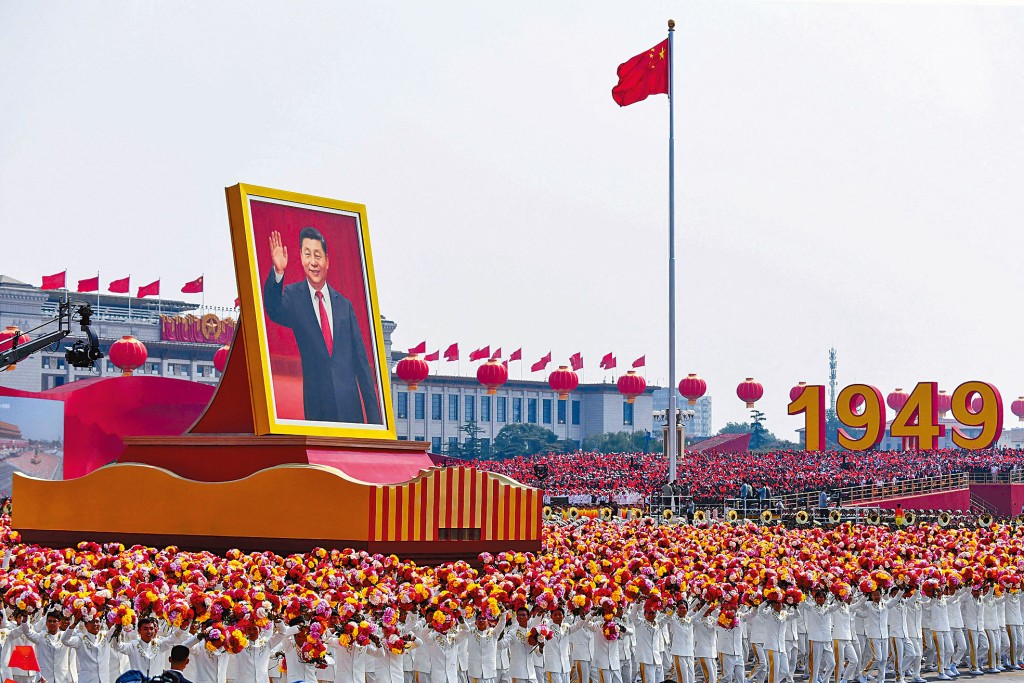
Therefore, no matter how many "extras" local officials organize to cheer Xi domestically, or how lavish welcomes some pro-CCP countries arrange for him abroad, it is all merely an illusion — and the myth of Xi as the CCP's "one supreme leader" has instantly shattered.