
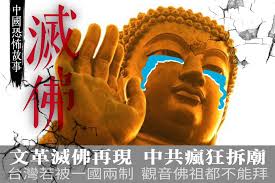
For thousands of years, the divinely inspired Chinese culture — in which Confucianism, Buddhism, and Taoism shone together — has been like sweet dew, like a clear spring, like a gentle breeze, bringing lasting peace, tranquility, and comfort to the ancient land of China.
Buddhism, which teaches "do no evil, do only good," spread widely in China after arriving from India in the first century AD, taking root and flourishing among a vast number of believers. Buddhist temples dotted China's green mountains and clear waters, and eminent monks of great virtue emerged generation after generation. Monks chanted sutras morning and night to the sound of bells and drums; believers recited the Buddha's name with devotion and gave generously to charity; and ordinary people, influenced by the widespread teachings of Buddhism, learned not to neglect small acts of good nor commit small acts of evil.
Throughout the dynasties, wise and enlightened rulers honored Buddhism, treated believers well, and spread the Buddhist teachings far and wide, so that across mountains and rivers, to the very ends of the earth, the light of the Buddha shone everywhere and propriety and righteousness prevailed.
But ever since the atheist Chinese Communist Party overthrew China's legitimate government, the Republic of China, on the mainland in 1949, every orthodox faith that believes in the divine has been suppressed by the CCP across China. Buddhism, too, suffered calamity, and by the time of the decade-long Cultural Revolution, Chinese Buddhism came close to total destruction. After the Cultural Revolution ended, Buddhism recovered somewhat, only to soon face an even deeper corruption.
I. Buddhism's First Ordeal
Master Xuyun was one of the most eminent monks in modern Chinese history, respected by Empress Dowager Cixi in the late Qing dynasty and by Sun Yat-sen and Chiang Kai-shek during the Republican era. Yet after the CCP came to power, Xuyun endured one calamity after another.
For instance, on March 31, 1951, Master Xuyun was preparing to confer monastic precepts at Dajue Temple on Yunmen Mountain in Guangdong. At the time, the CCP was carrying out its "Campaign to Suppress Counter-revolutionaries." More than a hundred militia members from Ruyuan County, on the pretext that the temple was hiding weapons, gold bars, and silver, imprisoned Master Xuyun along with 25 other monks. Besides searching the entire temple, they locked Xuyun in a room, denied him food and water, and forbade him from leaving even to relieve himself, demanding that he hand over gold, silver, and firearms. When Xuyun said there was none, he was brutally beaten. The militiamen first used wooden clubs, then iron rods, striking him until his head and face bled and his ribs were broken; they then dragged him to the ground and trampled him with their leather shoes. Blood flowed from all of Xuyun's facial orifices, and he collapsed on the ground, nearly dying.
After the CCP established its regime in 1949, Chinese Buddhism was struck hard during one bloody political campaign after another — land reform, the suppression of counter-revolutionaries, the Three-Anti and Five-Anti campaigns, the Anti-Rightist Campaign, and the Great Leap Forward. Many temples were demolished, Buddha statues destroyed, scriptures burned, and many monks and nuns forced to return to secular life.
In 1949, China had 800,000 monks and nuns; by 1954, only just over 70,000 remained. Before International Women's Day in 1951, the Hunan Provincial Women's Federation in Changsha ordered that all nuns in the province must decide to marry within a few days.
In 1953, under CCP control, the Buddhist Association of China was established. Following the Party's directives closely, the association required Buddhists to oppose imperialism and feudalism while supporting the Communist Party and Mao Zedong.
By early 1959, of the more than 2,300 monasteries in the Tibetan regions of Gansu, Qinghai, Sichuan, and Yunnan provinces, aside from some destroyed by warfare, the vast majority were closed, occupied, or demolished; of more than 170,000 lamas, most were forced to return to secular life.
II. The Great Catastrophe of the Cultural Revolution
In May 1966, Mao Zedong launched the Cultural Revolution, an unprecedented catastrophe descending upon China aimed at "revolutionizing" — that is, destroying — traditional Chinese culture.
On June 1, the People's Daily published an editorial titled "Sweep Away All Monsters and Demons," calling for the destruction of the "Four Olds" — the "old ideas, old culture, old customs, and old habits" accumulated over thousands of years.
On August 18, Mao Zedong, standing atop Tiananmen Gate, received one million Red Guards from across the country for the first time.
From then on, Beijing's Red Guards, as if injected with adrenaline, took to the streets, "smashing, looting, plundering, and burning" in the name of destroying the Four Olds. Before long, this overwhelming turbid tide swept across all of China.
Over five thousand years of history, every object connected to faith and reverence for the divine — temples, Taoist shrines, churches, scriptures — became a target for the Red Guards' campaign against the Four Olds.
According to incomplete statistics, of the 6,843 cultural and historical sites in Beijing alone, 4,922 were destroyed, along with 538,000 cultural relics of various kinds — all of them irreplaceable national treasures.
On August 24, Jile Temple, the largest temple in Harbin, was destroyed by a mob of Red Guards. The Red Guards also forced three monks to hold up a paper sign reading, "What Buddhist scriptures — it's all nonsense."
It was also during this "Red August" that the thousand-year-old, uncorrupted mummified body of Huineng, the Sixth Patriarch of Chan Buddhism, enshrined at Nanhua Temple in Shaoguan, Guangdong, was destroyed at the hands of Red Guards.
According to the Dharma Collection of Elder Master Foyuan: "One day, the Sixth Patriarch's mummified body was wheeled through Shaoguan on a handcart by Red Guards, who denounced it as fake, a fraud, and something meant to deceive people, and said it should be burned. They then struck it with an iron rod, punching a hole the size of a bowl through the chest and back, pulled out the internal organs, and threw them onto the floor of the main hall. Ribs and spine bones were scattered across the ground, and the Red Guards claimed they were pig bones or dog bones — fake." "They placed an iron bowl on the Sixth Patriarch's head, inscribed with the words 'bad element,' and left it in the main hall."
Also during this same "Red August," the Leshan Giant Buddha in Sichuan, located at the confluence of the Min, Qingyi, and Dadu rivers, narrowly escaped being blown up with dynamite by a group of Red Guards. It is said the explosive's fuse got wet in the rain and failed to ignite.
Famen Temple, located 10 kilometers north of Fufeng County in Baoji, Shaanxi Province, is known as the "ancestor of pagoda temples in the Guanzhong region." Its underground palace houses not only the only surviving finger bone relic of Sakyamuni Buddha in China, but also countless treasures from the Tang dynasty.
In the height of summer in 1966, a group of Red Guards intent on "destroying the Four Olds" stormed into Famen Temple and smashed all the statues in the main hall. They then claimed there was a "reactionary radio station" buried underground and began digging furiously. At that moment, the temple's abbot, Master Liangqing, doused himself entirely in kerosene, sat cross-legged before the pagoda, and set himself on fire. The blaze roared instantly, flames engulfing everything. The Red Guards, stunned and terrified, dropped their tools and scattered in all directions — and thus the Buddha's finger relic and countless treasures beneath the pagoda were preserved.
In 1987 and 1994, archaeologists conducted two excavations of the underground palace at Famen Temple. Afterward, some writers noted: opening the underground palace at Famen Temple is like opening half of the glory of the Tang dynasty. Had Master Liangqing not given his life to protect the temple, these countless treasures might all have been destroyed.
During the decade of the Cultural Revolution, the CCP acted with utter lawlessness and frenzy, and Buddhism on the Chinese mainland was pushed to the brink of extinction. The transmission of the Dharma was severed, monks scattered in all directions, and many were forced to return to secular life, subjected to struggle sessions, sent to labor camps, imprisoned, tortured, and even executed.
III. Disaster Strikes Again After the Calamity
After the ten years of the Cultural Revolution ended, Buddhism recovered somewhat for a time. But it soon fell into another great calamity.
Shi Xuecheng, then president of the Buddhist Association of China and the highest-ranking monk under CCP authority, was deeply influenced by the lascivious culture prevalent in CCP officialdom, sinking into the role of a womanizing "lecherous monk."
On August 1, 2018, Shi Xianjia and Shi Xianqi, former overseers of Beijing's Longquan Temple, published under their real names a 95-page "Report on Major Issues," accusing Shi Xuecheng of sexually assaulting numerous female disciples who had taken monastic vows. They alleged he used a variety of means to exert "mental control" over these women, engaging in so-called "dual cultivation" between men and women, along with illegal temple construction and unexplained huge sums of money.
Shi Xianjia and Shi Xianqi both hold doctorates in engineering from Tsinghua University. Their "Report on Major Issues" reads much like a doctoral dissertation — complete with a table of contents, appendices, factual statements, and substantial evidence, all logically rigorous and clearly organized. Its release caused a worldwide sensation.
The report revealed that Shi Xuecheng not only sexually assaulted female disciples but also sent some of them enormous numbers of extremely vulgar, filthy, and shameless sexually harassing text messages.
One female disciple, using the pseudonym Shi Xianjia (a different individual, written with a different character, from the whistleblowers named above), was pushed to her psychological limit by a barrage of sexually harassing messages from Shi Xuecheng. She wrote: "Monastic precepts are a monk's life, yet why does the master repeatedly use violations of the precepts to test whether I remain loyal to him, again and again crossing my bottom line? At this point I feel utter anguish, as if death were not far away, to the extent that I even wondered: does the master want to torment me to death... At this point, my system of faith was on the verge of collapse."
On February 5, 2018, this disciple wrote a will, stating: "I am afraid my life may be in danger," and "Should something happen to me, please help comfort and care for my parents."
At the time he was reported, Shi Xuecheng held the positions of president of the Buddhist Association of China, president of the Chinese Buddhist Academy, editor-in-chief of Dharma Sound magazine, president of the Fujian Buddhist Association, president of the Fujian Buddhist Academy, honorary president of the Shaanxi Buddhist Association, president of the Famen Temple Buddhist Academy in Shaanxi, abbot of Guanghua Temple in Fujian, abbot of Famen Temple in Shaanxi, and abbot of Longquan Temple in Beijing. In 2008, he was "elected" a standing committee member of the Chinese People's Political Consultative Conference (CPPCC); in 2018, he became deputy director of the CPPCC's Ethnic and Religious Affairs Committee.
After Shi Xuecheng's misconduct was exposed, CCP authorities merely removed him from his posts. His sexual assault charges have never faced any legal prosecution to this day.
While Shi Xuecheng served as president of the Buddhist Association of China, one of his deputies, a vice president of the association, was named Shi Yinshun.
While serving as vice president of the Buddhist Association of China, Shi Yinshun also held the positions of president of the Hainan Buddhist Association, president of the Shenzhen Buddhist Association, abbot of Shenzhen's Hongfa Temple, Sanya's Nanshan Temple, and the Zhonghua Temple in Nepal, president of the Shenzhen Benhuan Institute, president of the South China Sea Buddhist Academy, and member of the 14th National Committee of the CPPCC.
On December 11, 2017, at a training session held by the Hainan Buddhist Association to study the spirit of the CCP's 19th National Congress, Shi Yinshun delivered a three-hour lecture calling on Buddhists to "know the Party and love the Party, share one heart and mind with the Party, heed the Party's words and follow the Party."
He said: "The Communist Party is the living Buddha and Bodhisattva of this world"; "The report of the 19th Party Congress is the scripture of our age. I have already hand-copied it three times, and I plan to copy it another ten times!" He urged Buddhists to follow his example and "hand-copy the report of the 19th Congress with reverence — each copy brings its own insight and reward."
By calling the atheist Communist Party "the living Buddha and Bodhisattva of this world" and calling the 19th Party Congress report — saturated with CCP party culture — "the scripture of our age," Shi Yinshun openly slandered the Buddha.
Besides Shi Xuecheng and Shi Yinshun, another prominent figure in the Buddhist Association of China is Shi Yongxin, currently vice president of the association, president of the Henan Buddhist Association, and abbot of the Shaolin Temple.
Shi Yongxin's greatest "achievement" has been the commercialization of Shaolin Temple, renowned as "the foremost monastery under heaven."
"Xiake Dao," the WeChat public account of the overseas edition of the People's Daily, published an article stating: "Today, the scale of Shaolin Temple's assets is virtually bottomless. From the registration records of Shaolin's intangible-asset company visible to the media, Shi Yongxin holds an 80% stake and has invested in seven subsidiary companies. Comparing Shi Yongxin to a real-estate tycoon is not something I say on a whim."
During the May Day holiday in 2025, a female tourist drove to Shaolin Temple for a visit and, upon returning home, wrote an essay titled "Shaolin Temple's Table Manners Are Awfully Ugly," in which she wrote:
"Shaolin Temple's severe commercialization has long been criticized, but I never imagined it had gotten this bad."
"At most temples, the entrance has a few shops selling incense and candles. At Shaolin, everything blooms at once — the entrance to the scenic area is a bustling commercial district complete with restaurants, milk tea shops, and local specialty stores. Inside the temple, besides the usual sale of Buddhist prayer beads and religious items, fortune-telling, and portrait painting using your name, the most absurd part is that you can take a cable car up to the Sutra Cliff, where — believe it or not — there's even Shaolin kung fu massage and bone-setting services. The staff are uniformly dressed in monks' robes with shaved heads, and there's no telling whether they're real monks or fake ones."
"Shaolin Temple is simply a commercial complex centered around a temple. The Four Great Elements are empty? The Six Senses are pure? Not a chance!"
After a full day's visit: "30 yuan for the shuttle bus, 25 yuan for the sightseeing car, 80 yuan for admission, 100 yuan for the cable car — 235 yuan per person in total, plus 100 yuan for a guide and 300 yuan for a piece of calligraphy — all just to see one temple, a walled-off pagoda forest, and the Sutra Cliff, and made unhappier still by the traffic jam."
The author concluded: "Shaolin Temple — I will never go again! Shaolin Temple really isn't worth the trip!"
Buddhism has Five Precepts, one of which is to abstain from sexual misconduct, commonly known as the precept against lust. Buddhist scripture holds that those who violate this precept commit an extremely grave sin, "falling into the three lower realms, tantamount to having one's head cut off." Yet Shi Xuecheng, the highest-ranking monk in the CCP's Buddhist establishment, became a "lecherous monk" consumed by lust.
Sakyamuni was born a prince. Had he not renounced worldly life, he would have been heir to the throne and, eventually, king. But he had no interest whatsoever in worldly politics; rather than become "king," he left home to practice cultivation and ultimately attained the fruition of a Tathagata. When has an orthodox Buddhist ever taken part in the politics of ordinary people? Yet Shi Yinshun, vice president of the CCP's Buddhist Association, calls the CCP "the living Buddha and Bodhisattva of this world" and treats the report of its 19th Party Congress as "the scripture of our age." This is a "political monk" who openly slanders the Dharma.
In his time, Sakyamuni led his disciples to beg for alms and never touched money. Yet Shi Yongxin, vice president of the CCP's Buddhist Association, has become the "CEO of Shaolin Temple," holding an 80% stake and investing in seven companies — a "business monk" who has completely abandoned orthodox Buddhism.
Conclusion
In The Communist Manifesto, published in 1848, Marx — the CCP's forefather — demanded that Communists "make a most radical rupture with traditional ideas."
What is at the core of traditional ideas? It is faith in and reverence for the divine. All the ancestors of the Chinese nation believed in and revered the divine. Chinese Buddhism, as an important component of traditional Chinese culture, likewise believes in and reveres the divine.
Marx's demand that his followers "make a most radical rupture with traditional ideas" meant severing the connection between man and the divine. This is the origin of the CCP's atheism.
If the CCP won't let people believe in the divine, then what does it want people to believe in? The Communist Party itself. And how are people to believe in the CCP? Shi Yinshun, vice president of the Buddhist Association of China, provided the answer: the CCP is the "Buddha," CCP documents are the "scriptures," and kneeling before the CCP is "cultivating Buddhahood."
Has Chinese Buddhism, having degenerated to such a state, any right still to call itself Buddhism? In just 76 years of rule, the CCP has corrupted Buddhism to this degree — it is truly heartbreaking.