
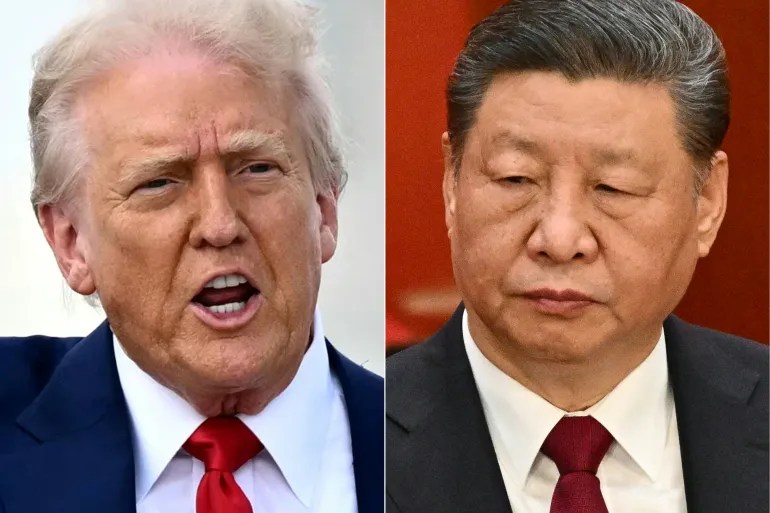
Analysis: The US-China Trade War Exposes the Malignancy of the CCP's Economic Structure
2025-07-25 22:26
Source:
The Epoch Times
Authors:
Song Tang
Yi Ru
For decades, the CCP has structured China's economy around export orientation while refusing to raise the political and economic standing of its own citizens. Now, in the US-China trade war, the bitter fruit of this policy is becoming apparent. Most Chinese exporters cannot withstand steep US tariffs, and with no way to absorb the impact domestically, this could lead to layoffs and even a wave of bankruptcies and closures, shaking China's economic stability.
Most Chinese Industries Cannot Withstand US Tariffs
The latest analysis from Bloomberg Economics shows that most Chinese industries cannot withstand the tariffs currently imposed by the Trump administration. This could lead to sharper price cuts, falling profits, and in the worst case, layoffs and even a wave of bankruptcies and closures.
Bloomberg analysts found that, with current US tariffs on China at roughly 40% and the average profit margin of Chinese industry in 2024 at about 14.8%, among the 33 industrial sectors examined, the ones at greatest risk include textiles, IT and communications equipment, and furniture manufacturing. Only five sectors — including pharmaceuticals, tobacco, and oil and gas extraction — have profit margins higher than the tariff rate.
"Some companies heavily reliant on the US market may not survive," the report states. "Others will scramble to adapt — accepting lower profit margins, cutting jobs, reducing wages, and potentially flooding the domestic market and other overseas markets with cheap goods."
Although official figures show second-quarter GDP growth of 5.2%, exceeding analysts' expectations, this was driven by front-loaded shipments and price cuts by manufacturers — both of which are unsustainable.
A report released in June by Tsinghua University's PBC School of Finance reached the same conclusion: rising US tariff rates on Chinese goods are directly squeezing corporate profit margins. Small and medium-sized enterprises reliant on the US market — such as those in toys and textiles — typically operate on profit margins of just 5% to 15%, making it difficult to fully pass on costs through price increases under high tariffs, potentially forcing them to halt production.
Small and medium-sized enterprises producing non-essential goods or replaceable low- and mid-tier products are bearing the brunt of the impact.
To keep their American clients, many Chinese exporters currently have no choice but to ship goods at a loss, with almost no bargaining power left.
"If you don't take the order, it's instant death — everyone would rather die slowly," Jacky Ren, a Chinese kitchen appliance manufacturer, admitted to Reuters.
According to a Stanford University research report, during the 2018 US-China trade war, US tariff increases hurt the profitability of Chinese exporters. On average, for every 1% increase in a company's tariff-inclusive export price, Chinese exporters' profit margins fell by 0.35 percentage points.
During the 2018 US-China trade war, in order to preserve profits, many companies operating in China shifted their supply chains to countries such as Vietnam and Mexico.
US economist Davy J. Wong told The Epoch Times that the average profit margin in most Chinese industries today is far below the Trump administration's 40% tariff rate. He believes the most vulnerable sectors are, in order: textiles and apparel; furniture and home appliances; telecommunications and IP hardware; toys and consumer electronics; and export-oriented small and medium-sized enterprises.
Taiwanese macroeconomist Wu Chia-lung told The Epoch Times that export-sector products with low technological content and high labor intensity are hit hardest by tariffs, while those with high technological content and strong competitiveness may still have room to raise prices or resist the tariffs.
China affairs expert Wang He told The Epoch Times that if the US can easily find substitutes for certain Chinese products, those industries will be severely impacted; but if China is the sole supplier, the tariff's impact will be limited.
He noted that, at present, Chinese electric vehicles simply cannot be sold in the US under tariffs exceeding 100%. But for products like phones and computers, which are difficult to relocate production for in the short term, if no substitutes can be found, the tariff burden will end up being shared between the US and China.
Data released by China's General Administration of Customs on July 14 shows that China's exports to the US fell 24% year-on-year (in US dollar terms) from April to June 2025, while exports to ASEAN, China's largest export destination, grew 18% year-on-year.
A report from the UK's Capital Economics shows that Chinese exports to the US routed through Indonesia and Vietnam grew 25% and 30% year-on-year respectively in May — believed to reflect an increase in Chinese exporters laundering the country of origin through third countries to enter the US market.
Why Is the CCP's Economic Structure Export-Oriented?
Bloomberg Economics' analysis found that nearly half of China's industrial sectors rely on overseas markets to absorb 10% or more of their output, with the US still China's single largest trading partner.
The analysts wrote that, in the long run, higher tariffs may prompt US companies to source goods from other countries.
The report also noted several factors that could cushion the blow to Chinese industry, including exporting to other countries not facing the same trade barriers; some products being absorbed by domestic demand; some sectors holding a monopoly on the global market, making it difficult or impossible for US companies to find alternative suppliers elsewhere; and the possibility of the CCP government stepping in with additional fiscal support, among other measures.
At present, the CCP authorities' approach includes promoting the so-called "domestic great circulation," "integration of domestic and foreign trade," third-country transshipment trade, and continuing to expand into emerging markets in Southeast Asia, Latin America, the Middle East, and elsewhere.
Wong said that in the short term, the "domestic great circulation" cannot make up for the gap left by foreign trade. More critically, Chinese society lacks a social safety net, valuable industries are largely monopolized, and integrating domestic and foreign trade will essentially only intensify society's internal, cutthroat competition ("involution").
He believes that expanding into Southeast Asian, Latin American, and Middle Eastern markets looks feasible in theory but faces enormous practical challenges: first, many of these countries will themselves become targets of US tariffs, so the dividend from shifting exports there will quickly disappear; second, the logistics and political risks of trading with these Asian, African, and Latin American countries are extremely high; third, since the vast majority of Chinese goods are designed with Europe and the US as their primary destination, shifting to Asia, Africa, and Latin America would require not just redesigning products but rebuilding entire supply chains, and profits could shrink dramatically.
The so-called "integration of domestic and foreign trade" is likewise fraught with difficulty.
Mainland media report that shifting from export to domestic sales faces four major obstacles: first, foreign trade enterprises that choose to pivot to domestic sales may face reduced preferential policy support and longer payment collection cycles; second, differing product certification standards between domestic and foreign trade weaken companies' incentive to make the switch; third, most foreign trade enterprises engaged in processing trade have both their supply sources and sales markets abroad, and lack the capability and experience to develop domestic market channels; fourth, homogenization of products in the domestic market is severe, and once foreign trade enterprises' high-value-added products are sold domestically, they are easily copied by domestic competitors.
Wu Chia-lung believes the fundamental problem with China's economy today is a mismatch between a relatively low-end consumption structure and a relatively high-end production structure.
He pointed out that the export sector has a high technological content, and its output exceeds domestic demand — yet there is currently no market comparable to the US that could absorb these high-end products.
"If domestic demand can't absorb it, how could Southeast Asia's purchasing power possibly absorb it?" he said.
Under these circumstances, Southeast Asia has become a channel for origin-laundering — but this channel is now being shut down.
Bloomberg's economic experts believe that if this strategy succeeds, it could impact as much as 70% of China's exports to the US and reduce China's GDP by more than 2.1%.
Wu Chia-lung said the US is now shutting down origin-laundering channels, starting with Southeast Asia and Africa, then Belt and Road countries, and third, the BRICS nations. In short, whoever supports the CCP against the US will find the US closing its market to them without hesitation.
Wu Chia-lung believes the best solution for China is to raise domestic consumption.
"Once the domestic consumption structure catches up, companies that used to focus on exports can shift to domestic sales. For example, higher-end sneakers that used to be made for export — if domestic consumption levels rise, lower-quality sneakers can be replaced with higher-quality ones."
"The basic logic is: once the consumption structure catches up with the production structure, dependence on foreign markets will decrease."
Wu Chia-lung believes China currently must rely on foreign markets to sustain its production structure. If it fights a trade war at this moment, substituting political judgment for economic judgment, it will ultimately harm its own economy.
In fact, many experts have pointed out that the reason the CCP relies so heavily on exports is that a domestic economy driven by consumption would require raising citizens' economic and political standing — which would undermine the interests of the Chinese Communist Party.
Wang He said that insufficient domestic demand in China is a long-standing problem. Very few people earn middle income or above; the vast majority are poor with little spending power, and China's wealth gap is among the highest in the world.
"For China's domestic circulation to actually circulate, ordinary people need money to spend, which requires raising the incomes of the vast majority — which in turn requires changing the current pattern of extreme wealth disparity. But the CCP's current income distribution pattern is essentially fixed and very difficult to break or change — this is a result of the CCP's current system."
"For the CCP, it currently has neither the ability nor the willingness to change this," he said.
US Tariffs Are Enough to Shake China's Economic Stability
Although tensions have eased somewhat following recent meetings between US and Chinese officials, the possibility of permanently removing tariffs remains limited.
Any long-term agreement between the US and China is still likely to include a minimum reciprocal tariff of 10%. In addition, the 20% fentanyl-related tariff has been explicitly excluded from current negotiations, while tariffs imposed under Section 301 during Trump's first term remain in effect on a large volume of Chinese goods. As a result, even a successful negotiation could still leave Chinese exports facing tariffs exceeding 40%.
At the outset of this trade war, Trump and his cabinet members made clear that the tariff fight was not simply about resolving the US-China trade deficit, but about compelling the CCP to restructure its economy and open up to the US.
Wu Chia-lung believes the US is calculating a political account, not an economic one.
Wang He said the US is now building a tariff alliance to isolate the CCP, and based on its agreements with the UK and Vietnam, significant progress has already been made. If other countries reach similar agreements with the US, it would amount to a reshaping of the entire international trade landscape.
He said China currently accounts for 30% of global manufacturing, and reorganizing global supply chains will take time — in the short to medium term, Chinese exports may still hold up for a while. But five years from now, if the current pattern of isolating China remains unchanged and other countries' industrial capacity increases, China's exports will essentially collapse.
Still, Wang He believes that just how far the US-China trade war will ultimately go can only become clearer once the final outcome of US-China negotiations is settled.
Wong said current US tariffs are enough to shake China's economic stability in three ways: first, the spread of employment risk; second, a potentially widening wave of bankruptcies among small and medium-sized enterprises; and third, mounting fiscal pressure on local governments alongside rising internal social tension and infighting.
Wu Chia-lung said that if the export sector is wounded, it's like a blocked blood vessel that triggers many complications. More people will be unable to find work, more will be unable to repay debts, local government finances will deteriorate, and this could trigger social unrest, followed by various forms of protest or even people jumping to their deaths.
"Either way, the economic situation is grim — a huge population suddenly losing jobs and losing orders. Without orders, employment cannot be sustained, leading to layoffs and price cuts — and these negative economic impacts will all manifest themselves."