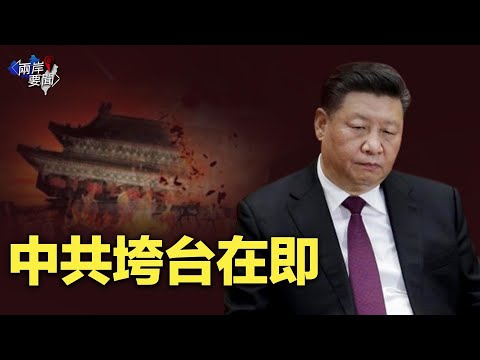
In this year of 2025, people around the world who love peace and freedom, who cherish civilization and justice, are quietly waiting for the collapse of the Chinese Communist Party (CCP) — the scourge of humanity for a century — just as its Soviet "father" died overnight 35 years ago. Chinese people, in particular, who can barely go on living, can hardly wait until tomorrow.
With China's "three engines" of economic growth already stalled, living conditions dropping to rock bottom fueling boiling public resentment, a governance panic spreading through the ruling clique, and on top of that massive floods, extreme heat, a plummeting population, and an uncontrollable epidemic — every kind of natural and man-made disaster striking the communist totalitarian regime is erupting all at once in China. Looking around, there is not a single piece of good news to give Beijing's authorities a breather — only the grim scenery of an approaching doomsday.
Even more chilling for the CCP's rulers is the news that a group of visionaries has already begun preparing for the critical moment when heaven brings down the CCP, ready to help the suffering Chinese people make a smooth transition to a civilized society and make the Chinese nation great again.
On July 16, 2025, the authoritative American think tank Hudson Institute published a 128-page report titled "China after Communism: Preparing for a Post-CCP China" (hereafter, the "Post-Communism Report").
The report examines and analyzes, from multiple angles, the possibility that the CCP could collapse soon, calling on the whole world — and Chinese society in particular — to prepare in advance, both materially and psychologically.
The report states bluntly that whether the CCP will collapse is no longer the question — the question is when. And most frightening of all, it may not fall gradually, but could suddenly change overnight.
All the evidence points to the fact that even though the CCP has survived several crises in the past by sheer luck, a sudden collapse of the regime this time is not entirely unimaginable.
And because the CCP is the longest-ruling communist dictatorship in the world, as well as the second-largest economy, policymakers need to consider what measures to take in response to a range of complex scenarios.
The shock value of this report may well exceed the power of the US military's 13-ton super bunker-buster bomb dropped on Iran's nuclear facilities. On June 23, the GBU-57 shattered Iran's nuclear-weapon dream; the Hudson report may likewise shatter the CCP's fantasy of holding onto power forever.
Mysteriously hidden within Beijing's Xishan National Forest Park, the "Xi Jinping bunker" reportedly reaches 20 kilometers underground and has been called "the deepest in the world" by outside observers. But so what? Can it withstand an unstoppable bomb?
The name of this bomb is the human heart.
The new government of a post-communist China, and a people who are no longer beasts of burden, have all the time in the world to wait — the great reckoning will come, sooner or later.
This writer would advise the CCP's court experts not to misinterpret the Post-Communism Report. Don't assume American experts write policy reports the way you do — full of flattery up front, cut-and-paste padding in the middle, and grand flourishes at the end, with no need for real substance, all just to please Chairman Xi.
Even if you think the report is nothing more than American experts engaging in armchair theorizing, don't forget old man Trump's follow-through. A special reminder: the report's lead author, Dr. Miles Yu, served as the chief adviser on China policy at the US State Department during Trump's first term.
Miles Yu is a fellow at both the Hudson Institute and the Hoover Institution. He graduated early on from the History Department of Nankai University, later earned his doctorate in history from UC Berkeley, and once taught East Asian and military history at the US Naval War College. He was also the first Chinese-born student in the US to enter the core circle of China policy at the US State Department.
Now let's look at the other contributors to the "Post-Communism Report."
China affairs expert Gordon G. Chang, author of Red Blueprint: How China Plans to Defeat America, The Coming Collapse of China, The Great U.S.-China Tech War, and China Is Going to War.
Dr. Ryan Clarke, an expert in biosecurity and strategic affairs who has worked in the Asia-Pacific region for more than 20 years, co-authored a 2023 work titled China's International Civil-Military Fusion in Virology: High-Risk Pathogen Research, Global Connections, and Strategic Implications.
Richard D. Fisher Jr., a senior fellow at the International Assessment and Strategy Center, author of China's Military Modernization: Building for Regional and Global Reach, and a contributor to top military publications such as Jane's Defence Weekly.
Nina Shea, director of the Hudson Institute's Center for Religious Freedom, has worked as a human rights lawyer for more than 30 years. In US foreign policy, she has been dedicated to advancing individual religious freedom and human rights, and to ending religious oppression and violence abroad.
These experts contributed sharp, substantive research and analysis to the Post-Communism Report, including:
How one-party rule could collapse in key areas of the state, how the political system might transition, what initial steps should be taken after the CCP regime falls, and the long-term trajectory China might follow after a period of stabilization.
The experts also discuss what forces could shape China's future, offering policy recommendations for managing the risks and opportunities that transition would bring.
The section on how US Special Operations Forces (SOF) could help stabilize a post-CCP era is particularly striking. This chapter envisions SOF assisting a post-CCP transitional authority, protecting critical infrastructure, and facilitating the peaceful rise of a new government.
This section explicitly outlines a plan for US military involvement in liberating China — a prospect that would surely keep CCP authorities awake at night.
There are other hard-hitting sections aimed squarely at dismantling the CCP system:
In "Precision Strikes on Biological Weapons Facilities After the Fall of the CCP Regime," Dr. Clarke outlines three options for destroying biological weapons labs, arguing that these programs should be completely shut down to prevent proliferation and disaster.
In "Securing and Restructuring the PLA, the Armed Police, and Militias," Richard Fisher recommends retaining a leaner military focused on national defense and disaster relief, while disbanding units associated with political repression (the "Party's SS").
He believes the Ministry of State Security (MSS) and local Public Security Bureaus (PSB) could be broken up. Drawing on Europe's experience with political transitions, he suggests dismantling secret police networks and opening their archives to public scrutiny.
Nina Shea believes the United States should intervene during the transition period to protect human rights and prevent ethnic violence, civil war, and political retribution, paying particular attention to the five autonomous regions of Guangxi, Xinjiang, Tibet, Inner Mongolia, and Ningxia. She argues it is necessary to take measures to address the grievances of religious minorities such as Christians and Falun Gong practitioners.
The report argues that China can only free itself from its crimes by investigating and disclosing the CCP's past wrongdoing, recommending that China follow South Africa's example and establish a national truth and reconciliation commission. Only through forgiveness and reconciliation can a peaceful transition to democracy be achieved.
The report's final chapter focuses on how a post-CCP China could establish constitutional democracy and the question of drafting a new constitution.
It must be said, the Post-Communism Report is genuinely inspiring.
Overseas media have said that the United States' "China playbook" has long been on the table. They are not simply waiting for the CCP to fall — they are waiting for the right moment to act decisively, to ensure China does not fall back into the abyss of dictatorship.
Some commentators believe the US will not send in massive ground troops, but will instead choose to deploy the CIA and special forces to quickly move into key regions of China, stabilize the situation, and identify forces it can work with. In truth, there's no need to worry — after so many years of the CCP's abuse, China is hardly short of people ready to collaborate with such an effort.
Right now, no matter how fiercely the infighting churns in the seaside baths of Beidaihe, and no matter how hard life gets for the country's overworked, underfed masses, this is nothing but the darkness before dawn.
This writer often tells fellow countrymen in the occupied mainland these days: hold on! Let's outlast this damned Communist Party.
Evil will ultimately be uprooted by justice! Ahead, the beautiful dawn of a new China without the Communist Party has already begun to break.