According to a post on the overseas social media platform X on July 8, 2025, Peng Lifa, the "Sitong Bridge warrior," after being secretly detained by Beijing authorities for more than two years, was recently sentenced by a CCP court to nine years in prison on combined charges of "picking quarrels and provoking trouble" and "arson," and was sent to prison to serve his sentence two months ago.
Peng Lifa, who goes by the online handle "Peng Zaizhou," is a native of Tailai, Heilongjiang, born in 1974. On October 13, 2022, on the eve of the CCP's 20th National Congress, he became the focus of global attention — and caused enormous panic among the authorities — by publicly hanging banners opposing Xi Jinping and the CCP's zero-COVID policy on Sitong Bridge in Beijing's Haidian District. One internet commenter remarked: "One man, acting alone, changed the name of a place — from then on, 'Sitong Bridge' ceased to exist. It can't be found on Baidu Maps, and even the sign has been taken down." "I just searched for the name 'Sitong Bridge' today, and DeepSeek has it blocked at the platform level. You can't find this place name — not even homophones work."
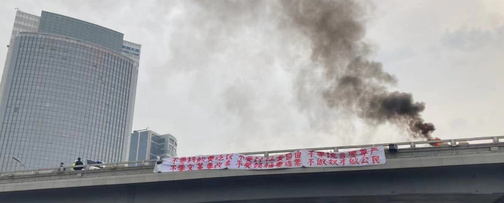
Footage from the scene shows Peng Lifa, disguised as a construction worker, hanging banners on the bridge. To draw the attention of pedestrians and passing vehicles, he deliberately set fire to materials to produce smoke and repeatedly broadcast the demands written on the two banners through a loudspeaker. He was later taken away by police.
In October 2023, Voice of America learned through multiple reliable sources inside China that Peng Lifa was still alive, but his family had not legally received any court documents and were unable to hire a lawyer for him. In addition, his wife, his two daughters, and even both sides' extended relatives were placed under close surveillance by CCP authorities.
Because of its sensitive timing and sensitive content, the Beijing Sitong Bridge incident quickly became a globally recognized symbol of the pro-democracy movement, and is regarded as the spark that ignited the "White Paper Revolution." Starting in November 2022, protests against the zero-COVID policy erupted across the country, spreading to universities, factories, and even overseas Chinese communities, ultimately forcing the authorities to abandon the widely criticized lockdown measures — objectively acknowledging the failure of Xi Jinping's forced zero-COVID lockdown policy.
Normally, when a case reaches the trial stage and the defendant, for whatever reason, has no defense lawyer, the authorities will typically appoint a legal aid lawyer to represent them in court. It is unclear whether a legal aid lawyer was appointed for Peng Lifa. But regardless of whether one was appointed, this generally has no substantive effect on the trial or sentencing — because such lawyers, like the "people's assessors" seated beside the judge in court, are essentially window dressing and decoration.
The CCP Court's Verdict Is a Fabricated Injustice
Upon learning that Peng Lifa had been convicted and imprisoned, one internet user commented: "Arson charges? 'Picking quarrels and provoking trouble' was already absurd enough, and now they've added 'arson' on top. He lit some flammable material to draw attention and create a visual effect (smoke), without causing the fire to spread or any actual property damage, let alone endangering anyone's life. By that logic, every smoker could be charged with arson. The verdict doesn't dare even mention the content of the two banners he hung — what are they afraid of?"
This user's skepticism about the charges is well-founded. The crime of arson, also known as intentional fire-setting, refers to deliberately setting fire to public or private property in a way that endangers public safety. Such conduct not only causes property damage but can also endanger lives.
The crime of "picking quarrels and provoking trouble" refers to reckless provocation, randomly beating or harassing others, arbitrarily damaging or occupying public or private property, or creating disturbances in public places, resulting in serious damage to public order.
Basic principles of criminal law tell us that establishing a criminal offense requires four elements: 1. the subject of the crime; 2. the object of the crime; 3. the subjective aspect of the crime; and 4. the objective aspect of the crime. Accordingly, determining whether a person's conduct constitutes a criminal offense requires that all four elements be present simultaneously — none can be missing.
Among these, the subjective aspect of a crime refers to the perpetrator's intentional state of mind; the objective aspect refers to the perpetrator's conduct actually infringing upon some specific, concrete object. Clearly, in Peng Lifa's Sitong Bridge incident, neither the subjective aspect nor the objective aspect of a crime can be found.
Because, first of all, one key point must be made clear: the fundamental purpose of Peng Lifa going onto Sitong Bridge was to hang banners, expressing public sentiment through this method. The reason he used combustible material to create smoke was entirely to draw more attention from passersby to the banners — this is completely unrelated to what the crime of arson refers to, namely "a person intentionally setting fire to burn public or private property, endangering public safety." It is likewise entirely unrelated to what the crime of picking quarrels and provoking trouble refers to, namely "a person engaging in reckless provocation, randomly beating or harassing others, or arbitrarily damaging or occupying public or private property, or creating disturbances in public places."
At the same time, since the North Third Ring Road main road where Sitong Bridge is located has six lanes in both directions, plus the width of the service roads and sidewalks, and the height of the bridge deck where Peng lit the smoke was more than 10 meters, it posed no fire threat whatsoever to nearby residents or pedestrians beneath the bridge. Moreover, judging from the footage, the smoke that rose was thick and heavy, suggesting the combustible material producing it was in a state of "smoldering" rather than open flame. So this, too, would not have constituted any safety threat to vehicles passing over the bridge. In fact, Peng's actions caused no loss or harm whatsoever to any individual citizen or social organization.
In summary, judged by the basic principles of criminal law, Peng Lifa's conduct lacks two of the essential elements required to constitute a criminal offense, and therefore the possibility of it constituting a crime is entirely ruled out.
We can therefore say that the CCP court's verdict against Peng Lifa is a wrongful conviction with absolutely no legal basis — law enforcement itself breaking the law.
An Assessment of the Legality of the Content of Peng Lifa's Sitong Bridge Banners
Having ruled out the legality of the CCP court convicting Peng Lifa over the smoke he set off, was he instead convicted because of the content of his banners? Let us analyze this further below.
He hung two banners high on the bridge. One read: "No to COVID tests, yes to food! No to lockdowns, yes to freedom! No to lies, yes to dignity! No to Cultural Revolution, yes to reform! No to a leader, yes to votes! Be a citizen, not a slave!" The other read: "Strike, boycott class, remove the dictator and national traitor Xi Jinping." For convenience, let us analyze these one by one as seven separate statements, divided by punctuation.
1. "No to COVID tests, yes to food!" If the court convicted Peng Lifa over this statement, it would be tantamount to the court openly declaring "No to food, yes to COVID tests!" This is clearly impossible.
2. "No to lockdowns, yes to freedom!" If the court convicted Peng Lifa over this statement, it would be tantamount to the court openly declaring "No to freedom, yes to lockdowns!" This is clearly impossible.
3. "No to lies, yes to dignity!" If the court convicted Peng Lifa over this statement, it would be tantamount to the court openly declaring "No to dignity, yes to lies!" This is clearly impossible.
4. "No to Cultural Revolution, yes to reform!" If the court convicted Peng Lifa over this statement, it would be tantamount to the court openly declaring "No to reform, yes to Cultural Revolution!" This is clearly impossible.
5. "Be a citizen, not a slave!" If the court convicted Peng Lifa over this statement, it would be tantamount to the court openly declaring "Be a slave, not a citizen!" This is clearly impossible.
6. "No to a leader, yes to votes!" If the court convicted Peng Lifa over this statement, it would be tantamount to the court openly supporting "No to votes, yes to a leader!" This one, actually, is plausible! In fact, this is precisely what the CCP has always done. Don't believe it? Just look: shortly before his death, Mao Zedong passed supreme power to his true "eldest son" Hua Guofeng with a note reading "With you in charge, I'm at ease," realizing a Mao-style hereditary succession; Deng Xiaoping first handpicked Jiang Zemin to succeed Zhao Ziyang, then designated Hu Jintao a generation in advance to succeed Jiang. Xi Jinping's own rise to power was actually the product of a three-way power struggle among Zhongnanhai's top leadership, CCP elders, and the CCP's "red second generation." To secure a third term, Xi Jinping even went so far as to amend the constitution — this is precisely the truest expression of "No to votes, yes to a leader!" But on second thought, "No to votes, yes to a leader!" can only be an unspoken rule of the CCP's backroom dealings, never something that could be put on the table — so it seems unlikely this would be used to convict Peng Lifa either.
7. "Strike, boycott class, remove the dictator and national traitor Xi Jinping!" On careful reflection, there's no basis for the CCP court to convict him over this statement either. Take "dictator" first — everyone knows Xi Jinping has a nickname within the Party: "the one and only core" — and isn't "the one and only" just another word for dictator? As for "national traitor," Xi Jinping broke unprecedented ground by shattering the CCP's own rule limiting a leader to two terms, using constitutional amendment to secure a third term and continue controlling the Party, the state, and the military — if that isn't "a thief who has stolen the nation," what is?
As for "strike, boycott class, remove," this statement calls on students and workers to rise up and force Xi Jinping out of power — there's really nothing more to say about it. After all, if he really is a "dictator and national traitor," shouldn't he be removed from office?
Overseas legal scholar Yuan Hongbing, citing sources within the CCP system, said that factions of the "red second generation," though divided into rival camps, are now rarely joining forces, having reached a consensus: to prevent Xi Jinping from securing another term at the 21st Party Congress. Red-second-generation families are reportedly jointly drafting a "Red Bloodline Recommendation to the Party Central Committee." Its core content can be summarized in two points: first, that Xi Jinping has violated the CCP leadership's principle of "keeping power in the hands of one's own people"; and second, that Xi has violated the CCP leadership's principle of "hiding one's strength and biding one's time," insisting instead on forcibly reunifying Taiwan by military force — a move that would seriously threaten the massive overseas assets held by red-second-generation families across the CCP. The solution, in their view, is to remove Xi Jinping from power.
If this is indeed true, then didn't Peng Lifa show remarkable foresight, stepping forward with the chivalrous courage to "risk being torn to pieces, but dare to pull the tyrant Xi Jinping off his horse"? Isn't this a great hero who rid the people of a scourge? A person capable of such a stunning act of justice deserves to be honored as a "national hero" — a service to this generation, a benefit to generations to come. If anything, he deserves to be crowned, not condemned. What crime has he committed?
Conclusion
For Peng Lifa (Zaizhou) —
The red dynasty totters, its fate hangs upside down, Beacon-fires of alarm rise in the capital's heart! Two banners, a sword to slay the demon; Seven demands, a whip to strike the dragon. A man of iron will from the White Mountains and Black River, A bridge spanning heaven and earth, a pillar holding up the sky. Why wait nine years to drink to victory? He who bears the boat can capsize it — in the blink of an eye!