In the latest, 2021 edition of A Brief History of the Chinese Communist Party, the period from the CCP's founding of the People's Republic in October 1949 to the end of the ‘Cultural Revolution’ in October 1976 is described as ‘a historical period in which our Party led the people through an arduous exploration of the path of socialist revolution and construction.’ The Brief History does acknowledge that China suffered ‘serious setbacks’ during this period. What the Party's official history does not tell the Chinese people, however, is that in the course of this ‘exploration,’ countless Chinese families were destroyed and tens of millions of Chinese people lost their lives.
Over these twenty-seven years, the CCP launched one political, economic, and cultural campaign after another — Land Reform, the Suppression of Counter-Revolutionaries, the Three-Anti and Five-Anti Campaigns, the Anti-Rightist Campaign, the Cultural Revolution, and more. In each successive bloodbath, some group was designated the new ‘class enemy’ and subjected to persecution, killing, and total destruction — first the landlord class, then the bourgeoisie, then intellectuals, then the peasantry, until finally the entire Chinese nation suffered.
Land Reform and the Suppression of Counter-Revolutionaries: The Extinction of the Landlord Class
Shortly after founding the People's Republic, the CCP extended the ‘Land Reform Movement’ — which it had already carried out in the so-called ‘old liberated areas’ under its control, namely the Northeast and North China — to the rest of the country. From the winter of 1950 through the end of 1952, a massive Land Reform campaign was carried out across the vast ‘newly liberated areas’ of East, Central-South, Southwest, and Northwest China.
The new edition of the Brief History describes Land Reform in entirely positive, affirming terms, calling it ‘a great historic victory’ in which ‘some 300 million landless and land-poor peasants across the country received roughly 700 million mu of land free of charge,’ an event that ‘marked the complete disappearance of landlord land ownership — the foundation of the feudal system that had persisted in our country for thousands of years — so that peasants truly became the masters of the land.’
What the Brief History does not mention at all is that it was not only ‘landlord land ownership’ that was completely wiped out — millions of actual, living landlords were also physically wiped out in the bloody violence of Land Reform.
Zhang Naiqi, a Chinese democratic figure, headed a Southwest China Land Reform work team organized by the Chinese People's Political Consultative Conference between May and August 1950, traveling to eastern Sichuan to witness local land reform firsthand. His son, historian Zhang Lifan, has spoken on a Voice of America program about what his father's diary recorded of land reform in eastern Sichuan.
He said: ‘My father's diary entry for August 10 reads: in such-and-such village, [people were] strung up and beaten — the female landlord He Jingxiu was beaten to death; in the fourth village, landlord Zeng Rui was beaten to death; in the sixth village, He Yunqiao and his son and daughter-in-law were strung up and beaten, one of them bound, and the eldest daughter-in-law hanged herself the next day; another landlord, He Yuwen, died after being strung up and beaten for twenty or thirty minutes; in the third village, eight people were strung up and beaten, two grain-loads' worth of grain was seized, and two people died...’
How many landlords were killed in total during land reform? Some conservative estimates put the number at around two million; others suggest it was between one million and four million. Song Yongyi, professor emeritus at California State University, Los Angeles, and a historian, has calculated — based on figures published by China's National Bureau of Statistics — that 4.7 million members of the landlord class died unnatural deaths between 1950 and 1954. Song has edited The Database of Contemporary Chinese Political Movements, which includes archival documents from every campaign since the CCP came to power, including the Cultural Revolution, the Anti-Rightist Campaign, the Great Famine, and Land Reform.
What the CCP's party history does not tell the public is that land reform could be carried out peacefully — Japan, South Korea, and Taiwan all carried out peaceful land reforms in East Asia. After the Republic of China government retreated to Taiwan, it purchased land from landlords and resold it to poor farmers at extremely low prices, ultimately achieving the goal of ‘land to the tiller’ without bloodshed.
The CCP's bloody, violent approach to land reform can be traced back to the 1930s, when the Party first established rural revolutionary base areas — though at the time it was called the ‘Land Revolution.’ Historian Zhang Lifan believes the purpose of the CCP's violent land reform was to bind peasants' fates to those of the Communist Party.
He told Voice of America: ‘In reality, the whole purpose of land reform was to get everyone's hands stained with blood. Not only did every peasant have to get blood on their hands through violence, but intellectuals too had to be bloodied in this violent revolution — so that they would be implicated, and would have no choice but to follow the Communist Party.’
CCP Vice Chairman Liu Shaoqi explained the purpose of this approach in a political report in September 1956: ‘By thoroughly mobilizing the peasant masses through the mass line, and fully awakening the class consciousness of the peasants, especially the poor peasants, through their own struggle... the broad masses of peasants stood up, organized themselves, and followed the Communist Party and the people's government closely, firmly seizing political and military power in the countryside. Land reform therefore not only destroyed the landlord class economically and greatly weakened the rich peasants, but also politically overthrew the landlord class and isolated the rich peasants.’
Analysts point out that Land Reform's greatest impact on Chinese society lay not in who owned the land, but in the class labels it assigned to the rural population. After Land Reform, rural residents were sorted into farm laborers, poor peasants, middle peasants, rich peasants, and landlords. Poor peasants and farm laborers were the class the CCP relied on; middle peasants were to be united with; landlords and rich peasants were designated the exploiting class, to be struggled against. From then on, landlords and rich peasants became a permanent underclass in China. This system of class labeling shaped the fates — and often the very lives — of generations of landlord and rich-peasant families. Members of the so-called ‘Five Black Categories’ (landlords, rich peasants, counter-revolutionaries, bad elements, and rightists) and their children were later brutally killed during the Cultural Revolution.
Historian Song Yongyi told Voice of America that this practice of assigning class labels during Land Reform became the theoretical foundation for how the CCP would go on to govern the country through political campaigns.
He said: ‘The theoretical basis of Land Reform was to incite hatred, manufacture enemies, and provoke one segment of the population into persecuting and killing another — and this became the theoretical foundation for the CCP's endless subsequent campaigns of governance.’ He said that in each of the CCP's later campaigns, a new ‘class category’ would invariably be drawn up and a new ‘class enemy’ manufactured — such as the ‘rightists’ of the Anti-Rightist Campaign or the ‘capitalist roaders’ of the Cultural Revolution.
Even as it carried out Land Reform, the CCP simultaneously conducted, from October 1950 to October 1951, a nationwide political campaign to investigate and suppress counter-revolutionaries.
The CCP's Brief History likewise describes the necessity and justice of the ‘Suppression of Counter-Revolutionaries’ campaign in affirming terms: ‘The campaign to suppress counter-revolutionaries swept away the remnants of counter-revolutionary forces left behind on the mainland by the Kuomintang, essentially wiped out reactionary organizations such as spy networks, underground armies, and secret societies, brought social order to an unprecedented level of stability, and provided powerful support to both land reform and the war to resist America and aid Korea.’
Historian Song Yongyi says that in some areas, the Suppression of Counter-Revolutionaries served Land Reform directly: ‘Whenever peasants were unwilling to denounce landlords, or a work team couldn't get things moving, they would simply kill someone first to create red terror and get the masses mobilized. This tactic was extremely common.’ Taiwanese historian Chen Yung-fa notes in his book The Chinese Communist Revolution, Seventy Years that the campaign's purge of rural secret societies effectively dismantled the power structures of landlords and rich peasants, clearing the way for Land Reform to proceed in the countryside.
The exact death toll of the Suppression of Counter-Revolutionaries campaign remains unclear. However, according to a September 1958 report from the Ministry of Public Security's Party Committee to the CCP Central Committee, ‘from the founding of the People's Republic through May 1958, a total of 6,118,246 counter-revolutionaries and other criminals were arrested nationwide, of whom 862,236 of the most serious offenders were executed, and 1,942,125 were placed under surveillance — essentially completing the historic task of wiping out counter-revolutionary remnants.’
The History of the Chinese Communist Party (Volume II), published in 2011, indirectly acknowledges that the campaign involved excessive killing, stating: ‘Because the judicial system and trial procedures were not yet well developed at the time, deviations such as wrongful arrests and wrongful executions occurred in the work of some localities; the Center discovered and corrected these in a timely manner.’
What the party history does not explain is that the top CCP leadership, including Mao Zedong himself, set execution quotas for the Suppression of Counter-Revolutionaries campaign. Mao is recorded as having explicitly instructed the officials responsible for the campaign in Shanghai and Nanjing: ‘Shanghai is a large city of six million people. Given that more than 20,000 have already been arrested there and only just over 200 executed, I believe that at least around 3,000 of the worst bandit chiefs, habitual criminals, local tyrants, spies, and secret-society leaders should be executed within 1951 — with at least around 1,500 executed in the first half of the year alone... Nanjing is a large city of 500,000 people, the former Nationalist capital; the number of reactionaries who should be executed there surely exceeds just 200. Nanjing has killed too few — more killing should be done in Nanjing.’
At Mao's suggestion, the CCP Central Committee met to discuss execution quotas, deciding to ‘set the ratio at one in a thousand of the population, beginning with half that number, and decide further action based on how things develop.’ Setting numerical targets and killing by quota was a practice Mao returned to again and again, recurring in the later Three-Anti and Five-Anti Campaigns, the Campaign to Eliminate Counter-Revolutionaries, and the Anti-Rightist Campaign.
The Three-Anti and Five-Anti Campaigns: The Bourgeoisie Consigned to History
If Land Reform destroyed the landlord and gentry classes, the CCP's next campaign set its sights on China's national bourgeoisie, in both the cities and the countryside.
According to the CCP's official explanation, the Three-Anti and Five-Anti Campaigns, running from late 1951 to October 1952, targeted Party and government personnel with a campaign against ‘corruption, waste, and bureaucratism,’ and targeted private industrialists and merchants with a campaign against ‘bribery, tax evasion, fraud against state property, cutting corners on materials and workmanship, and theft of state economic intelligence.’
The Three-Anti and Five-Anti campaigns appeared to be two separate movements targeting different groups, but they were closely linked. According to the CCP's Brief History, the Five-Anti Campaign was a direct outgrowth of the Three-Anti Campaign, since ‘corruption within Party and government agencies was often the result of collusion with unscrupulous businessmen.’
Less than a month after the Three-Anti Campaign began, the Five-Anti Campaign, aimed at capitalists and private industrialists and merchants, rapidly unfolded nationwide, mainly in the large cities. Shanghai, as China's commercial center, became the campaign's first target.
During the campaign, the CCP encouraged mass denunciations and had capitalists inform on one another anonymously, ‘back to back.’ Capitalists, business owners, and merchants deemed to have problems were made to wear tall dunce caps and were paraded through the streets, subjected to every kind of physical and psychological humiliation. Some were forced to hand over their entire assets; others, unable to bear the humiliation, took their own lives. Among them were Xian Guansheng, the famous owner of Shanghai's Kwong Sang Yuen confectionery company, and Lu Zuofu, China's celebrated ‘shipping king.’
Tony Saich, director of Harvard University's Asia Center, provides a telling figure in his new book, From Rebel to Ruler: One Hundred Years of the Chinese Communist Party: in the two months after the Five-Anti Campaign began, the number of suicides in Shanghai alone reached as high as 644.
By the time the Five-Anti Campaign ended in October 1952, the funds recovered from investigations into the ‘five poisons’ totaled 2 billion U.S. dollars, which were funneled into the war then underway in Korea — what China calls the war to ‘resist America and aid Korea.’
According to Taiwanese historian Chen Yung-fa's The Chinese Communist Revolution, Seventy Years, the Five-Anti Campaign hit a total of 467,776 industrial and commercial households across just eight major cities, including Shanghai, Tianjin, and Beijing. Facing crushing fines, many businesses were forced into bankruptcy. Many private business owners simply asked the government to confiscate their enterprises outright, preferring to become mere shareholders under joint state-private management in order to keep their families afloat.
This explains why the CCP's party history claims that the Five-Anti Campaign ‘laid important groundwork for the later peaceful transformation of capitalist industry and commerce.’ Through this kind of coercion, within a few years the CCP eliminated the bourgeoisie and private ownership across the entire country, bringing all commerce under Party control. After the Five-Anti Campaign, China's bourgeoisie too was consigned to history.
The Rectification and Anti-Rightist Campaigns: The Spiritual Annihilation of the Intellectuals
The Rectification and Anti-Rightist Campaigns, both beginning in 1957, were likewise two linked movements. The ‘Rectification’ campaign was an internal Party affair aimed at correcting the conduct of Party members, while the ‘Anti-Rightist’ campaign identified and targeted individuals both inside and outside the Party who were labeled ‘rightists.’
Fearing that the ‘complex new circumstances’ arising from the socialist transformation might trigger a crisis similar to Hungary's 1956 uprising, the CCP Central Committee issued its ‘Directive on the Rectification Movement’ on April 27, 1957, deciding to launch a Party-wide Rectification campaign against bureaucratism, sectarianism, and subjectivism. It called on people outside the Party to ‘speak out and air their views freely,’ encouraging the public to voice their own thoughts and opinions, and even to criticize the Party and government to help the CCP rectify itself.
Taiwanese historian Chen Yung-fa believes that the Chinese intellectuals given the chance to speak freely in 1957 were ‘carried away by emotion,’ voicing their dissatisfaction and suggestions for reform toward the Party and government without any inhibition, never imagining that a Party which could encourage ‘speaking out and airing views freely’ could just as easily call a halt to it.
Some criticized the CCP for treating the country as ‘the Party's private domain’; some proposed that the Communist Party and the democratic parties should ‘take turns holding power’; others argued that ‘one-party rule is harmful.’ But views like these proved intolerable to Mao Zedong and the CCP, who decided to strike back against the intellectuals.
The CCP's party history explains the start of the Anti-Rightist Campaign this way: 'As the Rectification Movement rapidly unfolded, some complex situations also emerged. Beyond criticism of the Party's work style, an extremely small number of bourgeois rightists seized the opportunity to launch an attack on the Party and the newly established socialist system... In June, the Center called for organized forces to counterattack the rightists' offensive.'
In the Anti-Rightist Campaign, a large number of intellectuals across politics, education and culture, publishing, government, science and technology, and business were branded rightists and reduced to a ‘political underclass.’ Depending on how contrite they were judged to be, these rightists were sorted into different levels of punishment — the most severe were sent to prison or even executed. Some were sent to reform-through-labor camps such as Beidahuang and Jiabiangou, and many of them later starved to death during the Great Famine that swept the country from 1959 to 1961. Others chose suicide.
The CCP's party history considers the Anti-Rightist Campaign ‘necessary’ and ‘correct,’ conceding only that it was ‘seriously excessive in scope.’ The party history states: 'Because the class struggle situation was assessed as far more severe than it actually was, a great many contradictions among the people were mistakenly treated as antagonistic contradictions with the enemy, and a great many matters of ideological understanding were mistakenly treated as political issues — as a result, the struggle against the rightists was seriously overextended.'
What the party history does not mention is just how vastly overextended the campaign actually was. According to a review conducted after the CCP's Third Plenary Session of the Eleventh Central Committee, of those branded rightists during the 1957 Anti-Rightist Campaign and the 1958 ‘Anti-Rightist Makeup Session,’ 552,877 people nationwide had their rightist label ‘corrected,’ while only 96 did not — a wrongful-designation rate of 99.998 percent. Data suggests that only just over 100,000 of those originally labeled rightists were even still alive by the time their cases were ‘corrected.’
Taiwanese historian Chen Yung-fa says: ‘Intellectuals outside the party-state system, having learned this harsh lesson, fell into terrified silence, and never again played any significant role in Chinese politics during the Mao era. With the intellectuals who might have provided some check on power now suppressed, the CCP's party-state apparatus increasingly came to resemble a colossal monster, operating purely according to its own internal logic. Mao Zedong then relied on this monster to launch the Great Leap Forward.’
Historian Song Yongyi of the California State University system says that, compared with other CCP campaigns, the number of intellectuals who actually died in the Anti-Rightist Campaign was relatively small. But the campaign effectively annihilated Chinese intellectuals as a class, both spiritually and in terms of social standing — whether inside the Party or outside it.
He told Voice of America: ‘The most important role intellectuals play in any society is their independence — their ability to hold those in power accountable. What happened in 1957 and 1958 stripped every intellectual of that independence completely. There's a saying in academic circles that the 1957 Anti-Rightist Campaign succeeded in ideologically and socially annihilating intellectuals as a modern social group.’
Many later analysts believe that the subsequent Great Leap Forward and Cultural Revolution were closely connected to the collective silencing of China's intellectuals — after the Anti-Rightist Campaign, the power of the Communist Party and of Mao Zedong himself was left with no check on it at all.
The Great Leap Forward Led to the Great Famine, Killing Tens of Millions of Peasants
The Great Leap Forward may be one of the few CCP campaigns that did not specifically manufacture a ‘class enemy.’ Yet because of the CCP's disastrous policies, it ended up causing the largest death toll of any campaign in Party history. Somewhere between 35 and 40 million people — some estimates go as high as 45 million — died in the Great Famine that the Great Leap Forward brought about, the overwhelming majority of them peasants.
From 1959 to 1961, China suffered an extraordinary famine. In the cities, people had to buy food with ration coupons and never had enough to eat; in the countryside, peasants resorted to eating grass roots and tree bark — and, in some cases, to cannibalism.
Yet in the CCP's own party history, the term ‘Great Famine’ remains taboo to this day, replaced instead by euphemisms like ‘Three Years of Natural Disasters’ or the ‘Three Years of Difficulty.’ The new edition of the Brief History does not even use the specific phrase ‘Three Years of Natural Disasters,’ stating only that the ‘leftist tendencies’ in the campaign against ‘right deviation,’ ‘natural disasters,’ and the ‘Soviet government's bad-faith tearing up of contracts’ left the new China facing ‘unprecedented and severe economic difficulties.’
Yang Jisheng, a former senior Xinhua correspondent, visited more than a dozen of the provinces hit hardest by the famine, interviewed survivors, and combed through vast archival records to write his monumental account of the Great Famine, Tombstone: A True Record of the Great Chinese Famine of the 1960s.
In a 2012 interview with Voice of America, he said this appalling tragedy was not a natural disaster but a man-made one, directly caused by the CCP's Great Leap Forward and related policies. Yang estimates that 36 million people died unnatural deaths in China between 1958 and 1962.
He said: ‘The Great Famine should really be understood as tied to the ‘Three Red Banners’ — that is, the Great Leap Forward, the General Line, and the People's Communes... Because the Three Red Banners created chaos across the entire country and produced the famine, the Three Red Banners were the direct cause of the Great Famine.’
In May 1958, the Second Session of the CCP's Eighth National Congress formally adopted the General Line of ‘going all out, aiming high, and building socialism with greater, faster, better, and more economical results,’ and the Great Leap Forward movement subsequently spread across the entire country.
On the industrial front, in order to fulfill Mao Zedong's target of doubling steel output from 1957 levels and to reach, ahead of schedule, the fifteen-year goal of overtaking Britain in steel production, the CCP launched a mass movement to produce steel through backyard furnaces. To supply the raw materials and fuel this required, forests were stripped bare across the country, iron farm tools and other means of production were melted down as raw material for steelmaking, and huge numbers of rural laborers abandoned agricultural work to join the steel-smelting drive, leaving many crops to rot unharvested in the fields. On the agricultural front, grain output was reported to have risen dramatically, with claims of harvests reaching tens of thousands of jin per mu appearing constantly.
Beyond the enormous damage the steel-smelting drive did to agriculture, a wave of exaggerated reporting in the agricultural sector pushed peasants further toward disaster. Even scientists, including missile expert Qian Xuesen, lent their credibility to these exaggerated claims, asserting that rice and wheat yields could reach as much as 40,000 jin per mu per year.
Yang Jisheng said: ‘The higher the ‘satellite’ figures launched — the more exaggerated the reported grain yields — the higher the state's procurement quotas were set. If you had actually produced 10,000 jin of grain, they'd requisition 2,000; if you'd produced 100,000, they'd take 20,000. ‘Procurement’ actually combines two things: ‘requisition,’ meaning the mandatory grain tax, and ‘purchase,’ meaning buying up the so-called ‘surplus grain,’ which all had to be sold to the state. But where were peasants supposed to find any surplus grain, or even enough to feed themselves? Even their livestock feed was seized as ‘surplus.’’
Yang Jisheng believes the communal canteens set up during the Great Leap Forward were another cause of peasants starving to death. ‘The canteens became a tool for cadres to control the peasants — they would withhold meals at the slightest provocation. If you didn't obey today, you didn't eat. Withholding food was extremely common, happening everywhere. Withhold food for a day, two days, three days, and people starved to death — many people died of starvation right at the canteen door.’
Amid this catastrophic disaster, the CCP Central Committee still enforced strict policies banning people from fleeing famine areas and forbidding the opening of state granaries. In January 1960, at the height of the famine, when massive numbers of peasants were starving to death, the authorities were, if anything, deliberately increasing grain reserves.
According to records, the deadliest twelve-month period nationwide was from April 1959 to April 1960. During this very period, state grain reserves ranged from a high of 88.7 billion jin to a low of 40.35 billion jin — enough to feed more than 100 million people for a full year. Yang Jisheng believes that simply releasing half of these reserves would have been enough to prevent any starvation deaths at all.
In January 1962, at the ‘Seven Thousand Cadres Conference’ convened to sum up the failures of the 1958 Great Leap Forward and the people's commune movement, then-head of state Liu Shaoqi said the Great Famine was ‘seventy percent man-made disaster, thirty percent natural disaster.’
The Cultural Revolution: A Catastrophe for the Entire Nation
In assessing the ‘Cultural Revolution’ that ran from May 1966 to October 1976, the new edition of the Brief History simply repeats the language of the CCP Central Committee's 1981 resolution on certain historical questions, stating: ‘It [the Cultural Revolution] was an internal upheaval wrongly launched by the leadership and exploited by counter-revolutionary cliques, bringing serious calamity to the Party, the state, and the people of all ethnicities, and leaving behind extremely painful lessons.’
Song Yongyi, the California State University historian and specialist on the history of the Cultural Revolution, believes that even this characterization falls well short of a genuine repudiation of the Cultural Revolution.
In a recent essay titled 'A Dangerous Signal: Xi's Version of A Brief History of the Chinese Communist Party Rehabilitates the Cultural Revolution, Openly or Otherwise,' he wrote: ‘Shifting the blame for the Cultural Revolution from Mao Zedong, its actual instigator, onto the so-called ‘counter-revolutionary cliques’ that supposedly ‘exploited’ him is simply unconvincing, and reeks of an attempt to whitewash and exonerate Mao. As everyone knows, the so-called ‘Gang of Four’ counter-revolutionary clique was not actually headed by Mao's wife Jiang Qing — it was headed by Mao Zedong himself. It wasn't a ‘Gang of Four’ — it was a ‘Gang of Five.’’
He argues that shifting responsibility onto the ‘Lin Biao counter-revolutionary clique’ is equally unconvincing — after all, Mao himself once described launching the Cultural Revolution and founding the ‘New China’ as the two great achievements of his life.
Unlike previous versions of CCP party history, the new edition of the Brief History folds the Cultural Revolution into the broader narrative of ‘arduous exploration.’ Song Yongyi believes this is a deliberate attempt to rehabilitate the Cultural Revolution — using the deceptively light word ‘exploration’ to gloss over, with a single stroke, the errors of both Mao Zedong and the ruling Party.
The Brief History goes on to defend Mao's launching of this internal upheaval, describing the Cultural Revolution as one of Mao's continuing explorations in search of China's own path to building socialism, and attributing its disastrous outcome merely to an ‘unclear understanding of the laws governing the construction and development of socialist society,’ which ‘ultimately led to internal upheaval.’ Beyond this, nearly half of the Brief History's discussion of the period is devoted to trumpeting supposed ‘major achievements’ in the economy, diplomacy, and national defense science and technology during the Cultural Revolution — an attempt to dilute and obscure the political catastrophe it actually caused.
A growing number of scholars believe the true cause of the Cultural Revolution was a power struggle at the top of the CCP. This was not only the spark that ignited the Cultural Revolution but the central theme running through it from beginning to end. Chinese scholar Zhang Xianyang summed up Mao's motive for launching the Cultural Revolution as fear that, while alive, he might be overthrown, and after death, his memory might be posthumously disgraced.
Gao Wenqian, the CCP party historian and author of The Later Years of Zhou Enlai, told Voice of America on the 50th anniversary of the Cultural Revolution's outbreak that Mao Zedong launched the Cultural Revolution simply to ‘seize back power.’
Gao Wenqian said: ‘The reason Mao launched the Cultural Revolution, in his own words — as he told [journalist Edgar] Snow — was that ‘great power had slipped from his hands.’ In other words, the Cultural Revolution was a power-seizure campaign personally launched and led by Mao himself — overthrowing everything and plunging the country into total civil strife, all in order to seize power amid the chaos.’
Because of the failure of the 1958 Great Leap Forward and the people's commune movement, Mao's standing within the Party was shaken. By contrast, then-Vice Chairman Liu Shaoqi won support and respect within the Party for helping to salvage the situation after the Great Leap's failure. After the 1962 Seven Thousand Cadres Conference, Mao retreated to the ‘second line,’ leaving Liu Shaoqi, Deng Xiaoping, and others to run the Central Committee's day-to-day affairs.
Wresting power back from Liu Shaoqi and Deng Xiaoping became Mao's foremost objective. On August 5, 1966, Mao wrote his big-character poster, ‘Bombard the Headquarters — My First Big-Character Poster,’ aimed directly at Liu Shaoqi and Deng Xiaoping. That October, Liu was expelled from the Party and secretly imprisoned; he died in detention in 1969. Deng Xiaoping was likewise purged.
The CCP's Brief History acknowledges that the Cultural Revolution left ‘Party organizations and state power severely weakened, large numbers of cadres and ordinary people cruelly persecuted, and democracy and the legal system trampled underfoot, plunging the entire country into a serious political and social crisis.’ Yet the Brief History gives no specifics on the devastating impact the Cultural Revolution had on China's politics, society, economy, and culture — and makes no mention whatsoever of the tens of millions who died unnatural deaths as a result.
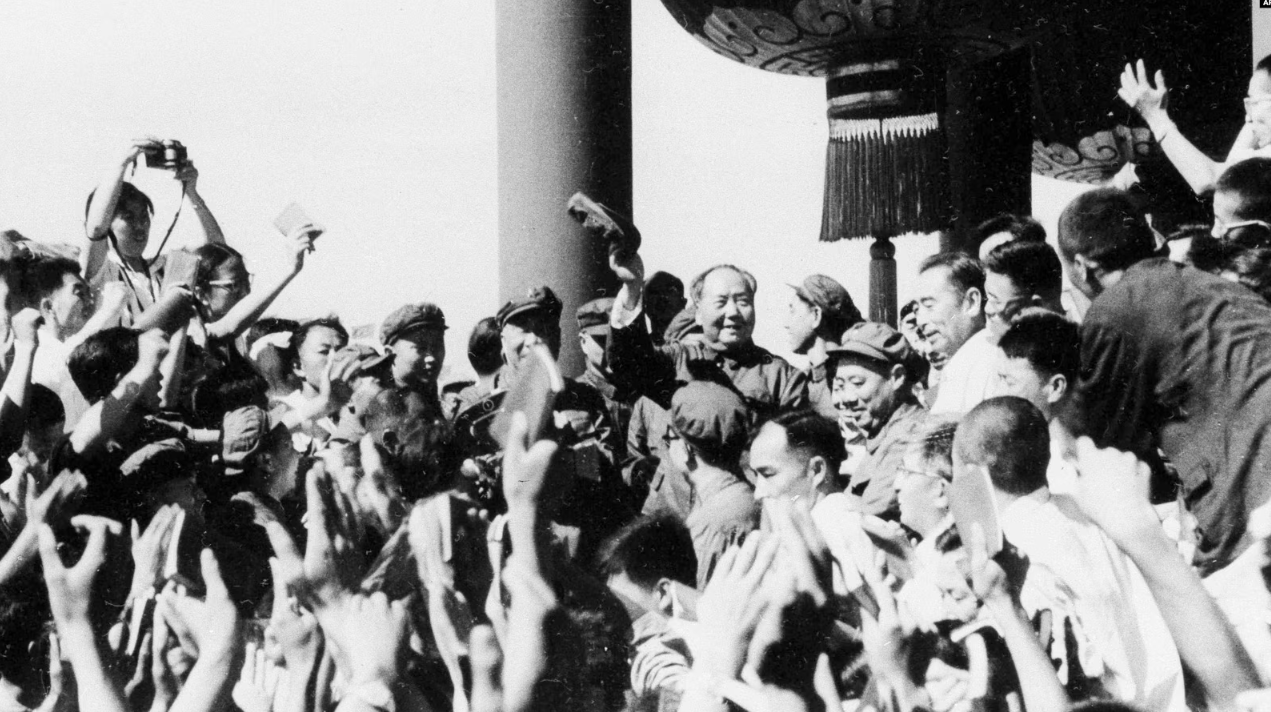
At the very start of the Cultural Revolution, Mao encouraged the entire population to ‘rebel.’ The so-called ‘Red Guards,’ made up of secondary school and university students, opened the curtain on this rebellion. Red Guards across the country poured out of their schools and, under the slogan ‘To rebel is justified,’ set about smashing the ‘Four Olds’ and violently beating ‘monsters and demons.’ Countless priceless cultural relics and historic sites across the country were destroyed.
Not long after the Cultural Revolution began, ‘rebel factions’ seized power on a massive scale, establishing revolutionary committees to replace Party and government organs. Well over half of all Party and government officials, including senior CCP leaders, were toppled by rebel factions, leaving governments at every level in a state of paralysis. Many people, including senior CCP officials, were persecuted to death during the Cultural Revolution. Besides Liu Shaoqi, Marshal Peng Dehuai, Marshal He Long, and Vice Premier Tao Zhu were all persecuted to death. The CCP's own statistics acknowledge that more than 60,000 cadres were persecuted to death.
Intellectuals were also among the first targeted for attack, branded ‘reactionary bourgeois academic authorities’ and ‘the stinking ninth category,’ and subjected to widespread denunciation and persecution. Prominent intellectuals, including the writer Lao She and the translator Fu Lei, took their own lives after being persecuted.
During the Cultural Revolution, schools were completely paralyzed, and an entire generation of young people was denied the education it should have received. In 1968, Mao issued the call: ‘It is highly necessary for educated youth to go to the countryside to be re-educated by the poor and lower-middle peasants.’ As a result, some 16 million middle and high school graduates were sent to rural areas across China.
Armed clashes between rival factions, commonly known as ‘armed struggle,’ broke out widely across the country. The Chinese military was in some cases drawn into this factional fighting, even using modern weapons such as tanks and anti-aircraft guns. According to the CCP document A Chronicle of Major Events in Guangxi's Cultural Revolution, in Guangxi province alone, the military's suppression campaign against one rebel faction in 1968 killed 200,000 people over a period of six months to a year.
Many people were brutally massacred during the Cultural Revolution. Large-scale massacres occurred in Beijing, Guangxi, Inner Mongolia, Guangdong, Yunnan, and elsewhere. According to official Chinese records, from August 27 to September 1, 1966, 325 landlords, rich peasants, and their family members across thirteen communes in Daxing County, Beijing, were killed one after another. Among the victims, the oldest was 80 and the youngest just 38 days old; 22 entire households were wiped out.
The number of people affected by, or implicated through association during, the Cultural Revolution is beyond counting. Former CCP General Secretary Hu Yaobang himself once said that the Cultural Revolution subjected more than 100 million Chinese people to persecution. Xi Zhongxun, father of current General Secretary Xi Jinping, was persecuted and investigated during the Cultural Revolution, and Xi Jinping himself suffered as a result of his father's fall.
Xi Jinping's own difficult experiences during the Cultural Revolution, and his family's suffering, led some to hold out hope early in his tenure that he might use his power to thoroughly repudiate the Cultural Revolution and abandon Mao Zedong's line.
Since taking power, however, Xi Jinping has grown increasingly like Mao Zedong himself, pursuing personal power and cultivating a personality cult of his own. He has also put forward the principle of the ‘Two Cannot Negates’: that the thirty years before reform and opening up cannot be used to negate the thirty years after, nor can the latter thirty years be used to negate the former. This is widely seen as a defense of the Mao era and the spirit of the Cultural Revolution.