One day in August 1967, a group of rebel factionalists stormed into Liu Shaoqi's office inside Zhongnanhai and subjected him to yet another struggle session.
Liu Shaoqi grabbed a copy of the Constitution from his bookshelf and loudly protested: "I am still the chairman of the People's Republic of China. How you treat me personally does not matter, but I must defend the dignity of the office of head of state. What you are doing insults our nation. I too am a citizen — why won't you let me speak? The Constitution guarantees that every citizen's personal rights are inviolable, and those who violate the Constitution must face severe legal sanctions."
But none of the rebel factionalists present listened to him; they continued the struggle session. During the "Cultural Revolution" launched by Mao Zedong, the "Constitution" could not protect Liu Shaoqi, chairman of the People's Republic of China. On the contrary, Liu was denounced and toppled as "the biggest capitalist-roader within the Party."
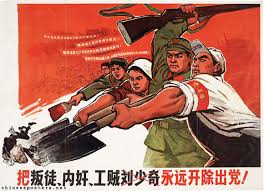
In October 1968, the 12th Plenum of the CCP's Eighth Central Committee formally declared Liu Shaoqi a "traitor, renegade, and scab," resolving to "permanently expel him from the Party and strip him of all positions inside and outside the Party," while continuing to prosecute him and his associates for the crime of "betraying the Party and the nation."
Why couldn't the "Constitution" protect Liu Shaoqi?
First, the campaign to deify Mao Zedong — which Liu Shaoqi himself had helped launch — reached its most extreme height by the time of the decade-long Cultural Revolution. Once Mao had been elevated to a godlike pedestal, and Mao wanted to bring Liu down, the Constitution naturally counted for nothing.
The cult of personality around Mao began during the Yan'an Rectification Movement in the 1940s. At that time, Liu Shaoqi was one of Mao Zedong's most important lieutenants in bringing down the "Soviet-returned faction" and establishing Mao's core position within the Party.
In 1945, at the CCP's Seventh National Congress, Liu delivered the "Report on the Revision of the Party Constitution," offering the first comprehensive overview of Mao Zedong Thought. Liu praised Mao as a "great leader," a "genius, creative Marxist," "the greatest theorist and scientist in Chinese history," possessing "the highest theoretical cultivation and the greatest theoretical courage," and declared Mao Zedong Thought the CCP's "sole correct guiding ideology."
A veteran CCP cadre recalled that in his report at the Seventh Congress, Liu mentioned Mao's name 105 times.
By August 1966, just three months after the outbreak of the Cultural Revolution, Mao was already being extolled as the "great teacher, great leader, great commander, and great helmsman."
Mao was called the "Red Sun" and the "Great Savior." The entire Party, the entire military, and the entire nation sang "Father and mother are dear, but not as dear as Chairman Mao," wished Mao "boundless longevity," and engaged in the "Three Loyalties" and "Four Boundless Loves" toward him, along with "morning requests for instructions" and "evening reports." Mao's every word was said to be "worth ten thousand." To defend Mao, fanatical rebel factionalists were willing to "climb mountains of knives and plunge into seas of fire."
After Mao's Red Guards toppled every "immortal and emperor" the Chinese people had worshipped since ancient times, Mao himself became the supreme "god." Once Mao had become a "god" who wanted to bring down Liu, what did the Constitution matter?
Second, Mao Zedong championed "rule by the Party," and Liu Shaoqi was no different.
On August 24, 1958, Mao remarked at Beidaihe: "We cannot rely on law to govern the majority... We essentially don't rely on that — we mainly rely on resolutions and meetings, four times a year. We cannot rely on civil or criminal law to maintain order. Every resolution we pass is law; every meeting we hold is itself a form of law." Mao also said: "We need rule by men, not rule by law. If a single People's Daily editorial is enforced nationwide, what need is there for law?"
Liu Shaoqi likewise said: "Is it rule by man or rule by law, in the end? In practice, it seems we rely on people — law can only serve as a reference for how things are done. The Party's resolutions are the law."
What Mao and Liu called "rule by man" was, in fact, "rule by the Party." By the time of the decade-long Cultural Revolution, as the deification of Mao progressed, "rule by the Party" gradually became the personal, arbitrary rule of Mao alone — that is, "rule by Mao," under which Mao could bring down anyone he wished.
If Mao wanted Liu dead, Liu had to die. At that point, the Constitution was nothing but scrap paper.
Third, Mao advocated "taking class struggle as the key link," and Liu did as well.
A resolution at the CCP's Eighth National Congress in 1956 stated that "the principal contradiction in Chinese society is between the advanced socialist system and backward productive forces." After the Eighth Congress, "the focus of Party and state work shifted from class struggle to economic construction."
But the very next year, in 1957, the CCP plunged back into the bloody storm of "taking class struggle as the key link."
"Taking class struggle as the key link" meant treating policy and law as tools of class struggle. Although the Constitution stipulated that citizens were "equal before the law" and possessed various rights, once a citizen was classified as a "class enemy," they were reduced to an "outcast" whom the Party could attack at will.
After the CCP established its regime, Liu Shaoqi served for a long time as the Politburo Standing Committee member overseeing political and legal affairs. In January 1955, after Zhang Dingcheng, procurator-general of the Supreme People's Procuratorate, reported to him, Liu instructed: "Our laws are not meant to restrain ourselves — they are meant to restrain our enemies, to strike at and eliminate our enemies."
In July of that same year, Liu Shaoqi told Zhang Dingcheng at Beidaihe: "If any law binds our own hands and feet, we must consider abolishing that law."
In every internal Party struggle Mao Zedong launched after coming to power, he considered himself the commander of the "proletarian headquarters," and cast his political rivals as agents of the "bourgeoisie." This was true from Gao Gang and Rao Shushi, to Peng Dehuai, Huang Kecheng, Zhang Wentian, and Zhou Xiaozhou, to Liu Shaoqi and Deng Xiaoping — none were spared.
Not long after the Cultural Revolution broke out in 1966, Mao branded Liu Shaoqi the chief culprit of the "bourgeois headquarters." Under the banner of class struggle as the key link, Liu was inevitably persecuted to the point of death — how could the Constitution possibly protect the chief of the "class enemies"?
Fourth, Mao insisted on the Party's absolute leadership over political and legal institutions, while Liu argued that political and legal institutions should be the Party's "docile tools."
In June 1958, the CCP Central Committee decided to establish five leading groups, including one for political and legal affairs. When revising the notice issued by the Central Committee, Mao reaffirmed the "unified" governing approach he had insisted on since 1942: "These groups belong to the Party Central Committee, report directly to the Politburo and the Secretariat, and answer to them directly. Major policies are decided by the Politburo, specific arrangements by the Secretariat. There is only one 'political design institute,' not two. Major policy and specific arrangements are both unified — Party and government are not separated... Power is concentrated in the Standing Committee and the Secretariat, and I am its commander-in-chief."
Mao Zedong, chairman of the CCP Central Committee, was the "commander-in-chief" of the Party's "unified" leadership. All institutions under him, including political and legal organs, were required to submit to his absolute leadership.
In July 1955, after Zhang Dingcheng, procurator-general of the Supreme People's Procuratorate, reported to Liu Shaoqi, Liu instructed: "Now the Party wants to carry out the socialist revolution, and those counter-revolutionary elements who sabotage the socialist revolution need to be arrested — so the Procuratorate must quickly take full responsibility for approving arrests and prosecutions. Whatever the Party committee decides to arrest, the Procuratorate should stamp its approval with its eyes closed. This approach may result in mistakes, and that can be explained clearly within the Party — but to the outside world, the Procuratorate must bear full responsibility for it... If the Procuratorate doesn't act as the Party's shield, democratic figures will use this to oppose the Party, which in effect would mean the Procuratorate itself opposing the Party."
Liu also said: "People at the Procuratorate must be told not to indulge in liberalism — they cannot, having stamped approval with their eyes closed, later say when a wrongful case surfaces, 'This case wasn't approved by me, I'm not responsible.' If anyone says such a thing, that is leaking Party secrets and asserting independence from the Party. The Procuratorate must serve as the Party's shield — internally this can be made clear, but externally, it must be said that all these cases were approved by the Procuratorate, and that I bear responsibility for them. Only this is correct. Otherwise, it violates Party discipline and must be punished accordingly."
Mao's theory of "absolute leadership" and Liu's theory of the "docile tool" were, in essence, the same thing — the former emphasizing the leader, the latter the led.
During the Cultural Revolution, Mao became the "absolute leader," while Liu became a target to be overthrown. With a single wave of Mao's arm, his "docile tools" rushed out in full force to "knock Liu to the ground" and "trample him under ten thousand feet."
Faced with the roaring fury of Mao's "docile tools," the "Constitution" Liu held aloft was as light as a feather.
Fifth, before the Cultural Revolution, Mao had already manufactured a great many wrongful and fabricated cases, and Liu was an eager follower in every one of them.
For example, in 1955, Mao fabricated the great miscarriage of justice known as the "Gao Gang–Rao Shushi Anti-Party Alliance" (although this case was never officially rehabilitated, the objective facts show that Gao and Rao neither "opposed the Party" nor formed an "alliance"); the great injustice of the "Hu Feng Counter-revolutionary Clique"; and the great injustice of the "Pan Hannian–Yang Fan Counter-revolutionary Clique." In 1957, he fabricated the great injustice of the "Anti-Rightist Campaign." In 1959, he fabricated the great injustice of the "Anti-Party Clique Headed by Peng Dehuai." In 1962, he fabricated the great injustice of the "Anti-Party Clique Headed by Xi Zhongxun," and so on.
When Mao brought down these so-called "class enemies," Liu Shaoqi never thought to defend "the dignity of the Constitution" — instead, he often played the role of kicking a man while he was down.
For example, at the 1959 Lushan Conference, after CCP Marshal Peng Dehuai was toppled for speaking the truth to Mao, Liu Shaoqi furiously denounced Peng, saying he had "the bones of Wei Yan" (a reference to the character in Romance of the Three Kingdoms said to have a rebellious streak at the back of his skull), "the Party spirit of Zhukov" (referring to Soviet Marshal Zhukov, who supported Khrushchev's palace coup), and "the demeanor of Feng Yuxiang" (i.e., a hypocrite).
At the CCP's Seven Thousand Cadres Conference on January 27, 1962, Liu Shaoqi said: "Everyone else can be rehabilitated — only Peng Dehuai cannot!"
"The reason the Lushan Conference had to launch the struggle against Peng Dehuai's anti-Party clique is that Peng Dehuai had long maintained a small clique within the Party. He was part of the Gao Gang–Rao Shushi anti-Party clique. When we opposed the Gao-Rao clique, he was not exposed at the time — he was a holdover remnant of the Gao-Rao clique, and one of its principal members."
Liu further stated: "Was it really the Gao-Rao alliance, or was it in fact the Peng-Gao alliance? I suspect it was more the Peng-Gao alliance — it wasn't so much that Gao Gang used Peng Dehuai, but rather that Peng Dehuai used Gao Gang. Both of them had foreign connections. Their anti-Party activities were connected to subversive activities carried out in China by certain foreigners."
After the Cultural Revolution ended, the CCP rehabilitated the case of the "anti-Party clique headed by Peng Dehuai." Looking back, Liu Shaoqi's denunciations of Peng Dehuai in 1959 and 1962 were entirely fabricated slander.
When Mao Zedong brought down Peng Dehuai, Liu Shaoqi never once thought of "the dignity of the Constitution." So when Liu himself fell from grace in 1967, did the Constitution still carry any dignity? Not the slightest.
Sixth, after Liu took charge of the Central Committee's work, he persecuted many people himself.
After the CCP's Seven Thousand Cadres Conference in 1962, Mao Zedong retreated to the "second line," and Liu Shaoqi took charge of the Central Committee's day-to-day work on the "front line." During his time overseeing central work, Liu likewise persecuted no small number of people. Here are three examples:
Example 1: Persecution during the 1964 Four Cleanups Movement.
At the time, Liu sent his wife, Wang Guangmei, to embed herself at the Taoyuan Production Brigade of Luwangzhuang Commune in Funing County, Hebei Province, where she "created" the so-called "Taoyuan Experience." After receiving Mao's endorsement, Liu took Wang Guangmei around the country to deliver reports promoting the "Taoyuan Experience." One major feature of the "Taoyuan Experience" was the brutal persecution of people through coercion, forced confessions, and belief in those confessions.
According to an article by Cultural Revolution history expert Song Yongyi, the Four Cleanups Movement directly guided by Liu Shaoqi and Wang Guangmei drove 77,660 cadres and ordinary people to death through persecution, and subjected more than 5.32 million people across urban and rural areas to political struggle — the vast majority of them wrongfully and unjustly accused.
Example 2: Sending work teams to persecute people at universities and middle schools in the early stages of the Cultural Revolution.
In May 1966, the "May 16 Notification" that launched the Cultural Revolution was passed under Liu Shaoqi's chairmanship. At the time, Liu did not know Mao intended to bring him down, and believed Mao was simply launching another Anti-Rightist-style campaign. In the movement's early stages, Liu sent his wife Wang Guangmei to lead a work team to "guide" the movement at Tsinghua University.
Under Wang Guangmei's "guidance," the work team branded Tsinghua University president Jiang Nanxiang and all vice presidents as members of a "black gang," ordering all cadres to "step aside" and submit to struggle sessions. Tsinghua's teachers and students described the ensuing chaos as "a long parade of public denunciation, mass struggle sessions everywhere, and a whole battalion sent to labor reform." Of the university's more than 500 cadres, a full 70% were thrown into the "black gang labor reform brigade."
Example 3: Toppling Peng, Luo, Lu, and Yang in the early stages of the Cultural Revolution.
In May 1966, Liu Shaoqi chaired an enlarged meeting of the CCP Politburo that branded a group as the "Peng-Luo-Lu-Yang Anti-Party Clique."
Peng Zhen was, at the time, a member of the CCP Politburo, a secretary of the Central Secretariat, and first secretary of the Beijing municipal Party committee; Luo Ruiqing was secretary-general of the Central Military Commission and chief of the general staff; Lu Dingyi was head of the Propaganda Department; and Yang Shangkun was director of the Central Committee's General Office.
Mao's move against Peng, Luo, Lu, and Yang was preparation for bringing down Liu Shaoqi. In Mao's view, Peng, Luo, Lu, and Yang were all senior Party, government, and military officials who had grown close to Liu while he oversaw central work — to topple Liu Shaoqi, Peng, Luo, Lu, and Yang had to be toppled first.
Liu, completely unaware of this, actually served as the vanguard in Mao's campaign against Peng, Luo, Lu, and Yang. On June 27, 1966, when briefing the heads of various democratic parties on the case against Peng, Luo, Lu, and Yang, Liu delivered a lengthy speech.
Liu said: "Class struggle is a life-and-death struggle. There can only be two outcomes: either the revolutionaries defeat the counter-revolutionaries, or the counter-revolutionaries defeat the revolutionaries. The Peng-Luo-Lu-Yang affair is exactly like this — either they overthrow Chairman Mao and overthrow us, or we overthrow them. Peaceful coexistence is impossible."
When bringing down Peng, Luo, Lu, and Yang, Liu never once gave a thought to "the dignity of the Constitution" — all he thought of was life-and-death class struggle.
When Liu himself was toppled, becoming a "class enemy" whom "the whole Party condemns, the whole Party eliminates" — how could the Constitution possibly protect him?
Conclusion
Why couldn't the CCP's Constitution protect Liu Shaoqi, chairman of the People's Republic of China?
Tracing this back to its roots, the CCP is a party that rose to power through violent revolution. What is "revolution"? It means taking away people's lives — in short, killing. CCP leaders have all been given the title of "revolutionaries." What is a "revolutionary"? A killer of families. The history of the CCP is a history of killing.
Can "killers of families" draft laws that conform to objective principles? Impossible. And even if such laws were drafted, these "killers of families" would never abide by them.