
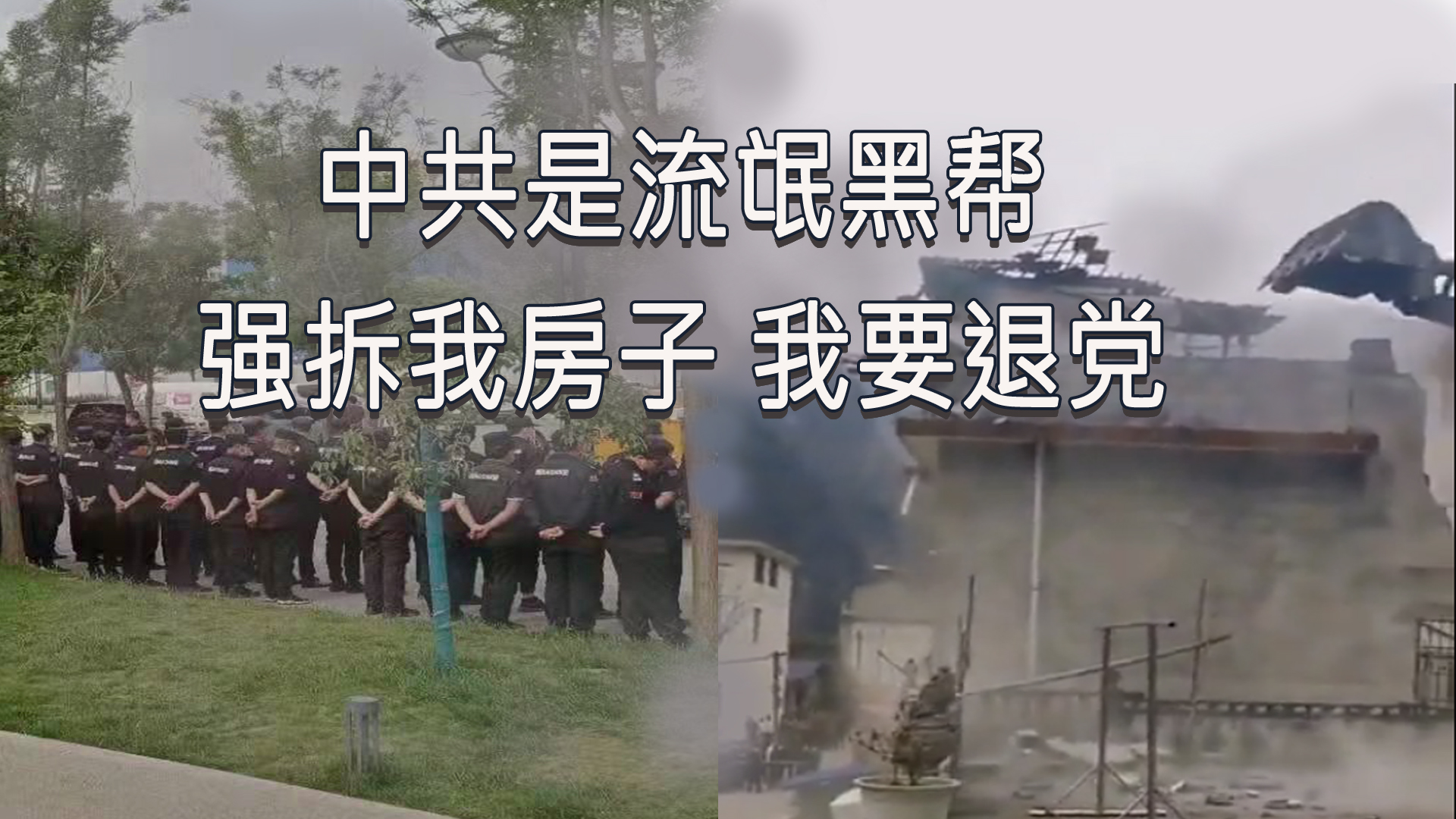
The Chinese term "liumang" (hooligan or thug) originally referred to a vagrant with no fixed occupation; it later came to describe someone who shuns honest work to engage in wrongdoing, or in acts such as harassing women. Its near-synonyms include "hoodlum," "scoundrel," "local ruffian," "scum," and "lowlife." Its behavioral hallmarks include making unreasonable scenes, throwing tantrums, and resorting to base and underhanded tactics.
The ninth of the Nine Commentaries on the Communist Party, "On the Thuggish Nature of the Chinese Communist Party," comprehensively and profoundly exposed the CCP's thuggish mask. In the early 1990s, a phrase became popular in China: "I'm a thug -- who's afraid of me?" This is precisely the bitter fruit of the CCP's century of rising to power through thuggery and ruling the country through thuggery: the thug-ification of the entire nation.
To offer solid, concrete evidence of the CCP's thuggish nature, this article presents three classic examples of the CCP playing the thug during its formative years of rising to power.
A Bandit Flag Raised on Jinggangshan: Posing as Nationalist Troops to Rob the People of Their Grain
In 1927, Mao Zedong launched the Autumn Harvest Uprising. The remnants of the "August 1" uprising forces led by He Long, Zhu De, Zhou Enlai, and others banded together with the local bandit gangs of Yuan Wencai and Wang Zuo, who had made themselves kings of Jinggangshan, gathering their forces there and living off looting homes and extorting the local population.
One day, the commander of a certain Red Army company grew worried over the meager and dwindling food supply for himself and his troops, and called together his three platoon leaders and the company's political instructor to discuss countermeasures. The five of them racked their brains but couldn't come up with a good solution. Suddenly, the first platoon leader -- a man known for always having some scheme up his sleeve -- furrowed his brow and, sure enough, hatched a "brilliant plan." He said proudly: "I've thought of a surefire trick. What do you all think?" The company commander, like a drowning man grasping at a life raft, urged him to spit it out at once. "What I've got in mind kills three birds with one stone: first, we get food and pay; second, we win a good reputation, making the people hate the Nationalist Party and its army while loving the Communist Party and the Red Army; and third, it will draw young people to join the Red Army and swell our ranks."
"Spit it out! Spit it out!" the other four urged impatiently, telling him to stop beating around the bush. "We split the whole company into two groups. One group dresses up as Nationalist troops, the other stays as our own Red Army. The ones disguised as Nationalist troops go into the village first and force the villagers to hand over grain, livestock, poultry, and other military supplies. Once they've seized a good haul, the Red Army suddenly appears outside the village shouting loudly, making them flee. The Red Army chases them off, recovers a small portion of the goods, and returns them to the villagers -- and while we're at it, we hold a public meeting to loudly denounce how terrible the Nationalist army is, and to praise the Red Army as a righteous force rescuing the poor and suffering common people..."
The other four applauded the plan as brilliant, and the company commander appointed the first platoon leader to play the role of the Nationalist army's ringleader. They then plotted out the details in secret, determined to make it convincing enough to genuinely provoke the villagers' hatred and disgust toward the Nationalist army while winning their love and support for the Red Army. Once the scheme was set, the soldiers were gathered for mobilization and training, with special emphasis placed on strict secrecy -- anyone who dared leak word of the plan would be executed without mercy. After careful preparation, they carried out their operation on a predetermined day.
The first platoon leader led his men, disguised as Nationalist troops, into a village and found the local headman, ordering him to gather the villagers for a meeting. Once everyone had assembled, the headman was made to tell the crowd how short of food and pay the Nationalist army was, demanding the villagers hand over the grain, pigs, sheep, chickens, and ducks in their homes. He then forcibly ordered two soldiers to follow each villager back to their home to collect grain and seize their poultry and livestock. Anyone who protested was met with vicious threats; anyone who dared resist was threatened at gunpoint. Seething with resentment yet forced to swallow their anger, the villagers had no choice but to sacrifice their property to save their lives, handing over the grain they had labored so hard to grow and the livestock they had raised.
The first platoon leader had a lecherous streak, and when he spotted a beautiful young woman walking back from outside the village, lust overtook him. He walked up to her, leering and making crude remarks, groping her as he spoke. The young woman screamed, and her mother came running at the sound, begging him to spare her daughter. But he paid the old woman no mind and kept pulling at the girl by force. Just then, the Red Army arrived at the edge of the village, and someone told them what was happening. The Red Army shouted loudly: "No robbing the people's property! No molesting the village's women!" Hearing this, the first platoon leader ordered two of his men to drag the girl away by force, while the rest fled in a panic, taking the extorted goods with them.
Entering the village, the Red Army shouted, "Drop the loot and return the people's property!" while firing shots into the air in pursuit. They caught up outside the village, recovering a few small sacks of grain and rescuing the young woman who had been dragged off, then returned to the village to hand everything back to the villagers. The villagers thanked the Red Army profusely, overwhelmed with gratitude -- especially the young woman who had nearly been abducted and her mother, who regarded the Red Army as their savior, kneeling to thank them for their rescue. The company commander and the political instructor rushed forward to help the old woman up: "Get up, dear grandmother, there's no need for such old formalities. The Red Army is the people's army -- protecting the people's property and personal safety is our duty. If you want to thank anyone, thank the Communist Party."
Striking while the iron was hot, the political instructor continued: "What happened in our village today fully proves that the Kuomintang represents the landlord and bourgeois classes, and that the Nationalist army is the Kuomintang's own private guard. Only by crushing the Nationalist army, overthrowing the Nationalist government, and toppling the landlords and the bourgeoisie can the poor rise up and be liberated, and live a free, democratic, happy life free of exploitation and oppression. Therefore, any young person, male or female, willing to join the Red Army may sign up to become a glorious Red Army soldier, fighting to defeat the Nationalist army, overthrow the Chiang family's dynasty, and establish a worker-peasant alliance government."
Hearing this speech, the villagers were "enlightened." They came to believe the Communist Party was the savior who would deliver the poor from their suffering, and that following the Communist Party would surely lead to a better life -- so young people rushed to sign up. Even the old woman whose daughter had just been "rescued" by the Red Army sent her own daughter off to enlist...
The CCP Orchestrates the Nanjing Anti-Foreign Riots, Prompting Chiang Kai-shek to Launch the "Purge of the Party"
The great "Party Purge" campaign led by Chiang Kai-shek in 1927 was a major event in modern Chinese history, and marked the beginning of Chiang's lifelong campaign to suppress the Communists.
On July 9, 1926, Chiang Kai-shek, commander-in-chief of the National Revolutionary Army, personally took command and swore an oath to launch the Northern Expedition, determined to end the warlord fragmentation then dividing northern China, expel the foreign powers' influence from China, and achieve the complete unification of China's territory and sovereignty. The campaign advanced with unstoppable momentum, winning victory after victory. In early 1927, it captured Jiangxi, then advanced into Hangzhou, and soon after took Shanghai and Nanjing in succession. In March, Chiang Kai-shek arrived in Shanghai, preparing to press further forward. It was at this very moment that a shocking anti-foreign riot broke out in Nanjing, stunning both China and the world.
The incident unfolded as follows: on March 22, the Jiangyou Army, part of the Central Army of the National Revolutionary Army taking part in the Northern Expedition, arrived at Nanjing. In the early hours of the next morning, they entered the city, firing shots and searching the streets, and inquired at the various foreign consulates in Nanjing whether any enemy combatants were hiding inside. After receiving negative answers, these troops calmly withdrew from the foreign consulates. But starting around 8 a.m., a large-scale wave of looting and violence against foreigners suddenly erupted across the city of Nanjing, continuing until 5 p.m.
During this time, Northern Expedition troops stormed into foreign consulates, churches, and trading companies, carrying out armed attacks and violence, killing six citizens of Britain, the United States, France, Italy, and other countries, and wounding dozens more. The British consul was killed, and the consul's wife was gang-raped and left severely injured; in addition, over a hundred foreign women were raped by Northern Expedition soldiers. Foreign consulates and the property of foreign residents suffered devastating losses.
The incident triggered enormous shock and outrage among Western nations. Around 3 p.m., several British and American warships stationed on the Yangtze River began retaliatory shelling of the city of Nanjing, killing more than thirty residents and wounding dozens more. Cheng Qian, commander of the Jiangyou Army at the time, worked simultaneously to halt the looting and to send Red Cross representatives to contact the British and American warships, requesting they cease the shelling. The British and American bombardment lasted about an hour before ending, and the wave of looting gradually subsided as well.
Because the Second and Sixth Armies of the Jiangyou Army contained many Communist Party members, Chiang Kai-shek's immediate reaction upon hearing of the Nanjing looting was to conclude that it must have been instigated by the Communists, and that it was specifically aimed at sabotaging the Northern Expedition. Chiang felt that if he did not thoroughly purge this Communist threat from within his own party, the great cause of the Northern Expedition would face serious disruption, or might even collapse just short of success. Combined with the various obstructive actions the Soviet Union and the CCP had already taken before and during the Northern Expedition, Chiang had long harbored deep suspicion toward the Soviet Union and the CCP, and with most of the Kuomintang's own membership already clamoring loudly against the Communists, Chiang Kai-shek resolutely pressed the button to launch the "Party Purge."
This anti-foreign riot secretly instigated by the CCP not only failed to gain the party any advantage, but very nearly brought it to the brink of total annihilation. In Chiang Kai-shek's "Party Purge" campaign, at least several hundred CCP members and activists were executed. Afterward, in May of that same year, the "Ma Day Incident" occurred in Changsha, resulting in the arrest and execution of even more CCP members and pro-Communist sympathizers, and the disarming of the CCP-organized labor unions and peasant self-defense militias. In the period that followed, the Nationalist government arrested and executed CCP members in many locations; it was during this period that early CCP leader Li Dazhao was executed, as was Xia Minghan, the party member repeatedly celebrated by the CCP for his line, "Never mind losing my head, so long as my faith remains true."
The CCP's Thuggery Played the Peasants Like Puppets
As we know, one defining characteristic of a thug is breaking one's word and constantly reversing course -- turning the palm up for clouds, turning it down for rain. Not only can such a person switch principles at will, but they can shift their stance at any moment as the need arises. In the eyes of the thuggish CCP, everything is a tool, everything merely a means to achieve its ends.
The opening piece of Mao's Selected Works is "An Analysis of the Classes in Chinese Society." In it, Mao writes that "the poor peasants and other semi-proletarians (lower-middle peasants, middle peasants, etc.) are the most numerous... they are the broadest and most reliable ally of the proletariat."
And yet, times change, and so does the CCP's tune. Whenever the CCP needs them to, poor peasants, lower-middle peasants, middle peasants -- this supposedly "broadest and most reliable ally" -- can instantly become beasts of burden to be enslaved at will, tools for conquering the world, the CCP's own "human flesh atomic bombs."
Yan Xishan, the "King of Shanxi" who once served as chairman of Shanxi Province under the Nationalist government and later as premier of the Republic of China government in Taiwan, suffered greatly through years of conflict with the CCP. Yan came to a deep understanding of the CCP's methods and its true intentions at heart: that the CCP was a "rebel party" bent on purging the people and delusionally scheming to turn the entire world red.
Back when Yan was in Shanxi, he had once obtained two internal documents from the CCP's top leadership, which made clear to him exactly why the Communist Party sought to erect an iron curtain. At the time, the CCP's strategy for dealing with the rural population was: enlist the middle peasants to purge the rich peasants; enlist the small peasants to purge the middle peasants; enlist the poor peasants to purge the small peasants; and finally, purge the poor peasants themselves. But local cadres unanimously opposed purging the poor peasants, considering it "unnecessary."
In order to unify thinking, the CCP arranged for a document to be secretly circulated among cadres at the county level and above: "...Once we have liberated China, this will provoke the imperialist coalition forces of Britain, America, and others to attack us. At that point, we must retreat our troops, our people, and our supplies together, keeping the enemy entirely in the dark, and then, once we have retreated a sufficient distance, cut off their supply lines and trap them until they starve -- this is how we will handle the imperialist offensive. By that time, among our people, we must have not a single reactionary, not a single neutral person -- even those merely sympathetic to us cannot be relied upon. Every single person must be in a position where they cannot survive apart from our regime, so that they will fight alongside us to the end and never leak our true intentions. If we do not purge the poor peasants, and they remain able to sustain themselves independently, then when the imperialists attack, such poor peasants will inevitably waver -- at the very least harboring some neutral sentiment. We must purge the poor peasants in order to guarantee our final victory."
So how, exactly, was this purging of the poor peasants to be carried out? The document specified: "As for purging the poor peasants, there is no need for any special rhetoric or method -- simply explain that the People's Liberation Army fights on behalf of the people, and that those who do not go to the front lines ought to bear the burden of supplying grain to the state. First demand this year's grain from him; if he still has more after that, demand last year's grain as well; if he still has more after that, demand the grain from the year before -- keep demanding until he can no longer sustain himself. Then, on the one hand, provide him relief, and on the other, allocate him production tools, so that his production and his very livelihood become bound up together with our regime -- only then will he fight alongside us to the very end." This document on purging the poor peasants left even Yan Xishan, a man deeply versed in the ways of the world, utterly stunned: so this was the kind of game the Communist Party played with people's lives?
The CCP hijacked everyone through this life-threatening method of "gripping the throat, cutting off the food supply," seizing funding and manpower through arson, murder, and plunder to fuel its own rapid expansion. Yan Xishan remarked with deep feeling: "We are a nation, doing everything in our power to protect the people; the CCP is a rebel party, going to every length to purge the people. The CCP has no need for the people to live in peace -- it needs the people to create chaos alongside it... What it needs is the money of the rich and the land of the landlords to fund its chaos-making; and what it needs even more is the lives of the poor to serve as tools for its human-wave tactics."
Next, this CCP document went on to explain what it considered its own "anti-atomic bomb," a passage worth preserving here as documented evidence. The document reads: "The imperialists of Britain, America, and others have the atomic bomb; we must have our own anti-atomic bomb in order to counter the enemy's atomic bomb. The enemy's atomic bomb is a military atomic bomb; our anti-atomic bomb is a political atomic bomb. The imperialist attack from Britain and America against us seeks to control industrial zones and bomb major cities; but if we organize the vast land and people of the Eastern continent so thoroughly that they become bound to us as flesh and blood, inseparable, this becomes our countermeasure against their atomic bomb, rendering the enemy's atomic bombs unable to achieve their intended effect no matter how many they drop. This is our approach to the anti-atomic bomb -- in other words, once we have our anti-atomic bomb, we need not fear the atomic bombs of the British and American imperialists. Moreover, we ourselves now also possess the atomic bomb; in turn, we can use our own atomic bombs to bomb the major cities of the British and American imperialists and destroy their industrial zones. Since Britain and America have no organized anti-atomic bomb of their own, they will certainly find themselves utterly helpless. We do not fear a third world war -- we instead welcome a third world war."
Conclusion
The phrase "I'm a thug -- who's afraid of me?" that became popular in China during the 1990s is a genuine portrait of how, in Communist China, the ruling party's example was faithfully followed all the way down the chain, turning the entire nation into a thug state. The recently exposed case of Yu Menglong's death -- with CCP authorities aggressively deleting online posts and the entire entertainment industry falling almost collectively silent -- is the latest, vivid specimen of this nationwide thug-ification.
Since thuggery is the CCP's true nature, and just as rivers and mountains may change but one's fundamental nature cannot, the CCP's thuggish nature will never die, never rest. Only without the Chinese Communist Party will there be no second Yu Menglong. Only without the Chinese Communist Party can this tragic state of nationwide thug-ification in Communist China finally be brought to an end.