
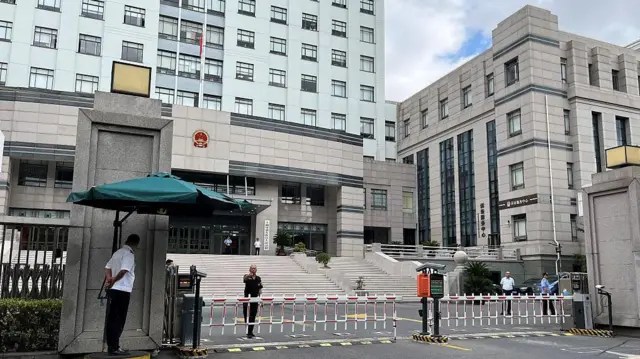
-- Secret Case Files
The CCP's illegal arrests and frame-ups of Falun Gong practitioners are always carried out furtively and evasively -- it would rather not notify lawyers, not notify family members, not post public notices of trial dates, and not allow any observers into the courtroom, conducting these black-box operations and secret sentencing. But through Falun Gong practitioners' continuous efforts to expose these cases internationally, some of these cases have had to go through the motions of legal procedure after all -- and it is precisely this "going through the motions" that has exposed every illegal act involved: illegal arrests, illegal searches of homes, illegal approvals of arrest, illegally blocking legitimate defense lawyers from taking part, denying defense counsel access to case files, illegal trials, illegal sentencing -- all of it illegal, every step of the way.
So what do these CCP judicial case files, buried deep in archive rooms, actually look like? During pretrial defense, appeals, and petitions for Falun Gong practitioners, defense lawyers requesting to review case files have been obstructed in every conceivable way -- some are allowed only to look but not to copy; some lawyers and family-member defenders are allowed to review the files, but only after signing a confidentiality agreement and being warned they will bear the consequences themselves. Such flagrantly illegal conduct itself proves, in reverse, that the files contain illegal records and serious problems too shameful to let anyone see. Today, we will piece together glimpses of these files from multiple angles -- the courtroom proceedings, the prosecutors, the presiding judges, the lawyers, the defendants, and their families -- and from these fragments, we can already determine the full picture.
I. The Many Forms of Illegality in the Case Files Exposed in Court
Example 1: The Facts Contradict the Search Record in the Case File
On the morning of October 17, 2024, at 9 a.m., the Xihu District Court in Benxi, Liaoning Province, held an illegal trial of Falun Gong practitioner Ms. Zhao Huijun; no verdict was announced that day. During the trial, a family-member defender presented a defense of innocence on Zhao Huijun's behalf, reading out a statement arguing her innocence; her lawyer likewise presented a well-reasoned defense of innocence, and pointed out in court the illegal conduct of Judge Wang Mian. The lawyer also noted that the prosecutor had misrepresented the indictment: the circumstances alleged in the indictment contradicted the materials in the case file itself. "Evidence" that the police had themselves separately collected was falsely written up as having been seized during a search of the defendant's residence -- contradicting the actual search record contained in the case file.
Example 2: Falsified Case Files, Forged Signatures
After Falun Gong practitioner Gong Yubo of Huludao published articles on overseas websites, he was tracked by the Cyber Security Division of the Shenyang Municipal Public Security Bureau and illegally detained for one year and four months. On May 18, 2023, he was wrongfully sentenced to four years and extorted for a 20,000-yuan fine. According to his lawyer's account: on August 1 and 2, 2022, the detention center refused to let Gong Yubo's lawyer visit him, violating the lawyer's right to visitation, claiming there were interrogations every day. Yet the case file used to persecute him contains no interrogation records for August 1 or August 2 -- only records for August 3 and August 5. The case file was falsified. During the illegal search of his home, village party secretary Wang Shufeng was not even present, yet the file contains his signature and fingerprint, which were forged after the fact.
Example 3: Case Handlers Illegally Served as Witnesses
Zhang Juhong, a Falun Gong practitioner from Guiyang, Guizhou, was subjected to an illegal trial at the Huaxi District Court on February 13, 2018, lasting nearly three hours, from 9:30 a.m. to past noon. First, prosecutor Zhao Tingsong of the Huaxi District Procuratorate -- who had also been the case handler at the procuratorate stage of Zhang Juhong's case -- read out a thick stack of "Decision to Amend the Indictment," taking more than twenty minutes to finish reading nothing but nonsense, empty phrases, and lies. The "Decision to Amend the Indictment" listed two so-called items of "criminal evidence," and the defense lawyer demanded that prosecutor Zhao Tingsong present the witnesses and the "evidence." Presiding judge Zhang Decai rapped the table and called the witnesses in. The witnesses were Luo Jisong and Chen Donghao, deputy chief and officer of the Sanjiang police station -- who had also been the case handlers at the police investigation stage of Zhang Juhong's case. Can case handlers themselves serve as witnesses?
Example 4: An Illegal Trial Was Held Even Though Neither the Case File nor the Bill of Indictment Reflected Any Record of Illegal Conduct by the Defendant
From 2:30 to 7:30 p.m. on June 1, 2023, Yu Hongying was subjected to an illegal trial at the Xichang Municipal Court in Sichuan Province. Yu Hongying's two lawyers presented a legal defense of innocence. During their defense, the prosecutor repeatedly interrupted them by prompting the presiding judge to cut them off, but the lawyers continued arguing on solid legal grounds, demonstrating that Yu Hongying had committed no crime and was not a "repeat offender" of any kind, hoping the judge would use his conscience to discern right from wrong. The lawyers asked: what loss, exactly, had Yu Hongying's conduct caused to society, to the state, or to the interests of any other person? Neither the case file nor the bill of indictment reflected any such loss whatsoever. On the contrary, the case file itself recorded Yu Hongying's own statement that she practiced Falun Gong simply for the sake of her health.
The lawyers also said that the "prisoner" standing in the defendant's dock today might be tomorrow's hero, while those wielding public power today might themselves be standing in that same dock tomorrow... The lawyers' remarks were once again cut off by the presiding judge.
Example 5: The Case File Does Not Record the Actual Circumstances at the Time, but Adds Content Arbitrarily
On the evening of December 3, 2015, more than twenty police officers suddenly burst into the home of Liu Qingyang in Panyu, Guangzhou. Without a search warrant, they tricked the family into opening the door, and using Liu Qingyang's internet use as a pretext, slapped on him the label of "colluding with hostile foreign forces," then forcibly took him away.
During the trial, the lawyer pointed out that the case handlers were suspected of illegally breaking into a private residence and coercing witnesses, and demanded that the officers involved and the coerced witnesses appear in court for cross-examination. A few days after the hearing, the court, apparently guilty of a bad conscience, notified the lawyer that he could review the case file -- and this time, a search warrant that had never previously existed in the file suddenly "appeared," complete with the "signature of the handling officer" and an "explanatory note" claiming it had already been read aloud to Liu Qingyang at the time, and, as an unnecessary flourish, a supplementary explanation stating that the search warrant had been logged and issued by the police system. Regarding the police's illegal break-in at the time, Liu Qingyang had already stated clearly in court: "There was no search warrant." At the time, Liu Qingyang's wife, father-in-law, and mother-in-law were all present at home, and they too told the lawyer: "No search warrant was shown, and none was ever read aloud." This was a case of the police, the procuratorate, and the court colluding together in violation of the law to frame Liu Qingyang.
Example 6: The Case File Contains Inconsistencies in the Names of Law Enforcement Officers Between the Search Warrant, the Search Record, and the Seizure Record
The Qingyang District Court in Chengdu, Sichuan Province, held four illegal trials between July 9 and July 29, 2013, against Falun Gong practitioners Xiao Hongming, Yang Yan, and Li Bei. The lawyers presented well-reasoned and forceful defenses of innocence on behalf of the defendants, leaving the prosecutor speechless and unable to produce any so-called "basis" for the charges. The lawyers pointed out that the names of the law enforcement officers listed in the search warrant, the search record, and the seizure record in the case file did not match one another; the search warrant did not indicate the time of the search; the person authorizing the search had not signed either the search record or the seizure record; the search warrant listed only two names, yet more than a dozen people actually took part in the search; the defendant himself was downstairs at the time but was not allowed to witness the search in person, nor was he later allowed to examine, identify, or sign off on the seized items; the photographs provided bore no timestamps and depicted an entirely different setting from the actual scene, suggesting they were taken afterward and should not be credited as evidence... The lawyers pointed out that physical evidence obtained through such an illegal search could not establish the relevance or authenticity of this so-called "evidence."
Example 7: Police Officer Guo Tiejun Was Caught in Court Giving False Testimony in the Case File
Yang Jiangwei, a Falun Gong practitioner from Suizhong County, Huludao City, Liaoning Province, was subjected to yet another illegal trial at the Lianshan District Court in Huludao on December 26, 2024, with Zhang Xiaojin as prosecutor and Wang Yueqiu as judge. A Beijing lawyer and Yang Jiangwei's sister appeared in court as his defenders. The lawyer pointed out that the content of the indictment did not match the facts, and that police officer Guo Tiejun and witness Liu Huan had given false testimony. The indictment claimed that the adhesive sticker Yang Jiangwei had put up read "Falun Dafa is good," but in fact, what Yang had put up read "Truthfulness-Compassion-Forbearance is good" -- and upon spotting Guo Tiejun approaching, Yang tore it down and crumpled it into a ball in his hand (as confirmed by a photograph in the case file, in which one character is still visible on the crumpled paper). At the time Guo Tiejun arrested Yang Jiangwei, there was no sticker on the utility pole at all. Yet the photograph in the case file shows a sticker reading "Falun Dafa is good" affixed to the utility pole -- a forgery. It is unclear how case handler Guo Tiejun managed to fabricate this scene. If Guo Tiejun himself put up the sticker, then does putting up Falun Gong-related material become legal simply because he did it, while illegal for anyone else? (In fact, even putting up a sticker reading "Falun Dafa is good" is not illegal at all -- it is simply a fact borne out by the experience of hundreds of millions of people between 1992 and 1999.)
Officer Guo Tiejun of the Gaoling Township police station in Suizhong County was caught in court giving false testimony in the case file. When the lawyer demanded that Guo Tiejun and the other witness, Liu Huan, appear in court, presiding judge Wang Yueqiu declared a "recess" and said the trial would "resume on another date."
Example 8: The Case File Contains Numerous Instances and Points of Suspicion Involving Deliberately Fabricated Evidence
Tian Liping, a 62-year-old Falun Gong practitioner in Shenyang, Liaoning Province, was abducted and detained by police from the Heping District Public Security Sub-bureau of Shenyang in March 2024, and was illegally sentenced to four years by the Hunnan District Court of Shenyang on September 24, 2024. During the trial, the defense counsel pointed out in court that the police had, to this day, never issued her family any relevant legal documentation whatsoever. Repeated attempts by the family to communicate were rebuffed every time -- and yet the "Notice of Arrest" in the case file blatantly states that "this notice has been received," complete with a forged family signature. The case file also contains numerous other instances and points of suspicion involving deliberately fabricated evidence, including: the case acceptance registration form, the case filing decision, the source of the case, the account of the arrest, the investigation report, the work report, the search warrant, the search record, the seizure decision, the seizure inventory, and photographs of the seized items -- all of which constitute evidence of the police's own criminal, illegal conduct in handling the case.
Example 9: Nearly Every Page of the Case File Contains Fabricated, Falsified, and Framed Content
On July 17, 2024, Shenyang Falun Gong practitioner Zhang Xinyue was framed with fabricated materials by domestic-security police from the Dadong District Sub-bureau of the Shenyang Municipal Public Security Bureau and police from the Ertaizi police station, and referred to the Dadong District Procuratorate; a few days later, she was framed and referred by the Dadong District Procuratorate to the Dadong District Court. After this, Zhang Xinyue's defense counsel reviewed the case file multiple times, and upon verifying the details with Zhang Xinyue, discovered that all of the content of the charges the defense counsel had seen had been fabricated and falsified -- nearly every single page of the case file contained material fabricated and framed by the domestic-security and Ertaizi police station officers. It can be seen in the case file that the procuratorate had the domestic-security officers remove a few instances of false testimony, but under pressure, the court nonetheless continued attempting to push the prosecution forward.
Example 10: The Content of the Confession Records in the Case File Was Written Up by the Handling Police Officers Themselves, and the Defendant Was Simply Made to Sign
Mo Xinzhong, a 55-year-old Falun Gong practitioner from Mozhuang Village, Zhaozhuang Town, Xiajin County, Dezhou, Shandong Province, was abducted along with his wife on February 9, 2020, by the domestic-security squad of the neighboring Gaotang County Public Security Bureau in Liaocheng and police from the Gaotang County Jiangdian police station. Mo Xinzhong was then held illegally at the Gaotang County Detention Center.
During the trial, the lawyer pointed out in the defense that the evidence obtained by the Gaotang County domestic-security police and the police station was obtained in violation of statutory procedure, and could not be used as a basis for establishing that Mo Xinzhong had committed a crime. On the night of February 9, 2020, Gaotang County domestic-security police and Jiangdian police station officers illegally broke into his home and searched it without ever showing Mo Xinzhong a search warrant or an arrest warrant, and abducted him to the Jiangdian police station; only on the morning of the 10th did police at the station finally show Mo Xinzhong an arrest warrant. The case file does not even specify the exact time at which the arrest warrant was shown to Mo Xinzhong.
The lawyer also pointed out that it was quite obvious that the defendant's confession recorded in the case file was neither objective nor truthful -- the content of Mo Xinzhong's confession record had all been written up beforehand by the handling police officers themselves, who then simply had the defendant sign it. Mo Xinzhong himself said: the police never let him read the record they had written up -- the police simply told him to sign it, and under pressure and given the circumstances at the time, he had no choice but to sign.
Example 11: The Lawyer and the Defendant Exposed in Court How the Prosecutor's Case File Records Were Fabricated to Frame Them
On April 2, 2021, the Hejiang County Court in Luzhou, Sichuan Province, held a trial of four Falun Gong practitioners -- Li Shifang, Dai Qunying, Jian Hongmei, and Liu Kaisheng. Their lawyer dismantled the fabricated evidence used to frame them:
1. The prosecutor alleged that the defendants had distributed materials amounting, when converted, to more than 800 leaflets, and claimed six witnesses could confirm this. Yet not a single one of these six witnesses appeared in court to testify. The lawyer noted that, judging from the witness statements in the case file, these witnesses were present at the scene when the four defendants were arrested, and it was only then that they came to recognize the four; when later asked to identify them and shown the confiscated materials, they naturally said, "Yes, it was these four who did it" (by ordinary logic, one could round up as many such "witnesses" as needed -- they could even be bought with money).
2. The prosecutor claimed that the four defendants had all "identified" one another -- referring to police records showing that Liu Kaisheng had identified Dai Qunying, and Dai Qunying had likewise identified Liu Kaisheng, and so on, with all of them "identifying" each other. The lawyer noted that the four already knew one another to begin with, so recognizing who someone is merely shows that they know each other -- it does not at all prove that this person went out and distributed any materials.
3. Jian Hongmei elaborated further on this "identification" process, exposing in court exactly how the police had exploited this identification procedure to fabricate evidence. She said the police simply showed her photographs and asked, "Isn't this Liu Kaisheng? Isn't this Dai Qunying?" -- and she truthfully answered, "Yes." Yet in their written record, this became: they went out together and distributed leaflet materials.
From what Jian Hongmei exposed, it is clear that the police quietly substituted a simple identification of who a person is for a confirmation of what that person had done -- completely distorting the true nature of the matter. They played this same trick on each of the defendants, and after making the rounds, it produced a bizarre loop in which each defendant appeared to "identify" all the others. This gave the police something to point to: "Look, they've all named you themselves." This is precisely the cunning, deceitful mode of thinking that CCP judicial personnel have developed under the poisonous influence of the evil Party's culture of falsehood, malice, and struggle -- and yet another of its evil tricks of substituting concepts and fabricating frame-ups.
II. The So-Called Evidence Provided by the Prosecution Itself Proves Precisely the Illegal Conduct Recorded in the Case File
Example 1: Presenting Video Footage in Which the Defendant Was Not Even Present to Make Arbitrary Accusations, With Witness Testimony That Does Not Match the Facts
Starting April 23, 2021, Zhou Deyong, a senior geological engineer at Shengli Oilfield in Dongying, Shandong Province, and a Falun Gong practitioner, was abducted and illegally detained for two years, and was subjected to three illegal trials by the Dongying District Court. Throughout the entire trial process, the prosecutor put forward witness testimony that gravely contradicted the facts; presented video footage in which the defendant was not even present to make arbitrary accusations; and brazenly fabricated so-called evidence bearing Zhou Deyong's forged signature. The trial process, moreover, lacked any real defense by counsel, was conducted in an arbitrary and heavy-handed manner, was severely lacking in witness testimony, and the charges themselves were absurd and laughable -- the prosecutor acted with total impunity, and the illegalities involved were shocking to behold. Under these circumstances, the judge nonetheless illegally sentenced Zhou Deyong to eight years and extorted a fine of 100,000 yuan.
Example 2: Numerous Instances of Police Illegality Discovered in the Video Footage Provided by the Prosecutor
Dai Yajuan, a Falun Gong practitioner in Anshan, Liaoning Province, was subjected to two illegal trials at the Tiedong District Court in Anshan. At the second illegal trial on November 22, 2016, the so-called criminal evidence the prosecutor provided was a video recording of a search. Examining this footage the prosecutor provided in its entirety, we found that, far from proving Dai Yajuan's guilt, the video instead demonstrated precisely the illegality of the police's own conduct in handling the case, and the falseness of the evidence provided.
1. The investigating officers did not present any relevant documentation or identification when conducting the search;
2. In the video, apart from Dai Yajuan and two others, everyone present was a law enforcement officer -- not a single one of them was the "witness" recorded in the search record;
3. During the search, Dai Yajuan was kept confined to the bedroom the entire time; by the moment the footage returns to the bedroom at 10:41, Dai Yajuan and the other two are nowhere to be seen -- meaning Dai Yajuan did not witness the search process at all;
4. The video shows no on-the-spot inventory of seized items and no record of the search being taken; Dai Yajuan herself stated in court that she had no idea where the pile of books shown on the bed in the video had even come from;
5. The video shows numerous books and items entirely unrelated to the case, such as communications technology manuals and beginner's computer guides; the defense counsel does not know whether such items were even counted among the "evidence."
This video footage indisputably confirms that the method of evidence-gathering in this case was seriously illegal, meaning that all evidence collected this way lacks any legal validity and cannot serve as admissible evidence; and since the process by which the search record in the case file was produced is unclear, its content cannot be considered authentic! As for which items seized belonged to Dai Yajuan's own personal use and which did not, neither the video, the search record, nor the seizure inventory made any such distinction -- everything was simply bundled together as one, and the purpose behind doing so is self-evident! Even if all these items and books did belong to Dai Yajuan, possessing them would have been entirely legal regardless.
Example 3: The Prosecutor Arbitrarily Edited the Video Footage, Brazenly Falsifying Evidence
At 2 p.m. on December 19, 2022, 60-year-old Ms. Lin Jianping walked into the courtroom of the Qixia Municipal Court, and found that the entire courtroom held no observers at all -- only the judge, two lay assessors, a court clerk, and two prosecutors. Lin Jianping asked: "Judge, is today's trial open to the public, or closed?" The judge replied: "It's open." Lin Jianping asked: "Then why is not a single witness or guarantor present? Did you notify them and they simply didn't come, or did you never notify them at all?" The judge replied: "People come if they want to -- if there's no need, they don't have to come."
The judge had the clerk play the video footage the prosecutor provided of Lin Jianping being illegally framed and taken to the Zhuangyuan police station. Although the footage in which Lin Jianping was telling people the truth, along with other important segments, had been edited out of the disc, one could still see from what remained: Lin Jianping was handcuffed at the time she was illegally framed, and she asked the police to show the legal basis for her unlawful detention -- which the police were never able to produce.
Another segment showed Zhuangyuan police station officers, who had gone to search her home in the middle of the night, forcing Lin Jianping's husband to summon the neighbor across the hall to serve as a witness. At the time, Lin Jianping's husband, not wanting to disturb the neighbor's rest, hesitated -- so the police threatened him, saying: "If you won't go call them, we'll call security instead." (These police, even while looting someone's home, still needed a witness -- outdoing even common bandits.) Yet another segment showed Lin Jianping simply sitting on a bench at the Zhuangyuan police station, sending forth righteous thoughts.
What is laughable is that the case file states: during the home search, Lin Jianping was present at the scene and was asked to sign the inventory, but refused to sign. The fabrications of the Qixia police and prosecutors, framing an innocent good person, were thus exposed for all to see.
In court, Lin Jianping asked the prosecutor with a smile: did you edit this video yourself? The prosecutor said nothing. Lin Jianping asked the judge: why not play the footage of the items seized from my home? The judge replied: "The prosecutor only brought this footage."
After submitting her written defense, Lin Jianping made the following statement:
This is a thoroughly fabricated frame-up from start to finish. In both the indictment and the case file, without any legal basis whatsoever, there has been further dereliction of duty, abuse of power, and outright fraud:
1) My date of birth is wrong. I was born on July 23, 1962; the indictment lists July 23, 1960. It was only corrected by the prosecutor during the trial, at the judge's prompting.
2) My level of education is wrong. I hold a junior college degree; the indictment lists middle school.
3) The interrogation record is fake. The young male police officer taking the record handed me a sheet of paper stating that I had "read it for three minutes and understood it clearly." I said: "I haven't even read it yet -- how can it already say I understood it? Isn't this fabrication?" I therefore refused to have a record taken. Afterward, this young officer spent a long time typing something on his computer by himself, then, without ever letting me see it, had my husband -- who had no idea what any of it said -- sign it.
4) The female officer said to have taken the record is fake. The person who actually took the record at the time was a young male officer. Yet the case file states that a female officer named "Zou Yunna" took my record, asking questions and receiving answers from me. I never cooperated when that young male officer took the record -- so how could I possibly have cooperated with some female officer named "Zou Yunna"? Moreover, from the afternoon of the sixth day of the Lunar New Year in 2022, when I was illegally framed and taken to the Zhuangyuan police station, throughout the entire process I never once saw a single female officer. When I needed to use the restroom, a male officer said they would find a woman to accompany me, and made me wait a good while -- but no woman was ever found, and in the end it was a male officer who stood outside the restroom keeping watch while I went in.
5) The claim that I was present during the home search is fake. It was already the middle of the night at that point, and I was being illegally detained at the Zhuangyuan police station. All I heard was someone say: they were going out on a call, and someone should keep watch over me. I later heard from my husband that the police forced him to open the door, and then in the middle of the night forced him to knock on the neighbor's door across the hall, coercing the neighbor into serving as a so-called witness to this illegal search, even threatening my husband that if he didn't cooperate, they would go call in the security office. To this day, whenever my neighbor recalls the scene of so many police officers bursting into my home, they still say with lingering fear: "My God, that was terrifying."
6) My so-called confession and statements are fake. All I ever did was tell them the truth about Falun Gong's persecution: I asked them to show the legal basis for illegally detaining me, explained that no national law designates Falun Gong an "evil cult," that there is no legal basis whatsoever for persecuting Falun Gong, told them the "Tiananmen self-immolation" incident was staged, and told them that persecuting good people will bring retribution.
7) The so-called "certification" within the "expert opinion" is utterly absurd. This so-called "certification" does not even bear the name of whoever supposedly certified it, nor any credentials whatsoever. Any valid expert opinion must be signed by the person who issued it -- and this basic requirement is entirely missing. And in any case, Falun Gong is not an evil cult at all, and everything related to Falun Gong is entirely legal.
8) The claim in the case file that I was given a urine test to check for drug use is fake. No one ever administered any such urine test to me at all -- the police signatures in the case file are forged, and the certificates included are nothing but window dressing.
From the police investigation, to the procuratorate's indictment, to today's court trial, the entire process has been illegal from start to finish -- it has damaged my reputation, seized my legally owned personal property, disturbed public order, disrupted the lives of local residents, terrified my family and neighbors, wasted a tremendous amount of my energy, seriously harmed my own health and that of my family, and caused all my relatives no end of worry, affecting the work and lives of my family members to varying degrees.
III. The Presiding Judge's Own Questioning Gave the Game Away
Example 1: Falun Gong Practitioners Having a Meal Together Also Became Grounds for a Prison Sentence
Wang Shengli, 80, a retired propaganda department head from Fuyang, Anhui, suffered repeated torment and persecution amid the CCP's crackdown on Falun Gong, yet, unmoved even by a monthly salary of several thousand yuan offered to make him renounce his faith, remained steadfast in his belief and continued practicing. Around 7 p.m. on the evening of December 5, 2010, Wang Shengli was sharing a meal with eight other Falun Gong practitioners when they were abducted by the domestic security and public security bureaus of Linquan, Fuyang, and framed as a so-called "case of nine."
When the presiding judge asked: nowhere in the entire case file is there any proof that these nine people held an illegal gathering -- all we see is testimony from multiple people that they simply went to have a meal together -- why is this being treated as an illegal gathering? The prosecutor was speechless for several minutes, and under repeated questioning from the presiding judge, finally muttered: "Eating together also counts as a gathering..." Wang Shengli was wrongfully sentenced to three years. In other words, simply eating a meal together had become grounds for a prison sentence.
IV. Instances of Fabrication and Frame-Up Discovered by Lawyers Reviewing Case Files
Example 1: A Senior Engineer in Guangzhou Framed by the Police, Procuratorate, and Court -- Interrogation Records and Expert Findings Both Falsified
On July 10, 2019, Zeng Jiageng, then 76 years old, was abducted while out on an errand by officers from the Second Investigation Squad of the Public Transportation Sub-bureau of the Guangzhou Municipal Public Security Bureau, and is currently held illegally at the Haizhu District Detention Center. Zeng Jiageng was framed by the handling police officers, procuratorate, and court personnel, and was subjected to two illegal trials. His lawyer and family filed complaints and accusations against the relevant personnel with multiple police, procuratorate, and court departments. To make their so-called evidence stick, handling officers Pan Yan'e, Chen Zhonghao, Li Jinlin, and Liu Cimin fabricated interrogation records while Zeng Jiageng refused to cooperate with the illegal interrogation and refused to answer any questions. After carefully comparing the illegal interrogation footage against the written record, the lawyer confirmed that the handling officers had falsified the record, and filed a complaint and accusation with the Guangzhou Municipal Procuratorate and the Guangzhou Municipal Public Security Bureau.
Example 2: The Mysterious "Special Informant" in the Case File Turned Out to Be a Petty Thief
Ms. Zhu Surong, now in her forties, was a village-run teacher at Zhongmengchang Elementary School in Dongmengchang Village, Baoxu Township, Li County, Baoding, Hebei Province. Zhu Surong was a model of virtue and kindness. Yet this very good person, simply for cultivating her heart toward goodness, was abducted, detained, and framed. Even more baffling is that in October 2019, Zhu Surong was illegally arrested as the result of a malicious accusation lodged by a petty thief.
In the so-called case file used to frame Zhu Surong, there appears a mysterious figure identified only as a "special informant." During the trial, Zhu Surong's lawyer questioned this directly: "The source of this case is unclear. The Case Source Explanation, the Case Acceptance Registration Form, the Application for Approval of Arrest, and the Bill of Indictment all state that 'a lead was received from a special informant indicating that anti-propaganda materials were stored at Zhu Surong's residence.' Who is this 'special informant'? Why does this person not appear anywhere in the case materials at all? How did this 'special informant' discover this? Why is there no record of any report made to police? If this case was based on a tip from a special informant, then why does the Case Acceptance Registration Form list the source of the case as 'discovered during the course of work'? Was this case actually a matter of a 'tip from a special informant,' or 'discovered during the course of work'?"
Indeed -- who was this "special informant," and how did he come to discover that Falun Gong materials were in Zhu Surong's home? This "special informant" was, in fact, nothing but a petty thief -- a man in his thirties from the same village as Zhu Surong. He habitually loafed about doing nothing productive, indulging in idleness and petty theft. After his ex-wife divorced him, he sank even further into self-destructive behavior, and even his own family had grown disappointed in him and no longer bothered to keep him in line. The day before Zhu Surong was abducted, this thief stole her electric bicycle -- and while stealing it, he noticed Falun Gong materials in her home. After the bike was stolen, Zhu Surong could well have guessed who the thief was. But being kind-hearted, and considering him a fellow villager, she took pity on his circumstances and chose not to hold it against him, never reporting him to the police. Yet this man repaid kindness with malice, betraying decency for personal gain -- in order to collect the small reward for informing, he turned around and maliciously reported Zhu Surong instead.
Example 3: Neither the Interrogation Records nor the Item Inventory Were in Electronic Form, and the Case File Itself Was Not Sealed -- All in Violation of the Law
Wu Yanhua, Guan Xingtao, and Du Yecheng, Falun Gong practitioners in the High-Tech Zone of Daqing, were abducted and illegally detained for more than a year, and were subjected to an illegal trial at the Ranghulu District Court of Daqing on August 12, 2019. The prosecutor framed the three Falun Gong practitioners with a patched-together case file of more than a hundred pages, containing nothing but books, cell phones, computers, and other personal belongings that the three legally owned and that should have been protected under the law.
In his courtroom defense, Wu Yanhua's lawyer spoke clearly and forcefully, first affirming that Wu Yanhua was innocent, then addressing, one by one, how the prosecutor's so-called "materials" failed to uncover anything proving she had committed any crime -- and moreover, that neither the interrogation records nor the item inventory were in electronic form, and that the case file itself was not sealed, both of which were violations of the law. As for the charge that Wu Yanhua had "used an evil-cult organization to undermine the implementation of the law," which law, exactly, had she undermined? The lawyer cited exactly how many articles existed in the relevant laws, sufficient to demonstrate that an ordinary citizen could never possibly undermine the implementation of the nation's laws to begin with -- only someone who wielded public power could ever actually undermine the implementation of the law.
Yet Guan Xingtao was illegally sentenced to eight years, Wu Yanhua to seven years and six months, and Du Yecheng to seven years.
Example 4: The Case File Described Ten Days Wang Desheng Spent Strapped to a "Tiger Bench" at a Police-Dog Training Base as "Residential Surveillance"
On August 11, 2016, the Dawukou District Court in Shizuishan, Ningxia, held an illegal trial of Wang Desheng and his wife. At the hearing, the lead defense attorney, Lawyer Zhao, pointed out that the witnesses named in the indictment were fabricated, that the appraisal results of the so-called evidence were invalid, and demanded that the "evidence" be presented. The prosecutor first claimed the contraband could not be displayed, then claimed it had already been burned. Yet, at the very same time, in another dedicated room, "610 Office" personnel in Dawukou were showing off their "trophies" -- large quantities of personal items, including looted materials exposing the truth about Falun Gong -- to visiting officials of every rank.
Wang Desheng exposed in court the persecution he suffered after being abducted by domestic-security personnel. The prosecutor argued sophistically: "We never let the police dogs bite you, the dogs never hurt you," and so on! Yet the lawyer, reviewing the procuratorate's case file, found that it blatantly described the ten days Wang Desheng spent strapped to a "tiger bench" at a police-dog training base as "residential surveillance."
Example 5: The Case File Contains a Secret Sub-File the Lawyer Was Refused Access To
Ma Minqing, a Falun Gong practitioner in Yuexiu District, Guangzhou, was jointly abducted at midday on July 9, 2019, while waiting at a bus stop near Yuexiu Park close to his home, by officers from the Second Criminal Investigation Squad of the Public Transportation Sub-bureau of the Guangzhou Municipal Public Security Bureau and police from the Huangsha subway station police station. When reviewing the case file, the lawyer discovered that Ma Minqing's file contained a secret sub-file, which both the Haizhu District Procuratorate and the court refused to let the lawyer review. On December 20, 2021, Ma Minqing was illegally sentenced by the Haizhu District Court to seven years and six months, and extorted for a fine of 10,000 yuan.
Example 6: A Verdict Document With No Case Number
On June 30, 2016, Zhang Jihong was illegally sentenced by the Suizhong County Court in Huludao, Liaoning Province, to two years, with a 5,000-yuan fine. On July 1, Zhang Jihong's lawyer called Judge Guan Shusen, who lied and claimed "the verdict hasn't been issued yet"; the lawyer only learned of the verdict after meeting with Zhang Jihong himself. Zhang Jihong's lawyer then submitted a notice of appeal to the Suizhong court.
The Suizhong County Court held a hearing on June 20 for Falun Gong practitioner Zhang Jihong, who had already gone on a 33-day hunger strike in protest of his illegal detention, and his lawyer presented a defense of innocence. The lawyer pointed out numerous holes in the prosecutor's roughly twenty-page case file. The "case" used to frame Zhang Jihong did not even carry a case number, and looking at the verdict document as a whole, one finds no trace of Chinese law's stated principle of "equality between prosecution and defense."
Example 7: Secret Sentencing, With the Case File Omitting the Lawyer's Defense Statement
On June 3, 2013, Li Wei, on his way to work at Broadway in Changchun, was abducted by domestic-security officer Gao Jun of the Changchun Municipal Public Security Bureau, Pan Gaofeng, and several other abusive police officers, while at the same time officers from the Changchun Economic and Technological Development Zone Public Security Sub-bureau illegally searched Li Wei's home. Despite his family inquiring at the Changchun Economic Development Zone Court almost daily, the relevant personnel refused to show themselves or answer the phone; the court neither informed the family of the case details or trial date, nor posted any public notice, and gave no response whatsoever to the family's request to bring in a lawyer. It was not until December 11, 2013 that the family learned from a lawyer that Li Wei had already been given an illegal, secret trial by the Economic Development Zone Court the previous day, December 10, 2013 -- a trial that lasted only ten minutes. At the time, Li Wei was in an extremely weakened physical state, his vision blurred, his consciousness clouded; after the ten-minute trial ended, Li Wei was carried back to the No. 3 Detention Center, where he remained unconscious and vomiting for an entire day.
On December 12, 2013, the Changchun Economic and Technological Development Zone Court issued an unjust verdict based on this secret trial. Li Wei, refusing to accept it, filed an appeal. Over a period of nearly four months, the Changchun Intermediate Court questioned appellant Li Wei only once, on January 17, 2014, at which point Li Wei requested a fingerprint comparison of the evidence and asked that his family be allowed to retain a lawyer once again. Intermediate court judge Zheng Wei accepted the lawyer's credentials on February 14, 2014, and allowed him to review the case file. The lawyer then presented a defense of innocence based on the facts and evidentiary materials and submitted a written defense statement, also requesting an open trial. The judge ignored the defense lawyer's opinions entirely -- the ruling document did not record the lawyer's defense opinion at all, nor was it even placed into the case file, treating the second-instance proceeding as though no lawyer had ever been involved, brazenly depriving the lawyer of his right to defend his client. Turning a blind eye to the illegality of the first-instance proceedings, the court issued a ruling upholding the original illegal verdict, one riddled with obvious fabrication -- the ruling document was dated April 4, 2014, yet the case file contained a notice, never actually posted, claiming a trial would be held on April 9, dated April 5, 2014 -- meaning no open trial was ever actually held at all.
Example 8: The Illegal Supplementary Material -- a "Circumstances Explanation"
On the morning of February 12, 2014, the Xinshi District Court and the Xinshi District Procuratorate in Baoding secretly held a trial of Falun Gong practitioner Kong Hongyun at the Baoding Detention Center. As the Beijing lawyer refuted the so-called "evidence" point by point, none of the so-called "facts" fabricated by the police station and the Public Security Bureau could hold up. In the end, the court announced a recess at 11:30 a.m., citing insufficient evidence.
In early June 2014, the Xinshi District Court in Baoding called the lawyer to notify him that a second hearing was scheduled for the morning of June 11. The lawyer demanded to know: why do you always hold hearings inside the detention center, instead of in a proper courtroom -- is it Kong Hongyun who can't be seen in public, or is it you? This righteous challenge left the judge speechless. On June 5, the case file gained a new "circumstances explanation" concerning witnesses being unable to appear in court -- an explanation not signed by any witness at all, but bearing the signatures of police station chief Hou Rubo and deputy chief Chen Yu instead. Moreover, this "circumstances explanation" should have been the supplementary material submitted after the case file was returned for insufficient evidence following the first hearing. According to Article 268 of the Criminal Procedure Law, governing time limits for supplementary investigation, a case returned to the public security organs for supplementary investigation must have that investigation completed within one month. By law, then, this material should have been supplemented no later than March 12 -- otherwise it would be invalid. Yet the procuratorate still included it in the case file regardless, a clearly illegal act. This time, the case was once again returned for insufficient evidence, and the procuratorate submitted yet another "request to postpone the trial" to the court.
V. Instances of Case File Fabrication Provided by Falun Gong Practitioners and Their Families
Example 1: A Falsified "Inspection Record"
Chen Jing, a 42-year-old Falun Gong practitioner from Jiamusi, Heilongjiang, was subjected to brutal persecution by the CCP for holding fast to her belief in Truthfulness, Compassion, and Forbearance and refusing so-called "transformation." The following is Ms. Chen Jing's own account:
On the afternoon of January 21, 2016, Yang Bo and two others from the Heilongjiang Provincial Public Security Department's Anti-Cult Task Force, Li Zhongyi and Liang Huawei from the Jiamusi Municipal Public Security Bureau's Anti-Cult Division, and Zhang Weiming, Li Qiang, Wu Bin, and Zhang Jia from the Jiamusi Suburban District Public Security Bureau -- more than a dozen people in total, arriving in about three or four white SUVs -- "lay in wait" outside the entrance to my residential compound and forcibly abducted me the moment I stepped outside. These people had already searched my home that same afternoon of January 21, and I myself had been held in continuous detention from the afternoon of January 21, 2016 onward. Yet the "Inspection Record" in the case file falsely states: "From 8:30 to 9:30 a.m. on January 22, 2016, a search was conducted of the above-named person's residence; the person being inspected cooperated with the inspection and raised no objections to the inspection activities."
Example 2: The Case File Erased All Record of Jin Yijun's Administrative Litigation Trial
Jin Yijun, female, 47, a Falun Gong practitioner in Qilihe District, Lanzhou, Gansu Province, formerly a legal worker at a Lanzhou law firm, has had her professional license renewal refused by the Lanzhou Municipal Justice Bureau every year since 2013, continuing to this day. On November 7, 2011, Jin Yijun was abducted outside the gate of her own residential compound by officers from Division 26 of the Lanzhou Municipal Public Security Bureau and illegally sentenced to one year of re-education through labor. Jin Yijun lawfully filed an application for administrative reconsideration, but the Gansu Provincial Re-education Through Labor Committee upheld the original decision. Jin Yijun then lawfully filed an administrative lawsuit with the Chengguan District Court.
During the trial, the defense and statements presented by the lawyer and Jin Yijun herself, along with their cross-examination of the evidence, left the two staff members from the municipal bureau's legal affairs section who were present in court speechless, and made clear to every police officer present that the police had acted illegally and framed an innocent person -- Jin Yijun had been wrongfully arrested and then illegally sentenced to re-education through labor. But the Chengguan District Court, through labor camp police, pressured Jin Yijun to agree not to appeal once the court's ruling came down. Jin Yijun refused, insisting that if the court failed to uphold justice and issued an unlawful ruling, she would most certainly appeal according to law. As a result, the Chengguan court kept delaying its ruling indefinitely -- and by the time Jin Yijun's illegal term of re-education through labor had ended and she had returned home, the court, astonishingly, treated the case as automatically withdrawn on the grounds that she had twice failed to appear after being summoned, and erased the entire record of the actual trial proceedings from the case file. Staff at the court's archive room refused to provide Jin Yijun with copies of the case file materials -- meaning that after Jin Yijun had already been illegally sentenced to re-education through labor, court personnel then joined forces to strip her of her legal right to seek redress and defend her own rights.
Example 3: A Fabricated "Charge" Used to Frame Ms. Zhang Shanying
Ms. Zhang Shanying, 79, a Falun Gong practitioner in Hefei, Anhui, is a retired state-agency cadre living within the Hefei Municipal Party Committee compound. Simply for holding fast to her belief in Truthfulness, Compassion, and Forbearance, she has repeatedly been threatened and harassed by CCP personnel. In 2021, she was framed and referred to the procuratorate on a fabricated "charge" invented by the Xiaoyaojin police station. Ms. Zhang Shanying said: On the morning of April 25, 2022, the lawyer I had hired went to the procuratorate to retrieve my case file materials, and it was only then, to my utter shock, that I learned Xie Hanmin and Wu Bin, the officers in charge of handling my case at the Xiaoyaojin police station, had once again secretly manufactured two more unjust, false cases against me! These were fabricated entirely out of thin air. I was given two administrative detentions, yet not a single person from the Xiaoyaojin police station ever informed me of either one, nor did they ever give me any administrative penalty decision -- especially given that I have never once done anything illegal or in violation of any regulation?! The Xiaoyaojin police station and prosecutor Li Hui manufactured these unjust, false cases against me out of nothing, with absolutely no factual basis. These two administrative detentions are themselves evidence of your own illegal, criminal conduct -- and are precisely the kind of invalid evidence that ought to be excluded!
Example 4: A Person Who Was Not Even a Case Handler Privately Fabricated a So-Called Interrogation Record, Complete with Self-Posed Questions and Self-Supplied Answers
Hao Mingmei, a female teacher and Falun Gong practitioner in Daqing, Heilongjiang, was subjected to three illegal trials at the Ranghulu District Court within a single month, from November to December 2017, with the prosecutor abusing Article 300 of the Criminal Law to charge her with "using an evil-cult organization to undermine the implementation of the law" (when in truth it is the CCP itself that is the real evil cult undermining the implementation of the Constitution). Yet none of the three trials ever actually presented evidence, cross-examined, or argued this so-called "charge" itself -- instead, the prosecution built its case around files stored on Hao Mingmei's computer, hard drive, and USB flash drives, with the writing of articles and uploading them to the Minghui website becoming the primary basis for convicting and sentencing her.
The three trials fully exposed the tricks CCP police, procuratorate, and court personnel use to collude with one another in seeking revenge, framing people, and deceiving kind-hearted citizens. The third illegal trial mainly consisted of playing video footage -- surveillance recordings of Hao Mingmei's interrogations at the detention center were played in court. The footage of officers Yang Bo and Feng Haibo illegally interrogating Hao Mingmei five separate times was played, in fragments, for roughly two hours. Yet nowhere in this footage did one see Yang or Feng threatening Hao Mingmei with a pre-written interrogation record to force her to sign it -- instead, the footage repeatedly showed only moments where Hao Mingmei appeared to be "nodding in agreement." Finally, the judge asked the prosecutor: has it all been played? The prosecutor replied: all the "key points" have been played. What were these "key points"? They were the moments that could supposedly prove Hao Mingmei "admitted to writing" the material in question. The judge told Hao Mingmei: "We've also played the footage addressing the objections you raised -- none of what you claimed appears anywhere in the video." Hao Mingmei replied: "There's so much more that hasn't been played. There were five interrogation sessions in all -- the coercion, the leading questions, everything they said -- none of that has been played."
In fact, the video footage did contain some sounds and scenes of Feng and Yang threatening, intimidating, and leading her toward specific answers, but the judge and prosecutor simply claimed "that was just technique."
Hao Mingmei described the unplayed footage as follows:
"On April 6 and 7, 2017, Yang Bo and Feng Haibo interrogated me three times, working in tandem -- Yang played the false, ingratiating good cop luring me into a confession, while Feng played the bad cop applying pressure: 'You have to admit it -- if you don't confess, such-and-such will happen to you.' On April 8 and 9, they told me to think it over carefully, and said someone would come the following Monday (April 10) to take my formal statement. I asked: 'Why don't you two just take the statement yourselves?' They said: 'We don't have the authority to take statements. It has to be done by the unit handling the case.'"
"On the morning of April 10, Feng and Yang came again, this time bringing along a case handler named Wang Feiran, who looked utterly bewildered -- though physically present, he was purely a prop, doing nothing at all. Feng opened his laptop and simply read straight from an interrogation record he had already written up himself beforehand, in a question-and-answer format he had composed entirely on his own. Everything Feng Haibo read out from that record was pure fabrication -- he claimed I had attended some kind of Dafa gathering, that I had been reading Zhuan Falun at the time, that a fellow practitioner had come to invite me to a gathering, and so on. I told him: you're lying -- I never said any such thing, not once did I ever mention reading Zhuan Falun at home, so why are you lying? Feng also wrote that I had bought my computer at the Dewei Computer Mall, and I said I don't even know where I bought it, so why write that? He also fabricated numerous other far-fetched lies in the record, all designed specifically to incriminate me. When I objected, Feng snapped viciously: 'I've already got this recorded on video -- if you dare not confess, I'll burn it onto a disc.' I was so furious at that point that I broke down in tears in front of them."
In court, Hao Mingmei also discovered another forged record in the case file: the prosecutor had taken an interrogation record made by officer Chen Dongying of the Chengfeng sub-bureau during Hao Mingmei's abduction on April 20, 2016, and altered it to appear as an interrogation record from March 23, 2017. In other words, they had fabricated an entirely false record. Coincidentally, March 23 was exactly the day when every detention center and holding facility in Daqing began relocating, with all facilities placed under lockdown -- so how could any interrogation possibly have taken place that day? Neither the judge nor the prosecutor offered any answer to Hao Mingmei's questioning on this point.
The prosecutor's illegal indictment stated that Hao Mingmei had received an administrative detention for "disturbing public order" in 2016, and that being penalized twice within two years constituted a prior offense warranting an enhanced sentence. Her lawyer pointed out that, according to the case file itself, the two incidents were actually a single matter, and that in 2016 no criminal liability had been pursued against the defendant at all -- meaning there was no "prior offense" to speak of in the first place.
Yet Hao Mingmei had been abducted the previous year while simply waiting at the train station -- how could waiting to board a train possibly constitute "disturbing public order"? This time, she was abducted after police tricked their way into her home and lured her to open the door, only to have this reframed as "using an evil-cult organization to undermine the implementation of the law" to escalate the persecution against her. In truth, it was simply that articles exposing the facts of Yang Bo's and Feng Haibo's persecution of Dafa practitioners kept appearing on the overseas Minghui website, and they suspected Hao Mingmei was responsible, and so deliberately sought revenge against her. Both of Hao Mingmei's abductions were carried out under the direct instigation of Yang Bo and Feng Haibo.
Example 5: A Falsified Interrogation Record Used to Fabricate a Charge
Pei Zhonghua, male, over seventy years old, from Suizhong County, Huludao, Liaoning Province. In his younger years he had practiced martial arts, often got into fights, and caused damage to others' property; some people had even knelt to beg him to accept them as students. After taking up the practice of Falun Gong, he truly underwent what could be called a total transformation, casting off every bad habit and becoming a kind, gentle-faced old man.
On the afternoon of January 14, 2016, domestic-security officers led by Wang Baomin abducted Falun Gong practitioners Pei Zhonghua, Li Yujie, Ding Qingyan, and Yu Xiurong, and seized personal items from their homes, including Dafa books and portraits of Dafa's founder. During the abduction of the couple Pei Zhonghua and Li Yujie, Wang Baomin's subordinates once again struck the already 70-plus-year-old Pei Zhonghua. Yu Xiurong, tormented by the persecution, developed insufficient blood supply to her brain and had to have her daughter come pick her up after a phone call. Elderly Pei Zhonghua went on a hunger strike in protest, and the detention center, left with no other choice, finally granted him release on bail pending trial on grounds of "serious illness." He was later illegally sentenced to one year and extorted for a 5,000-yuan fine; at the trial, Wang Baomin drove away observers, ultimately allowing only five family members to attend. Pei Zhonghua appealed to the Huludao Intermediate Court, pointing out the fact that the case handlers from the Suizhong domestic-security squad had added a fabricated interrogation record to the case file as false testimony. Pei Zhonghua also retained a lawyer from Shandong, who presented a compelling defense of innocence. Because the appellate judge refused to hold an open hearing, the lawyer submitted a written statement of defense arguing innocence; in the end, the Huludao Intermediate Court illegally upheld the original verdict, and Pei Zhonghua was sent to be illegally detained at Shenyang No. 1 Prison.
Example 6: The Case File Concealed the Actual Time and Location of Yang Zhixiong's Initial Abduction
Yang Zhixiong, male, 48, had once studied at Hebei University of Economics and Business, and was formerly a reporter for Hebei's Legal Daily. In early October 2012, he took a job as a sales manager at an environmental protection company in Beijing, and was abducted less than a month after starting work. According to witnesses, at around 2 p.m. on November 3, more than a dozen police officers, some in uniform and some in plainclothes, drove unmarked black vehicles without license plates into the company's courtyard without presenting any identification whatsoever, and ransacked room after room. Witnesses then saw Yang Zhixiong being lifted up by two officers and dragged toward a vehicle; all of his belongings were completely looted, including his bedding, laptop computer, and every other personal item.
After Yang Zhixiong's family learned of his abduction, they went to the local police station in Beijing to inquire, and were told that Guo Junxue and Shi Guoqiang of Xiong County had taken Yang Zhixiong away. Yang's family found Guo Junxue at the domestic-security squad, but Guo flatly denied having abducted Yang Zhixiong at all. During this period, the family called Su Shiliang, deputy director of the Public Security Bureau, who also claimed to know nothing about the matter; they also went to Guo Xiangdong of the "610 Office," who likewise claimed ignorance. The family immediately sensed something suspicious about the whole affair. With no other option, the family went once more to the Shunyi police station in Beijing to confirm the matter, and this time they were told: here is a photocopy of Guo Junxue's work ID, proving that it was indeed Guo who had abducted Yang Zhixiong. By that point, Yang Zhixiong had already been forcibly disappeared for a full month. As this case continued to be exposed on the international internet, it drew the attention of the World Organization to Investigate the Persecution of Falun Gong. On December 3, the family once again confronted Guo Junxue, who this time admitted that he himself had abducted Yang -- but would not say specifically where he was being held, and claimed that the entire operation had been ordered by Guo Xiangdong. Throughout this entire period, the family never received any formal notification whatsoever from the police.
On December 10, the family suddenly received a notice stating that Yang Zhixiong had been illegally placed under criminal detention on December 9. Yet the case file the domestic-security squad provided to the procuratorate concealed the criminal fact that Yang Zhixiong had actually been abducted back on November 3, and gave no indication of where he had been illegally detained in the meantime. Why was this omitted? Did the Public Security Bureau itself know full well that it had been acting illegally from the very start? If so, was the abduction and detention of Yang Zhixiong for those 37 days merely the personal conduct of Guo Junxue and Guo Xiangdong acting on their own? The Xiong County Procuratorate, though fully aware of these facts, conducted no investigation into the matter whatsoever, and on December 12 issued an illegal approval of arrest for Yang Zhixiong. On December 14, prosecutor Fang Heming of the Xiong County Procuratorate filed an illegal indictment against Yang Zhixiong.
Example 7: A Withdrawn Case Was Illegally Reopened, With the Case File Concealing the Original Withdrawal Document
On the evening of June 2, 2008, the couple Liu Jinglu and Sun Lixiang were abducted by police who had abandoned their proper duties, and more than 300,000 yuan worth of their private property was looted by the Jixi "610 Office" and the Mishan Municipal Public Security Bureau. During their illegal interrogation, both Liu and Sun were subjected to torture-induced coerced confessions by multiple officers from the Mishan domestic-security squad and the Jixi domestic-security division.
On October 28, 2008, the family had already retained a local lawyer in Jixi along with three Beijing lawyers to serve as defense counsel for the couple. After the Jiguan District Court in Jixi held an illegal trial of the couple on October 30, 2008, and adjourned, the statutory one-month period allowed for the Jiguan District Procuratorate to conduct supplementary investigation passed, and on December 1, 2008, the Jiguan District Court of Jixi issued Decision No. (2008) Jiguan Criminal First Instance No. 174, ruling the case withdrawn, notifying both the Jiguan District Procuratorate and the lawyers by fax. Under the law, a decision to withdraw a case means it may not be prosecuted again.
Yet a month and a half later, on December 14, 2008, the Jiguan District Procuratorate suddenly re-indicted Liu and Sun in this same unjust case. Several agitators told Sun's mother to send an urgent message to the Beijing lawyers, dismissing them, claiming that the second hearing would simply be a formality after which she would be released -- promising she would be reunited with her daughter right away. As a result, in the hastily fabricated verdict issued after this second trial, we find, on the very first page, the following: that in accordance with instructions from the Jixi Municipal Procuratorate and the Jixi Intermediate Court, the Jiguan District Procuratorate of Jixi issued Indictment No. Jiguan Prosecution [2009] No. 45... and the Jiguan District Court of Jixi issued Criminal Verdict No. (2009) Jiguan Criminal First Instance No. 34 -- two documents that were themselves illegal and unconstitutional, clearly not reflecting the genuine will of the Jiguan District Procuratorate or Court themselves, but rather the work of the "610 Office," the CCP's own obedient inner-circle organization, functioning much like the Gestapo of World War II.
On February 19, 2009, the Liu family once again retained Beijing lawyers to present a defense of innocence. After reviewing the case file, the lawyers submitted to the Jixi Intermediate Court both a "Request for an Open Court Hearing" and a "Statement of Defense." Based on the following facts, the lawyers argued for a second-instance hearing and for the defendants' innocence under the law:
The request for an open hearing stated that the first-instance court had diverted attention and concealed the truth of the original trial: during the first trial, defendant Sun Lixiang gave a detailed account of being tortured into a coerced confession, a matter of serious severity and significant impact, which led to the trial being suspended and the hearing postponed. The procuratorate specifically launched an investigation into this matter -- but the subjects of that investigation were precisely the very personnel accused of carrying out the torture, while no investigation was ever conducted among eyewitnesses or at the hospital involved. The procuratorate's investigative findings therefore could not possibly reflect the truth at all. Although the procuratorate could not itself resort to coercive interrogation tactics the way the accused personnel had, it nonetheless failed to exhaust every available investigative avenue and every relevant subject. These circumstances plainly contradicted the defendant's own accusations and statements made during the trial, fully warranting the conclusion that the procuratorate had deliberately concealed the trial transcript in order to shield the investigators who had handled the case illegally. After the first trial was postponed, because the prosecuting body failed to apply, within the statutory period, for the court to resume the trial, the court issued a written decision to treat the case as withdrawn -- yet, for some unknown reason, this document too is nowhere to be found in the case file.
The first-instance court, without offering any explanation, never held a third session of the trial. According to the first-instance trial record itself, after the second session, the procuratorate had, on January 15, 2009, applied for a postponement of the trial, and on February 10 had notified the court that its supplementary evidence was complete, requesting that the trial resume. Yet, puzzlingly, the court never resumed the trial for any stated reason, and there is no record whatsoever of any third trial session. Since no trial was ever actually held, the defendants naturally had no opportunity to see whatever supplementary evidence the prosecuting body had gathered -- rendering any direct verdict against the defendants under these circumstances fundamentally unfair.
Based on the two points above, in order to avoid provoking even greater controversy and social conflict, it was absolutely necessary for the Jixi Intermediate Court to hold an open hearing -- otherwise, it would inevitably raise serious suspicion of shielding the judicial personnel of the first-instance trial, and would lead the public and the Falun Gong parties involved to seriously conclude that officials were simply protecting one another, and that the second-instance procedure was nothing more than a formality.
Yet the Jixi Intermediate Court showed nothing but contempt for the lawful request of a lawyer courageous enough to defend the Constitution and the legitimate rights of his clients -- contempt that, naturally, masked deep fear, since what they were concealing were significant facts and exculpatory evidence. They did exactly as they pleased, upholding the illegal original verdict and convicting good people of crimes they did not commit -- an utterly commonplace occurrence in China today, yet a scandal that would be met with disbelieving laughter in the annals of international judicial history.
Conclusion
These few cases are merely the tip of the iceberg of the CCP's twenty-six years of brutal persecution of Falun Gong practitioners. Every one of the hundreds of thousands, even millions, of case files concerning Falun Gong practitioners stands as evidence of crimes committed by police, procuratorate, and court personnel who took part in persecuting good people -- without exception. In the not-too-distant future, these crimes, sealed away by the CCP's authoritarian power, will be pried open and exposed in full, out in the light of day. Whoever committed the evil will bear its consequences -- the day when evil meets its retribution is coming.