
Between 1959 and 1961, the CCP's “Great Leap Forward” campaign triggered three years of nationwide famine. Corpses littered the land, cannibalism occurred in places, and nearly forty million people starved to death. Yet what the seven hundred million ordinary Chinese people of the time could never have imagined was that the “Red Sun” they worshipped was secretly building himself a brand-new villa back in his hometown.
Mao Zedong personally ordered the construction of the Dripping Water Cave villa in 1960. Some estimate its cost at the time reached more than 3.55 million yuan -- not even counting building materials, construction labor, road-building, and a host of other supporting expenses. Others estimate the true cost reached as much as 100 million yuan.
Yet in the fourteen years between its completion and Mao's death, he spent only ten nights there in total. Even leaving aside the cost of running, maintaining, and guarding the villa, and calculating at the actual value of currency in the 1960s, the cost of a single night's bed for Mao there came to roughly 10 million yuan -- making it arguably “the most expensive bed in the world.”
So what did this “bed” actually look like? What did it mean to Mao? In this piece, we take a look at the Dripping Water Cave villa.
Mao Hints at “Building a Thatched Hut”
Mao Zedong twice instructed the Party secretaries of Hunan Province to build him a villa.
The CCP party-history magazine Party History Vista once reported that in June 1959, after swimming in the Shaoshan reservoir upon returning to his hometown, Mao told Hunan Party Secretary Zhou Xiaozhou, who was accompanying him, that he wanted to “put up a thatched hut” at Dripping Water Cave in Shaoshan to live in after retirement. In May 1960, when Mao visited Hunan again, he told the newly appointed Party secretary Zhang Pinghua that there was a spot called Dripping Water Cave in Shaoshan, and that it would be nice to build a house there.
Given Mao's status at the time, what kind of “thatched hut” or “house” could possibly have suited him? And so “putting up a hut” and “building a house” turned into a drawn-out, enormously expensive, top-secret state-level construction project.
In the second half of 1960, the Dripping Water Cave villa project, code-named “203,” was launched under total secrecy, built by engineering troops of the People's Liberation Army. Security was so tight that even local residents had no idea what was happening.
What the Dripping Water Cave Villa Looked Like
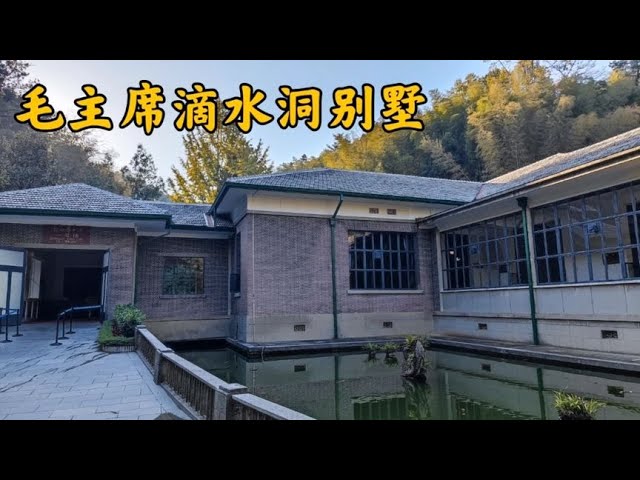
After more than two years of construction, the Dripping Water Cave project was essentially completed in 1962. The main building consisted of three structures, of which Building No. 1 was reserved exclusively for Mao. Comprising an office, a bedroom, a meeting room, and more, it served as Mao's living and working quarters -- a single-story, T-shaped villa of grey brick in a Soviet architectural style, with enclosed covered walkways on both sides, blending Chinese and Western design. It was warm in winter and cool in summer, and easy to keep secure. Building No. 1 was the core of the entire project and bore a striking resemblance to Mao's residence in Zhongnanhai.
In 1970, a 100-meter-long air-raid tunnel was added behind Building No. 1. The tunnel kept a permanent stock of supplies and daily necessities, and one side housed an anti-earthquake room, a command room, and other military facilities. Both ends of the tunnel were fitted with lead-and-iron doors weighing several tons each, capable of withstanding the blast of a nuclear detonation of a certain yield.
Building No. 2 had 24 rooms and served as living quarters for accompanying central leaders, adjoining Building No. 1 directly. Building No. 3 stood more than a hundred meters from the other two and housed the security personnel and other staff. In addition, the construction team also built a road connecting Mao's former residence to Dripping Water Cave.
In 1970 the Dripping Water Cave project was expanded and air-conditioning was added. Wang Dongxing, then director of the CCP Central General Office, took part in designing a new bedroom and bathroom based on Mao's personal habits.
Mao's “Eleven Days” at the Villa
From June 18 to June 28, 1966, Mao Zedong secluded himself at Dripping Water Cave for ten nights and eleven days. He was seen walking along Building No. 1, looking it over, and gazing at the surrounding mountains -- clearly very pleased.
During this period, the only person who knew Mao's whereabouts was Zhou Enlai. Every day, Zhou would have a special plane fly documents from Beijing, which were then driven from Changsha to Shaoshan for Mao to review.
At the time, Mao's personal security was handled by the 8341 Unit under Zhang Yaoci, while outer perimeter security was the responsibility of the Hunan Provincial Public Security Department.
In the book Zhang Yaoci Remembers Mao Zedong, Zhang recalled that while staying at Dripping Water Cave, Mao saw no one at all. Aside from handling documents, reading books, and reading newspapers, he spent the rest of his time deep in thought, and no one dared disturb him lightly.
Mao once asked Zhang to check whether it was possible to swim in nearby Youth Lake, whose clear waters made it a fine spot for swimming. But at the time Mao was consumed and exhausted by the mess left behind by the Great Leap Forward, and had no leisure of mind for swimming.
During those eleven days, Mao ventured out only once -- riding in a wheelchair, accompanied by others, for a short outing of just 300 meters. Before leaving, he said: “Take good care of this house! I will be back!”
There was no news coverage at all of Mao's eleven days at Dripping Water Cave. Even the reports that later appeared in the newspapers omitted exactly where he had gone. Even foreign intelligence agencies were unable to determine his whereabouts.
According to an article titled “Mao Zedong at Shaoshan's Dripping Water Cave,” published in Hubei Wenshi, on the afternoon of June 17 -- the day Mao entered Dripping Water Cave -- several young girls happened to be gathering pig fodder by the roadside near the cave, and one girl surnamed Mao recognized him.
After returning home, the girl told her father, Mao Jisheng, what she had seen. That very night, however, officers from the Hunan Provincial Public Security Department showed up at the Mao family's home and explicitly declared that Mao Zedong was in Beijing, and that the man who had come to Dripping Water Cave that afternoon was in fact Li Qiang, head of the Hunan Provincial Public Security Department. In this way, news of Mao's return to Shaoshan never got out.
Wanting to Return to Dripping Water Cave Before His Death
By June 1976, Mao was gravely ill and deeply homesick. In August, when his condition eased slightly, he insisted on returning to Dripping Water Cave to convalesce, but the CCP Central Committee did not approve it. In September, Mao still could not stop thinking about Shaoshan. After his repeated insistence, the Politburo finally agreed to let him return to Dripping Water Cave in Shaoshan on September 15. But Mao never lived to see that day.
September 8, 1976, was the last day of Mao's life. According to the article “The Last Twenty-Four Hours of Mao Zedong's Life,” on the morning of September 8, Liao Shiyu, the caretaker of Dripping Water Cave in Shaoshan, received a phone call from the provincial Party committee office saying that Party Secretary Zhang Pinghua would come that evening to inspect the site, as Mao would soon be arriving.
Liao immediately gathered all the staff and arranged every preparation. But Zhang Pinghua never showed up that evening. Around 11 p.m., Liao received another call telling him Zhang was not coming after all.
Less than two hours after Liao hung up the phone, Mao died in Beijing. The record of Mao's time at Dripping Water Cave came to a final stop right there.
The Villa's Three Great “Embarrassments”
The Dripping Water Cave villa -- the place Mao most wanted to return to as he lay dying -- left behind three glaring examples of CCP abuse of power, wasteful spending, and disregard for the people's welfare.
First, the villa was a product of Mao's “abuse of power.” Why, one might ask, didn't Mao simply tell Hunan's two successive Party secretaries outright that he wanted a villa built, instead of hedging and hinting around the subject? Because he knew perfectly well that this was not something he could do openly and aboveboard.
While Mao already had numerous other residences across the country, he built himself yet another villa in his hometown -- and did so precisely while the whole nation was suffering a great famine, with people dying everywhere and even cases of cannibalism occurring. No Party rule, government decree, or law granted Mao such power. This was, in short, a textbook case of “abuse of power” -- an illegal, criminal act.
Another piece of evidence for this “abuse of power” is that the entire project employed engineering troops, including the famous “Ouyang Hai Company.” The military's function is to resist foreign aggression and defend the nation. Deploying troops for a civilian construction project that had nothing whatsoever to do with military operations was utterly absurd.
The Dripping Water Cave villa is also a classic example of the CCP “burning money.”
Whatever the exact figure, the total cost of the Dripping Water Cave project was already a staggering sum of money in the 1960s.
The Mao Zedong Memorial Hall in Beijing undergoes a minor renovation every year and a major one every ten years. If Dripping Water Cave, now 62 years old since its completion, had followed the same pattern, it would have undergone 62 minor renovations and 6 major ones. How much money would that amount to?
From its completion in 1962 until Mao's death, fourteen years passed. Aside from the eleven days Mao actually stayed there, the villa remained on constant “standby” for the entire fourteen years, because Mao might return at any moment. Daily expenses likely included: a constant supply of fresh food kept ready at all times; utility bills; wages for the on-site staff; wages for security personnel; and more. Over those fourteen years, how much would all of that have cost?
In February 1982, Dripping Water Cave was handed over to the Hunan Shaoshan Administrative Bureau, managed directly by the Shaoshan Guesthouse, with outer security still provided by troops (today the First Company of the First Detachment of the Xiangtan Regiment of the Hunan Armed Police Corps). It was not until September 1984 that the site began accepting internal visits from officials at the county-and-regiment level and above -- only then did the era of Dripping Water Cave's money-burning largely come to an end.
The construction of the Dripping Water Cave villa was also, in itself, a prime example of the CCP's “disregard for the people's livelihood.” The funds for the villa's construction came mainly from Hunan provincial finances. At the very time the whole nation was suffering a great famine, Mao's tens of millions of fellow Hunan natives could never have imagined that even as they themselves were on the verge of starvation, they would still have to tighten their belts to foot the bill for Mao's Dripping Water Cave villa.
Building Grand Villas During the Great Famine
Most of Mao's residences were built around the time of China's three years of great famine.
According to incomplete statistics, villas built or completed between 1958 and 1959 include: the Wang Villa Guesthouse in Hangzhou, the Garden Villa Guesthouse in Harbin, the Xiyuan Hotel in Nanning, the Xincheng Guesthouse in Hohhot, the Shengli Guesthouse in Xining, the Zhangbagou Guesthouse in Xi'an, the Ningwozhuang Guesthouse in Lanzhou, the Nanhu Guesthouse in Changchun, the Binjiang Guesthouse in Nanchang, Building No. 1 at Meiling in the Donghu Guesthouse in Wuchang, Building No. 1 at Songshan in Shaoshan, and a small villa at Beidaihe.
Villas built or completed between 1960 and 1961 include: the Xijiao Guesthouse in Shanghai, the Nanjiao Guesthouse in Jinan, the Dripping Water Cave villa in Shaoshan, and Villa No. 1 at Lulin on Lushan.
Among these:
The “Lulin No. 1” villa on Lushan broke ground in 1960 and was completed in 1961. Built specifically for Mao's visits to Lushan, it covered a floor area of 2,700 square meters, with grounds spanning over ten thousand square meters. Tour guides say the Lulin Lake in front of the villa is an artificial lake, and that Mao enjoyed swimming there whenever he visited Lushan.
Building No. 1 at Meiling in the Donghu Guesthouse in Wuchang is also known as “Comrade Mao Zedong's Villa.” The picturesque Meiling area of East Lake was the place, aside from Zhongnanhai, where Mao spent the most time in residence.
The Xijiao Guesthouse in Shanghai -- codenamed Project 414 -- covered more than a thousand mu of land. Over more than a decade, Mao stayed there for only a handful of days in total.
The Nanjiao Guesthouse in Jinan, built in the early 1960s, covers 1,160 mu with a floor area of 115,800 square meters. Known as “Shandong's Fishing Terrace,” it was built specifically for Mao's visits to Shandong.
Nearly all of these villas were built in the early 1960s. At the time, the Great Leap Forward that Mao had launched had already caused a famine in which 38.6 million Chinese people starved to death. Just imagine how many lives the money spent on these villas could have saved!