
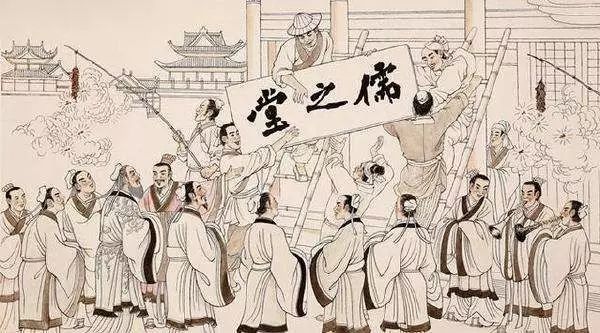
Traditional Chinese education has a long history. Since ancient times, every dynasty followed the tradition of valuing virtue and understanding, of teacher and student growing together -- teachers “imparted the Way, taught the trade, and resolved doubts,” while students were expected to “surpass their teachers, as blue dye surpasses the indigo plant it comes from.” For thousands of years, traditional education continued unbroken, nourishing the hearts and morals of the Chinese people.
The Shuowen Jiezi, China's ancient dictionary, explains: “To jiao (teach) means what those above impart, and what those below emulate.” The original meaning of jiao was to instruct and to lead by example from the top down. “Yu (nurture) means to raise a child so that he becomes good.” From this we can see that the original meaning of the term “education” was to cultivate good character in a person.
The Origins of Education
As early as the Xia dynasty, schools already existed, called xiao; in the Shang dynasty they were called xu; in the Zhou dynasty, xiang. Education flourished by the Han dynasty, with both official schools (the Imperial Academy at the center, and local schools in the provinces) and private academies operating on a considerable scale. In the Tang dynasty, the Imperial College was the official school, under which were the National University and other institutions; in the Song dynasty, the Imperial University was the highest institution of learning; and by the Qing dynasty, the Imperial College had become the nation's sole highest institution. Alongside official schooling, private academies began to spread widely from the Song through the Yuan, Ming, and Qing dynasties, becoming the primary form of education among the common people.
Traditional Chinese educational philosophy held to the principles of “teaching without discrimination” and “teaching according to aptitude.” “Teaching without discrimination” meant that regardless of rank or status, everyone could receive an education; “teaching according to aptitude” meant using different teaching methods suited to students of different capacities. Ancient education already recognized that “each person has their own destiny” -- that people are not stamped out of the same mold -- and so teachers guided different students according to their individual circumstances. This is entirely different from the image, often seen in television dramas, of ancient students swaying their heads back and forth while mechanically memorizing the rigid “eight-legged essay” for the imperial examinations.
Confucius said: “Learning without thought is labor lost; thought without learning is perilous.” Guiding students to learn how to think was true learning. Was the teacher an untouchable, absolute authority? Not at all.
On one occasion, Confucius asked his student Zigong: “Between you and Zilu, who is more virtuous?” This was a way of letting a student dare to evaluate his own teacher independently. After thinking it over, Zigong replied: “You, Master, are skilled at guiding others; Zilu is skilled at putting things into practice.” This was neither flattery nor an absolute judgment. Confucius laughed with delight: “That you can point out the difference shows you are skilled at observation.” Confucius excelled at inspiring independent thought in his students. Only through genuine thought of one's own can a principle truly enter the heart, rather than being “passively received.”
Han Yu, one of the Eight Great Prose Masters of the Tang and Song dynasties, often asked his students in his later years to “critique my writing.” He would hand his own essays to his students to read, saying: “Whatever can be improved, you must say so.” Both Liu Zongyuan and Li Ao openly pointed out instances where Han Yu's phrasing had been overly extreme. Not only did Han Yu accept such criticism, he often adopted it publicly. As a towering figure of the literary world, Han Yu used this method to encourage his students to dare to question authority rather than blindly follow it.
Western culture holds a similar tradition. Socrates encouraged his students to “defeat” him openly, often telling them, “Please refute me.” He constantly prodded his students to challenge him logically and to point out flaws in his arguments. In both the Apology and the Republic, he repeatedly let his students directly reject his premises. Socrates stands as an enlightening figure in the history of Western education and philosophy.
The Eastward Spread of Western Learning
In the modern era, as Western learning spread eastward, a new style of education -- known as “Western-affairs schools” -- emerged. During the Republican era, many Chinese who had studied in Europe and America returned home and brought back a culture of critical classroom discussion. Universities were autonomous, academic freedom was upheld, schools could refuse improper government interference, students could criticize their teachers and even their presidents, and professors could openly debate one another without needing to “toe a single line.” Republican-era society broadly respected knowledge and respected professors, and the period came to be known as an “age when great masters flourished.”
Hu Shih, teaching at Peking University, often told his students: “Do not believe every word I say -- ask instead: is what Hu Shih says correct?” He asked students to write him letters of criticism, to raise questions in class, and to voice objections after his lectures -- he even included students' criticisms in his own books. One student, Zhou Binglin, once pointed out to Hu Shih's face that a certain argument in his History of Vernacular Literature was overly simplified. Hu Shih openly acknowledged: “What the student points out here is indeed better.”
In the early twentieth century, societies in both East and West underwent enormous change, yet people's values and moral views remained relatively traditional. So at this stage, the “eastward spread of Western learning,” as far as education itself was concerned, represented a genuine clash and confluence of ideas -- an understanding reached through mutual communication.
Force-Feeding a “Potion of Confusion”
However, starting in 1949, once the CCP seized power, it began systematically remolding everything according to atheist and evolutionary ideology. Education, too, was reduced to a tool of ideology. More than seventy years have passed -- a long stretch of time in which all of this has become second nature, and people have grown accustomed to it under the weight of powerful ideological remolding. As for what traditional China was really like, or what traditional education really looked like, it has become almost unimaginable.
“The Party controls everything.” The educational freedom of the Republican era vanished entirely. In the classroom, those seemingly lively, vivid-sounding words were nothing more than poison laced with honey.
One classroom text, “The Golden Fishhook,” tells of an old squad leader during the Red Army's Long March who, in order to let his soldiers eat fish, ate grass roots and tree bark himself. He gave all the fish to the younger soldiers and eventually died of hunger and weakness. The fishhook became “golden,” symbolizing the spirit of self-sacrifice. This “moving” story allows for only one standard answer: to “devote” one's life to communism.
The text “Five Heroes of Langya Mountain” describes how, during the war against Japan, five soldiers of the Eighth Route Army covered the retreat of civilians and troops and, in the end, jumped off a cliff. Students' reflections on the piece almost always contain the line: “I am deeply moved, and I want to learn from them.”
In 2013, however, the historian Hong Zhenkuai published an article on Caijing's website titled “Numerous Inaccuracies in the Elementary School Text 'Five Heroes of Langya Mountain',” which, based on historical research and careful examination of the details, argued that the five heroes had not lured the enemy up the mountain -- the enemy had already been there -- and that the two who survived had not jumped off the cliff at all, but had slid down along the cliff face and were caught and saved by tree branches.
In fact, as early as July 1994, the Yangtze Daily had already published an article stating that the history of the “Five Heroes of Langya Mountain” contained numerous doubtful points -- for instance, that the sixth squad at the time was not made up of five men but six, including a deputy squad leader who defected to the enemy and was killed.
Today, kindergarten and elementary-school children in China become targets of CCP ideological brainwashing and indoctrination from the moment they enter school, completely deprived of any room for independent thought. Just imagine what kind of person someone raised from childhood in such an environment will grow up to be. Looking for a standard answer to everything, taking every order from above as the final word, never engaging the brain, never analyzing, never distinguishing right from wrong -- are these not exactly the kind of “human tools” produced by such an education: the students who beat their own teachers to death during the Cultural Revolution, the people who sealed residents inside their apartment buildings during the pandemic, the police, prosecutors, and judges at every level who harbor baseless hatred toward Falun Gong practitioners and subject them to violence?
The BBC has pointed out that “Five Heroes of Langya Mountain” is one of the CCP's “red classics” of propaganda. According to figures released by the Nationalist government, its forces suffered roughly 3.23 million casualties during the war of resistance against Japan, with nearly 1.33 million killed in action. The CCP, by contrast, claims that the forces it led suffered 450,000 casualties during the war, with 160,000 killed in action. Even by the CCP's own claimed figures, its military casualties amounted to less than one-seventh of the Nationalist government's. The true numbers remain, as ever, top-secret material the CCP will never allow to see the light of day.
The report notes that widespread skepticism abroad toward the CCP's “Langya Mountain” narrative reflects the Chinese people's own desire to learn the true history, as well as public distrust of CCP propaganda.
Lies have been enshrined as classics, held up in classrooms for decades as “models of the spirit,” and devoured night and day by hundreds of millions of Chinese children -- generation after generation raised on this spiritual “potion of confusion.” Their souls left empty, their spirits exhausted.
Lives Lost
The CCP uses its curriculum content not only as a tool for training uniform thought, but also leaves students no room of their own in how they spend their time or in their inner spiritual space. If everyone grew tired of dry textbooks and instead went off to read more widely and think freely in their spare time, would people still remain obedient sheep? The devil's malice is beyond human measure.
According to Peking University's China Family Panel Studies (CFPS), in 2022 Chinese high-school students spent an average of 59.7 hours per week studying -- nearly 11 hours more than the average working adult -- while middle-school students spent 55.2 hours and elementary-school students 46 hours. This means that from elementary school through high school, children's “working hours” increase at every stage, eventually surpassing those of most adults.
According to a 2017 report by Xinhuanet, titled “How Should Life Be 'Educated'? One in Five Middle-School Students Has Considered Suicide.”
According to a 2025 report by Life Times, “based on the China Children's Suicide Report published by Peking University's Sixth Hospital Children's Development Center, roughly 100,000 adolescents die by suicide in China each year.” Among adolescent suicides, middle-school students account for about 51 percent -- meaning more than 50,000 middle-school students take their own lives each year.
A 2015 article on the China Education and Research Network, titled “Suicide Has Become the Leading Cause of Death Among Chinese Youth -- How Can This Tragedy Be Prevented?”, concluded that “relevant research shows that student suicides are mostly linked to an inability to bear academic pressure.”
In early 2025, five separate cases occurred in Jiangsu Province in which groups of high-school students, holding hands, took their own lives together, resulting in 37 deaths in total. The Jiangsu Provincial Education Department urgently ordered a strict blackout on the news, and suspended classes across the province's entire education system for three days. Because of the CCP's news blackout and gag orders, we cannot know the full picture -- how many more children lose their precious lives every single day remains unknown. But one thing is certain: things like this are happening every single day...
The true meaning of education is to nurture the person, the heart, and the character -- to cultivate the capacity for independent thought, the ability to distinguish good from evil, and one's own standard of judgment. Growing up, not everyone becomes a scientist, a boss, or a wealthy person; rather, each person finds the work suited to them. As the Chinese saying goes, “Among the three hundred and sixty trades, each produces its own champion” -- meaning each person has their own destiny, and one should follow it naturally rather than force things. Today, the CCP's crimes of destroying education and poisoning lives stand plainly before everyone's eyes, and more and more people on the mainland are waking up. This evil clings to a fading breath, its allotted time nearly exhausted. The moment the red devil finally vanishes will be the moment China's traditional education truly returns.