
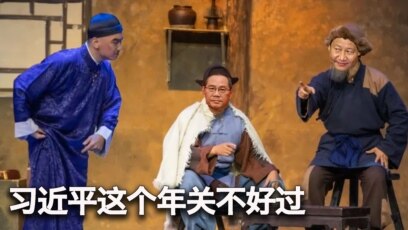
Had Zhang Youxia never been part of the CCP's ranks, he might well not have met today's fate and outcome. “Killing the donkey once it has finished turning the millstone” is a logic and a law within CCP ranks. The more prominent one's status, and the greater one's ability, the more this logic and law applies. The logic is this: within this group there are no true comrades, because there is no genuine shared belief -- only the law of the jungle, where people use one another without ever trusting one another. This is simply how they survive and advance, and it has become a law unto itself. A quick glance at some of the figures who have occupied high and important positions makes this abundantly clear. And of course, this same logic and law applies equally to the CCP's grassroots organizations.
Zhang Youxia's connections and abilities upheld Xi and the CCP; Wang Qishan made an enormous contribution to Xi's power and Xi's version of the CCP; Hu Jintao exhausted his own strength to support Xi in order to preserve the CCP's grip on power; Liu Yuan stepped forward for Xi and for the CCP, playing an extremely pivotal role -- and the fates of all of them are there for everyone to see. Guo Boxiong, Xu Caihou, Zhang Wannian, and others upheld Jiang Zemin's version of the CCP; likewise, the CCP's “Ten Marshals,” along with Liu Shaoqi and Zhou Enlai, actively helped the CCP overthrow the Nationalists and uphold the Party. Even the “Gang of Four” upheld the CCP in their own way. Every single one of these people met a bad end in the end. And the various CCP leaders involved in what the Party itself calls its “ten line struggles” throughout its rise to power likewise met no good outcome or fate.
Within CCP ranks, there has been no shortage of people whose original motives were genuinely to serve the country and the people -- yet their outcomes and fates were even worse. Take, for instance, Peng Dehuai, one of the aforementioned Ten Marshals, who sympathized with the forty million mainland Chinese who starved to death during the Great Leap Forward and dared to speak candidly on behalf of the people -- only to be made an example of, thrown in prison, and persecuted. Zhao Ziyang, Hu Yaobang, and Wan Li all wanted to do something genuine for the country and the people. Hu Yaobang rehabilitated the wrongful convictions of the Mao era and refused to let crimes committed within the communist camp itself go unpunished under some pretext of special favor; “for grain, look to Ziyang; for rice, look to Wan Li” was how ordinary people once described Zhao Ziyang and Wan Li. And what came of it? The CCP's own interest groups -- greedy, tyrannical, and utterly self-serving, propped up entirely by power -- understood that if you genuinely try to serve the country and the people, you end up nurturing basic humanity and granting the people their human rights, and this is precisely what the CCP fears. So the more one does, and the bigger one does it, for “the people,” the more one draws fire upon oneself -- because such motives and goals run directly counter to the CCP's own. “Serving the people” has only ever been a facade.
There have also been many renowned people of conscience, scientists, advocates of democratic progress, as well as pursuers of truth and civilizational progress from the Nationalist Party, the United States, and other Western countries, who were taken in by the CCP's smooth talk, its “united front” tactics, and its surface-level pretenses, and who actively supported the CCP with their own actions. In the end, everyone among them who remained on the mainland was persecuted through the CCP's endless series of political campaigns -- some to the point that they died without even a proper burial, especially during the Cultural Revolution, when not a single one slipped through the net. Even a lowly platoon-level officer of the surrendered Nationalist army was paraded through the streets during the Cultural Revolution and sent down to the countryside for ideological “reform,” forbidden from “speaking or acting out of turn.” There are simply too many examples -- ordinary people who lived on the mainland in the 1950s and 60s can all point to many people around them who were persecuted.
No matter what one's original motives or goals may have been, anyone who has upheld the CCP has never met a good end -- simply keeping one's life counts as a fortunate outcome -- because the CCP is a gangster organization at its core, in which only the most evil and most thuggish can rise to become its leaders, and even then, safety is only ever relative, never absolute. The CCP rose from thuggery and banditry, replacing everything, including basic humanity, with Party loyalty. Party loyalty demands absolute obedience alone; whenever humanity and Party loyalty come into conflict, humanity must yield to Party loyalty -- which is why this Party, as a whole, is devoid of humanity. This pattern shows up everywhere, throughout the CCP's founding and rule, in matters inside and outside the Party, and in the ordinary business of state administration -- it is, in fact, the normal state of affairs. The same pattern is equally evident on the international stage, where the CCP has consistently supported dictatorial regimes and inhumane, evil forces.
A gangster-style criminal organization, combined with a thuggish Party loyalty that extinguishes basic humanity, naturally leaves no room for genuine loyalty or righteousness among its members. What is upheld and believed in within such ranks is not any shared set of values or ideals, but purely self-serving, extreme power -- power that cannot withstand the test of time or changing circumstances. Trust does not exist among them, not between colleagues, not between superiors and subordinates; everyone remains constantly on guard, fearing the loss of their own interests, and open or hidden power struggles, mutual sabotage, and brutal infighting are inevitable. The more pivotal one's position, the more dangerous it becomes -- even if you harbor no ambition whatsoever and pose no threat to anyone, no one will believe it, which is why the outcome and fate are never good.
As for the flowery rhetoric the CCP proclaims about socialism, communism, and “serving the people,” these are nothing but a cake painted in the air, used to win support, trust, and to safeguard power. The Party members themselves neither understand nor genuinely believe in their own “-isms” -- these were never the Party's true ideology to begin with. That is why the term “comrade” could only fool people for a while; after seizing power it became a mere verbal formality, and once the reform-and-opening era arrived, the CCP's true nature was laid bare, and it naturally abandoned the term, unable to continue using it in any meaningful way. In its rise to power, the CCP used these very deceptions to gather together a great many talented and capable people, and thereby seized control of the state. Because its theory was inherently deceptive, not only could it never achieve any “great harmony under heaven” -- the people were stripped even of their most basic human rights, chasing a cake painted on the wall that could never actually be eaten. Its real purpose was always to protect the interests of the communist clique, to ride roughshod over the people and lord it over them -- and to this end, it repeatedly used political campaigns to slaughter the people, killing more than eighty million Chinese people through various political movements after seizing power, more than the combined death toll of both world wars, all to preserve its grip on power at any cost. Humanity has always been seen by the CCP as a threat, and so it continually works to extinguish it. Within such a group, conditions rival the animal kingdom, governed entirely by the law of the jungle -- so no matter what one's purpose or original motive may have been, within these ranks, especially for anyone of prominent standing who upheld the CCP, the outcome and fate will never be good, and for some it turns out especially tragic -- Liu Shaoqi among them.
When brainwashing the people, the CCP boasted of itself: “The Zunyi Conference turned the tide of fortune”; after the Zunyi Conference, “our Party became more mature.” In truth, it was no longer merely a roving bandit force but had become a fascist-style, more cultured and more mature gang of thugs and tycoons masquerading as a party. To this day, its thuggish, bandit-like nature has only kept pace with the times. In the past, in order to deceive people both in China and abroad, it still felt the need to keep up appearances on the surface, observing certain gangster-style rules while conducting its real business behind closed doors. Now it has evolved to the point where it no longer even bothers to hide its true nature on the surface, openly displaying its thuggish, bandit character. Take the promotion of officials, for example: in the past, the various power factions would strike secret deals behind the scenes -- backroom dealing completed first, then a sham process was gone through for appearances' sake. Now even that pretense of process has been dropped; there is no more effort to keep up appearances -- just a brazen attitude of “I'm a thug, and who's going to stop me.”
When the beam at the top is crooked, the beams below follow suit, and what happens at the top is copied below -- so at the grassroots level, the CCP's corruption runs even more rampant, though space does not allow a full accounting here. In truth, this is precisely the final sign of the CCP's coming demise -- heaven lets it run wild for a while longer, only to let it perish all the more completely. So whoever follows the CCP is bound to meet misfortune, and may even end up being buried alongside it.