
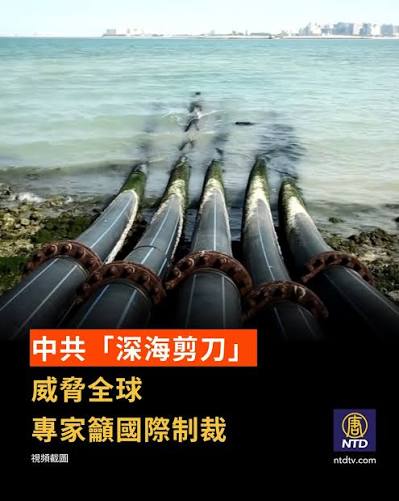
The CCP's state media and research institutions have recently confirmed that a domestically developed subsea cable-cutting device has successfully completed testing at a depth of 3,500 meters. Analysts say this technological breakthrough is not only troubling to international security experts, but also threatens Taiwan within the first island chain and endangers the strategic security of Guam, within the U.S. military's second island chain.
CCP Deep-Sea Cable-Cutting Device Draws International Attention
According to Xinhuanet, citing China's Ministry of Natural Resources, the research vessel "Haiyang Dizhi 2" (Marine Geology No. 2) completed its first deep-sea mission of the year on April 11, which included using a "deep-sea underwater electro-hydraulic actuator" to cut cables at an extreme depth of 3,500 meters (about 2 miles).
CCP state media claimed that "this is the first time in the world that a country has publicly acknowledged possessing the capability to cut cables at such extreme depths — a diving depth even twice the average depth of existing undersea communications infrastructure."
According to reports, the device was developed by the U.S.-sanctioned China Ship Scientific Research Center and its affiliated State Key Laboratory of Deep-Sea Manned Equipment.
The public disclosure of this technology has drawn intense international attention.
The South China Morning Post, citing the official announcement on April 15, reported that the deep-sea cable-cutting device "is capable of severing the world's most heavily protected undersea communication or power cables, and could shake up the global balance of maritime power."
Veteran American journalist Stephen Silver warned in an article for the military-affairs outlet 19FortyFive that although the CCP has publicly stated the device was developed for civilian salvage and deep-sea mining purposes, experts see its "dual military-civilian use" potential as unmistakable.
The Threat of Subsea Cable-Cutting to Taiwan and Guam
Silver warned that this CCP technology poses a direct challenge to the U.S. military's strategic posture in the Indo-Pacific. Guam, the cornerstone of America's Indo-Pacific strategy and the hub of the second island chain, has a defense strategy centered on deterring the CCP; the island hosts more than 12 fiber-optic cables serving both private companies such as Google and the U.S. military.
The South China Morning Post reported that if Beijing were to use such a device to cut cables near strategic hubs, it "could paralyze global communications during a geopolitical crisis."
For Taiwan, the threat is even more urgent.
Hsu Yu-jen, a senior fellow at the Hudson Institute and a former Taiwanese legislator, testified in early March at a hearing of the U.S.-China Economic and Security Review Commission (USCC) in Congress, explaining the role subsea cables could play in a potential conflict.
He said that, in fact, 97% to 99% of the world's intercontinental internet traffic is carried by undersea cables. Citing CCP military documents, he noted that in the event of a Taiwan Strait conflict, an attack on subsea cable infrastructure would most likely be the first move by Chinese forces before any invasion of Taiwan.
Hsu said that while low-Earth-orbit satellite systems like SpaceX's Starlink played a role in Ukraine, the situation in Taiwan faces severe limitations.
Timothy Stronge, chief research officer at TeleGeography, explained at a separate cybersecurity hearing last November that satellites serve only as an important emergency backup for mission-critical use, and cannot replace the absolute advantage of fiber-optic cable in capacity and cost-effectiveness — "for the simple reason that the cost per unit of cable capacity is 2,800 times cheaper than satellite."
Hsu further warned that the Chinese navy would not even need to cut all of Taiwan's cables — precisely severing just three key cable clusters near the Bashi Channel could theoretically reduce Taiwan's bandwidth by 99%.
He said this kind of "digital blockade" would throw military command and control into chaos, paralyze financial markets, spark public panic, and cut off Taiwan's real-time communication with the international community.
According to CCP data captured by George Mason University's Mercatus Center, it lists numerous strategic points in Taiwan, including many subsea cable landing stations — evidence that Chinese forces have conducted extensive intelligence gathering.
In his testimony, Hsu noted that the CCP has long been actively upgrading cable-cutting technology into a systematic wartime capability. Entities affiliated with the Chinese military have filed related patents for more than a decade: a patent for a deep-sea fiber-optic cable cutting and recovery device in 2013; a patent for cutting and securing both ends of a cable in 2022; and patents for an underwater cutting device and a towed cutting system in 2025.
In addition, the China Ship Scientific Research Center released a design in early 2025 for an electric cutting device capable of operating at a depth of 4,000 meters; in mid-2025, the CCP publicly unveiled a new type of subsea cable-cutting vessel, equipped with a six-inch-diameter, diamond-coated grinding wheel spinning at 1,600 revolutions per minute, capable of piercing through the sturdiest reinforced outer sheathing at a depth of 4,000 meters.
All of this is now regarded as a new type of weapon of warfare for Beijing to "disrupt global communications and the global order."
Gray Zone: Undersea Sabotage Tactics Under China-Russia Coordination
Beyond its high-tech dedicated cutting vessels, the CCP has also been accused of exploiting loopholes in international law by using civilian vessels to carry out gray-zone sabotage operations. A 2025 report by the U.S. Center for Strategic and International Studies (CSIS) noted that undersea cables have become a key battleground vulnerable to "plausibly deniable sabotage," accidental severing, and eavesdropping. Beijing routinely attributes cable damage to accidents, but the frequency and timing of these incidents have aroused experts' suspicion.
Report authors Erin L. Murphy and Matt Pearl noted that even more concerning is the emergence of a "China-Russia gray-zone axis."
From late 2024 to early 2025, the Chinese vessel Shun Xing 39 and the Russian-operated Vasili Shukshin were observed moving back and forth around Taiwan and near cable landing stations, in what appeared to be reconnaissance activity.
In European waters, the "Yi Peng 3" incident of November 2024 shocked the world. The Chinese vessel dragged its anchor for more than 100 miles (over 160 kilometers) across the Baltic Sea, successively severing two critical cables — one connecting Finland to Germany, and another connecting Sweden to Lithuania.
The CSIS team believes that such operations, using "shadow fleets" and identity manipulation, give Beijing multiple layers of "plausible deniability," allowing it to assist Russia behind the scenes while simultaneously accumulating real-world operational experience for its own Taiwan-focused efforts.
The Rise of the Subsea Cable Industry — The CCP's "Digital Silk Road" Strategy
The subsea cable industry is driven by commercial interests, with investors — rather than national or international security needs — largely deciding when, where, and how new cables are built.
Beijing, meanwhile, is rapidly expanding its global market share through its "Digital Silk Road" initiative. Statistics show that Amazon, Google, Meta, and Microsoft currently own or lease roughly half of the world's undersea bandwidth.
HMN Technologies (formerly affiliated with Huawei) is now the world's fourth-largest and fastest-growing builder of subsea cables, having completed more than 100 projects across 78 countries.
China's four leading fiber-optic companies — Yangtze Optical Fibre and Cable, Hengtong Optic-Electric, Fiberhome Telecommunication Technologies, and Jiangsu Zhongtian Technology — now together control more than 35% of the global market, and Beijing has set an ambitious target of capturing 60%.
Unlike semiconductors, which remain subject to export controls, the CCP already possesses a complete, independent set of technologies for building and deploying cables — heightening the risk that it could install wiretapping devices (taps) inside cables, intercept data, or carry out strategic sabotage during a conflict.
Additionally, Beijing has used its nine-dash-line claims in the South China Sea to seize permits for competitors' cable projects, forcing major cable projects backed by Google and Meta (Facebook's parent company) to be rerouted.
U.S. Lawmakers Introduce Subsea Cable Resilience Bill; Experts Call for Strengthened International Sanctions Against the CCP
In response to this escalating threat, Hsu Yu-jen presented concrete policy recommendations to the U.S. Congress, such as authorizing stronger sanctions powers, pushing to update international conventions, and establishing clear damage standards along with mandatory investigation and accountability mechanisms.
He also said he hopes the U.S. will appropriate funding to support an "Indo-Pacific Subsea Cable Surveillance Network," and authorize the procurement of cable-repair ships to make up for the shortage of military and commercial repair capacity in Taiwan and the western Pacific region.
CSIS experts, for their part, recommended that — given the vastness of the oceans — stronger cooperation is needed between governments and the private sector, along with measures such as "joint patrols" with allies, funding for surveillance satellites, and deploying sensors on cables, in order to form a real deterrent against saboteurs.
In addition, Republican Senator John Curtis and Democratic Senator Jacky Rosen introduced the Taiwan Undersea Cable Resilience Initiative Act last year, aimed at protecting Taiwan's critical communications infrastructure and deterring malicious Chinese "gray-zone" operations.
Under the bill, the Secretary of State would be required to coordinate with the Secretary of Homeland Security and the Secretary of Defense to develop and deploy an advanced subsea cable monitoring system for Taiwan, capable of detecting disruptions or potential sabotage in real time, and, where appropriate, providing Taiwan with early warning drawn from the global intelligence network.
The bill also requires the Secretary of the Navy and the Commandant of the Coast Guard to work with Taiwan's coast guard and regional allies to strengthen situational awareness of the waters around Taiwan, with a focus on detecting suspicious vessels or activity near key subsea cable routes, monitoring potential threats, and preventing sabotage.
If any individual or entity damages a subsea cable relevant to Taiwan's national security, the Taiwan Undersea Cable Resilience Initiative Act authorizes sanctions such as freezing U.S.-based assets or barring entry into the United States, and requires the executive branch to regularly report threat assessments and countermeasures to Congress.
"Beijing is intensifying its efforts to isolate Taiwan, including by sabotaging its critical undersea cables — we cannot stand idly by," said Senator Curtis. He said this bipartisan bill sends a clear message: that "the United States stands with Taiwan and our allies in defending our shared infrastructure, sovereignty, and freedom."