
Recently, a series of trials targeting dissidents and democracy activists took place in Beijing and Hangzhou, drawing widespread outside attention. Analysts believe that, under the current political climate, these cases not only reflect the authorities' continued tightening of control over speech and association, but are also seen as a major blow struck against society's challenge to the CCP's ban on political parties.
Authorities Hand Down Secret Sentences on Charges of "Inciting Subversion"
According to sources with knowledge of the matter, on March 30, the CCP's Beijing No. 2 Intermediate People's Court held a closed-door trial of seven members of the Beijing branch of the China Democracy Party on charges of "subversion of state power," issuing its verdict the following day: Vice Chairman Wang Shi was sentenced to seven years and six months in prison; Li Wu, Zhao Qiang, Li Yun, Sun Shuai, Li Fei, and Yu Yang were given sentences ranging from three to seven years, with suspended sentences; party chairman Wang Yunpu has gone into exile abroad. The trial was not held publicly, and even family members faced restrictions on attending as observers.
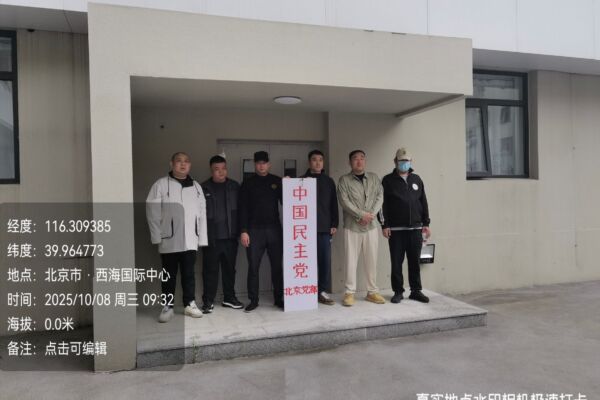
The Beijing branch of the China Democracy Party was established in Beijing on October 8, 2025; pictured are members who attended the founding assembly. (Photo courtesy of the China Democracy Party United Headquarters)
Sources say the seven were detained together in January of this year. The case was designated a "major case," overseen directly by relevant departments. Last October, those involved announced the founding of the Beijing branch of the China Democracy Party near Sitong Bridge in Beijing, and publicly read out a (provisional) party charter, proposing principles of "openness, rationality, peace, and non-violence," and advocating for pushing China toward freedom, democracy, and the rule of law.
Beyond the Beijing case, a similar case went to trial in Hangzhou, Zhejiang, on February 13. A local court charged democracy activist Zou Wei and independent writer Zan Aizong with "picking quarrels and provoking trouble," sentencing them to three years and six months, and three years, respectively. That case likewise involved restrictions on courtroom observers.
Party-Building Activity Reveals Deep Public Discontent with the CCP
For a long time, the development of the China Democracy Party within mainland China has repeatedly been suppressed. Since it was openly founded in 1998, participants in many regions have been detained, sentenced, or driven into exile abroad. Despite facing intense pressure, related activity has persisted, in various forms, through different periods.
In this case, only a few months passed between the founding of the Beijing branch and the arrest and sentencing of its members. Some commentators say this reflects just how severe the current political climate has become; yet at the same time, that people would still openly form a party to voice political demands, despite the CCP's strict restrictions, shows just how deep Beijing residents' discontent with the ban on parties runs.
Overseas Democracy Groups Call for Release of Detainees
In response to the verdicts, several overseas pro-democracy groups issued statements calling attention to the case and strongly urging Beijing authorities to stop suppressing citizens' basic rights in the name of "national security," and to release those detained over speech and association activities.
In its statement on the 13th, the China Democracy Party United Headquarters said that the members who were sentenced had engaged in political expression and organizing activity within a constitutional framework — a basic right of citizens in any modern society. Since the party was openly founded on the mainland in 1998, countless members have paid the price of suppression, imprisonment, and even exile. "Even facing the prospect of prison, people still step forward; even when the organization is destroyed, the conviction lives on among the people."
The statement called on the world: "Please do not remain silent. Let the voice of justice continue to be heard. Let us together protect those who have paid the price for freedom, and work toward a China that is truly free, just, and democratic."
Human rights in China have long been a focal point of international concern. The state of basic rights — including freedom of speech, freedom of association, and the right to political participation — has repeatedly been included in various annual assessment reports. Observers believe this case will continue to fuel international concern and condemnation of the CCP's human rights abuses.