
China's economic downturn has led to the appearance of large numbers of homeless beggars across the country. CCP authorities recently amended the law, changing the official term "vagrants and beggars" to "displaced persons." Analysts say this reveals the collapse of official claims about total poverty eradication and a "moderately prosperous society." One lawyer said that, compared with being renamed, it is far more terrifying that the physical bodies of vagrants and beggars are simply disappearing — they may be trafficked, or even become a source for the organ trade.
Official Renaming of the Homeless Draws Mockery; Analysts: The Lies Are Collapsing
On April 24, the Legislative Affairs Commission of the Standing Committee of the CCP's National People's Congress held a press conference introducing revisions to the draft Social Assistance Law, one of which changes the term "vagrants and beggars" to "displaced persons."
After taking power, the CCP subjected rural migrants who flooded into cities to forced custody and repatriation, labeling them "blind drifters" (people who "blindly" flowed from the countryside into cities). In 1982, the CCP's State Council issued the Measures for the Custody and Repatriation of Urban Vagrants and Beggars, defining such drifters as "vagrants and beggars" — terminology that has remained in use ever since.
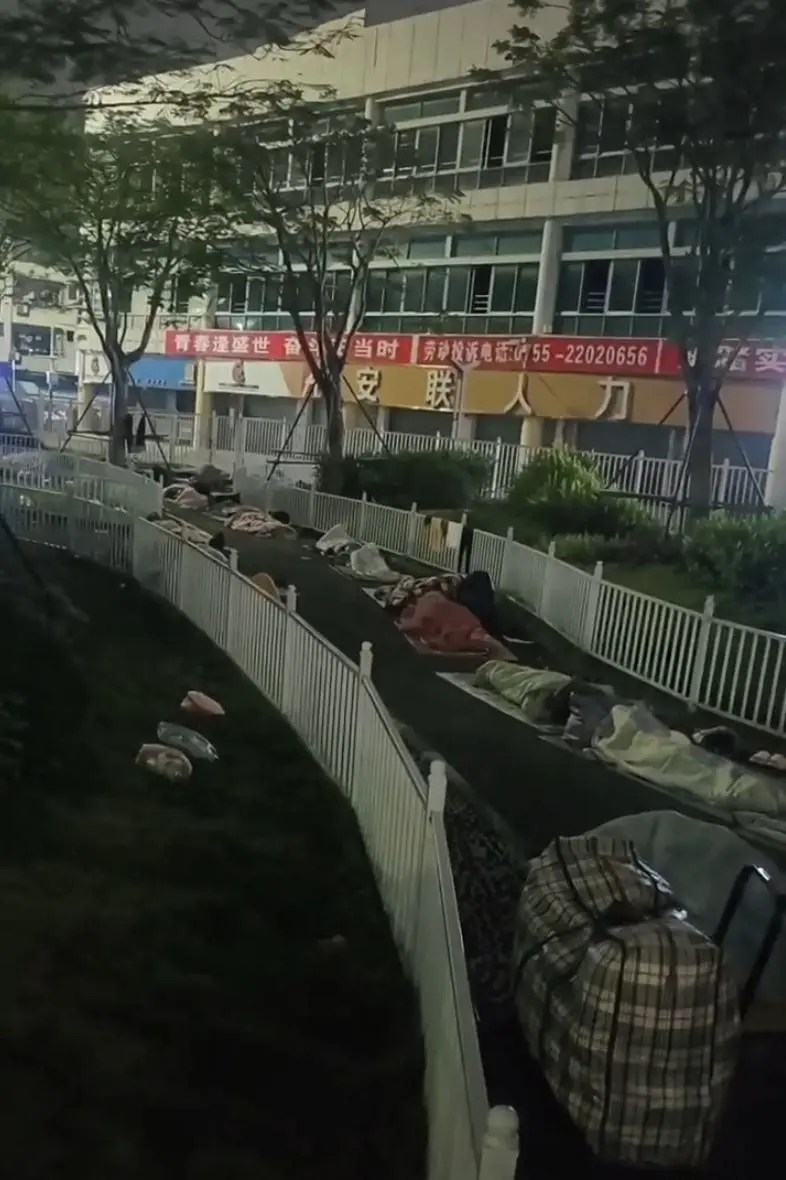
In recent times, videos have repeatedly circulated online showing large numbers of migrant workers flooding into cities, only to end up sleeping on the streets after long periods without finding work, reduced to a drifting existence.
Against the current backdrop of weak domestic demand and a severe employment situation in China, CCP authorities have renamed "vagrants and beggars." Wu Shaoping, head of the Overseas Human Rights Lawyers Alliance, told The Epoch Times that the CCP has always built its rule on wordplay and deceiving the public through propaganda. The reason for changing "vagrants and beggars" to "displaced persons" in the Social Assistance Law, he said, is that China's economy is facing enormous problems, with massive unemployment and growing numbers of vagrants and beggars appearing in cities — undermining the CCP's narrative of "economic optimism," prompting it to resort once again to wordplay.
In December 2025, one blogger posted asking: what reason could there be for these people to be sleeping on Shenzhen's streets on winter nights? (Video screenshot)
Ai Shicheng, a media editor and former founder of a Shenzhen-based NPO, told The Epoch Times that the CCP's real motive for renaming the homeless population is, first, propaganda: replacing the term "vagrants and beggars" — which carries strong negative connotations of chronic poverty — with the neutral term "displaced," implying merely that they are scattered outside and temporarily in difficulty, in order to downplay the "systemic problem."
Second, it is meant to cover up economic problems. The appearance of homeless people is caused by high unemployment, weak domestic demand, and shrinking job opportunities; by renaming the phenomenon, the authorities are effectively denying any increase in "vagrancy and begging," in keeping with the official themes of "economic optimism" and "common prosperity."
Jie Lijian, chairman of the China Democracy Party International Federation, told The Epoch Times that the CCP's renaming of vagrants and beggars as "displaced persons" is a rhetorical cover-up for the collapse of the economy, and for the collapse of the lies of total poverty eradication and a "moderately prosperous society."
After news broke that "vagrants and beggars" had been renamed "displaced persons," Chinese internet users overwhelmingly mocked the move. Some ridiculed officials for their "undeniably world-leading" skill in crafting phrases. One user said, "It would be more fitting to call them 'the soon-to-be-wealthy'"; another said, "'Soon-to-be-wealthy' sounds so much more sophisticated." Others quipped, "One renaming dissolves a thousand beggars," and "With this change, there will be no more beggars in the world from now on — brilliant."
Jie Lijian said that the homeless population keeps growing — it's not only people with disabilities relying on begging to survive; many young people now carry their luggage out looking for work, and when they can't find any, train stations and bus stations become where they sleep. Ordinary citizens are well aware of this, so under the CCP's internet censorship, they use humor and mockery to satirize the authorities.
"Instead of solving the economic problems, instead of addressing the real issues, they're just playing games with wording — that will only breed more resentment," he said.
In late October 2025, an internet user filmed people sleeping rough in a park in Kunshan, Jiangsu. (Video screenshot)
China's Missing-Persons Data Remains Unclear; Lawyer: Disappearance in the Flesh Is Far More Frightening
In June 2025, the CCP's Ministry of Civil Affairs claimed that traditional vagrants and beggars were gradually decreasing, and that people in temporary difficulty had become the primary group served. Over the past year, it said, civil affairs departments and assistance agencies had provided aid to 709,000 person-instances of people in various forms of temporary difficulty, and in 2024 had helped 4,051 missing persons reunite with their families.
On December 31, 2025, the Ministry of Civil Affairs released data claiming it had provided assistance to 625,000 person-instances of vagrants, beggars, and other destitute individuals that year.
Wu Shaoping, head of the Overseas Human Rights Lawyers Alliance, said the CCP has never published statistics on the total number of vagrants and beggars — only figures on those it claims to have "assisted," which obviously represent only a fraction of the total homeless population.
The China Missing Persons White Paper (2020), released in February 2021, disclosed that the annual number of missing persons between 2016 and 2020 never fell below one million, reaching as high as 3.26 million in 2016 alone — yet all related data has disappeared entirely since 2021. The CCP authorities have never released comprehensive, transparent annual statistics on missing persons.
Wu Shaoping said that, compared with being renamed, it is far more terrifying that the physical bodies of the homeless are disappearing. Homeless people taken away by street-level officials to assistance centers sometimes turn up dead for no clear reason; these assistance centers may well have become sites of human trafficking, precisely because they lack transparency and face very limited social oversight.
The CCP operated its custody-and-repatriation system from 1961 to 2003. In 2003, Sun Zhigang, a 27-year-old from Hubei, was beaten to death by staff at a detention center in Guangzhou. Under public pressure, the CCP authorities abolished the custody-and-repatriation system that same year, and all existing detention-and-repatriation stations were renamed "assistance centers."
Recently, a video alleging that at least several thousand people died or went missing at the Zhangmutou detention center in Dongguan, Guangdong suddenly went viral on Chinese social media, before being censored. (Related report: A Survivor's Account Reveals the CCP Detention Center Cover-Up: Every Village Has Someone Who Never Came Home)
Wu Shaoping said that in the past, the detention-and-repatriation centers were the site of every kind of atrocity, with large numbers of people going missing or dying. But abolishing the custody-and-repatriation system and renaming the facilities "assistance centers" does not change the nature of such places — because the CCP has never held anyone accountable for the disappearances and deaths caused under the old system; renaming it an "assistance center" is merely swapping the sign on the door while the same staff remain — old wine in a new bottle.
He questioned what ultimately happens to the large numbers of homeless people forcibly taken to assistance centers by street-level officials, urban management officers, or police — their fates are simply unknown. "Were they really sent home, or were they taken away to be trafficked — sold, say, into illegal brick kilns, or turned into a source of body organs?"
A person sleeping rough on the streets of Kunshan, Suzhou. (Photo provided by interviewee)
On March 8, 2026, Guangzhou resident Gao Fei sent an "Emergency Proposal" to five CCP bodies — the General Office of the Standing Committee of the National People's Congress, the General Office of the State Council, the Ministry of Public Security, the National Supervisory Commission, and the National Health Commission — demanding a comprehensive review and suspension of organ transplant operations. The related joint petition drive was suppressed by CCP police. (Related report: Nearly 800 People on the Mainland Sign Joint Petition: Review and Suspend Organ Transplants)
Jie Lijian said that some young people have gone to assistance centers seeking help, hoping to get a ticket home, only to end up locked inside and subjected to disguised forms of abuse. Assistance centers have also been implicated in embezzling funds — for instance, by falsely inflating the number of people assisted, turning one person into twenty on paper, with the difference split among the center's staff.
In recent years, scandals at the CCP's social assistance centers have erupted repeatedly. In 2015, a 13-year-old boy (some reports say 9) named Wang Zhiqiang, from Xinyang, Henan, was beaten and starved to death at the Xinyang assistance center. In 2016, a Shenzhen assistance center was also exposed for beating homeless children. Because of official information suppression, many more such cases have never come to light.