
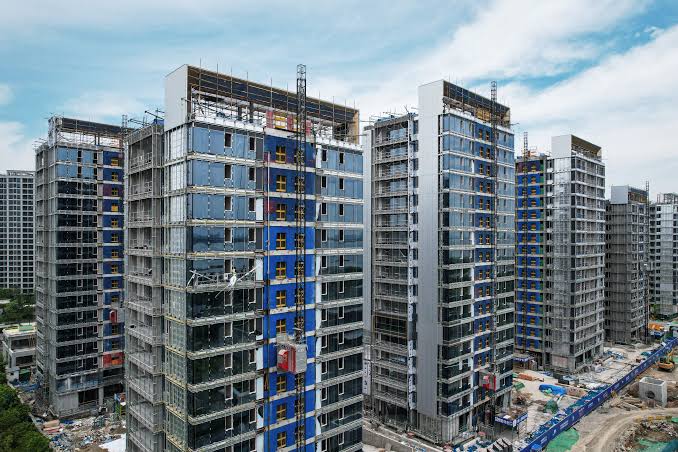
For years, local governments under the CCP have relied heavily on land-sale revenue to fund their budgets. Now that nationwide land-sale revenue has collapsed off a cliff, the local debt crisis has escalated across the board. With Beijing's coffers running dry, its various methods of scrambling for money have drawn widespread criticism.
Land-Sale Revenue Collapses Off a Cliff; the CCP's Fiscal Gap Keeps Widening
The gap between the CCP's fiscal revenue and expenditure keeps widening. Data from state media show that in 2025, the shortfall in the general public budget reached 7.135 trillion yuan (RMB, same below), while the shortfall in the government fund budget reached 5.517 trillion yuan, for a combined total of 12.652 trillion yuan — an increase of 2.2222 trillion yuan over 2024.
In 2026, the opening year of the so-called "15th Five-Year Plan," nationwide general public budget expenditure surpassed 30 trillion yuan for the first time, while nationwide government fund budget expenditure reached as high as 1.186 trillion yuan.
The root cause of local fiscal distress under the CCP lies in the collapse of the land-based fiscal model. For years, local governments relied on land-sale revenue to fund infrastructure, pay salaries, and sustain public services. Local authorities' land-sale revenue peaked at a historic high of roughly 8.7 trillion yuan in 2021. But as the property market has remained mired in a prolonged slump in recent years, the land-based fiscal model has completely collapsed.
In 2025, land-sale revenue for CCP local governments fell to roughly 4.2 trillion yuan, and the downward trend has continued into 2026. Data recently released by the CCP's Ministry of Finance show that in the first quarter of 2026, local authorities' revenue from the transfer of state-owned land-use rights (land-sale revenue) totaled 517.6 billion yuan, down 24.4% year-on-year.
Data from the CCP's National Bureau of Statistics show that in the first quarter of this year, nationwide real estate development investment fell 11.2% year-on-year; floor space of newly built commercial housing sold fell 10.4% year-on-year; and funds available to real estate development companies fell 17.3% year-on-year. In March, prices for newly built commercial residential housing in first-, second-, and third-tier cities fell 2.2%, 3.3%, and 4% year-on-year, respectively.
Li Rong, a professor at the School of Finance at Renmin University of China, said the widening decline in local land-transfer revenue in the first quarter shows that local authorities are facing considerable fiscal pressure.
Separately, China's local debt crisis has continued to escalate across the board this year. In the first four months of this year, local government borrowing under the CCP hit a new record high, with local governments issuing about 3.92 trillion yuan in bonds — up roughly 10.8% year-on-year and a new record for the same period in any prior year.
According to data from the CCP's Ministry of Finance, local government debt stood at 56.59 trillion yuan as of early 2026. However, official CCP data often conceals unfavorable realities, and the actual figures may well be worse, including a massive amount of hidden, off-the-books debt. The International Monetary Fund (IMF) and the Bank for International Settlements (BIS) estimate that China's government debt reached 100 trillion yuan in 2024.
Beijing Scrambles for Money Everywhere; Its Methods Draw Scrutiny
The CCP's 2025 Central Economic Work Conference and its 2026 budget report both rarely emphasized "placing importance on resolving local fiscal difficulties." But faced with fiscal distress, the CCP government's chosen solutions have drawn widespread skepticism.
The first method is to go after private enterprises. In recent years, law enforcement agencies across the country have carried out increasingly broad crackdowns targeting executives of private companies, with a clear profit-driven motive behind most of these cases. This has stirred up widespread public anger, and China's legal community has coined a term for such practices: "deep-sea fishing." In the first half of 2024, non-tax revenue — mostly in the form of fines — grew roughly 25.2% year-on-year at one point.
The second method is confiscating the wealth of corrupt officials. In recent years, purges within the CCP have intensified, and figures from the Central Commission for Discipline Inspection's "anti-corruption" campaign keep climbing. On April 23, the CCP's Central Commission for Discipline Inspection reported its so-called "anti-corruption achievements" for the first quarter of this year: 56 provincial- and ministerial-level officials were disciplined, four times the number from the same period last year. Data for all of 2025 show that 115 officials at the provincial/ministerial level or above were placed under investigation, 42 more than the previous year — a record high.
Sources within the system in multiple regions have previously told The Epoch Times that the number of people held in prisons and detention centers in some parts of China has noticeably increased, with a rising share of detainees being officials implicated in corruption and bribery.
Yuan Hongbing, a legal scholar based in Australia, recently told The Epoch Times that facing an extremely severe economic crisis, once ordinary citizens have already been squeezed dry, the CCP turns to squeezing the wealth of businesspeople. Having wrung nearly everything it can out of private enterprises, it is now seizing the assets of corrupt officials on an even larger scale.
Yuan Hongbing also said that Xi Jinping's wealth-extraction targets have recently begun shifting toward two groups: one is temples across China, especially the most prosperous ones with heavy incense traffic, which have now become fat targets closely watched by the CCP's tax authorities; the other is the underground sex workers now found everywhere in China, whom CCP officials and police target — and once caught, the main punishment imposed is a fine.
He said bluntly that this is infuriating, and reflects just how severe the CCP's fiscal crisis has become.
A source with knowledge of the CCP's tax system recently told The Epoch Times that religious venues in places like Zhejiang and Fujian have been ordered to hand over their financial ledgers, close their shops selling religious articles, and disclose the fees charged and total revenue from every religious service held. Local state tax authorities have internally circulated notice that they will comprehensively step up tax audits of temples, and will pursue back taxes and impose strict penalties wherever tax irregularities are found.
As for underground sex workers, that refers to the sex trade. Crackdowns on prostitution in China have often served as a revenue-generating scheme for local governments: authorities allow the trade to run wild for a period, then launch a crackdown to confiscate the illicit earnings of sex workers, before easing off again — repeating the cycle over and over.
One source with knowledge of the matter said police everywhere know they will never truly clean up this trade — otherwise they would lose a source of income. In normal times, police still serve as the protective umbrella for the owners of such businesses, regularly collecting protection money.
There is no overall data on the CCP government's revenue from anti-prostitution crackdowns.
Commentator Wang He, writing for The Epoch Times, described further ways in which the CCP is squeezing money from the public to resolve its fiscal woes.
One is a recent joint judicial interpretation by China's "Two Highs" [the Supreme People's Court and the Supreme People's Procuratorate], under which, starting May 1, 2026, employees of private companies who commit job-related crimes will face the same charges and penalties as public officials, with the threshold for criminal prosecution lowered from 60,000 yuan to 30,000 yuan. This is, in essence, the CCP government using the judicial system to "harvest leeks" [extract wealth from ordinary people].
Second, the draft Financial Law, whose public comment period ended last month, states that administrative agencies may directly penetrate citizens' communications privacy and strip them of their right to dispose of their property without judicial review or court authorization; and that regulatory authorities have the power to directly bar from leaving the country any person suspected of violations "whose departure could endanger national security and interests," including unit heads and other directly responsible persons, and to notify immigration authorities to enforce the ban. This means that, going forward, private businesses, wealthy individuals, and others will become utterly defenseless meat on the CCP's chopping block.
Third, since March 2026, tax authorities in multiple regions have moved to claw back a 20% tax on offshore trusts. Since 2024, the CCP has intensified taxation of overseas income, and combined with the official rollout of Golden Tax Phase IV in 2025, personal income tax revenue grew by as much as 11.5% in 2025, even as nationwide tax revenue growth for the year was only 0.8%. Judging from the authorities' actions, it is clear that "collecting tax on overseas income" will remain a key enforcement focus in 2026 to prop up the year's overall tax revenue.
The CCP's fiscal system has long suffered from structural imbalance — "fiscal authority concentrated upward, administrative responsibility pushed downward" — leaving local governments to bear the brunt whenever the economy turns down.
Wang He said that the Xi administration has already lost the capacity to carry out major reforms. In the more than a decade since Xi took power, there have been constant minor tweaks to the fiscal and tax system, but almost no genuine major overhaul. Fiscal and tax reform has no clear direction and cannot establish reasonable goals — and this, more than anything, is the CCP's greatest fiscal problem. Without knowing which way the road ahead leads, a host of specific fiscal problems — grassroots fiscal hardship, the short-termism of land-based finance, hidden local government debt, and so on — will naturally remain tangled in an impossible knot.