
CCP Closely Monitors College Students Circumventing the Firewall; Military-Linked VPN Detection System Exposed
Even as democratic Taiwan strengthens its defenses and social resilience, across the strait on the Chinese mainland, a recently deleted WeChat article has exposed a new development in the CCP's information-control apparatus.
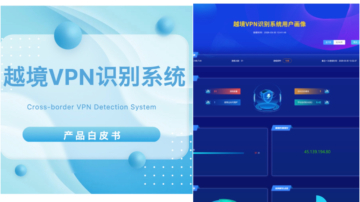
The article was originally published on the WeChat public account "Guoji Beisheng edu," under the title "Cross-Border VPN Detection System Product White Paper." After sparking controversy, it was quickly deleted — but the overseas outlet China Digital Times had already archived it.
So what does this article actually describe? Put simply, it's a system deployed inside the campus networks of Chinese universities, designed to identify when students and faculty are "circumventing the firewall." In plain terms, it's a campus surveillance tool.
And the background of the company that developed this system is anything but simple. "Guoji Beisheng edu" is the public account of Guoji Beisheng (Nanjing) Technology Development Co., Ltd, a subsidiary controlled by the 55th Research Institute of China Electronics Technology Group Corporation (CETC).
This "55th Institute" is a key military-industrial research institute directly under the CCP Central Committee, affiliated with China Electronics Technology Group Corporation — and CETC itself is a large, state-owned military-industrial conglomerate that has long served the CCP's military, national security, public security, electronic countermeasures, and communications surveillance systems.
So what this amounts to is: a surveillance system developed by a military-linked enterprise directly under the CCP Central Committee has been rolled out across universities throughout China, and is now monitoring the online behavior of both students and faculty.
What's more, the most notable thing about this system isn't its claim to be able to crack encrypted content — it's that it tries to identify people based on "behavioral patterns." In other words, what it monitors isn't "content," but "traces."
According to the article's description, this system isn't installed directly in the path of network traffic — it's placed alongside the key exit points of the campus network, functioning like a wiretap: it copies a duplicate of the data traffic flowing in and out as students and faculty go online, then monitors and analyzes it. In other words, it's like installing a hidden camera right beside the campus network's main gate. It won't necessarily block every single visit you make, but it will sit there watching you, quietly recording and analyzing your behavior.
The system also claims to be able to distinguish among various common methods of circumventing the firewall, and has pre-built a so-called "database of violation signatures." In other words, the system compares suspicious online behavior against the patterns in this database, then combines multiple indicators into a score to determine whether a given person is circumventing the firewall. If enough of these indicators match, the person gets flagged as a suspect.
What it records isn't limited to simply "whether someone is circumventing the firewall" — it also includes the device's network address, the user's account, the identifying code of the computer or phone, and what operating system and browser is being used. It even records which proxy server the connection routes through, what website that server disguises itself as, and its location.
The system then compiles all this data into what it calls a "violation user profile," assigns each suspect a score, and finally generates a leaderboard on its monitoring dashboard ranking who is most suspicious and which device is most suspicious.
This is genuinely sinister, and absurd to an extreme. In other words, when students and faculty at Chinese universities simply use a VPN to browse foreign websites, the CCP goes to enormous lengths to compile what amounts to a "most-suspected-of-circumventing-the-firewall leaderboard." The CCP claims to have so-called "institutional confidence" and "confidence in its own path" — yet it goes to such extraordinary lengths just to monitor faculty and students browsing external websites.
This also shows that the CCP is, in fact, deeply lacking in confidence. The CCP knows full well that once information starts flowing freely, its lies become very hard to sustain — because once young people have something to compare against, they inevitably start questioning the official Party-state narrative.
It's worth noting that within this surveillance system, content "related to politics" and content "related to religion" are actually flagged as "key tags," placed on the same level as content "related to terrorism." That is quite telling.
Because while "terrorism-related" content can at least be packaged as a security issue, why would "politics-related" and "religion-related" content be grouped together with it? In a normal country, a college student reading international news, researching political systems, or reading religious materials would simply be exercising basic freedoms.
This, in turn, proves the opposite point: under the CCP system, when people "independently" and "freely" try to understand politics or take an interest in religion, the authorities treat it as an extremely high risk. This also shows that the CCP's crackdown on circumventing the firewall has nothing to do with so-called cybersecurity — it is entirely about political control.
Analysts also point out that college students are precisely the group the CCP is most anxious to prevent from learning the truth. Ever since seizing power, what the CCP has feared most has always been intellectuals — because intellectuals think, and they can tell right from wrong. The CCP has launched campaign after campaign against intellectuals over the decades, all aimed at making them obedient and compliant. Especially after the June Fourth Tiananmen incident in 1989, Chinese university students have been kept under especially tight control, to prevent any aspirations toward freedom and democracy from taking root.
But as we know, circumventing the firewall is actually extremely common among Chinese college students today. The main reasons boil down to two things: first, college students are generally curious about new things and eager to hear different voices from overseas; second, many college students need to circumvent the firewall simply to do academic research — using Google Search or accessing overseas AI tools. Precisely because of this, college students have become a key target of CCP surveillance.
And this year, the CCP's crackdown on circumventing the firewall has clearly escalated. On one hand, the CCP's newly revised so-called "Cybersecurity Law" has already taken effect, and a so-called "Cybercrime Prevention Law" is also being drafted; on the other hand, multiple internal CCP documents leaked overseas show that the Cyberspace Administration of China and the Ministry of Industry and Information Technology are both stepping up governance of cross-border data connections.
One document shows that on April 16, the CCP held a seminar in Beijing titled "Studying the CCP Leader's Vision of a Cyber Power," after which multiple universities were reported to have launched checks targeting students who circumvent the firewall. One internet user posted on Reddit saying that a college classmate was invited by the local police station to "have tea" — a euphemism for informal police questioning — for circumventing the firewall.
And in March of this year, a new technical solution was also exposed, involving the detection of whether a computer has VPN or similar functions enabled — and it has now entered a substantive review stage.
Taken together, all of these developments reveal an entire stability-maintenance industry chain within the CCP system: policy comes first, then companies follow, technology gets deployed, universities serve as pilot sites, and finally the police step in to take over.
But analysts also point out that the CCP's blockade of information is a double-edged sword that cuts back against itself. Because information blockades create a fatal problem: they don't just block political information — they also block scientific, academic information, and international exchange. Countless open-source projects, research platforms, and technical communities are all blocked behind the CCP's firewall. So the tighter the CCP's blockade becomes, the more disconnected Chinese universities become from the rest of the world, and the more young Chinese people gradually lose the ability to engage normally with the outside world.
In other words, when the CCP treats information as an enemy, it ultimately ends up treating knowledge as an enemy too — and in the end, it strangles the nation's own vitality along with it.
Xiaojun, the technical lead at the Global Service Center for Quitting the Chinese Communist Party, also warns that the real danger of this system lies in how it links together campus networks, corporate networks, real-name verification, alert logs, and law enforcement procedures. In a controlled network environment like a university campus, its surveillance effect becomes even more powerful.
Put simply: a single instance of a student circumventing the firewall on the campus network could be flagged by the system, logged, turned into a report, and ultimately lead to administrative punishment or even a police interview — potentially affecting that student's future job prospects.
The reason the CCP is building this kind of surveillance system now is precisely that it cannot fully eliminate firewall-circumvention technology. Circumvention and blocking have always existed in a shield-and-spear relationship — every time blocking technology is upgraded, the technology to break through it is upgraded right along with it.
So what this CCP surveillance system is really trying to achieve is a chilling effect. As long as it makes most people afraid — makes students feel that "circumventing the firewall might get me caught," or even makes teachers afraid to look up material from foreign websites, afraid to share or discuss it — then the system's political goal has already been achieved.
In other words, it doesn't necessarily need to catch every single person — it just needs everyone to believe that they might get caught. That is precisely the insidiousness of the CCP's approach.
And today, the CCP's so-called stability maintenance has even become a business jointly driven by the power apparatus and vested interest groups.
As far back as 2017, the Ministry of Industry and Information Technology issued a so-called "Notice" requiring that companies and individuals not build or lease cross-border network channels — including VPNs — without approval from the telecommunications regulatory authority. Once this kind of regulation was issued, local governments, schools, and businesses all developed enormous demand for related governance products.
And once demand appears, business follows. State-owned enterprises, military-industrial-linked companies, cybersecurity firms, and local IT companies have all seized the opportunity, producing and packaging products around so-called "anti-circumvention" and "cross-border connection monitoring," then selling them to institutions within the system.
Zhang Xiaogang, a veteran pro-democracy activist and computer expert based in Australia, told The Epoch Times that this type of system mainly helps the CCP's state security, public security, and political-security apparatus identify who is circumventing the firewall — it is part of the broader stability-maintenance system. And today, it has become an entire industry, with many companies competing for stability-maintenance funding.
Looking at the root cause, why is the CCP so afraid of Chinese people circumventing the firewall? The most fundamental reason is that circumventing the firewall breaks its monopoly on information. Once people get around the firewall, they may see the truth about June Fourth, materials on the CCP's persecution of Falun Gong, Tibet, and Xinjiang, real comparisons between China's political system and those of other countries, and alternative explanations — entirely different from the official narrative — for China's current economic troubles and the international isolation it faces.
This information may not immediately drive people to rise up in resistance, but it will make them start to doubt the CCP authorities — and once that doubt takes hold, the CCP's brainwashing of the people is no longer complete. So what the CCP truly fears isn't VPN technology itself — it's the door to free information that lies behind it. The more it escalates its blockade, the more it reveals that it knows its own narrative cannot withstand comparison.
And the fact that the CCP uses military-industrial state enterprises to monitor university campuses shows that it regards young students as "potential enemies"; and the fact that it treats political and religious information as key surveillance targets shows that what it fears most is people having independent thought and independent belief.
So this "cross-border VPN detection system," in a sense, has become a diagnostic report on the CCP's fear. It diagnoses the pathology of this regime: a regime that sustains its rule by blocking information will never fear an external enemy as much as it fears its own people learning the truth.