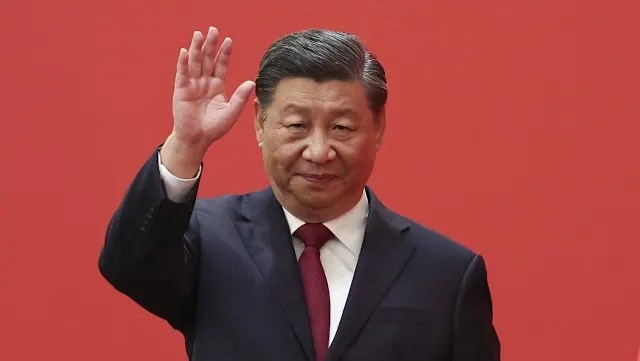
The CCP's 21st Party Congress is due to be held next year as scheduled, drawing renewed attention to how the leadership reshuffle might unfold. Most outside observers believe Xi Jinping will not voluntarily hand over power until his death, unless he is suddenly incapacitated by some unforeseen event during his term. Some scholars predict that if Xi were to suddenly fall, three major wild cards could end up breaking the CCP's iron law of succession.
This year marks the 60th anniversary of former CCP leader Mao Zedong launching the Cultural Revolution. Taiwan's Chang Fu Foundation for Educational and Cultural Affairs recently held a forum analyzing how the CCP regime might change in the "post-Xi Jinping era."
Wu Guoguang, a senior research fellow at Stanford University's Center on China's Economy and Institutions, said at the forum that non-democratic systems essentially oscillate back and forth between personal dictatorship, in which "one person has the final say," and oligarchy, in which "power is shared among a small group."
Reviewing the history of power struggles within the CCP, Wu noted that Mao Zedong seized power during the Yan'an period and pushed the cult of personality to its absolute peak during the Cultural Revolution, thoroughly sidelining figures such as Liu Shaoqi, Zhou Enlai, and Deng Xiaoping.
After Mao's death, his successor Hua Guofeng was unable to replicate strongman rule, and the CCP quickly reverted to an oligarchy in which power was shared among Hua Guofeng, Deng Xiaoping, Ye Jianying, and others.
But by the late 1970s, Deng Xiaoping had become the de facto top decision-maker, and in 1989 he alone decided to crush the Tiananmen Square protests — marking a return to personal dictatorship.
After Deng's death, power passed through the Jiang Zemin and Hu Jintao eras under the so-called "nine dragons managing the water" arrangement, in which supreme power was divided among the nine members of the CCP Politburo Standing Committee.
It was only after Xi Jinping came to power that power once again became "concentrated in a single figure." Xi has once more transformed the oligarchic system back into personal dictatorship.
As for how China's political system might evolve after Xi Jinping steps down or falls, Wu Guoguang made a bold prediction: whoever holds power after Xi will, with very high probability, revert to an oligarchic system of collective rule by a small group. But he also warned that three major wild cards could break this century-old iron law of CCP governance.
The first is "AI technology." Wu said the CCP is actively using advanced technology to reshape its mode of rule, and it is hard to predict what impact AI technology will have on the CCP's power structure in the future.
The second is social development. Chinese society has already become considerably more pluralistic, making a full return to monolithic, unitary rule very difficult. If Xi Jinping were to suddenly fall and this triggered people taking to the streets, whoever takes power next would face a severe test.
The third involves international factors and the Taiwan issue, as well as the friction the CCP's "wolf warrior" diplomacy has generated with the international community — factors that are bound to place enormous pressure on the CCP regime.