
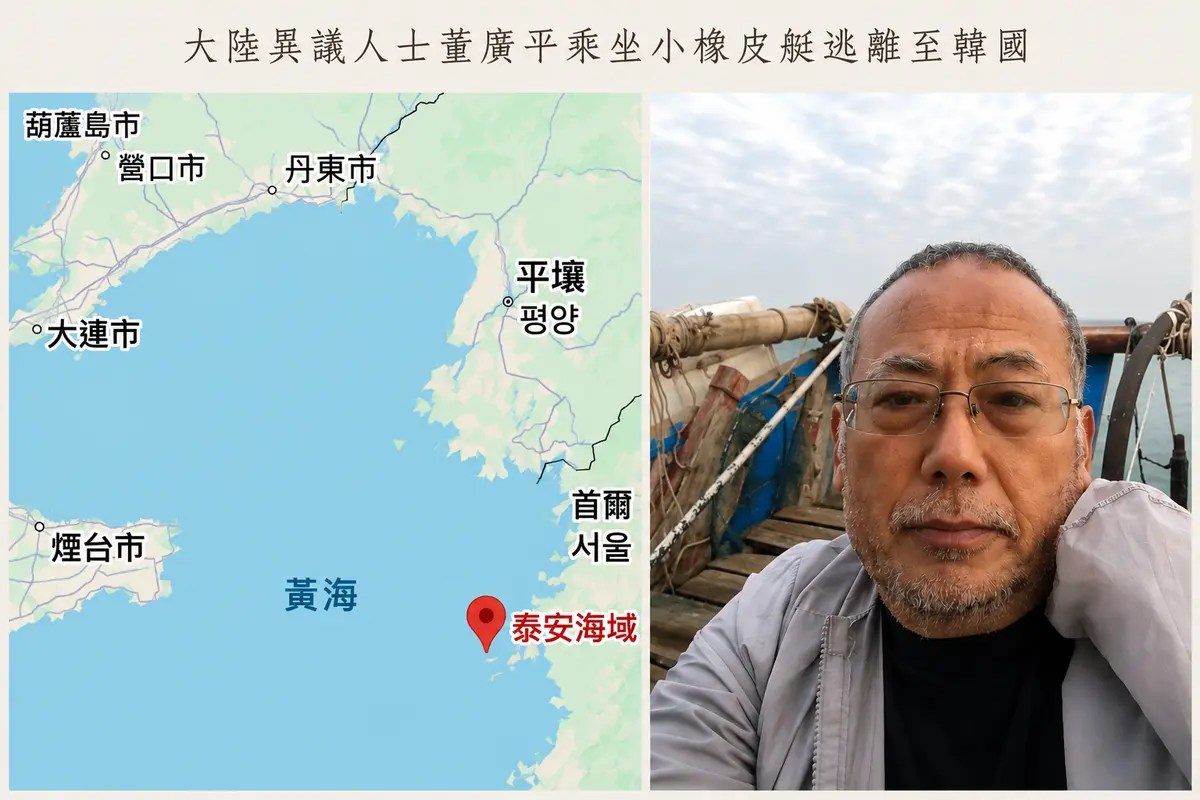
Dong Guangping, a well-known Chinese dissident, finally reached Canada last week after enduring tremendous hardship. The former police officer described his harrowing escape to the media, saying that freedom of speech in China “feels like living in a cage -- utterly suffocating.”
Dong Guangping, now 68, was once a police officer before facing long-term suppression by the CCP authorities for supporting the 1989 pro-democracy movement and continuing to advocate for political reform, and was imprisoned multiple times.
Speaking to the Associated Press in an online video interview from Toronto, Dong said that after his release from prison, he was unable to collect his pension, unable to renew his passport, and remained under constant police surveillance.
Speaking of freedom of speech in China, he said, “It feels like living in a cage -- utterly suffocating.”
He was dismissed from the police force after signing an open letter at the end of 1999 commemorating the tenth anniversary of the 1989 Tiananmen Square massacre. Between 2001 and 2004, authorities imprisoned him for three years on charges of “inciting subversion of state power.” After his release he continued his human-rights activism. From May 2014 to February 2015, he was detained again for taking part in June Fourth commemoration activities.
He had attempted to flee China several times before, but none of those attempts succeeded.
Overcoming the Fear of Death
Last month, he tried to escape once again. Recalling this latest journey, he said that in the early hours of May 24, he set out from Weihai, Shandong, on a gray inflatable boat fitted with an engine. His original destination was Japan, because he believed the Japanese government would not send him back to China.
The next day, however, thick fog rolled in. When he discovered that his phone -- his only means of navigation -- had just one bar of battery left, he was gripped with panic. His portable power bank was also dead. He quickly switched to his backup plan: heading for South Korea instead. He was filled with fear at the time, knowing that if the wind and waves picked up, his small boat could capsize at any moment. But with no way back, he had no choice but to set aside his fear of death and keep moving forward.
“Living conditions back home are so terrifying that being alive and being dead amount to almost the same thing, so there was no reason left to fear death,” he said, adding, “If I kept going forward, at least there was still a chance to survive.”
By nightfall, he spotted lights in the distance and steered toward them. The first boat he encountered didn't hear his cries for help and left. Later, he came across a fishing boat, and the fishermen agreed to pull him aboard. He asked them to contact the police. The South Korean Coast Guard subsequently detained him on suspicion of violating the country's immigration laws.
He was later sent to a refugee center in Incheon, a port city near Seoul. He said that earlier this month, the UN refugee agency contacted him through a video call.
A staff member at the refugee center later asked him about his height, weight, and eye color. He was initially somewhat worried, but later realized this was actually a good sign. His lawyer told him the request had come at Canada's diplomatic mission.
About a week later, he boarded a flight to Toronto, Canada, arriving on June 26.
“I was completely stunned, utterly astonished. It still feels like a dream. Everything happened so fast,” he said.
Dong Guangping said that since arriving in Toronto, he has finally felt at home, saying it is the first time in more than a decade that he has truly felt free.
“Not a trace of fear,” he said.
In 2015, Dong Guangping and his family fled to Thailand, but Thai authorities forcibly sent him back to China; his wife and daughter managed to settle in Canada. He was sentenced to three and a half years in prison in China. In 2020, he fled again, this time to Vietnam, and was again forcibly sent back by Vietnamese authorities.
For him, this struggle is far from over. He plans to continue calling for democratization in China.
“My ultimate goal is to see China achieve constitutional democracy,” he said.
In recent years, the CCP has tightened its control over protests and political dissent through sophisticated censorship and surveillance using facial recognition and other AI tools. This has driven some Chinese dissidents toward highly unconventional escape routes, rather than through neighboring countries like Vietnam or Thailand, whose track records on protecting Chinese dissidents have been inconsistent at best.
On August 16, 2023, Kwon Pyong, a Chinese rights activist of Korean ethnicity, crossed the Yellow Sea on a jet ski towing five fuel canisters, navigating with a compass and binoculars over roughly 300 to 400 kilometers, before finally reaching the vicinity of Incheon, South Korea.