
January 23, 2001 fell on the eve of Chinese New Year. At 2:41 p.m., in Beijing -- the political heart of CCP power -- flames suddenly leapt up in Tiananmen Square.
Xinhua reported that a man named Wang Jindong set himself on fire on the northeast side of the Monument to the People's Heroes, and moments later four women self-immolated on the north side of the monument as well; the incident left a woman named Liu Chunling dead on the spot, and the other four -- including Liu Chunling's 12-year-old daughter, Liu Siying -- severely burned.
Less than two hours after the incident, Xinhua issued an English-language wire report to foreign media with unusual speed, declaring that “all the self-immolators were Falun Gong practitioners.” A week later, CCTV's Focus Interview program aired a 30-minute special that pushed the number of “self-immolators” from five to seven, with close-up footage showing charred, blackened flesh mixed with the heart-wrenching screams of those on fire.
This “Tiananmen self-immolation hoax” instantly ignited fear, anger, and hatred among hundreds of millions of people who had no idea what had really happened.
The 2001 Tiananmen self-immolation hoax staged by the CCP. The scene of the self-immolation resembled a film set, with a crowd gathered around the cameras, watching police put out the flames as a kind of performance. (CCTV video screenshot)
Before this incident, the persecution of Falun Gong launched by Jiang Zemin's criminal clique in July 1999 had already dragged on for a year and a half. Yet despite exhausting every tactic, the CCP had failed to crush Falun Gong, and ordinary people both inside and outside the system had grown deeply weary of and disgusted by this baseless crackdown, making the persecution difficult to sustain. But the sudden emergence of the “self-immolation hoax” overnight instantly filled many people with fear toward Falun Gong. The CCP used it to escalate this illegal crackdown into an all-out campaign of genocide against an entire population.
Yet paper can never contain fire forever, and no wall of lies, however high, can block out the faint light of truth.
Twenty-five years have passed, and this “scam of the century,” which once poisoned the minds of countless people, has long since been stripped bare by forces of justice both inside and outside China. So what became of those who orchestrated and performed this hoax, both in front of the camera and behind the scenes?
A Sweeping Lie Exposed in Slow Motion
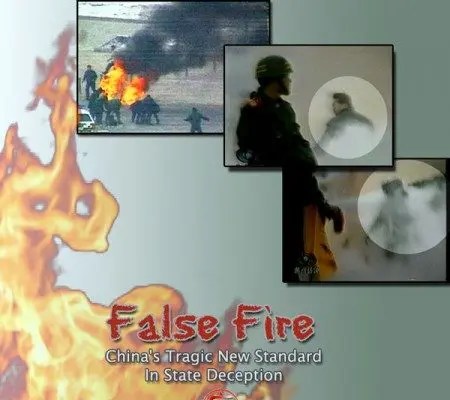
In 2003, a documentary titled False Fire won an Award of Excellence at the 11th Columbus International Film and Video Festival. The documentary contained no political slogans of any kind -- it simply slowed down, froze, and analyzed frame by frame the self-immolation footage aired on CCTV's Focus Interview, and in doing so exposed the holes in this carefully scripted “self-immolation” drama woven by the CCP's propaganda machine.
Flaw One: The Fatal Blunt Object
Slow-motion playback revealed that as the self-immolator Liu Chunling ran and struggled in the flames, a man wearing a military overcoat suddenly appeared holding a long, blunt object and struck her violently on the head from behind.
Slow-motion replay of CCTV's Tiananmen self-immolation footage confirms that Liu Chunling was beaten to death by police -- proof that the Tiananmen self-immolation was a hoax staged by the CCP. (Minghui.org)
Liu Chunling immediately collapsed, and an object resembling a stick flew upward and several meters away from behind her head. In other words, Liu Chunling -- whom CCTV claimed had “burned to death” -- had in fact died on the scene from being struck with a heavy object. When CCTV later rebroadcast this footage, it quietly cut out this incriminating moment of the blow.
Flaw Two: Unburned Hair and the “Sprite Bottle”
Anyone with basic common sense knows that human hair is extremely flammable and will turn to ash instantly upon contact with open flame. Yet in the footage, while Wang Jindong suffered burns across much of his body and his face was charred black, his hair -- the most flammable part of all -- remained perfectly neat and completely undamaged, without a single singed strand on his hairline or eyebrows.
More absurd still, the green plastic Sprite bottle between his legs, supposedly filled with gasoline, remained bright green and untouched after this so-called “high-temperature self-immolation,” without even the slightest deformation from heat at its edges.
In the CCP's staged “Tiananmen self-immolation” hoax, “self-immolator” Wang Jindong suffered severe burns and his clothes were charred, yet his hair, eyebrows, and the plastic Sprite bottle holding gasoline between his legs remained completely intact. (CCTV video screenshot)
A Minghui.org report from May 2003 revealed that Li Yuqiang, the female Focus Interview reporter, once “interviewed” illegally detained Falun Gong practitioners at Hebei's Provincial Legal Education Training Center; when a practitioner confronted her directly about the giveaway of the Sprite bottle, she admitted on the spot: “That was reshot footage we added later. If we'd known it would give it away, we wouldn't have used that shot.”
Flaw Three: The Singing Tracheotomy Patient
Twelve-year-old Liu Siying became a key figure the CCP used to stir up public hatred toward Falun Gong. CCTV reporter Li Yuqiang went to the hospital and filmed little Siying wrapped head to toe in bandages.
In the program, doctors claimed that Siying had just undergone a tracheotomy due to severe burns to her respiratory tract. Yet just four days after this supposed operation, Siying appeared before the camera speaking clearly and fluently to the reporter, and even sang a song into the recorder.
This is, by the standards of modern clinical medicine, simply impossible. One American Western-medicine doctor, after watching the report, stated bluntly: “There's no way someone can recover their ability to speak this quickly after a tracheotomy. Either Xinhua is lying, or it has created a medical miracle.”
Four days after undergoing a tracheotomy for “severe burns,” Liu Siying was interviewed by a reporter in her hospital room -- with no protective gown or mask worn by the reporter -- and was even able to sing. (CCTV video screenshot)
Strangely enough, Liu Siying suddenly died on the very day she was discharged from the hospital, March 17, 2001.
Flaw Four: Police Patrolling With Fire Extinguishers on Their Backs
Tiananmen Square normally has no fire extinguishers on hand, and police there had never before been seen patrolling with fire extinguishers strapped to their backs. The nearest building to the site, the Great Hall of the People, is a 20-minute round trip away. Yet police appeared on camera carrying large quantities of fire extinguishers and fire blankets within 90 seconds of the incident.
One European journalist later questioned: “I've never seen police at Tiananmen Square patrolling with firefighting equipment on their backs -- why was that day different?”
In 2001, the armed police carrying out routine patrol duties at Tiananmen Square were not carrying fire extinguishers. (Stephen Shaver/AFP via Getty Images)
Flaw Five: Impossibly Skillful Tracking Footage
At the same time, in response to what was supposedly a sudden, unplanned self-immolation, CCTV reporters carrying professional cameras managed to capture remarkably skillful tracking footage on the scene -- wide shots, medium shots, and close-ups, all perfectly captured, even including the farcical, incriminating shot of Wang Jindong shouting slogans as he burned, with a police officer standing behind him holding a fire blanket, apparently “waiting for him to finish shouting before covering him.”
The CCP's official “Tiananmen self-immolation” footage captures a supposedly sudden event with a complete range of wide, medium, and close-up shots. (CCTV video screenshot)
Afterward, in an attempt to explain this away, CCTV claimed that the close-up footage came from a videotape confiscated from a CNN reporter. But CNN quickly and clearly responded: “Impossible” -- because their reporter had already been detained by police and prevented from filming shortly after the incident began.
The Washington Post: The Flames of Self-Immolation Illuminate China's Dark Underside
Twelve days after the incident, The Washington Post ran a front-page investigative report titled “Human Fire Ignites Chinese Mystery,” in which reporter Philip Pan traveled personally to Liu Chunling's hometown of Kaifeng, Henan, to investigate. Neighbors there consistently told the same story: Liu Chunling had worked at a nightclub, had once beaten her adoptive mother and her daughter, and “no one had ever seen her practice Falun Gong.”
The Financial Times: No Evidence the Self-Immolators Were Falun Gong Practitioners
Britain's Financial Times stated bluntly: “There is no evidence that the self-immolators were Falun Gong followers.” Reuters wrote: “Beijing is using the horrifying images of charred bodies as its latest weapon in a media war against Falun Gong.”
International Education Development: The Incident Was Staged by the Government Itself
On August 14, 2001, the International Educational Development organization delivered a formal statement at a United Nations meeting: “Our investigation indicates that it is precisely the Chinese Communist authorities who are truly harming lives... We obtained a video of this incident [the Tiananmen self-immolation case] and concluded from it that the event was staged by this very government.” The statement called on the entire international community to “urgently intervene against the CCP authorities' acts of state terrorism.” The statement has since been placed on record with the United Nations.
CNN Producer: No Children Were Seen Among the Self-Immolators
The identities of the self-immolators in Tiananmen Square were also called into question by a CNN producer who was present at the scene at the time, regarding the Chinese government's claim that 12-year-old Liu Siying had been urged by her mother to set herself on fire. She stated that she did not see any children among the self-immolators at the scene.
What Became of Those Who Took Part in This Hoax
Yet good and evil are always repaid in the end. According to years of continuous reporting by Minghui.org, several key figures involved in planning, producing, and disseminating this hoax later met with various forms of misfortune.
Chen Meng, then deputy director of CCTV's News Commentary Department and producer of Focus Interview, was the producer responsible for the “Tiananmen self-immolation” hoax within CCTV -- he died of stomach cancer in 2008 at just 47 years old.
Chen Meng, former producer of CCTV's Oriental Horizon program, suddenly died of cancer at age 47. (Internet photo)
Luo Jing, former anchor of CCTV's Xinwen Lianbo (News Broadcast), repeatedly reported on the “Tiananmen self-immolation” story during his lifetime -- he died of lymphoma in 2009 at just 48 years old. Before his death, his mouth was covered in ulcers so severe that, according to his attending physician, even taking a sip of water or swallowing a pill felt like “swallowing razor blades.”
Luo Jing, former CCTV anchor and deputy section chief of the news editorial department. (Epoch Times archive)
Li Dongsheng, former deputy director of the CCP's State Administration of Radio, Film and Television, was one of the main planners of this hoax and personally took part in and oversaw the entire process of broadcasting the “self-immolation” footage to the world -- he was sentenced to 15 years in prison in 2015 on corruption charges.
Li Dongsheng (right), former director of the 610 Office and deputy minister of public security, under investigation. (Getty Images)
Conclusion
Twenty-five years on, the “Tiananmen self-immolation” hoax has become a carefully staged deception recognized as such by the international community -- forever etched into this chapter of history alongside the unburned Sprite bottle, the singing tracheotomy patient, and the arm swinging into view in slow motion. And the fates of those who planned and carried out this hoax have, one by one, come to light as time has passed.