
August 1 this year marks the 99th anniversary of the founding of the CCP's military, and also the 14th year of CCP leader Xi Jinping's rule. Outside observers note that although Xi Jinping, who also chairs the Central Military Commission, has continually purged military leadership, he still has not fully brought the armed forces under his control -- and this latent political instability remains the single greatest threat to his long-term hold on power.
At a recent Politburo group study session, Xi Jinping declared that the military's anti-corruption struggle must be pushed forward in depth, in order to “ensure that the gun -- the military -- always obeys the Party's command.”
Immediately afterward, in his latest “August 1st” speech, Defense Minister Dong Jun once again loudly insisted that the military must “heed the Party's words and follow the Party,” must “fully implement the system of the Chairman of the Central Military Commission taking overall responsibility,” and must “strengthen political army-building.”
Independent commentator Cai Shenkun, writing on X, analyzed that Dong Jun's continued high-profile statements reflect a profound political reality underneath: after 14 years in power, Xi Jinping still has not fully brought the military under his control, and the latent political instability within its ranks remains the greatest threat to his long-term rule.
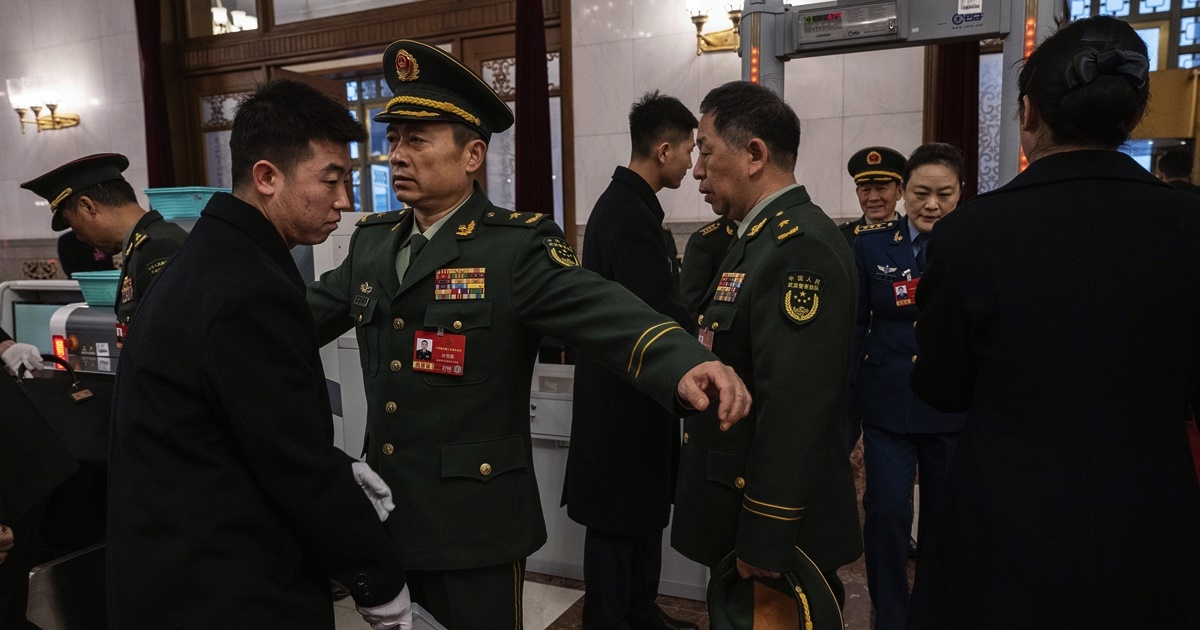
Since taking power in 2012, Xi Jinping has never stopped purging the military -- in particular, senior generals he personally promoted have been purged one after another. At present, the Central Military Commission consists of only Xi Jinping himself as chairman and Zhang Shengmin, promoted to vice-chairman last October; all five of the commission's other members have since fallen.
On May 7 this year, two former defense ministers, Li Shangfu and Wei Fenghe, were both handed suspended death sentences.
In January this year, Zhang Youxia, First Vice Chairman of the Central Military Commission, and Liu Zhenli, Chief of the Joint Staff Department of the Central Military Commission, fell from power at the same time.
On October 17 last year, Central Military Commission Vice Chairman He Weidong and Director of the Commission's Political Work Department Miao Hua, along with seven other full generals, were expelled from the Party and the military. The others included He Hongjun, former executive deputy director of the Commission's Political Work Department; Wang Xiubin, former executive deputy director of the Commission's Joint Operations Command Center; Lin Xiangyang, former commander of the Eastern Theater Command; Qin Shutong, former political commissar of the Army; Yuan Huazhi, former political commissar of the Navy; Wang Houbin, former commander of the Rocket Force; and Wang Chunning, former commander of the People's Armed Police.
A tally by the Washington-based think tank the Center for Strategic and International Studies shows that since 2022, roughly 100 senior CCP military officers have been removed from their posts or vanished from public view, affecting about half of all senior military leadership positions -- a scale of turmoil unprecedented in modern Chinese history.
Cai Shenkun believes that Xi Jinping's purge of Zhang Youxia signals a complete break between Xi and the special political interest bloc within the military made up of “red second generation” and “military second generation” princelings.
Du Wen, a former CCP system insider, wrote on X that Xi Jinping's failure to bring the military fully under control after 14 years in power stems from his reliance on personal centralization of power to solve institutional problems, on political loyalty in place of professional competence, and on repeated purges to paper over organizational dysfunction. He has seized control of military power, but failed to build trust; he has forced the generals into submission, but failed to win the hearts of the troops.
Du Wen said that a cold, suspicious dictator (Xi Jinping) who demands absolute loyalty from everyone else while offering no one any sense of security can produce obedience, but cannot build genuine loyalty; he can make everyone bow their heads, but cannot make everyone act as one in a moment of crisis.