
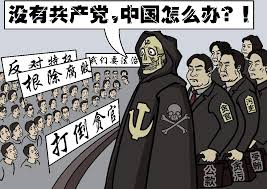
The communist movement, which raged noisily for more than a hundred years, brought humanity nothing but war, poverty, bloodshed, and despotism. With the collapse of the Soviet Union and the communist parties of Eastern Europe, this absurd drama that inflicted such harm upon the world finally drew to a close at the end of the last century -- by then, hardly anyone, from ordinary citizens to the Party's own general secretaries, still believed in the nonsense of communism.
Communist regimes, neither founded on the 'divine right of kings' nor on 'democratic election,' now face an unprecedented challenge to the legitimacy of their rule, now that the very faith they depended on for survival has been utterly shattered.
Rather than bowing to the tide of history and stepping voluntarily off the historical stage, the Chinese Communist Party has instead deployed every rogue tactic it accumulated across decades of political campaigns -- a complete inventory of evil -- launching yet another round of frenzied struggle to search for legitimacy and claw its way back from the brink of death.
Whether it calls it 'reform' or 'opening up,' the CCP's real purpose is simply to cling, with all its might, to its collective interests and its dictatorial hold on power. China's economic development over the past twenty years -- the fruit of the Chinese people's own hard labor, achieved even while still tightly bound by the Party's constraints -- has not moved the CCP to lay down its butcher's knife; instead, the Party has stolen these achievements as capital to bolster its own claim to legitimacy, making its habitual rogue conduct all the more deceptive and disorienting. Most terrifying of all, the CCP is now throwing everything it has into destroying the moral foundations of the entire Chinese nation, attempting to turn every Chinese person, to one degree or another, into some kind of rogue themselves -- all so as to create an environment in which the Party itself can 'keep pace with the times' and continue to survive.
For the sake of the nation's long-term peace and stability, and to help China enter, as soon as possible, an era without the Communist Party and reclaim the nation's former glory, it has become especially important, at this moment in history, to see clearly why the Communist Party behaves like a gang of rogues, and to understand its rogue nature for what it truly is.
I. The Communist Party's Rogue Nature Has Never Changed
(1) Whom Does the Communist Party's Reform Actually Serve?
Throughout history, every time the CCP has faced a crisis, it has displayed some sign of improvement, stirring up fresh illusions among the people about the Party. Without exception, every one of these illusions has eventually burst. Today, beneath the CCP's short-sighted, showcase facade of economic prosperity, people have once again fallen prey to illusions about the Communist Party. But the fundamental conflict between the Party's own interests and the interests of the nation and its people guarantees that this prosperity cannot last. The 'reform' it promises exists solely to preserve CCP rule -- new packaging around the same old medicine, a lame, half-measure reform at best. Behind this deformed development lurks an even greater social crisis, and once that crisis erupts, the nation and its people will once again be struck a tremendous blow.
As CCP leaders pass from one generation to the next, they no longer have the credentials that come from having fought to win the country, and they command less and less real authority to rule it. Yet as a collective whole, in the midst of this crisis of legitimacy, the Party's defense of its own collective interests has increasingly become the fundamental guarantee protecting each individual member's personal interests. To imagine that such a party -- one built on private self-interest and subject to no restraint whatsoever -- could ever develop without further turmoil is nothing but wishful thinking.
Let us look at what the CCP's own People's Daily has to say:
'The dialectics of history have taught Chinese Communists this: what should change, must change -- without change, decline follows; what should not change, must never change -- for to change it would be self-destruction.' (Front page, July 12, 2004)
And what is it that must never change? 'The Party's basic line of "one central task, two basic points" must govern us for a hundred years, and cannot be shaken.' (Front page, July 12, 2004)
People may not fully understand what this 'central task' and these 'basic points' actually are, but everyone understands that this evil communist spirit remains utterly unrepentant in its determination to defend its own collective interests and its dictatorial rule. It is true that communism has collapsed across much of the world -- a fate destined for a doctrine already at death's door. But the closer a thing comes to its own destruction, the more destructive its death throes become. Negotiating democratic reform with the Communist Party is like asking a tiger to give up its own hide.
(2) 'Without the Communist Party, What Would Become of China?'
Just as the Communist Party is heading toward its own decline, people have made a startling discovery: this evil-spirit-possessed Party has, over decades, using its endlessly shifting rogue tactics, injected its own evil elements into every corner of ordinary people's lives.
Back then, so many people wept before Mao Zedong's portrait, repeating the same lament over and over: 'Without Chairman Mao, what will become of China?' Ironically, more than twenty years later, at a moment when the Communist Party has lost its own claim to legitimacy, the CCP's new media propaganda has once again stirred up this same anxious question among people: 'Without the Communist Party, what will become of China?'
In reality, the CCP's all-pervasive style of rule has stamped its imprint deep into our culture, our very way of thinking, and even the standards by which we judge the Party itself -- to the point where these standards are simply the CCP's own logic. If the Party once controlled people's thinking through indoctrination, now is the moment it reaps the harvest of that effort. Because everything it indoctrinated people with has already been fully absorbed, transformed into people's own cells, people now spontaneously think according to the CCP's own logic, putting themselves in the Party's shoes to judge right and wrong from the Party's own vantage point. On the June Fourth shootings, some say: 'If I were Deng Xiaoping, I'd have used tanks to suppress them too.' On the persecution of Falun Gong, some say: 'If I were Jiang Zemin, I'd have wiped them out too.' On the banning of free speech, some say: 'If I were the Communist Party, I'd have to do the same thing.' Truth and conscience are gone -- all that remains is the Communist Party's own logic. This is one of the most insidious and vicious tactics within the CCP's rogue nature. As long as this poison still lingers within people's minds, the Party can keep drawing energy from it to sustain its own rogue existence.
'Without the Communist Party, what would become of China?' -- this very way of thinking is exactly what the CCP has always dreamed of achieving: getting people to think about every problem using its own logic.
The Chinese nation had already traveled through five thousand long years of civilization without the Communist Party's existence, and no society anywhere in the world has ever halted its own forward progress simply because one dynasty collapsed. Yet after decades of CCP rule, people have grown numb to this simple truth. Through years of relentless propaganda comparing the Party to a mother, and through its all-pervasive presence in every corner of political life, the CCP has made people forget how to even imagine what life would be like without it.
China did not collapse without Chairman Mao. Will it really collapse without the Communist Party?!
(3) Who Is the True Source of Chaos?
Many people have a fairly clear understanding of the CCP's rogue behavior and feel a real revulsion toward it, disgusted by communism's whole apparatus of persecuting and deceiving people. But ordinary people have been so thoroughly frightened by the Party's political campaigns and the chaos they have repeatedly stirred up that they now dread the very prospect of chaos in China. Whenever the CCP threatens the public with the specter of 'chaos,' people, feeling utterly powerless against the Party's raw power, often have no choice but to silently acquiesce to its rule.
In truth, it is the CCP, with its several million troops and armed police, that is the actual source of 'chaos' in China. Ordinary people have no reason to create 'chaos,' and even less standing to do so. It is only the Communist Party, swimming against the tide of history, that grows so jumpy and paranoid it drags the entire nation into chaos. Slogans such as 'stability trumps everything' and 'nip every destabilizing factor in the bud' have become the theoretical foundation for the CCP's suppression of its own people. Who is really China's greatest source of instability? It is the Chinese Communist Party itself, running its dictatorial tyranny. The very Party responsible for creating chaos then turns around and uses the threat of 'chaos' to blackmail the people -- this is exactly how a gang of rogues always operates.
II. Economic Development as the CCP's Sacrificial Offering
(1) Stealing Credit for Achievements Created by the People's Own Hard Labor
The CCP believes its 'legitimacy' rests on these past twenty-some years of economic development. In truth, this development has been built up, bit by bit, by the Chinese people themselves, once they were granted just a slight loosening of the Party's constraints -- it has nothing whatsoever to do with the CCP. Yet the Party propagandizes it as entirely its own achievement, demanding the people's undying gratitude, as though none of it would exist without the Party. As everyone knows, countless other countries without any Communist Party at all have long since enjoyed a far better version of everything China has achieved.
When athletes win Olympic gold medals, they are made to thank the Party, and the Party itself does not hesitate for a moment to seize upon the false crown of being a 'great sporting nation' as further capital to sing the praises of its own brilliant leadership. When China was badly battered by the SARS epidemic, the Party in the end declared that it was only 'thanks to the Party's basic theory, basic line, basic program, and basic experience' that the virus was defeated (in the words of the People's Daily). When the Shenzhou 5 spacecraft reached orbit -- an achievement that truly belonged to the nation's own aerospace scientists and engineers -- the CCP claimed it as proof that only the Party could lead the Chinese people into the ranks of the world's great powers. Even the right to host the 2008 Olympics, an olive branch the West extended to encourage improvements in China's human rights record, was seized upon by the CCP as another gilding for its own 'legitimacy' and used as a pretext for an unprecedented crackdown on its own people. And the 'enormous market potential' that so excites foreigners, which in truth derives entirely from the consuming power of 1.3 billion Chinese people, has likewise been claimed by the CCP as its own possession, wielded as a sharp weapon to force the West into cooperating with its rule.
Whenever something bad happens, it is always the work of 'reactionary forces' and people with 'ulterior motives'; whenever something good happens, it was only ever accomplished 'under the Party's leadership.' Any achievement whatsoever is seized upon by the CCP to gild the legitimacy of its rule. Even certain disasters, the Party manages to spin into something that serves its own ends. For example, once the truth about the spread of HIV/AIDS -- long suppressed under a tight CCP information blackout -- could no longer be contained, the Party abruptly transformed itself, carefully orchestrating a propaganda offensive spanning everyone from famous actors to the Party's own general secretary, instantly reinventing itself, the very culprit behind the crisis, as a savior to patients, a nemesis of AIDS, a champion in the fight against human disease. Faced with a matter of such life-and-death gravity, all the Party could think to do was exploit it to whitewash itself. Only a gang of rogues like the CCP could commit such an act -- brazenly seizing credit while treating human life with such utter disregard.
(2) Short-Term Thinking Leads to the 'Late-Development Disadvantage'
Facing a serious crisis of legitimacy, the CCP's reform and opening-up policy, pursued purely to preserve its own rule, has been marked by short-sighted, quick-fix thinking that has trapped China in what is known as the 'late-development disadvantage.'
The concept of the 'late-development disadvantage,' as opposed to the 'late-development advantage,' holds that because a less-developed country starts out behind, it has the opportunity to imitate more advanced countries in many respects. Such imitation can take two forms: imitating institutions, or imitating technology and industrialization models. Imitating institutions is far more difficult, since institutional reform inevitably threatens certain vested interests, so less-developed countries tend to favor imitating technology instead. Technological imitation, while it can produce visible results in the short term, leaves behind many hidden dangers for long-term development, and can even lead to long-term developmental failure.
It is precisely this failed path of the 'late-development disadvantage' that the CCP has followed. The 'technological imitation' of the past twenty-some years has produced certain achievements, which the CCP has seized upon as capital to demonstrate its own legitimacy to the public -- thereby further entrenching its resistance to any political-system reform that might threaten its own interests, and choosing, again and again, to sacrifice the nation's long-term development for the sake of its own short-term survival.
(3) The CCP's Economic Development Has Come at a Devastating Cost
The CCP is forever boasting about its economic progress, yet in reality China's economic standing in the world today is actually lower than it was during the reign of the Qing dynasty's Emperor Qianlong. Under Qianlong, China's GDP accounted for 51% of the entire world's total. In the early years of the Republic, when Dr. Sun Yat-sen founded it, China's GDP still made up 27% of the world total; by the eleventh year of the Republic, it still stood at 12%. By the time the CCP established its regime, China's GDP had fallen to just 5.7% of the world total, and by 2003, it had fallen further still, to less than 4%. And unlike the decades of war-driven economic decline suffered under the Nationalist government, the decline under the CCP occurred largely during peacetime.
In pursuit of its own legitimacy, the CCP has today pursued a short-sighted, lame economic reform that places the Party's collective interests above all else, and the nation has paid a devastating price for it. More than twenty years of rapid economic growth have, to a great extent, been built on the excessive, extractive overconsumption -- even outright waste -- of resources, very often at the cost of the environment. A considerable portion of China's GDP figures has been achieved by sacrificing the opportunities of future generations. In 2003, China contributed less than 4% of total world economic output, yet consumed fully one-third of the world's total steel and cement (Xinhua News Agency, March 4, 2004).
From the 1980s to the end of the 1990s, the area of land turning to desert in China each year grew from just over 1,000 square kilometers to 2,460 square kilometers. In 1980, China's per capita arable land stood at nearly 2 mu; by 2003 it had shrunk to just 1.43 mu. Amid a frenzied wave of land enclosure, the nation's total arable land shrank by 100 million mu in just a few recent years, while the land seized in this frenzy achieved a utilization rate of just 43%. China's total wastewater discharge currently stands at 43.95 billion tons, exceeding the environment's carrying capacity by 82%. Among the country's seven major river systems, 40.9% of the water is unfit even for human or livestock consumption, while 75% of lakes show some degree of eutrophication... The tension between the Chinese people and the natural world has never been as acute as it is today. Growth of this kind is more than China, or even the entire world, can sustain (Xinhua News Agency, February 29, 2004). Those intoxicated by the gleaming skyscrapers before their eyes may still be blissfully unaware of the ecological crisis drawing ever closer. But once nature finally exacts its revenge upon humanity, the blow it deals the Chinese nation will be nothing short of catastrophic.
By contrast, Russia, having abandoned communism, pursued economic and political reform simultaneously, and after a brief period of pain, set out on a path of rapid development. Between 1999 and 2003, Russia's GDP grew by a cumulative 29.9%, and living standards for ordinary citizens improved markedly. Western business circles not only began discussing the 'Russian economic phenomenon,' but started pouring into Russia as an emerging investment hotspot on a large scale. Russia's ranking among the world's most attractive investment destinations rose from seventeenth in 2002 to eighth in 2003, entering the world's top ten most popular investment destinations for the first time.
Even India -- a country most Chinese people picture as poor, backward, and beset by constant ethnic conflict -- has seen its development accelerate markedly since its 1991 economic reforms, with annual economic growth rising to between 7% and 8%. India possesses a relatively complete legal framework for a market economy, a healthy financial system, a relatively mature democratic system, and a steady national temperament, and the international community widely regards it as a country with enormous development potential.
By contrast, the CCP has pursued economic reform alone, without any political reform, and beneath the facade of short-term economic prosperity, has blocked the natural process of 'institutional evolution.' This incomplete, half-hearted reform has left Chinese society ever more deformed and social tensions ever sharper, with none of the development the people have achieved today enjoying any real institutional protection. The CCP's own privileged elite, meanwhile, has exploited its power to line its own pockets throughout the process of privatizing state-owned assets.
(4) The CCP's Repeated Betrayals of the Peasantry
The CCP's rule over China was won on the backs of the peasantry, and the people of its old revolutionary base areas gave everything they had to the Party's cause. Yet once the CCP seized power, the peasantry found itself subjected to severe discrimination.
After coming to power, the CCP established a deeply unjust system: the household registration system, which forcibly divided the population into 'agricultural' and 'non-agricultural' residents, needlessly splitting a single nation into two opposed classes. Peasants have no medical insurance, no unemployment benefits, no pension, and cannot obtain loans. Peasants make up China's poorest class, and yet they also bear its heaviest tax burden. They must pay into public accumulation funds, public welfare funds, administrative management funds, education surcharges, family-planning fees, militia-training fees, rural road-construction fees, and veteran-support fees. On top of this, they must also hand over grain quotas, agricultural taxes, land taxes, special-product taxes, slaughter taxes, and more -- not to mention a whole range of arbitrary levies and assessments. Every single one of these taxes and fees is something the 'non-agricultural' population never has to pay at all.
In early 2004, Premier Wen Jiabao issued the government's 'Document No. 1,' revealing that Chinese peasants, agriculture, and the countryside were facing their most difficult period since the start of reform and opening-up, with the incomes of most peasants stagnating or even declining, growing poorer by the day, as the income gap between urban and rural residents continued to widen.
At a forestry farm in eastern Sichuan, higher authorities allocated 500,000 yuan for tree-planting and afforestation. The farm's own leadership first pocketed 200,000 yuan for themselves, then subcontracted the remaining 300,000 yuan down through layer after layer of officials, each skimming off their own cut, until only a paltry remainder was left to distribute among the local peasants who actually did the planting. The government need not worry that peasants might refuse to plant trees because the pay was too low -- they are so poor that, no matter how meager the wage, they will always do the work anyway. This is the very same logic behind why 'Made in China' goods are so cheap.
(5) Using Economic Interests to Blackmail Western Nations
Many people believed that trade with China would promote human rights, free speech, and democratic reform there. More than a decade on, this has proven to be pure wishful thinking. The clearest example lies in the very principles of doing business: the fairness and transparency prized in the West have, in China, become a matter of personal connections, bribery, and corruption. Many major Western corporations have become eager vanguards fueling corruption in China, and some have even become a shield behind which the CCP tramples human rights and suppresses its own people.
Playing the economic card is simply the diplomatic expression of the CCP's rogue tactics. Whether an aircraft order goes to France or to the United States depends entirely on whether that country has dared to criticize the CCP over human rights or freedom of speech. China's economic interests have thoroughly ensnared no small number of Western businessmen and politicians. Certain North American internet companies have supplied specialized products to help the CCP censor the internet; certain web portals, eager to gain entry into the Chinese market, voluntarily impose 'self-discipline,' filtering out any information the CCP dislikes.
According to statistics from China's Ministry of Commerce, by the end of April 2004, the cumulative amount of contracted foreign investment utilized nationwide had reached 990.13 billion US dollars -- a clear indication of just how significant a transfusion of economic lifeblood foreign investment has provided to the CCP. Yet throughout this transfusion, foreign capital has never brought the principles of democracy, freedom, or human rights to the Chinese people as any kind of fundamental condition. The 'unconditional' cooperation of foreign businesses and foreign governments, along with the flattering deference of certain nations, has instead become propaganda capital the CCP uses to bolster its own rule. Beneath the veneer of economic prosperity, collusion between officials and businessmen, the carving up of state assets, and the obstruction of political reform have all reached truly extreme proportions.
III. The CCP's Brainwashing Techniques Evolve From 'Crude and Blatant' to 'Refined and Sophisticated'
One often hears people say something like, 'I know the CCP has told endless lies in the past, but this time it's telling the truth.' Ironically, if we turned back the clock, we would find that people said exactly the same thing at nearly every major moment of error throughout CCP history. This is simply the deceptive skill in lying to the people that the CCP has honed over the course of decades.
As people have developed some resistance to the crude, exaggerated lies of the 'launching satellites' era (a reference to the fabricated production claims of the Great Leap Forward), the CCP's propaganda of lies has likewise evolved toward becoming more 'refined' and 'professional.' Lies have shifted from the sloganeering propaganda of the past toward something more 'gradual' and 'meticulously detailed' -- and especially under a tight information blackout, lies built upon selectively chosen 'facts' now mislead the public in ways that are even more disorienting and harmful than the old crude exaggerations ever were.
The English-language magazine ChinaScope published a case-study analysis in October 2004 of how the CCP now fabricates lies and conceals the truth using more 'refined' techniques. During the SARS outbreak in mainland China in 2003, the outside world widely suspected the CCP of covering up the epidemic, but the Party repeatedly denied it. To determine whether the CCP's reporting on SARS had actually been objective, the article's author read through all 400-plus articles on SARS published on Xinhuanet from the start of the year through early April. From these articles, the author learned that: as soon as SARS appeared, experts from the central government down to the local level had promptly convened, diagnosed, and treated patients, all of whom had already recovered and been discharged; bad actors had tried to stir up panic-buying, but the government had promptly debunked the rumors, stamping them out and safeguarding social stability; a small handful of anti-China forces abroad had baselessly suspected the Chinese government of a cover-up, but the vast majority of nations and peoples did not believe them, and the Guangzhou International Trade Fair was set to draw the largest number of exhibitors in its history; foreign tourists testified that traveling in China was perfectly safe; and, most tellingly, (deceived) World Health Organization experts had themselves stated publicly that the CCP had cooperated well, taken appropriate measures, and that there was no problem at all -- with these same experts (whose visit had been delayed by more than 20 days) then finally approved to conduct an open inspection in Guangdong. Having read through all 400-plus of these articles, the author felt that the CCP had been utterly transparent throughout these four months, absolutely responsible for public health -- how could it possibly have been hiding anything? It was only on April 20, when the State Council Information Office held a press conference announcing that SARS had erupted nationwide in China -- an implicit admission that the epidemic had indeed been concealed all along -- that the author finally understood the truth, having witnessed firsthand the CCP's ever-evolving, 'keeping pace with the times' rogue tactics of deception.
During Taiwan's presidential elections, the CCP employed this same 'gradual,' 'patiently guiding' method to suggest to the public that electing a president would lead to: rising suicide rates, stock market crashes, an increase in 'strange illnesses,' mental breakdowns, mass emigration from the island, families turning against each other, listless living, deserted markets, random shootings in the streets, disputes and protests, mobs surrounding the presidential office, total chaos, political farce, and so on -- day after day, feeding the mainland public a steady diet of these images of turmoil, so that people would spontaneously arrive, of their own accord, at the conclusion: 'All of this chaos is caused by elections,' and 'We must never, ever attempt democratic elections ourselves.'
On the question of Falun Gong, the CCP's smear tactics have reached an entirely new level of sophistication. Everything is staged with such convincing realism, one fabrication rolled out after another, that it becomes almost impossible for ordinary people not to believe it. The CCP's rogue methods of deception have achieved something remarkable: getting the deceived to willingly and enthusiastically believe the Party's lies of their own accord, all while the deceived remain convinced they themselves possess the truth.
Over these several decades, the CCP's brainwashing propaganda has grown ever more 'refined' and 'microscopic' in its deceptive craft -- a natural extension of its fundamentally rogue, deceptive nature.
IV. The CCP's Human Rights Disguise
(1) From Fighting for Democracy to Seize Power, to Dictatorial Rule and a Human Rights Disguise
'In a democratic nation, sovereignty rightfully belongs to the people -- this is a matter beyond question. If a nation calls itself democratic while sovereignty does not rest in the hands of the people, this is no legitimate path at all, but a perversion, and such a nation is not truly democratic... Without ending one-party rule, without implementing universal suffrage for the people, how can democracy ever be achieved? Give the people's rights back to the people!'
You might assume this was a manifesto from some hostile foreign force denouncing the CCP. You would be wrong -- the declaration above was published in the CCP's own official newspaper, Xinhua Daily, on September 27, 1945.
The very same CCP that once loudly championed 'universal suffrage' and demanded 'giving the people's rights back to the people,' once it seized power, made even the topic of 'universal suffrage' into a taboo subject -- while the people, supposedly 'masters of their own house,' were left with not the slightest power to actually decide anything. For conduct like this, even the word 'rogue' hardly does justice to describing the CCP's true face.
If you believe that, after all these years, this cult-like CCP -- which rose to power through killing and has ruled ever since through lies -- might now be reforming for the better, willing to genuinely 'give the people's rights back to the people,' you would be wrong once again. Let us hear what the CCP's own official newspaper, People's Daily, has to say today, sixty years later:
'Firmly maintaining leadership over ideological work is a fundamental necessity for consolidating the Party's ideological and political foundations of rule.' (Page 9, November 23, 2004)
Among the CCP's recently promoted so-called 'new Three No's,' the very first is 'develop without debate.' 'Development' here is mere pretense -- what the CCP truly aims for is enforcing its own single voice by insisting there be 'no debate' at all.
When Jiang Zemin was once interviewed by the famous CBS journalist Mike Wallace and asked why China still had not implemented universal suffrage, he offered this explanation: 'The quality of the Chinese people is too poor.'
Yet as far back as February 25, 1939, the Communist Party itself declared in Xinhua Daily: 'They (the Nationalists) believe that China achieving democratic government is not something to happen today, but something for many years down the road; they hope to raise the Chinese people's level of knowledge and education to match that of the bourgeois democracies of Europe and America before implementing democratic government... But in truth, it is precisely under a democratic system that it becomes far easier to educate and train the population.'
This is a vivid portrait of the CCP's true rogue face.
After June Fourth, the CCP returned to the world stage carrying a heavy burden of human-rights infamy. History offered the Party a choice: the first path was to learn to respect its own people and genuinely improve its human rights record; the second was to keep violating human rights domestically while presenting a false human-rights disguise to the outside world, evading condemnation.
Unfortunately, the Party's rogue nature guaranteed it would choose, without the slightest hesitation, the second path: cultivating a great many figures -- including scientists and religious leaders -- specially tasked with deceiving the outside world and touting fabricated 'progress' in the CCP's human rights record; cobbling together a whole body of specious human-rights sophistry, such as the notion of a right to mere 'subsistence' (does going hungry really mean one loses the right to speak? and even if a hungry person cannot speak for themselves, does that mean a well-fed person cannot speak up on their behalf either?); and endlessly playing games with human rights to deceive both the Chinese people and the Western democracies -- to the point of boasting outright that 'this is currently the best period in history for human rights in China.'
Article 35 of the CCP's own constitution states that citizens of the People's Republic of China enjoy freedom of speech, of the press, of assembly, of association, of procession, and of demonstration. This is purely a game of empty words played by the CCP. Under CCP rule, countless people have been stripped of their rights to believe, to speak, to publish, to assemble, and to mount a legal defense -- and certain groups have even had their right to petition the government declared illegal outright. Since 2004, some petitioning groups have repeatedly requested permission to organize demonstrations in Beijing, only to have the government not only refuse but arrest those who submitted the applications. Even Hong Kong's 'one country, two systems' arrangement, enshrined in the CCP's own constitution, has proven to be a hoax -- supposedly '50 years unchanged,' yet within just five years the Party was already attempting, through the notorious Article 23 legislation, to collapse the two systems back into one.
Exploiting the illusion of 'looser speech restrictions' to conceal the reality of ongoing surveillance and control is one of the CCP's newer rogue strategies. Chinese people today appear to speak far more freely than they once did, and the rise of the internet has also made information spread much faster. So the CCP proclaims that free speech has arrived, and many ordinary citizens believe it too. But this is an illusion. It is not that the CCP has grown more benevolent -- it is that social development and technological progress have simply outpaced the Party's ability to hold them back. Looking at the actual role the CCP plays on the internet, it is one of censorship, filtering, surveillance, control, and criminal prosecution -- running entirely against the tide of the times. Today, with the help of capitalists willing to abandon their own conscience regarding human rights, CCP police have even acquired the technical capability to monitor every internet user's every move directly from a moving patrol car. Looking at what the CCP actually does amid the great global tide of democracy and freedom, openly committing wrongdoing right in front of everyone's eyes, how could its human rights record possibly be improving? Even the Party itself describes its own approach as 'loose on the outside, tight within' -- its rogue essence has not changed in the slightest.
In order to save face at the UN Human Rights Commission, the CCP staged a series of activities in 2004 supposedly cracking down harshly on human rights violations. But all of this was purely for foreign audiences, with no substantive content whatsoever. Because in China, the greatest violator of human rights is the Communist Party itself, along with its former general secretary Jiang Zemin, former Political and Legal Affairs Committee secretary Luo Gan, Minister of Public Security Zhou Yongkang, and Vice Minister Liu Jing. Relying on figures like these to crack down on human rights crimes is nothing but a thief crying 'stop, thief.'
This is exactly like a habitual rapist who once, in secret, violated ten young girls a day. Later, as more and more people began passing by, the criminal was forced to commit his crime in front of passersby, but only once a day instead. Can we really say this criminal has reformed for the better? Going from committing his crimes in secret to committing them openly, in full view of others, only proves that his conduct has become even more shameless and depraved than before. The habitual rapist's true nature has not changed one bit -- he has simply found it less convenient than before to carry out his crimes.
The CCP is exactly like that habitual rapist. Its dictatorial nature, and its instinctive fear of losing power, guarantee that it will never truly respect the rights of the people. The manpower, resources, and money it spends disguising its human rights record vastly exceed anything it actually spends improving human rights in practice. That this Communist gang of rogues has been allowed to run rampant across China is a profound misfortune for the Chinese people.
(2) Exploiting 'Legal' Means, Playing the Rogue While Dressed in a Suit
In order to protect the private interests of its own privileged elite, the CCP has, on the one hand, torn off its old disguise and completely abandoned the workers and peasants; on the other hand, as more and more of its human-rights scandals are exposed to the international community, its methods of deception and roguery have likewise 'kept pace with the times,' plying people with intoxicating potions brewed from fashionable words like 'rule of law,' 'market,' 'serving the people,' and 'reform.' The evil, rogue nature of a CCP now dressed in Western suits has not changed in the slightest -- it is simply more disorienting and deceptive than the CCP that once wore Mao suits. Just as the pigs in Animal Farm learned to stand upright and walk on two legs, giving themselves a new image, their essential 'pig nature' never changed at all.
1) Enacting Various Laws, Regulations, and Ordinances That Violate the Constitution
These are handed down to law-enforcement officers at every level as so-called 'legal grounds' for severely cracking down on the public's every effort to 'resist persecution, fight for freedom, and defend human rights.'
2) Resolving 'Non-Political' Issues Through 'Politicized' Means
Ordinary social issues are deliberately elevated to the level of 'competing with the Party for the loyalty of the masses,' 'the downfall of the Party and the nation,' 'chaos,' or 'hostile forces,' deliberately 'politicizing' what were once 'non-political' matters, and then using the propaganda methods of a full-blown political campaign to incite hatred among the public.
3) Resolving 'Politicized' Issues Through 'Non-Politicized' Means
Against certain democracy activists and free-thinking intellectuals, the CCP's newest tactic is to set traps and fabricate 'civil or criminal offenses' -- such as 'soliciting prostitution' or 'tax evasion' -- in order to throw them in prison. This both conceals the Party's true motive from public view and evades outside condemnation, all while allowing it to publicly humiliate the individuals in question through these reputation-destroying charges.
If the CCP's rogue nature has changed at all, it has only changed by becoming even more shameless, even more devoid of humanity.
(3) A 'Hostage-Taking Rogue Culture' That Holds More Than a Billion People Hostage
Imagine a burglar who breaks into someone's home and, overcome by lust, commits rape, then argues in court that his act of 'rape' meant he had no opportunity to also murder his victim -- and since, between 'rape' and 'murder,' murder is surely the worse crime, he should therefore be acquitted on the spot, and people should even praise him for having 'good reason to rape.'
This sounds absurd, and yet on this very point, the logic behind the CCP's June Fourth crackdown is exactly the same as that burglar's: the Party claims that 'suppressing the students' timely prevented a possible outbreak of 'internal chaos.' Therefore, compared to 'chaos,' its 'crackdown was justified.'
What does it mean when a burglar demands of the judge in court, 'Which is better -- rape or murder?' It can only mean that this rapist is a shameless rogue. Likewise, when it comes to June Fourth, the CCP and its apologists never actually address the question of whether the killings should be acknowledged as a crime -- instead, they demand of society: 'Which is better, a crackdown or a civil war?'
The CCP controls the entire apparatus of the state and every instrument of propaganda, and in a very real sense, its 1.3 billion citizens are hostages held captive by the Party itself. As long as it holds these 1.3 billion hostages, the CCP can always invoke its 'hostage theory': that if it does not suppress certain people, chaos might break out and plunge the nation into disaster. Under this pretext, the CCP can suppress whoever it wants, whenever it wants, and its 'crackdown' is always, forever, 'justified.' Could there possibly be a bigger, more shameless rogue than one who violates the will of the people this way?
(4) Carrot and Stick: From Bestowing 'Freedom' as a Gift to an Ever-Intensifying Crackdown
People generally feel that life today is much 'freer' than before, and this fills them with hope for the prospects of CCP reform. In truth, the degree of freedom the Party 'grants' to the people has a great deal to do with the Party's own sense of crisis at any given moment. As long as it serves the interests of preserving the Party's collective power, the CCP is capable of doing absolutely anything -- even doling out a small taste of so-called democracy, freedom, or human rights.
But under Communist rule, any 'freedom' obtained purely through the Party's largesse carries no legal protection whatsoever. This 'freedom' is simply a tool the CCP uses, under pressure from the great tide of international opinion, to pacify and control the population. At its core, it stands in irreconcilable conflict with the Party's own despotic interests. Once that conflict intensifies beyond a point the CCP can tolerate, the Party will instantly withdraw every last bit of that 'freedom.' CCP history has seen several periods of relatively free speech, only to be followed each time by a plunge back into harsh control -- this repeated back-and-forth is itself a manifestation of the Party's rogue nature.
In today's internet age, if you go read Xinhuanet or People.cn, you will indeed find a considerable amount of negative news reported there. First, there is simply so much bad news today, and it spreads so fast, and with media outlets competing against each other, they have little choice but to report it. Second, the basic framing of such reporting always aligns perfectly with the Party's interests -- a bit of 'mild scolding that ultimately helps the greater cause' -- with the blame for any bad event always pinned on some individual, never on the Party itself, while the 'solution' inevitably comes back to the conclusion that 'only the Party's leadership can fix this.' The CCP has honed to a fine art exactly what should and should not be reported, to what degree, whether it should be reported by mainland media or by pro-Communist media co-opted overseas, and how to 'elevate' bad news into a good outcome that rallies public support. Many young people on the mainland feel that speech under the CCP is now quite free, and as a result have grown ever more affectionate toward, and hopeful about, the Party -- precisely the kind of victim this 'refined' rogue media strategy is designed to produce. Worse still, the messier the CCP makes the overall social situation, paired with just the right amount of negative reporting, the more it can threaten people into believing that only the Party's iron-fisted rule can hold everything together -- coercing people into concluding they have no choice but to support the CCP.
So whenever the CCP appears to release some gesture of goodwill on human rights, there is no need whatsoever to believe the Party has truly transformed itself. After all, the CCP first appeared on the historical stage, in its struggle to overthrow the Nationalists, wearing the mask of a fighter for democracy. The Party's rogue nature guarantees that none of its promises can ever be relied upon.
V. A Survey of the CCP's Rogue Faces
(1) Selling Out the Nation for Glory: Its Claim to Uphold Unity Is False, Its Betrayal of the Nation's Territory Is Real
'We must liberate Taiwan' and 'unify Taiwan' have been CCP propaganda slogans for decades, through which the Party casts itself as a defender of nationalism and patriotism. Does the CCP genuinely care about the territorial integrity of the nation? Not at all! Taiwan is simply a historical legacy of the conflict between the Nationalists and the Communists, one the CCP exploits as a bargaining chip to attack its rivals and win over public sentiment.
In its early days, the CCP established the 'Chinese Soviet Republic' beneath the surface of the Nationalist government, and Article 14 of its own 'constitution' declared that 'every ethnic minority within China's borders, and even every province, may establish an independent state.' To echo Russia, the CCP's slogan of the time was likewise 'defend the Soviet Union.' During the war against Japan, the CCP's overarching goal was to seize the opportunity to grow and strengthen itself. When Soviet Red Army troops looted, raped, and pillaged their way through the northeast in 1945, and when the Soviets backed Outer Mongolia's independence, the CCP never uttered a single word of condemnation.
At the end of 1999, the CCP signed with Russia the 'Protocol Between the Government of the People's Republic of China and the Government of the Russian Federation on the Description of the Eastern and Western Sections of the China-Russia Border,' formally recognizing a whole series of unequal treaties between the Qing government and Russia and thereby ceding away more than a million square kilometers of national territory -- equivalent to dozens of Taiwans. In 2004, after China and Russia signed a 'Supplementary Agreement on the Eastern Section of the China-Russia Border,' it was reported that China had also ceded sovereignty over half of Heixiazi Island in Heilongjiang province.
On other matters of border demarcation, on the Spratly Islands, and even on sovereignty over the Diaoyu Islands, since none of these issues offer any benefit toward preserving the CCP's own grip on power, the Party simply does not care. The CCP's constant harping on 'unifying Taiwan' is nothing more than a smokescreen used to divert attention from internal contradictions and whip up nationalist sentiment for its own rogue purposes.
(2) A Political Rogue With No Moral Bottom Line
Every government needs oversight. In democratic nations, a system of separated powers, along with freedom of speech and of the press, already serves as an effective mechanism of oversight in itself, and religious faith further provides a source of moral self-restraint.
The Communist Party, by contrast, preaches atheism, so there is no divine morality to restrain it, and it practices centralized, despotic rule, so there is no political or legal restraint upon it either. This is why the CCP, when it plays the rogue, can do so utterly lawlessly. So how does the CCP explain to the people who is supposed to oversee it? Its answer: 'itself'! This has been the CCP's deceptive mantra for decades. From the early practice of 'self-criticism,' to later 'self'-supervision and 'self'-perfection of Party leadership, to the more recent 'self'-improvement of the Party's governing capacity -- what the CCP emphasizes, over and over, is its own supposedly powerful capacity for 'self-improvement.' And the Party has not merely talked about this -- it has taken action too, establishing deceptive 'decorative vase' institutions such as the 'Central Commission for Discipline Inspection' and the 'Bureau for Letters and Visits.'
'Self-improvement' unrestrained by any morality or law is, in traditional terms, simply 'letting one's own mind give birth to demons.' This is nothing more than an excuse the CCP uses to reject outside oversight and refuse to lift its bans on independent political parties and a free press -- a smokescreen this political rogue uses to fool the people, all in the service of preserving its own collective interests and its claim to legitimacy.
Playing political rogue tricks is one of the CCP's great specialties. Terms like 'people's democratic dictatorship,' 'democratic centralism,' and 'political consultation' are all deceptive playthings -- of all of them, only the 'dictatorship' part is actually real.
(3) Playing Conspiratorial Games -- From Fake Resistance Against Japan to Fake Counterterrorism
The CCP has always claimed that it led the entire nation to defeat the Japanese. But a great deal of historical evidence has since revealed that the CCP deliberately avoided participating in the actual war against Japan, choosing instead to build up its own strength while the Nationalists did the fighting -- actively holding back the war effort against Japan.
The only two large-scale battles the CCP participated in were the Battle of Pingxingguan and the Hundred Regiments Offensive. As for Pingxingguan, the CCP was hardly the 'leading and primary force commanding and taking part in the battle' -- it merely ambushed an enemy supply convoy. And the Hundred Regiments Offensive was actually regarded, within the CCP's own ranks, as having violated the Party Central Committee's strategic guidance. After this, Mao Zedong and his Communist Party never again fought a single battle worth mentioning against Japan, and produced not one single anti-Japanese hero comparable to Dong Cunrui or Huang Jiguang (heroes of later, Party-glorified conflicts) -- only a small number of senior officers died on the anti-Japanese battlefield, and to this day the CCP has never even published a basic casualty count. Across the vast expanse of mainland China, one would be hard-pressed to find a single memorial to a CCP martyr who fell fighting Japan.
During the war, the CCP established the so-called 'Shaan-Gan-Ning Border Region Government' behind the lines supposedly fighting Japan -- in today's terms, essentially a 'one country, two systems' arrangement, a state within a state, a 'two Chinas' setup of its own. While individual officers and soldiers no doubt harbored genuine enthusiasm for resisting Japan, the CCP's top leadership had no real intention of fighting the war at all -- instead, it deliberately and methodically preserved its own strength, using the war purely as an opportunity to grow and strengthen itself. When China and Japan normalized diplomatic relations, Mao Zedong confided the truth of the matter to then-Japanese Prime Minister Kakuei Tanaka: the CCP actually owed Japan its gratitude, since without that war, the Party never could have won control of China at all.
This is the real truth behind the CCP's own claim to have 'led the entire nation through eight years of resistance to final victory.'
More than half a century later, after the September 11 terrorist attacks in the United States, counterterrorism became a global priority. Once again, the CCP resorted to the same rogue trick it had used with its fake resistance against Japan. Using counterterrorism as a pretext, the CCP has classified many religious believers, dissidents, and regional or ethnic disputes as 'terrorism,' using this cover of an international climate to carry out sweeping, violent crackdowns.
On September 27, 2004, Xinhua News Agency, citing The Beijing News, reported that Beijing might establish the country's first counterterrorism bureau among all its provinces and municipalities. Certain pro-Communist media outlets overseas ran sensationalized headlines such as '"610 Office" Joins the Fight Against Terrorism' (the 610 Office being the agency specifically dedicated to persecuting Falun Gong), claiming that the new counterterrorism bureau would focus its efforts on cracking down on 'terrorist organizations' including Falun Gong.
The CCP has labeled unarmed, peaceful petitioners -- people who neither fight back when struck nor curse back when insulted -- as 'terrorists,' seizing the opportunity to deploy heavily armed 'special counterterrorism forces' to swiftly crush these vulnerable and decent members of the public, all while using the label of 'counterterrorism' to escape outside condemnation and scrutiny. This is exactly the same rogue playbook as its fake resistance against Japan used to disguise its real expansion decades ago, and it casts a tremendous stain of shame over the international community's own counterterrorism efforts.
(4) Paying Lip Service While Betraying Its True Intent -- Going Through the Motions in Earnest
'Not believing something itself, yet forcing others to believe it' is one of the most roguish tactics of this cult-like Communist Party. The Party knows perfectly well that its own doctrine is false, that socialism is a bankrupt fiction -- it does not believe any of it itself -- and yet it still demands that the people believe it, refusing to allow anyone not to believe, and cracking down on anyone who does not. Most absurd and shameless of all, the Party has even written this fraudulent doctrine directly into its constitution, as the founding charter of the nation.
In real life, an amusing phenomenon can be observed: senior officials who ultimately fall in China's political power struggles over corruption spend their days delivering grand speeches at official meetings about 'honest and incorruptible public service,' only to spend their nights taking bribes and indulging in every kind of debauchery. Former Yunnan governor Li Jiating, former Guizhou Party secretary Liu Fangren, former Hebei Party secretary Cheng Weigao, former Minister of Land and Resources Tian Fengshan, former Anhui vice governor Wang Huaizhong -- every one of these 'public servants' behaved exactly this way. If one goes back and examines their own speeches, one finds, without exception, that even as they were accepting bribes, they were also repeatedly demanding, in report after report, that everyone else practice 'clean governance' and 'intensify the fight against corruption.'
The CCP has held up countless model figures, and often recruits people with genuine ideals and real accomplishments into the Party to dress up its own facade. Yet everyone can see with their own eyes just how badly moral standards have degenerated in China today. Why does the CCP's 'spiritual civilization' propaganda have so little actual effect?
In truth, when Communist Party leaders lecture the public about 'communist moral character' and 'serving the people,' almost all of it is empty nonsense. Marx fathered a child out of wedlock; Lenin frequented prostitutes and contracted syphilis; Stalin was accused of forcing himself upon a female singer; Mao Zedong indulged himself endlessly in sensual pleasures; Jiang Zemin engaged in sexual improprieties; Romanian dictator Nicolae Ceausescu elevated his entire family to positions of power and privilege; Cuban leader Fidel Castro reportedly held hundreds of millions of dollars in offshore bank accounts; and the descendants of North Korea's man-eating tyrant Kim Il-sung spend tens of thousands of dollars a day... This gap between what Communist Party leaders preach and how they actually behave has existed ever since the very founding father of communism, Marx, himself.
In the daily lives of ordinary Chinese people, everyone despises the hollow, hypocritical rituals of political study, and treats so-called 'political education' with ever more perfunctory indifference, because everyone already knows it is all a deception. Both those delivering the lessons and those sitting through them understand this tacitly, yet no one dares to say so out loud. This phenomenon has come to be called 'earnestly going through the motions.' The 'Three Represents' of a while back, then the 'improving governing capacity,' and more recently the so-called 'three hearts' of 'warming hearts, steadying hearts, and winning hearts' -- all of these amount to empty phrases that say absolutely nothing at all. What ruling party in the world should not represent the interests of its people? What ruling party does not need to worry about its own governing capacity? What ruling party does not aim to win the hearts of its people? Any party that failed at these things would have been thrown out of office long ago. And yet the CCP treats these empty phrases as some kind of profound, sophisticated theory, demanding that the entire nation study them with great fanfare.
Once 'going through the motions' has quietly become an ingrained habit shared by well over a billion people, a defining phenomenon of the Party's own culture, it inevitably produces a society-wide pattern of empty, exaggerated falsehood and a crisis of basic trust. Why does the CCP insist on doing this? In the past, it was for the sake of 'ideology'; today, it is purely for the sake of its own 'interests.' Even knowing full well that it is just an empty ritual, the Party still insists on going through it -- because without these rituals, it would lose that essential feeling of being a gangster boss, and then how could it ever get ordinary people to both revere and fear it at the same time?
(5) Extinguishing Conscience, Subjugating Individual Moral Conviction to the Party's Interests
Liu Shaoqi, in his book How to Be a Good Communist, specifically laid out the principle that 'a Party member's individual interests must unconditionally submit to the interests of the Party.' Throughout CCP history, there has never been any shortage of righteous men who genuinely cared about the nation and its people, honest officials willing to do real good for ordinary citizens. But within this vast machine of Party self-interest, such officials have never had any real future. Under the relentless pressure of forcing human nature to submit to Party nature, they inevitably either find themselves unable to continue, get pushed out of the system entirely, or are forced to compromise themselves and go along with the corruption around them.
Ordinary people have witnessed the CCP's bloodshed to the very core of their being, and have come to fear the Party's rogue 'raw power.' As a result, people no longer dare to stand up for justice, no longer believe in fairness -- first submitting reluctantly to 'raw power,' and gradually growing numb and indifferent, treating anything not directly affecting themselves as none of their concern. Even their own logic of thought has come to submit, unconsciously, to that same 'raw power.' This is the mafia-like rogue nature of the Chinese Communist Party.
(6) 'Patriotism' -- The Cult's Command for Nationwide Emergency Mobilization
The CCP's slogans of 'patriotism' and 'nationalism' are nothing but sugar coating meant to seduce people. 'Patriotism' and 'nationalism' are not only the Party's own banner -- they are its most reliably effective rallying cry. Overseas Chinese who have not dared to return and settle in China for decades can, after just a few years of reading nationalist propaganda in the overseas edition of People's Daily, become even more fervently patriotic than people actually living inside the country. Chinese people who dare not, and are not permitted to, say 'no' to any policy of the Communist Party will nonetheless, once organized by the Party under the banner of 'patriotism,' dare to throw eggs and stones at the gates of American embassies and consulates in China, burn cars, and even burn the American flag.
The Communist Party has fully grasped this dynamic: whenever it needs the entire nation to fall in line on some major issue, it invariably mobilizes the public through urgent appeals to 'patriotism' and 'nationalism.' On Taiwan, on Hong Kong, on Falun Gong, on the U.S.-China aircraft collision incident -- in every case, the Party has combined high-pressure fear tactics with mass brainwashing to whip the entire population into a kind of wartime frenzy. This bears an unmistakable resemblance to the fascist tactics of Nazi Germany.
Because of its tight information blackout, the Party's brainwashing has proven remarkably effective. Even Chinese people who dislike the CCP still find it difficult to escape thinking about matters using the Party's own logic. During the Iraq War, quite a few people, watching CCTV's daily, heavily biased news analysis, found themselves eagerly working themselves up, filled with hatred, a desire for revenge, and an eagerness for war, cursing on and on about yet another conflict entirely unrelated to their own country.
(7) Utterly Shameless: Confusing Party and State, Forcing the People to Mistake an Enemy for a Father
One phrase the CCP often uses to warn the public is 'the fall of the Party means the fall of the nation' -- notice that 'Party' comes before 'nation.' The founding principle of the state is 'without the Communist Party, there would be no New China.' From early childhood, people are taught to 'obey the Party's words' and 'be a good child of the Party.' The songs they sing include 'I compare the Party to my mother,' 'Party, oh dear mother,' 'the Party's kindness runs deeper than the sea,' and 'not even my own father and mother are as dear to me as the Communist Party.' The guiding principle for action is 'wherever the Party points, that is where we strike.' When the government provides disaster relief, people are taught to say 'thank the Party and the government' -- thanking the 'Party' first, and the 'government' only second. The army's own slogan is 'the Party commands the gun.' Even the four gold buttons on the collar of the judicial robes that mainland experts once designed for judges are said, from top to bottom, to symbolize the Party, the people, the law, and the nation -- meaning that even as a judge, the Party still ranks eternally above 'the law,' 'the nation,' and 'the people' alike.
'The Party' has become the supreme title in China, while 'the nation' has instead become a mere appendage to the Party. The nation exists for the sake of the Party; the Party has become the embodiment of the people and the very symbol of the nation. Loving the Party, loving the Party's leaders, and loving one's country have all been deliberately conflated into a single, indistinguishable idea. This is the fundamental reason why patriotism in China has become so thoroughly distorted.
Under the sustained, quiet influence of prolonged education and propaganda, many people -- Party members and non-members alike -- have come, consciously or not, to confuse the Party with the nation, accepting that 'the Party's interests' stand above everything else, or tacitly assuming that 'the Party's interests are the people's interests, the nation's interests.' This has created enormous room for the CCP's rogue clique to sell out the nation's actual interests at will.
(8) The 'Rehabilitation' Trick -- Turning Crimes Into 'Glorious Achievements'
The CCP has committed many grave errors throughout its history. Yet it always resorts to 'rehabilitation and exoneration,' pinning the blame for each error on some individual or some particular faction -- not only leaving the victims feeling grateful to the Party, but also absolving the Party itself of all responsibility for its own crimes. 'Not only prone to making mistakes, but bold enough to correct them' has become the Party's own miracle elixir, allowing it to escape death again and again -- and so the Party remains, forever, 'great, glorious, and correct.'
Perhaps one day the CCP will officially 'rehabilitate' June Fourth, or 'rehabilitate' Falun Gong. But all of this will amount to nothing more than a rogue's last-ditch tactic for clinging to survival once it has run out of options -- the Party will never possess the courage to genuinely reflect on itself, or to settle accounts for its own crimes.
VI. The Rogue Face Fully Exposed: Using State Terrorism to Eradicate 'Truthfulness, Compassion, Tolerance'
The 'Tiananmen self-immolation hoax' staged by the CCP's cult-like regime stands as the lie of the century. In order to strike a blow against Falun Gong, a government actually lured five people to impersonate Falun Gong practitioners and stage a fake self-immolation on Tiananmen Square. The result: some were beaten to death on the spot, others silenced afterward. Slow-motion footage from CCTV's own recording shows unmistakably that Liu Chunling, one of the supposed self-immolators, was actually beaten to death by police at the scene. The footage is riddled with glaring inconsistencies -- the meditation posture Wang Jindong was seen sitting in, the plastic bottle wedged between his legs even after the fire had been extinguished, the strange exchange between a reporter and the young girl Liu Siying, questions about exactly how the cameraman happened to be on the scene so quickly -- all of which conclusively demonstrate that this self-immolation incident was a maliciously staged hoax, engineered by Jiang Zemin's rogue clique in order to frame Falun Gong.
That a political party would resort to such utterly despicable, cruel methods -- mobilizing the entire strength of the nation accumulated over more than twenty years of reform and opening-up, deploying its Party, government, military, police, secret agents, diplomatic corps, and every kind of governmental and civic organization at its disposal, manipulating a media system spanning the entire globe, and employing an airtight information blockade ranging from person-to-person surveillance to the most advanced technology -- all against a peaceful group devoted simply to spiritual and moral cultivation, represents the single most thorough exposure of the CCP's true rogue nature.
No rogue or scoundrel in all of history has ever perpetrated a lie as sweeping, as all-encompassing, as the one Jiang Zemin and the CCP unleashed. It targets every conceivable belief lodged in each individual person's mind, deploying every kind of lie to cater, from every conceivable angle, to whatever that person already thinks, then amplifying and exploiting it, so that people accept the lie and come to hate Falun Gong. Do you believe in science? Then the Party tells you Falun Gong is superstition. Do you dislike politics? Then it tells you Falun Gong meddles in politics. Are you envious of others who have gotten rich and emigrated abroad? Then it tells you Falun Gong is a money-making scheme. Do you dislike organized groups? Then it tells you Falun Gong is a tightly organized network. Are you weary after decades of personality cults? Then it tells you Falun Gong practices mind control. Are your patriotic feelings running high? Then it tells you Falun Gong is anti-China. Are you afraid of chaos? Then it tells you Falun Gong undermines stability. Do you point out that Falun Gong teaches Truthfulness, Compassion, and Tolerance? Then it tells you that Falun Gong is neither truthful, nor compassionate, nor tolerant at all -- that even a compassionate heart, twisted enough, can give birth to murderous intent.
Do you believe the government would not tell such enormous lies? Then it simply tells even bigger ones, escalating from self-harm and suicide to self-immolation, from killing one's own family members to killing strangers, from killing a single person to killing entire groups of people -- piling up so much that you feel you have no choice but to believe it. If you show sympathy for Falun Gong, the Party ties your own job performance directly to how you 'handle' Falun Gong: if a Falun Gong practitioner in your jurisdiction travels to Beijing to petition, you lose your position, get laid off, or have your bonus docked, forcing you to become Falun Gong's enemy. Worse still, countless Falun Gong practitioners have been kidnapped and sent to brainwashing centers, subjected to every kind of twisted, false doctrine, pressured through family ties, employment, and education, coerced through collective-punishment tactics threatening their family members and colleagues, and tortured, all in an effort to force them to sign statements renouncing their practice and abandoning their true faith. Then those who have already been brainwashed into renouncing their beliefs are, in turn, made to help pressure others into doing the same. The rogue CCP's true aim is to turn human beings into something less than human, dragging them down a single dark path to the very end.
VII. 'Socialism With Chinese Characteristics' Is Rogue Socialism
'Chinese characteristics' is simply the CCP's own fig leaf. The Party has always claimed that its success in the Chinese revolution stemmed from 'combining Marxism-Leninism with the specific practice of the Chinese revolution.' Abusing the notion of 'special circumstances' is one of the CCP's consistent tactics, laying the theoretical groundwork for its endlessly fickle, rogue policies.
(1) Fickle and Deceptive, Hoodwinking Heaven Itself
Under this rogue banner of 'Chinese characteristics,' all the CCP has truly achieved is a string of absurdities and farces.
The Communist Party's revolution was supposedly aimed at achieving public ownership of the means of production, and this deceived many young people into joining the Party's ranks in pursuit of the ideal of a Great Harmony -- no small number of them betraying their own well-off families in the process. Yet more than eighty years later, the bourgeoisie has returned -- only this time, it is the very Communist Party that once marched under the banner of 'Great Harmony' that has itself become that bourgeoisie. Today, among the children and relatives of Chinese Communist leaders, one finds no shortage of newly minted capitalists sitting on vast fortunes, and plenty of Party members are scrambling to join their ranks as well. In the name of revolution, the Communist Party exterminated landlords and capitalists, seizing their private property outright -- and now the Party's own new elite, through corruption, has become an even wealthier class of bureaucratic-capitalist nouveau riche than the capitalists it once destroyed. For those who once followed the Party to help it conquer the nation, this truly is a case of 'had we known it would come to this, why did we ever bother in the first place?' After decades of bloody struggle, it all amounts, in the end, to nothing more than having sacrificed their own fathers' and brothers' property, and their own entire lives, to this cult that is the Communist Party.
The Communist Party teaches that the economic base determines the superstructure. In reality, the corrupt bureaucratic economic base built by the Party's own corrupt officials determines a superstructure of high-pressure repression -- which is precisely why suppressing the people has become the Party's own basic policy line.
Another of the CCP's rogue traits is its ability to swap out the meaning of any concept found in human culture and then use these distorted concepts to criticize and dominate everyone else. Take the very idea of a 'party,' for instance -- political parties, in the ordinary human sense, have existed throughout history, in every corner of the world. But only the Communist Party has completely exceeded the ordinary bounds of collective self-interest that define such organizations. Join its ranks, and it seeks to control everything about you, down to your very humanity, your survival, and your private life. Let it hold power, and it seeks to control absolutely everything -- society, government, and the machinery of the state itself. From matters as vast as who becomes head of state or defense minister, or what laws and regulations get enacted, down to matters as small as where a person may live, whom they may marry, and how many children they may have -- the CCP has pushed these mechanisms of control to an extreme beyond anything imaginable.
In the name of dialectics, the CCP has thoroughly destroyed the holistic, integrated mode of thinking, the capacity for genuine reasoned debate, and the spirit of intellectual inquiry that philosophy is meant to cultivate. The Party preaches 'distribution according to labor,' yet what its process of 'letting some people get rich first' has actually delivered is 'distribution according to power.' Under the banner of 'serving the people wholeheartedly,' it deceives those who genuinely hold such beautiful ideals, then subjects them to brainwashing and comprehensive control, gradually turning them into tamed instruments that 'serve the Party wholeheartedly' instead -- no longer daring to speak up on behalf of the people at all.
(2) A Rogue Party 'With Chinese Characteristics'
It is precisely this principle of stopping at nothing for the sake of the Party's own interests that has allowed the CCP, operating like a cult, to warp the whole of Chinese society into a true anomaly within human civilization -- an anomaly unlike any other nation, political party, or organization on earth. Its guiding principle is the absence of any principle at all; behind its smile lies not a shred of genuine sincerity. Decent, good-hearted people find the CCP simply incomprehensible, because they instinctively judge it by the ordinary moral standards that govern human behavior everywhere else, and cannot fathom that something this roguish could possibly claim to represent an entire nation. This is the 'Chinese characteristic' with which the Party has taken its place among the nations of the world -- but 'Chinese characteristics,' in truth, is simply shorthand for 'CCP rogue characteristics.'
China's lame form of capitalism has been rebranded as 'socialism with Chinese characteristics'; 'unemployment' has become, with Chinese characteristics, 'awaiting employment'; being 'fired' has become, with Chinese characteristics, being 'laid off'; 'poverty' has become, with Chinese characteristics, 'the primary stage of socialism'; and the human right to freedom of speech and belief has become, with Chinese characteristics, a mere 'right to subsistence.'
(3) A Nation Turned Roguish: The Chinese Nation Faces an Unprecedented Moral Crisis
In the early 1990s, a phrase became popular in China: 'I'm a rogue -- who am I supposed to be afraid of?' This is the bitter fruit of decades of rogue governance under the CCP: the roguification of the entire nation itself. Alongside China's illusory economic prosperity has come a comprehensive collapse in the moral fabric of the whole of society.
Delegates to China's National People's Congress hold extensive discussions on the problem of 'trustworthiness' during their sessions, and China's national college entrance exam has assigned essay topics on the theme of 'trustworthiness' -- clear evidence that the loss of trust and the broader moral crisis have become an invisible yet all-pervasive catastrophe throughout Chinese society. Corruption, an epidemic of counterfeit goods, rampant fraud, base and degraded hearts, a rapidly deteriorating social atmosphere -- basic trust between one person and another has simply vanished.
People who claim, again and again, to be satisfied with their improved standard of living -- isn't what they truly care about, above all, the stability of that life? And what is the single most important factor underpinning social stability? It is morality. A society whose morals have collapsed can never possibly enjoy true security.
By now, the CCP has suppressed nearly every traditional religion and dismantled traditional values altogether, while pursuing wealth by any means necessary and deceiving the people by any means necessary -- and when the beam at the top is crooked, the ones below inevitably follow, rapidly dragging the whole of society toward roguery. The CCP, which rules through rogue methods itself, fundamentally needs a rogue society as the very environment it depends on to survive, and so it does everything in its power to drag the people down with it, attempting to turn the Chinese people, to one degree or another, into rogues of every size and stripe. This is precisely how the CCP's own rogue nature is destroying the very moral foundation that has always sustained the Chinese nation.
Conclusion
As the old saying goes, 'mountains and rivers may change, but one's basic nature never does.' History has proven that every time the CCP loosens its shackles and chains, this has never meant it would abandon those chains for good. After the Great Famine of the early 1960s, the CCP once implemented the 'Three Freedoms and One Contract' policy to restore agricultural production, but this never meant the Party intended to change the peasants' status as virtual serfs. Nor did the 'liberalization' and 'economic reform' of the 1980s stop the CCP from raising the butcher's knife against its own people in 1989. In the future, too, the CCP will never change its fundamentally rogue nature simply by changing its outward appearance.
If one believes that times have simply changed, that this Party is no longer the party it once was, and settles for the illusion presented today -- even mistakenly believing the Communist Party has already reformed, or is currently reforming, or genuinely intends to reform, and thereby lets the past fade steadily from memory -- that is precisely what grants this rogue CCP clique the opportunity to continue surviving and continue harming humanity.
Everything the Communist Party strives for is aimed at making people 'forget'; everything the people struggle for is the effort to 'remember.'
In truth, the history of the Communist Party is a history of severing the people's own memory -- a history in which each new generation never learns the truth known to the one before it, a history in which hundreds of millions of ordinary people have endured great suffering, caught between cursing the Party's past and still, somehow, holding out hope for its present.
Ever since this evil spirit of communism first descended upon the human world, and the Communist Party seized power through rogue uprisings and riffraff revolution to gain its foothold, its true business has been to establish and maintain, through bloody tyranny, a despotic society possessed by 'the Party' itself. Using its so-called spirit of 'struggle' -- a spirit opposed to nature, to heaven's own principles, to human nature, and to the very cosmos -- it has worked to destroy humanity's conscience and its impulse toward goodness, to destroy humanity's traditional civilization and its moral values, using bloody massacres and forced brainwashing to build a single, unified realm ruled by this cult of communist madness gripping an entire population. Across CCP history, there have been periods of frenzied red terror at its very peak, and there have also been moments of desperate, ignominious flight to the very brink of extinction -- and every single time, the Party has managed to survive its crises and march on to its next wave of frenzy purely by exhausting every rogue trick available to it, continuing to fool the people all the while.
The moment people everywhere come to recognize the Communist Party's true rogue nature, and are no longer deceived by its illusions, will be the very moment that brings an end to the CCP and its rogue nature once and for all.
* * *
Set against China's five-thousand-year sweep of history, the CCP's roughly fifty years of rule amount to little more than the blink of an eye. In the long ages before the CCP existed, China once created one of the most glorious civilizations in all of human history. The CCP, which seized its opportunity to grow powerful amid China's domestic turmoil and foreign invasion, has brought a tremendous catastrophe upon the Chinese nation. This catastrophe has cost the Chinese people not only tens of millions of lives and countless shattered families, and not only the ecological resources on which our nation's very survival depends -- more seriously still, it has left our nation's moral resources and its finest cultural traditions nearly destroyed beyond recognition.
What will China's future look like? Where is China headed? These are weighty questions, complex and exceedingly difficult to answer briefly. But one thing is certain: without a rebuilding of the Chinese nation's morality, without restoring clarity to the relationship between humanity and nature, between humanity and heaven and earth, and without a faith and culture that allows people to coexist with one another in harmony, the Chinese nation cannot possibly have a glorious tomorrow.
Decades of CCP brainwashing and suppression have pressed its own ways of thinking, its own distorted standards of good and evil, deep into the very core of Chinese people's lives -- to the point where all of us, to some degree, have come to accept and internalize its twisted logic, becoming part of it ourselves, and in doing so, providing the very ideological foundation on which the CCP's continued existence depends.
Purging from our own lives every false doctrine the CCP has instilled in us, seeing clearly the Party's true nature as an embodiment of every conceivable evil, and reviving our own humanity and conscience -- this is the necessary path toward a peaceful transition to a society without the Communist Party, and it is the essential first step along that path.
Whether this path can be walked steadily and peacefully depends on the genuine, heartfelt change of every single Chinese person. Although the CCP appears, on the surface, to control every resource and every instrument of violence in the nation, if each of us can come to believe in the power of truth and hold firmly to our own moral principles, this evil communist spirit will lose the very ground it stands on, and every resource it commands could, in an instant, return to the hands of justice -- and that moment will be nothing less than the rebirth of our nation.
Only without the Chinese Communist Party can there be a New China;
Only without the Chinese Communist Party will China truly have hope;
Only without the Chinese Communist Party will the just and kind-hearted Chinese people surely reshape the glory of their history once more.