
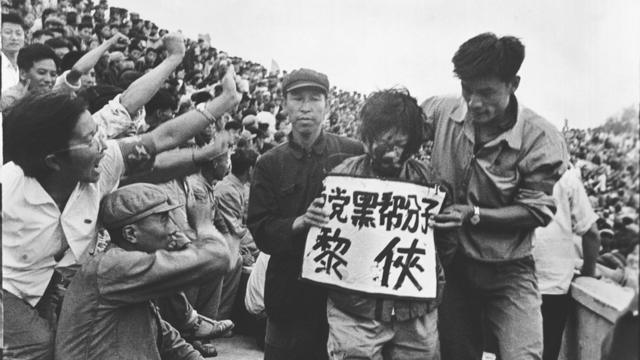
According to the ancient dictionary Shuowen Jiezi, the character dang (黨, 'party') originally meant 'favoring darkness.' The words dang and dangren ('party' and 'partisan') carry a negative connotation in Chinese. Confucius said: 'A gentleman is dignified but does not compete; he associates with others but does not form cliques.' A commentary on the Analects explains: 'To help one another conceal wrongdoing is called forming a dang.' Small political factions throughout Chinese history were often called pengdang ('cliques of associates'), a decidedly negative concept in traditional Chinese culture -- hence the derogatory expression 'a gang of foxes and dogs,' and the fact that 'forming a clique' and 'pursuing private interests' are so often linked together.
Why did a Communist Party emerge in modern China, grow into a real force, and go on to seize power? The Chinese Communist Party has relentlessly indoctrinated the Chinese people with the idea that history chose the CCP, that the people chose the Communist Party, and that 'without the Communist Party, there would be no New China.'
But did the Chinese people truly choose the Communist Party, or did the Communist Party instead form its clique to pursue its own interests and force the Chinese people to accept it? We can only find the answer by looking to history.
From the late Qing dynasty through the early years of the Republic, ancient China endured tremendous shocks from abroad along with sweeping internal transformation, and society was mired in chaos and suffering. Throughout this period, many intellectuals and men of conscience were consumed by a deep sense of crisis and a burning desire to save the nation. But amid national calamity and chaos, their disappointment gradually deepened into utter despair. Like a sick man who, in his desperation, will try any remedy, they searched outside China for a miracle cure -- if the British model failed, they turned to the French model; if the French model failed, they turned to the Russian model -- willing to try even the harshest, most extreme remedies, desperate to revive China overnight.
The May Fourth Movement was the fullest expression of this despair. Some advocated anarchism, some called for 'toppling the House of Confucius,' others pushed for wholesale importation of foreign culture -- but all shared a negative view of traditional Chinese culture, rejected the doctrine of the mean, were eager to find shortcuts, and advocated smashing everything in sight. The radicals among them, finding no way to serve their country through conventional means, yet utterly convinced of the rightness of their own ideals and will, came to believe the existing world was beyond saving and that they alone had discovered the hidden mechanism driving historical development -- and so they threw themselves with tremendous fervor into revolution and violence.
Different circumstances led different people to different theories, doctrines, and paths. Eventually, one particular group encountered liaison agents sent from Soviet Russia's Communist Party. The Marxist-Leninist idea of 'seizing power through violent revolution' matched their restless, anxious mood and their longing to save the nation and its people -- the two clicked immediately. And so they introduced into China an ideology entirely foreign to it. Thirteen delegates attended the CCP's First National Congress; some later died, some fled, some defected to the Japanese and became collaborators, and others left the Party to join the Nationalists, becoming traitors or opportunists. By the time the CCP seized power in 1949, only Mao Zedong and Dong Biwu of the original thirteen remained in the Party. One wonders whether these founders of the CCP ever imagined, at the time, that the 'deity' they had summoned from Russia was in fact an evil spirit, and that the miracle cure for national strength they had sought out was in truth a lethal poison.
At the time, the Soviet Russian Communist regime, having only recently succeeded in its own revolution, already harbored ambitions toward China. In 1920, Soviet Russia established the Comintern's Far Eastern Secretariat, tasked with establishing communist parties in China and elsewhere, headed by Boris Shumyatsky with Grigori Voitinsky serving as deputy; together with Chen Duxiu and others they began preparing to found the Chinese Communist Party. In June 1921, they submitted a plan to the Comintern for a Chinese branch of the Far Eastern Secretariat, making clear that the Chinese Communist Party was to be a branch operating under Comintern leadership. On July 23, 1921, organized by Nikolsky and Maring (Hendricus Sneevliet), the Chinese Communist Party was formally established.
From that point on, the communist movement was introduced into China as an experiment, with the Party's own survival placed above everything else, destined to conquer everything else -- and it began inflicting an endless catastrophe upon China.
I. The CCP's Rise to Power Was a Process of Accumulating Every Evil, Chinese and Foreign Alike
Transplanting a Communist Party utterly incompatible with Chinese tradition into a China with five thousand years of civilization -- introducing, in effect, a foreign evil spirit -- was never going to be a simple or easy task. The CCP deceived the public and patriotic intellectuals who had no other outlet by invoking communism's ideal of a Great Harmony, then further distorted a communist theory that had already been badly distorted by Lenin, using it as a pretext to destroy every tradition and value that stood in the way of its rule, and to eliminate every social class and individual that stood in the way of its rule. The CCP borrowed the Industrial Revolution's erosion of faith, and then added communism's even more thorough atheism on top of it. It borrowed communism's rejection of private property, and then added Lenin's theory of violent revolution. At the same time, the CCP also inherited and further developed the very worst elements of China's own imperial system.
The history of the CCP's rise is a process in which it progressively assembled a complete inventory of evils, both Chinese and foreign, gradually perfecting nine genetic traits with 'Chinese characteristics': evil, deception, incitement, struggle, plunder, thuggery, infiltration, extermination, and control. These traits have been passed down without interruption, their methods and their degree of malice further intensified and refined through each successive crisis.
(1) Trait One: Evil -- Wearing the Evil Skin of Marxism-Leninism
What initially attracted Chinese Communists to Marxism was the idea of 'smashing the old state apparatus through violent revolution and establishing proletarian rule.' This is precisely the fundamental evil at the core of Marxism-Leninism.
Marxist materialism, in fact, amounts to little more than a narrow economics of productive forces, relations of production, and surplus value. Formulated when early capitalism was still undeveloped, its one-sided, short-sighted prediction of capitalism's demise and the proletariat's triumph has already been refuted by both history and reality. The Marxist-Leninist doctrines of proletarian violent revolution and proletarian dictatorship advocate raw power politics and the notion that the proletariat should dominate all else. The Communist Manifesto laid out the Party's view of history and philosophy entirely through the lens of class antagonism and class struggle, with the proletariat's stated goal of struggle being to smash existing traditional morality and social relations and seize power outright. From the very outset, communism positioned itself in opposition to every tradition that came before it.
Human nature universally recoils from violence, and violence turns people cruel and tyrannical. The Communist Party's doctrine of violence is, by its very nature, rejected by everything common to human nature. It bears no substantive lineage to any prior thought, philosophy, or tradition -- it is an inexplicable system of terror that seemingly dropped out of nowhere, out of thin air.
This evil worldview rests on the premise that 'man can conquer heaven' -- that the world can be forcibly reshaped by human will alone. The Communist Party has drawn no small number of followers with its ideals of 'liberating all of humanity' and building a 'world of great harmony.' Those most susceptible to being deceived by the Party were people burdened with a deep sense of crisis who also yearned to accomplish something great. Forgetting that heaven watches from above, and swept up in the beautiful lie of building a 'paradise on earth' and in the pursuit of glory and achievement, they came to despise tradition, to regard other people's lives as worthless, and to treat their own lives as lighter than a feather.
The man-made 'communist world' was elevated to the status of ultimate truth -- 'our blood boils in our chests, ready to fight for the truth.' The Communist Party used this absolute, absurd belief system to sever people's connection to heaven above, to cut the bloodline linking them to their ancestors and their national traditions, summoning them instead to sacrifice themselves for communism and to feed the Party's own capacity for slaughter.
(2) Trait Two: Deception -- For Evil to Masquerade as a Righteous God, It Must Deceive
Evil must always deceive. Whenever the Communist Party needed to exploit the working class, it crowned workers as 'the most advanced class,' 'utterly selfless,' 'the leading class,' 'the vanguard of the proletarian revolution.' Whenever it needed to exploit the peasants, it praised them, declaring 'without poor peasants, there would be no revolution; to attack them is to attack the revolution,' and promised them 'land to the tiller.' Whenever it needed the help of the bourgeoisie, it crowned them 'fellow travelers of the proletarian revolution' and promised them a 'democratic republic.' When the CCP was on the verge of being completely wiped out by the Nationalists, it cried out that 'Chinese should not fight Chinese' and promised to submit to Nationalist leadership. But the moment the war against Japan ended, it turned on the Nationalists with full force, overthrew their government, swiftly eliminated the bourgeoisie once it had established the People's Republic, and finally reduced both workers and peasants into a proletariat left with absolutely nothing at all.
The 'United Front' is one of the Party's classic deceptive maneuvers. To win the civil war, the Communist Party temporarily abandoned its earlier practice of killing entire landlord and rich-peasant families, adopting instead a 'temporary united front policy' toward these class enemies. On July 20, 1947, Mao Zedong instructed: 'Apart from a small number of reactionary elements, a moderate attitude should be taken toward the landlord class as a whole... in order to reduce the number of hostile elements.' Yet after the Communist Party seized power, landlords and rich peasants still did not escape the fate of mass extermination.
The Party says one thing and does another. Whenever it needed to make use of the minor democratic parties, its slogan was 'long-term coexistence, mutual supervision, sharing hearts and honor alike.' Yet anyone who genuinely disagreed with it, or whose thinking, words, actions, or organizational affiliation did not conform to the Party's demands, had to be eliminated. Marx, Lenin, and CCP leaders alike have all said, in one way or another, that Communist power cannot be shared with others -- communism carried the innate genetic trait of dictatorship from the very start, plainly and without pretense. Because of this inherently exclusionary, despotic nature, the Communist Party has never, whether while seizing power or while holding onto it, ever genuinely coexisted with other political parties or organizations in good faith; even during its supposedly more tolerant periods, other parties were treated, at best, as mere decorative vases.
The lesson of history is this: not a single promise the Communist Party makes can be trusted, and not a single guarantee it gives will ever be honored. Whoever trusts the Communist Party on any given matter is likely to lose their life over that very matter.
(3) Trait Three: Incitement -- Skillfully Manufacturing Hatred, Turning One Group Against Another
Deception exists to enable incitement. Struggle always requires hatred -- and where no hatred exists, it must be manufactured. Rural China had a deeply entrenched system of land tenure and clan lineage, which stood as a fundamental obstacle to the Communist Party's establishment of power. Rural society had, in fact, been fundamentally harmonious: the relationship between landowners and tenants was not one of absolute opposition -- landlords supported the peasants, and peasants supported the landlords. The Communist Party took this relationship of mutual, if unequal, dependence and recast it as one of class antagonism and class exploitation, transforming harmony into hostility, hatred, and struggle; turning what was reasonable into the unreasonable, order into chaos, and shared community into despotism -- advocating expropriation, and killing for money: murdering landlords and rich peasants themselves, murdering their family members, and wiping out their entire clans. Many peasants were unwilling to seize other people's property outright; they would take it during the day and quietly return it to the landlord's home at night, only to be scolded by Party work teams for insufficient class consciousness. The story of 'The White-Haired Girl' -- originally a tale of a fairy maiden, not a story of oppression -- was rewritten by military arts-and-propaganda cadres into a play, an opera, and a ballet expressly to incite class hatred. When Japan invaded China, the Communist Party did not fight the Japanese; instead, it attacked the Nationalist government as traitorous for failing to resist Japan, and even, in the very midst of national crisis, incited people to turn against the Nationalist government.
Inciting one segment of the population to hate and slaughter another is a classic Communist Party technique, and it is precisely how the formula 'ninety-five percent versus five percent' for classifying people came about. The Party's later series of political campaigns made full use of this technique, refining it further and further. Falling within the 95% meant safety; falling into the 5% meant becoming an enemy to be struggled against. Scrambling to secure a place in the 95% became the self-preservation strategy of the fearful majority, and this is precisely how kicking a man while he was down became so widespread a practice.
(4) Trait Four: Thuggery -- Building Its Core Ranks From Hooligans and Riffraff
Thuggery is the foundation of evil, and evil must always rely on thugs. Communist revolution has always been, at its core, an uprising of riffraff and hooligans -- the classic case of the Paris Commune was, in essence, nothing but murder, arson, and looting carried out by society's lowest criminal elements. Even Marx himself looked down on the lumpenproletariat, writing in the Communist Manifesto that 'the "dangerous class," the social scum, that passively rotting mass thrown off by the lowest layers of old society, may, here and there, be swept into the movement by a proletarian revolution; its conditions of life, however, prepare it far more for the part of a bribed tool of reactionary intrigue.' Marx and Engels even held that peasants, owing to their innate dispersal and ignorance, hardly qualified as a class at all.
The Chinese Communist Party developed this very aspect of Marx's thought in its most malignant direction. Mao Zedong wrote that 'the riffraff and hooligans always despised by society are in fact the most courageous, most thoroughgoing, and most resolute force in the rural revolution.' The lumpenproletariat fed the CCP's own capacity for violence, helping establish the early rural Soviet regimes. 'Revolution' -- a word the Party's own discourse has filled with positive meaning -- was, in truth, a source of terror and calamity for every decent person, quite literally a taking of 'life.' When discussing the lumpenproletariat during the Cultural Revolution, the Communist Party, uncomfortable with being called 'hooligans,' simply shortened the term to 'the proletariat.'
Another expression of this thuggish nature is sheer shamelessness: whenever accused of being a dictatorship, the Party puts on the face of a bully and declares outright, 'My dear sirs, you are quite right, that is exactly what we are. Every experience the Chinese people have accumulated over these several decades tells us to carry out a people's democratic dictatorship, or, if you prefer, a people's democratic despotism.'
(5) Trait Five: Infiltration -- Penetrating, Dividing, Dismantling, and Replacing
When deception, incitement, and thuggery still were not enough, infiltration was brought to bear as well. The CCP was highly skilled at infiltration. Its 'Three Heroes' of underground intelligence work -- Qian Zhuangfei, Li Kenong, and Hu Beifeng -- actually answered to Chen Geng, chief of the CCP Central Committee's Second Section of Special Services. Qian Zhuangfei served as confidential secretary and trusted aide to Xu Enzeng, director of the Nationalist Central Investigation Bureau; through this position, he obtained intelligence on the Nationalist government's first and second encirclement campaigns against Jiangxi, which he passed on, disguised as correspondence from the Nationalist Central Organization Department, with Li Kenong personally delivering it into the hands of Zhou Enlai. In April 1930, nominally under Qian Zhuangfei's leadership but in reality directed by Chen Geng, an entire dual espionage network was established in the northeast using the credentials and funding of the Nationalist Central Investigation Bureau -- outwardly loyal to the Nationalists, secretly controlled by the Communists. Li Kenong also managed to infiltrate the Republic of China's Army-Navy-Air Force Headquarters as a code clerk; it was Li who intercepted and decoded the urgent telegram reporting the arrest and defection of Gu Shunzhang, head of the CCP's Central Secret Service, and it was Qian Zhuangfei who then delivered that decoded message to Zhou Enlai -- sparing the Party's underground network from being wiped out entirely.
The pro-Communist Yang Denglei served as the Nationalist Central Investigation Bureau's special commissioner in Shanghai; whenever the CCP judged one of its own members unreliable, it would arrange to have that person arrested and executed through him. In Henan, one veteran cadre, having offended another cadre within the Communist Party, was secretly handed over by his own comrades to a Nationalist prison, where he was held for several years.
During the civil war, the CCP's intelligence network reached all the way into Chiang Kai-shek's inner circle: Lieutenant General Liu Fei, deputy chief of operations at the Ministry of National Defense and the man who controlled Nationalist troop deployments, was in fact a secret Communist Party member. Yan'an would receive intelligence on a troop movement, and draw up battle plans accordingly, before the troops being moved even knew of the order themselves. Xiong Xianghui, confidential secretary and trusted aide to Hu Zongnan, reported Hu's plan to attack Yan'an directly to Zhou Enlai, with the result that when Hu Zongnan's forces finally marched into Yan'an, all they found was an empty city. Zhou Enlai once remarked: 'Chairman Mao had already seen Chiang Kai-shek's battle orders before they had even reached his own army commanders.'
(6) Trait Six: Plunder -- Seizure by Force and Fraud Becomes the New Order
Everything the Communist Party ever acquired, it seized by force. Raising the Red Army and carving out armed territorial strongholds required money for weapons, ammunition, food, and clothing, and its method of 'raising funds' was to 'strike the local tyrants' and rob them of silver -- indistinguishable from ordinary banditry. Li Xiannian's Red Army, operating in western Hubei, kidnapped members of the wealthiest families in county towns -- not just one person per family, but one person from every wealthy household in a given clan, a practice called 'live hostage-taking.' A 'live hostage' was not killed outright but kept alive precisely so that the family would keep sending jar after jar of silver dollars to sustain the Red Army. Only once the Red Army had been sufficiently fed, or once the family had been utterly ruined with nothing left to squeeze from them, would the half-dead hostage finally be released. Some hostages died from the sheer terror and torment of the ordeal.
The slogan 'strike the local tyrants, redistribute the land' extended this same practice of seizure by force and fraud across the whole of society, replacing tradition with a new order. The Communist Party has committed evil great and small alike, while never accumulating good, great or small. It handed out small favors to whoever it needed, purely to turn one part of the population against another. In this way, the accumulation of virtue and moral cultivation was destroyed entirely -- all that mattered was the willingness to kill. 'Communist harmony' became, in effect, nothing more than an endorsement of violent seizure.
(7) Trait Seven: Struggle -- Destroying the Traditional Clan Order and State Institutions
Deception, incitement, thuggery, and infiltration all served the ultimate ends of plunder and struggle. The Communist Party's philosophy is, at its core, a philosophy of struggle. Communist revolution was never mere disorganized looting and destruction -- the Party explicitly declared that 'the peasants' main targets of attack are the local tyrants and corrupt gentry, the lawless landlords, and secondarily the various forms of clan-based ideology and institutions, the corrupt officials in the cities, and backward customs in the countryside' -- making plain its intent to destroy traditional rural institutions and customs.
The Communist Party's concept of struggle also encompassed armed violence and military combat. 'Revolution is not a dinner party, not an essay, not a painting or piece of embroidery; it cannot be so refined, so leisurely and gentle, so temperate, kind, courteous, restrained, and magnanimous. Revolution is an insurrection, an act of violence by which one class overthrows another.' Struggle was essential in seizing power -- and years later, during the Cultural Revolution, this same genetic trait of struggle was deployed once more, this time to indoctrinate the next generation.
(8) Trait Eight: Extermination -- Constructing a Complete Theoretical System of Genocide
Many of the things the Communist Party has done have been utterly ruthless and final. It promised intellectuals a paradise on earth, only to later brand them 'rightists' and reduce them to 'the stinking ninth category.' Its expropriation of landlords' and capitalists' property, its extermination of the landlord and rich-peasant classes, its destruction of rural order, its seizure of local governments, its kidnapping and extortion of the wealthy, its brainwashing of prisoners of war in mind and spirit, its 'transformation' of the industrial and commercial bourgeoisie, its infiltration and dismantling of the Nationalist Party, its splitting from and betrayal of the Comintern, its purges through successive political campaigns after founding the People's Republic, and its high-pressure politics within the Party itself -- every one of these actions has been carried out with utter ruthlessness and finality.
All of this rests upon a foundation of genocidal theory; every single one of the Party's political campaigns has, without exception, been a campaign of terroristic mass extermination. From its earliest days, the Communist Party has continually built out a complete theoretical system of genocide, composed of its theories of class, of revolution, of struggle, of violence, of dictatorship, of mass movements, and of the political party -- all of it, in sum, a distillation of its varied practical experience in carrying out mass extermination.
The most distinctive form of extermination practiced by the CCP is extermination at the level of thought and conscience itself -- a method of rule through fear that serves the Party's most fundamental interests. Oppose the Party, and it will destroy you; support the Party, and it may still destroy you. Whatever it decides needs to be eliminated, it eliminates -- to the point where every single person is left living with a constant sense of crisis, in fear of the Communist Party.
(9) Trait Nine: Control -- Using Party Nature to Control the Entire Party, Then Extending That Indoctrination to the Entire Nation and Society
Every one of these genetic traits serves the same ultimate purpose: high-pressure control through fear. The Communist Party's evil nature makes it the natural enemy of every other force in society. From the very day of its founding, the Party has struggled through one crisis after another, and its greatest and most enduring crisis has always been the crisis of its own survival -- its very existence is defined by fear, a permanent and unending sense of crisis. Fear in the midst of crisis has become the Communist Party's highest interest of all -- the difficult, unceasing task of preserving the Party's own survival and power as a collective entity. The Party has often had no choice but to compensate for its own insufficient strength by appearing even more ruthless than it actually is. The Party's interest is never the interest of its individual members, nor the sum of all their individual interests -- it is the interest of the Communist collective itself, standing above every individual's interests.
'Party nature' is one of the most formidable essential traits of this evil spirit that is the Party -- an infinitely expansive, coercive force capable of devouring human nature and turning people into something less than human. Zhou Enlai and Sun Bingwen had been revolutionary comrades; after Sun died, Zhou took Sun's daughter, Sun Weishi, as his own goddaughter. During the Cultural Revolution, Sun Weishi was persecuted, and after her death her family discovered that a long nail had been driven into her skull. And yet it was Zhou Enlai himself who had signed the order authorizing her arrest.
Ren Bishi, one of the early CCP leaders, served during the war against Japan as the Party's opium commissioner. Opium was, after all, a symbol of foreign imperialist aggression against China, so daring to defy such fundamental national principle by cultivating opium on a massive scale genuinely required no small measure of 'Party nature.' Because the matter was so sensitive, the CCP used the code word 'soap' for 'opium,' shipping it abroad to raise funds. On the hundredth anniversary of Ren Bishi's birth, a new CCP leader delivered a speech praising him as possessing 'lofty moral character, a model Communist Party member. His convictions were firm, and his loyalty to the Party's cause was boundless' -- offering the highest praise for his 'Party nature.'
One model of 'Party nature' was Zhang Side. The Party's official account says he died when a brick kiln collapsed on him; popular accounts say he actually died while processing opium. Because he served quietly and without complaint as a soldier in the Central Guard Regiment, never seeking promotion, the CCP praised his death as 'weightier than Mount Tai.' Zhang Side, together with another later exemplar of Party nature -- Lei Feng, famous as 'the screw that never rusts on the machine of revolution' -- has long been held up to educate the entire Chinese population to be as loyal to the Party as they were. 'The power of a good example is limitless,' and countless Communist Party heroes and role models have been deployed in exactly this way, to reinforce the Party's iron will and its principle of absolute Party loyalty.
After seizing power, the Communist Party developed this genetic trait of thought control even further, successfully forging several generations of the Party's own 'tools' and 'screws.' Party nature was reinforced into a fixed pattern of thinking, a uniform pattern of behavior, and then extended across the entire nation and its whole population. This behavioral pattern of Party nature wore the skin of the state itself, and this pattern of thinking became the mechanism by which the entire population brainwashed itself, submitting to and cooperating with evil.
II. The Chinese Communist Party's Inglorious Rise to Power
The Chinese Communist Party describes its own history as a glorious one, 'marching from one victory to the next.' This self-glorification exists solely to grant legitimacy to Communist rule. In truth, the Party's rise to power is not glorious in the slightest -- it was only through its nine genetic traits of evil, deception, incitement, struggle, plunder, thuggery, infiltration, extermination, and control that it ultimately managed to seize power at all.
(1) The Founding of the CCP -- Raised on the Milk of the Soviet Communist Party
The CCP has taught the Chinese people that 'the cannon-fire of the October Revolution brought us Marxism-Leninism.' In reality, at its founding the CCP was merely the Chinese branch of Soviet Russia's Asian operations -- a party that betrayed its own nation's interests from the very beginning.
In its earliest days, the Chinese Communist Party had no money, no theory, no practical experience, and above all no backbone of its own. Joining the Comintern meant joining in, and becoming dependent upon, a program of violent revolution -- Chinese violent revolution stood as a direct continuation of the violent revolutionary tradition of Marx and Lenin. The Comintern served as the global headquarters for subverting governments around the world, and the CCP was, at the time, simply its Eastern branch, carrying out the Eastern strategy of Soviet Russia's red imperialism. The CCP relied entirely on the Soviet Communist Party's mature experience in seizing power through violence and imposing proletarian dictatorship; its political, ideological, and organizational lines all took their orders from Moscow, copying wholesale the clandestine survival methods of illegal underground organizations abroad, complete with rigid surveillance and control. The Soviet Communist Party was the CCP's backbone and its patron.
The Party constitution adopted at the CCP's First National Congress was drafted under the Comintern's direct supervision, and its declaration was grounded in Marxism-Leninism, class struggle, proletarian dictatorship, and party-building doctrine, drawing heavily on the Soviet Communist Party's own charter as its essential model. The very soul of the CCP was a foreign import in the Soviet mold. When Chen Duxiu, the CCP's leader, once disagreed with Comintern representative Maring, Maring brought Chen a letter stating that if he were a true Communist, he must obey the orders of the Third International. Even Chen Duxiu, the CCP's founding father, had no choice but to obey the Comintern's papal-like authority and submit in subordination to Soviet Russia.
At the Party's Third National Congress in 1923, Chen Duxiu openly acknowledged that the Party's funding came almost entirely from the Comintern. Over the previous year, the Comintern had spent more than 200,000 [Chinese silver dollars] in China, and yet, dissatisfied with the CCP's poor results, the Comintern reproached its Chinese comrades for not working hard enough.
According to incomplete statistics from declassified CCP documents, income received was 16,655 yuan between October 1921 and June 1922; 1,500 US dollars plus 32,927.17 yuan in 1924; and 187,674 yuan in 1927, with the Comintern's monthly contributions averaging roughly 20,000 yuan. The very methods the CCP relies on today -- cultivating connections, going through back doors, currying favor, bribery, and even outright threats -- were already in use in its earliest days. A Comintern official once sharply criticized the CCP Central Committee's relentless demands for money: 'They exploit the fact that funding comes through different channels (the International Liaison Department, the Comintern Executive Committee's representative, military organizations) to obtain funds this way, because one source has no idea that another source has already made a disbursement... What is interesting is that our visiting comrades not only understand the moods of their Russian counterparts with remarkable precision, but even know exactly how to differentiate their treatment of a given comrade depending on which particular allocation is involved. And once most of them become convinced that money cannot be obtained through official channels, they begin avoiding routine meetings altogether. They then resort to the crudest forms of extortion -- spreading rumors, for instance, that grassroots workers seem to be blaming the Soviets for giving money to warlords instead of to the central leadership.'
(2) The First United Front -- Possessing the Host and Hollowing It Out, Sabotaging the Northern Expedition
The CCP has always taught the Chinese people that Chiang Kai-shek betrayed the Nationalist Revolution, and that the Communist Party was forced into armed uprising as a result.
In reality, the Communist Party entered into the First United Front purely in order to attach itself to the Nationalist Revolution and grow at its expense, and in practice it moved impatiently to seize power and launch its own Soviet-style revolution, thereby sabotaging and betraying the Nationalist Revolution itself.
At the CCP's Second National Congress in July 1922, opinion opposing an alliance with the Nationalist Party dominated the proceedings, driven by the Party's eagerness to seize power on its own. But the Comintern, acting as the CCP's supreme overlord, overturned this resolution and ordered the CCP to join the Nationalist Party after all.
During the First United Front, the Chinese Communist Party held its Fourth National Congress in Shanghai in January 1925, and the question of leadership had already been raised before Sun Yat-sen's death. Had Sun Yat-sen not died, the target of the CCP's bid for power would not have been Chiang Kai-shek at all, but Sun himself.
Backed by Soviet Russia, the Communist Party seized power aggressively within the Nationalist Party during the united front period: Tan Pingshan became head of the Nationalist Central Organization Department; Feng Jupo became secretary of the Workers' Department with full authority over its affairs; Lin Zuhan became head of the Peasant Department, with Peng Pai serving as its secretary; and Mao Zedong served as acting head of the Nationalist Propaganda Department. Leadership over military academies and the armed forces had always been a particular focus for the Communist Party: Zhou Enlai served as director of the Political Department at the Whampoa Military Academy, with Zhang Shenfu as his deputy. Zhou also concurrently held the post of chief of the Military Justice Bureau, and Soviet military advisers were planted throughout. Numerous Communist Party members served as political instructors and staff at Nationalist military academies and as party representatives at every level of the National Revolutionary Army, and a rule was established that no order was valid without the countersignature of its accompanying party representative. As a result of this parasitic attachment to the Nationalist Revolution, CCP membership exploded from fewer than a thousand in 1925 to thirty thousand by 1928.
The Northern Expedition began in February 1926. Between October 1926 and March 1927, the Chinese Communist Party staged three armed uprisings in Shanghai, the last of which even attacked the headquarters of a Northern Expeditionary Army division, only to be disarmed by that same army. In Guangdong, the general strike's picketing squads clashed violently with police on a near-daily basis, and this kind of unrest directly precipitated the Nationalist Party's sweeping purge of the Communists on April 12, 1927.
In August 1927, Communists within the National Revolutionary Army seized the opportunity to launch the Nanchang Uprising, which was quickly suppressed. In September, they launched the Autumn Harvest Uprising, attacking Changsha, which was likewise suppressed. The Communist Party then began implementing its network-style system of control -- 'establishing Party branches at the company level' -- and fled to the Jinggang Mountains region, where it established a local rural regime.
(3) The Hunan Peasant Uprising -- Mobilizing Riffraff to Rebel
During the Northern Expedition, while the National Revolutionary Army fought against the warlords, the Communist Party was busy fomenting rural rebellion to seize power for itself.
The Hunan Peasant Movement of 1927 was likewise an uprising of riffraff, corroborating the pattern set by the very first famous communist revolution, the Paris Commune. Both the French people and foreigners living in Paris at the time personally witnessed how the Communards were a band of destructive brigands utterly devoid of any real ideals, living in mansions, feasting on delicacies, thinking only of immediate pleasure and giving no thought to death. During the Commune's uprising, they imposed censorship on the press; seized Archbishop Georges Darboy, who had preached to the king, as a hostage and shot him, along with sixty-four other clergy massacred outright; set palaces ablaze; and took delight in smashing to rubble government buildings, private homes, and monuments and commemorative pillars alike. Paris, the most magnificent capital in the world, without equal in all of Europe, was left with its grand buildings reduced to ash and rubble and its people reduced to bare bones after the uprising -- a catastrophe of a cruelty rarely matched in all of history.
Mao Zedong himself admitted: 'The peasants in the countryside have indeed gone in for a bit of "excess." The peasant associations hold supreme authority, forbidding landlords from speaking at all, sweeping away their prestige entirely. This is equivalent to knocking the landlord to the ground and then stamping one more foot on him. "You've been marked down in the register now!" Fines and levies are imposed on local tyrants and corrupt gentry, and their sedan chairs are smashed. Groups of people storm into the homes of gentry who oppose the peasant associations, slaughtering their pigs and hauling off their grain. They can even go stomp around on the ivory beds of the local tyrants' and gentry's daughters and young wives. People are seized and paraded through the villages wearing tall dunce caps at the slightest provocation -- "You corrupt gentry, you know us now!" Doing whatever they please, however aberrant, has indeed created a state of terror in the countryside... To put it plainly, every village must go through a brief period of terror like this; there is no other way to suppress the activities of rural counter-revolutionaries, no other way to overthrow the power of the gentry. To correct a wrong, one must go too far; without going too far, the wrong cannot be corrected... Many of the so-called "excesses" during the revolutionary period were, in truth, necessities of revolution.' Revolution had established an order of terror.
(4) 'Going North to Resist Japan' -- A Defeated Flight
The CCP has portrayed the 'Long March' as a march to go north and resist Japan, hyping the Long March into a myth of the Chinese revolution: the Long March, it says, was 'a declaration of principles,' 'a propaganda team,' 'a sower of seeds,' concluding with 'our victory and the enemy's defeat.'
'Going north to resist Japan' is a shameless lie the CCP invented to cover up its own defeat. The historical fact is that between October 1933 and January 1934, the Communists' fifth counter-encirclement campaign ended in disastrous defeat, one after another of their rural regimes was lost, their base areas shrank steadily smaller, and the Central Red Army was forced to flee for its life. This -- and this alone -- was the true origin of the 'Long March.'
The true intent behind the route of the Long March was to break out westward and make an indirect approach toward Outer Mongolia and the Soviet Union. At the time, the CCP was struggling desperately, and moving west, closer to Outer Mongolia, meant it would not be caught and annihilated between two fronts -- and if defeated in battle, it could still retreat into Soviet territory. Choosing to pass through Shanxi and Suiyuan served two purposes: on one hand, it allowed the Party to raise high the banner of resisting Japan and win over public sympathy; on the other, this region was actually safe, since there were no Japanese troops there at all -- Japanese forces had only occupied the area along the Great Wall. A year later, by the time the Communists' Long March had fled all the way to northern Shaanxi, the main force of the Central Red Army had dwindled from more than 80,000 troops to a mere 6,000.
(5) The Xi'an Incident -- A Successful Use of Espionage, a Second Round of Parasitic Attachment
The Xi'an Incident refers to the mutiny in December 1936 in which Zhang Xueliang and Yang Hucheng detained Chiang Kai-shek in Xi'an.
According to CCP textbooks, the Xi'an Incident was a 'military remonstrance' by Zhang and Yang to force Chiang into resisting Japan; the Communist representative Zhou Enlai was invited to Xi'an to help settle the aftermath, and through mediation by all sectors of society across the country, the incident was resolved peacefully, ending ten years of civil war, spurring the formation of a national united front against Japan, and becoming the pivotal turning point that resolved China's crisis. The CCP paints itself here as the patriotic hero acting for the greater good, resisting Japan.
More and more evidence has revealed that, on the eve of the Xi'an Incident, numerous Communist agents had already gathered around both Yang Hucheng and Zhang Xueliang. The underground Party member Liu Ding was introduced into Zhang Xueliang's inner circle through Song Qingling. After the Xi'an Incident, Mao Zedong praised him, saying: 'Liu Ding deserves credit for the Xi'an Incident.' As for Yang Hucheng, his own wife, Xie Baozhen, was herself a Communist Party member who worked in the political department of Yang's own army, and their marriage in January 1928 had been approved in advance by the CCP organization. Wang Bingnan, a Communist who later rose to become vice minister of foreign affairs, was at the time a frequent guest at Yang's residence. It was precisely these numerous Communist Party members surrounding Yang and Zhang who directly planned this mutiny.
At the very start of the incident, the CCP's leaders very much wanted to kill Chiang Kai-shek, in revenge for the encirclement campaigns waged against them. At the time, the CCP's forces in northern Shaanxi were extremely weak, in such dire straits that a single decisive battle could have wiped them out entirely, and so the CCP used every trick of incitement and deception at its disposal to instigate Zhang and Yang's mutiny. Stalin, needing to keep Japan tied down and prevent it from attacking the Soviet Union instead, personally wrote to the CCP Central Committee instructing that Chiang Kai-shek must not be killed, and that a second united front must be formed instead. Mao Zedong and Zhou Enlai also recognized that, given the CCP's actual strength at the time, there was absolutely no way it could defeat the Nationalists outright -- and that killing Chiang Kai-shek would only make it more likely that vengeful Nationalist forces would come and wipe the Communists out entirely. The CCP immediately changed its tune, using the banner of a united front against Japan to force Chiang Kai-shek to accept a second period of Nationalist-Communist cooperation.
The Communist Party first instigated the mutiny, placing Chiang Kai-shek under the executioner's blade, then turned around and played the hero, pressuring Chiang into accepting the Communists back once again. Not only did the CCP escape complete annihilation, it managed to attach itself parasitically to the Nationalist government for a second time -- the Red Army was reorganized as the Eighth Route Army, and the Party grew and strengthened itself once more. In cunning and deception, the CCP must be called a true master of the craft.
(6) The War Against Japan -- Killing With a Borrowed Knife, Expanding Its Own Power
When the war against Japan broke out, the Nationalist Party fielded more than 1.7 million troops, warships totaling 110,000 tons in displacement, and roughly 600 aircraft of various types. The Communists, even including the New Fourth Army reorganized in November 1937, numbered no more than 70,000 in total, riven by internal power struggles, and so weak that a single battle could have wiped them out completely. The CCP knew perfectly well that if it sent its forces out to fight the Japanese directly, it could not even defeat a single Japanese division. In the CCP's own eyes, the central issue of the national united front was never national survival, but rather leadership -- and so it devised the policy that 'in the process of allying with Chiang, we must struggle to secure leadership, but this can only be discussed within the Party, and must be implemented through actual practical work.'
After the Mukden Incident of September 18, 1931, what the CCP actually did was, in effect, to act in coordination with the Japanese invaders. In its declaration on the Manchurian Incident, the CCP called on the entire Chinese people, 'within the areas under Nationalist rule, to go on strike as workers, to riot as peasants, to boycott classes as students, to strike as the urban poor, and to mutiny as soldiers' -- all in order to overthrow the Chinese government.
While flying high the banner of resisting Japan, the Communist Party in fact spent the war years in the rear, absorbing local militias and guerrilla units. Aside from a handful of engagements against Japan, such as the Battle of Pingxingguan, the Communists have essentially nothing to show in the way of actual combat record against Japan -- they were far too busy expanding their own territory, and when Japan finally surrendered, they rushed to accept the surrender of Japanese forces themselves, expanding into a formidable force claiming more than 900,000 regular troops and 2 million militia members. The entire burden of the front-line fighting against Japan was left to the Nationalist army, which lost more than 200 generals killed in action, while Communist commanders suffered almost no losses at all. CCP textbooks nonetheless insist, again and again, that the Nationalists did not resist Japan, and that it was the Communist Party that led the great victory in the war against Japan.
(7) The Yan'an Rectification Movement -- Pioneering a Model of Persecution That Struck Terror Into All Who Heard of It
Under the banner of resisting Japan, the CCP drew countless patriotic young people to Yan'an, where it then used the Rectification Movement to persecute thousands upon thousands of these very same revolutionary youths. After founding the People's Republic, the CCP has portrayed Yan'an as a 'sacred site of revolution,' while never speaking of the crimes committed there during the Rectification Movement.
The Yan'an Rectification Movement was one of the most terrifying, darkest, and most brutal power games ever devised among human beings. In the name of purging the 'poison' of petty-bourgeois tendencies, the Party set about eradicating the very values of civility, independence, freedom, tolerance, and dignity within each person. The first step of the Rectification Movement was to compile a personal file on every comrade, including (1) a self-summary, (2) a chronological record of political and cultural background, (3) family class background and social relationships, (4) a personal autobiography detailing shifts in one's thinking, and (5) a self-criticism of one's Party nature.
In this file, one had to account for every person one had ever known since birth, every event, and the precise time and place of each -- writing and rewriting it over and over. Any discovered omission would mark you as a suspect figure. One also had to account for every social activity one had ever taken part in, particularly the circumstances of joining the Party, with special emphasis on one's thoughts and feelings throughout each activity. Most crucial of all was the self-criticism of one's Party nature, meant to determine whether one had displayed any anti-Party tendencies in thought, speech, work attitude, daily conduct, or dealings with others. In the realm of thought, for instance, one had to examine whether, after joining the Party or the army, one had calculated personal gain, or used Party work to serve private ends; whether one had ever wavered regarding the prospects of the revolution; or whether one had feared death in battle, or missed home and one's wife. Because there was no objective standard whatsoever, everyone, without exception, was found to have some kind of problem.
The vetting of cadres relied on forced confessions, and the hunt for hidden 'traitors within' inevitably produced countless miscarriages of justice. Yan'an during the Rectification era was described as a purgatory of human nature, one that wounded a great many cadres. When cadre-vetting work teams moved into the Anti-Japanese Military and Political University, two months of red terror followed -- impromptu confessions, model confessions performed for others, collective persuasion sessions, five-minute persuasion sessions, individual interrogations, mass-meeting denunciations, and the hunt for 'water radishes' (red on the outside, white within -- meaning secret counter-revolutionaries hiding behind a revolutionary facade). There were even 'photograph sessions,' in which people were hauled up on stage in batches for everyone to look over: whoever kept a straight face was presumed fine, and whoever did not became a suspect to be investigated further.
Even the Comintern's own representative could not bear it, remarking that the situation in Yan'an was utterly demoralizing: people dared not associate with one another, everyone harbored secret suspicions, and anxiety and fear were etched on every face. No one dared speak up for the truth, or defend a friend who had been slandered and defamed -- everyone simply sought to save their own skin. Scoundrels rose swiftly through flattery, while humiliating one's comrades and one's own self-humiliation became defining features of daily life in Yan'an. People were nearly driven mad; all anyone wanted was to preserve their own life and their livelihood, and honor, dignity, and comradely affection were all abandoned entirely. People no longer expressed their own opinions, but instead simply recited passages from the writings of the Party's leaders. This same pattern, almost unaltered, would go on to describe every major and minor political campaign after the founding of Communist China.
(8) The Three-Year Civil War -- Selling Out the Nation to Seize Power
Russia's February Revolution had been a moderate bourgeois revolution, and even the Tsar, putting the nation above all else, chose to abdicate rather than resist to the bitter end. Lenin hurried back to Russia from Germany and staged a second coup, slaughtering the very bourgeois revolutionaries who had overthrown the Tsar, launching a Communist revolution and strangling Russia's bourgeois revolution in its crib. The CCP, following exactly the same pattern as Lenin, seized the fruits of victory won by the Nationalist Revolution -- launching, once the war against Japan had been won, a 'liberation' war to overthrow the Nationalist government, plunging China once more into the disaster of war.
The Communist Party is notorious for its 'human wave' tactics. In the Liaoshen, Pingjin, and Huaihai campaigns, it employed the most primitive, savage, and inhumane tactic imaginable: using human flesh as cannon fodder. During the siege of Changchun, in order to exhaust the city's food supply, the People's Liberation Army was under orders not to allow ordinary civilians to flee. As a result, over the two-month siege of Changchun, nearly 200,000 civilians who had tried to flee the city and were trapped outside its gates were left to starve and freeze to death, denied any mercy whatsoever -- and afterward, the Party expressed not the slightest trace of remorse, boasting instead that 'Changchun was liberated without shedding a drop of blood.'
Between 1947 and 1948, the CCP signed, in succession, the Harbin Agreement and the Moscow Agreement with the Soviet Union, selling out the nation's interests and the resources of the northeast in exchange for full Soviet support, both diplomatic and military. Under these agreements, the Soviets agreed to regularly supply the CCP with 50 aircraft, to hand over all captured Japanese weapons to the CCP in two installments, and to sell military ammunition and supplies from the Soviet-controlled northeast to the CCP at cost. Should the Nationalists launch an amphibious assault on the northeast, the Soviets would secretly assist Communist forces in battle. The Soviet Union also helped the CCP seize control of Xinjiang, established a joint Sino-Soviet air force, and equipped 11 CCP divisions, shipping a full third of the 13 billion dollars' worth of American-supplied weapons given to the Soviets into the northeast. In exchange for Soviet support, the CCP promised the Soviet Union special privileges over land and air transport routes in the northeast; agreed to provide intelligence on the movements of the Nationalist government and American forces; agreed to supply the Soviets with the northeast's goods, cotton, soybeans, and strategic materials in exchange for advanced weaponry; granted the Soviet Union priority rights to mine Chinese mineral resources; granted it the right to station troops in the northeast and Xinjiang; and allowed the Soviet Union to base its Far Eastern intelligence bureau on Chinese soil. Should war break out in Europe, the CCP agreed to send an expeditionary force of 100,000 troops and 2 million laborers to support the Soviet Union. Beyond all this, the CCP also promised that special districts of Liaoning and Andong provinces would, at the appropriate time, be annexed to North Korea.
III. Manifestations of the Party's Evil Genetic Traits
(1) The Defining Feature of Party History -- A Permanent Sense of Fear
A permanent sense of fear is the single greatest defining feature of the CCP's history, and the Party's very survival has become its innate, highest-priority interest from birth. This overriding interest in continued survival exerts tremendous force in sustaining the essential fear that lies beneath its endlessly shifting outer skins. Like a primary cancer cell, it spreads and infiltrates every part of the body it inhabits, killing off normal cells and letting malignant ones grow unchecked. Throughout the historical cycle, society has never been able to resolve this mutated substance that is the Communist Party, allowing it to spread unchecked; no level or scope of society has ever been able to metabolize this powerful mutating agent, and as a result, countless societies have been contaminated, with communism or communist elements flooding across an ever-wider area. These elements, in turn, are continually reinforced and exploited by the Communist Party, fundamentally mutating human morality and society itself.
The Communist Party does not adhere to any commonly recognized moral principles. Every one of its principles serves, absolutely, its own collective interests; absolute selfishness is its highest guiding principle, with no moral principle whatsoever able to restrain its collective desires. Because self-interest is its fundamental principle, it must constantly don different outer skins. In the early stages of this continuous chain of crisis, the CCP attached itself to the Soviet Communist Party, to the Nationalist Party, to the Nationalist government as an institution, and to the Nationalist Revolution itself. After seizing power, the CCP attached itself to every form of opportunism, to popular sentiment and public opinion, to society's mechanisms and instruments, and to everything else besides -- turning every crisis it faced into an opportunity to grow, while continually reinforcing its coercive instruments of control.
(2) Consistent Evil Has Been the 'Magic Weapon' of Its Rise
The Communist Party claims its revolutionary victory rested on three great 'magic weapons': the united front, armed struggle, and Party-building. The Nationalist Party, drawing on its own bitter experience, would add two more to that list: propaganda and the use of espionage. Every one of the Party's great 'magic weapons' is, in fact, threaded through with all of its gangster-like genetic traits: evil, deception, incitement, struggle, plunder, thuggery, infiltration, extermination, and control.
Marxism-Leninism was evil at its very core. Absurdly, though, almost none of the CCP's own members actually understood it. Lin Biao once said that hardly any CCP members had truly read Marx and Lenin. Qu Qiubai, widely regarded as one of the Party's own theorists, admitted he had only ever skimmed the surface of Marxism-Leninism. Mao Zedong Thought was, in truth, a homegrown, backwoods version of Marxism-Leninism suited to a peasant uprising. Deng Xiaoping's theory of the 'primary stage of socialism' was, in substance, actually capitalist. And Jiang Zemin's 'Three Represents' amounted to nothing more than an empty, cobbled-together slogan. The CCP never understood Marxism-Leninism at all -- it simply inherited its evil essence, and then stuffed its own even more evil contraband onto that same foundation of evil.
Particularly worth noting is the CCP's 'united front' work, which combines deception with short-term bribery. Uniting exists purely in order to fight -- turning the Communist Party from an isolated, friendless force into one with numbers and strength on its side, shifting the balance of power in its favor. Wherever there is uniting, there is also dividing: dividing people into enemies, friends, comrades of the left, center, or right; dividing them into those to be courted and those to be attacked, and deciding when to court and when to attack. What is treated as an enemy at one stage can be turned into a friend at the next, and a friend at one stage turned into an enemy at the next. For example, the bourgeoisie was united with during the democratic revolution, then eliminated during the socialist revolution. Or take the leaders of the minor democratic parties, such as Zhang Bojun and Luo Longji -- the CCP needed their vocal support while it was seizing power, but once it had secured power it no longer needed them, and so it branded them 'rightists' instead.
(3) The Party Is a Fully Mature Gangster Organization
The Party wields both soft and hard techniques. Its soft techniques include propaganda, united front work, sowing discord, espionage, subversion, two-faced duplicity, hollowing people out from within, brainwashing, spreading rumors and lies, covering up the truth, psychological warfare, manufacturing an atmosphere of terror, and inducing chronic fear and forced amnesia -- soft techniques capable of extinguishing human nature and drawing out the evil within people. Its hard techniques include violence, armed struggle, suppression, political campaigns, murder to silence witnesses, kidnapping, forced silencing, violent factional clashes, and periodic 'strike hard' crackdowns -- hard techniques that guarantee the Party's ability to manufacture terror.
The Party often deploys soft and hard tactics together, alternating between periods of relaxation and periods of tightening -- appearing loose on the surface while remaining tight underneath, releasing pressure only to reapply it, luring the snake out of its hole. The CCP incessantly used the language of democracy to attack the Nationalist forces, and yet when the intellectual Wang Shiwei, living within Communist-controlled territory, expressed even the slightest dissenting opinion, he was made an example of and subjected to struggle sessions, ultimately hacked to death with an axe -- the notorious 'Wild Lily' incident. One veteran cadre who had gone through the Yan'an Rectification Movement and been persecuted himself recalled being hauled in to be tortured into confessing, forced under extreme duress to betray his own conscience and fabricate lies. Facing this ordeal for the first time and consumed with guilt over the comrades he had implicated, he wished only for death. There happened to be a gun lying on the table; he picked it up, aimed it at his own head, and pulled the trigger. There was no bullet in it. The cadre in charge of interrogating him then walked in and said, 'It's fine to admit your mistakes -- the Party's policy is one of leniency.' In this way, the Party, having tested him to his very limit, could now confirm his 'loyalty' to it, and he was allowed to pass. The Party always operates this way: driving you to the very brink of death, savoring every moment of your pain and humiliation, and then, just as you feel life is no longer worth living, stepping in warmly to offer you a path where a wretched life is still better than a good death -- thereby making you feel eternally grateful, as though the Party had saved your very life. Years later, this same veteran cadre learned about Falun Gong while in Hong Kong and thought well of it. But the moment the persecution began, all his old memories came flooding back, and he no longer dared say a good word about Falun Gong.
A similar example is that of Puyi, the last emperor, who, while imprisoned, repeatedly witnessed others being executed and came to believe he too was about to be put to death. Driven by the instinct for survival, he actively cooperated and brainwashed himself, eventually writing his memoir From Emperor to Citizen -- held up as a model example of the CCP's successful 'thought reform.'
According to modern medical research, in environments of fear, extreme pressure, and isolation, many victims develop a distorted dependence on their abusers, taking on their abuser's moods as their own emotional cues; the moment the abuser shows even the smallest kindness, the victim is overcome with gratitude, and may even come to feel something resembling 'love.' This psychological phenomenon has long been successfully exploited by the CCP in its spiritual control and thought reform of both its enemies and the ordinary population alike.
(4) The Party Is the Most Evil Entity of All
The overwhelming majority of CCP general secretaries have, at one point or another, been branded anti-Party elements. It is clear that this Party has a life of its own -- it is a living, independent organism. It is not necessarily the Party's leaders who determine the Party's direction and fate; rather, it is the Party that determines the fate of its leaders. When the Jiangxi Soviet was under encirclement by Nationalist forces, with survival itself in doubt, this did nothing to stop the Party from dragging its own members out at night to be shot, or bludgeoned to death with rocks to save bullets, all under the pretext of hunting down the so-called 'AB Corps.' Surviving precariously wedged between Japanese and Nationalist forces in northern Shaanxi did nothing to stop it from carrying out a massive internal purge under the name of the Yan'an Rectification Movement, killing countless people. Such large-scale, repeated internal massacres did nothing to prevent the Party from expanding its power and ultimately coming to rule all of mainland China, extending this same pattern of self-cannibalization from its tiny Soviet base area to the entire nation. It is like a malignant tumor: as it grows uncontrollably, its core dies off even as its periphery continues spreading into the healthy original tissue around it. Once part of the original body has been infiltrated, new tumors grow out of it. Whether a person is good or bad hardly matters -- once inside the Communist Party, they become part of its destructive force, and the more principled and earnest they are, the more destructive they become. There is no doubt that when this body is finally destroyed completely, that will also mark the death of the tumor itself. And yet, this is simply how a tumor is destined to behave.
Chen Duxiu, the widely acknowledged founder of the Chinese Communist Party, was a cultural figure of the May Fourth Movement who disliked violence, and warned his fellow Communists that if the Party's own partisan consciousness within the Nationalist ranks were reinforced, and if it took too keen an interest in seizing leadership, it would inevitably create tension within the revolutionary camp. Even the most radical figure of the May Fourth generation still retained some measure of tolerance in his heart. He became the very first person to be branded with the label of 'right-leaning opportunism.'
Another leader, Qu Qiubai, believed the Communist Party should personally fight, kill, organize uprisings, and destroy any level of government it was capable of destroying, using extreme disorder as the very means of restoring order to Chinese society. Yet, unexpectedly, Qu Qiubai confessed shortly before his own death: 'I have absolutely no wish to die pretending to be a martyr. In truth, I left your ranks long ago. Alas! It was a mere accident of history that forced me, a "man of letters," to muddle through so many years on the political stage of revolution. I could never overcome my own gentlemanly sensibilities -- in the end, I simply could not become a true soldier of the proletariat.'
Party leader Wang Ming, acting on Comintern instructions, advocated genuine cooperation in resisting Japan rather than expanding the Communist base areas. At Party meetings, Mao Zedong and Zhang Wentian could not persuade their comrades otherwise, frustrated by their inability to state the plain truth outright: that given the Red Army's actual strength at the time, it could not possibly annihilate even a single Japanese division, and that if it had rashly thrown its forces into battle on a moment's impulse, the course of Chinese history would certainly look very different today. Within a cultural climate still shaped by the traditional value of 'sacrificing oneself for righteousness,' Mao Zedong had no choice but to remain silent on the matter. Wang Ming was later condemned as an opportunist, first for excessive leftism, then for excessive rightism.
Hu Yaobang worked to rehabilitate the victims of unjust convictions from successive political campaigns, winning back a measure of public goodwill for the Communist Party -- and was purged from power regardless. Zhao Ziyang pursued reform in an effort to save the Communist Party, and in the end met no better a fate. What, then, can any new leadership of the Communist Party actually accomplish? Truly reforming the Communist Party would mean the Party's own destruction, since the power granted to any reformer would instantly lose its legitimacy. Relying on a force produced by a machine to change that very machine can only go so far before it inevitably fails. Genuine reform of the Communist Party is therefore simply impossible.
If every leader of the Party has been fundamentally evil, how has the revolution managed to keep going and even expand? At many of its most evil moments, the Communist Party's own supreme leaders have fallen from power precisely because their own capacity for evil fell short of what was needed -- only the most evil could ever truly satisfy the Party's demands. Every leader of the Party has met a tragic end, while the Party itself has stubbornly survived. The leaders who managed to survive were never the ones who could actually control the Party, but rather those who had thoroughly grasped the Party's own evil nature and gone along with it, feeding it energy and helping it weather its crises. It is little wonder, then, that Communist Party members can struggle against heaven, struggle against earth, and struggle against their fellow man -- but can never struggle against the Party itself. Every one of them is merely a tamed tool of the Party, and the highest state any of them can achieve is one of mutual exploitation.
Sheer shamelessness has today become one of the great spectacles of the Party. This mistake belongs to Zhang Guotao, that one belongs to the Gang of Four. Mao Zedong is judged '70% right, 30% wrong'; Deng Xiaoping, '60% right, 40% wrong.' The Party itself, however, is never wrong -- whenever the Party has erred, it is always the Party itself that corrects the error, urging everyone to 'look forward' and 'not dwell on old historical grievances.' Even communism's promised paradise on earth has degenerated into the mere goal of socialist subsistence; even Marxism-Leninism itself has effectively been supplanted by the 'Three Represents'; the Party can even criticize itself, when convenient. In order to preserve its rule, no one should be surprised to see the Communist Party embrace democracy, open up religious freedom, abandon Jiang Zemin overnight, or even rehabilitate Falun Gong. There is only one thing that will never change: the Party's ultimate purpose -- its collective goal, its collective survival, its collective grip on power -- remains constant, as does its determination to preserve the Communist Party's own power and rule.
The Communist Party has infused violence, fear, and high-pressure control into its own theoretical program, transforming them into Party nature itself, into the Party's highest guiding principle, into the very soul of its leaders, and into the operating mechanism of the entire Party and the code of conduct binding every one of its members. The Party is a rigid, steel-like party, bound by iron discipline and a unified will, in which every member's actions must fall perfectly in line.
Conclusion
What historical force chose the Communist Party? Why the CCP, and not something else? We all know that two kinds of forces, two kinds of choices, exist in this world. One is the old, evil force, which makes evil, negative choices. The other is the righteous, good force, which makes good, virtuous choices. The Communist Party represents the choice made by the old, evil force. It was chosen precisely because it embodies the concentrated accumulation of evil from every era and every corner of the world -- it is evil's most concentrated representative. It excels, above all, at exploiting and taking advantage of people's basic goodness, and it was through this that it gradually grew, step by step, into the force it is today.
What does the Communist Party's slogan 'without the Communist Party, there would be no New China' actually mean? From the CCP's founding in 1921 to its seizure of power in 1949, everything proves only this: without the Party's bloodshed and cunning, there would be no realm for it to rule over at all. The CCP is unlike any other organization in history -- it interprets the theories fabricated by Marx and Lenin however it pleases, dressing up every arbitrary action in high-sounding justification, deceiving, inciting, or exploiting whichever segment of the population it needs, offering forceful interpretations as required, and through relentless, unceasing propaganda, wrapping its policies and tactics in the guise of theory in order to implement them -- all so as to prove itself eternally, unfailingly correct.
The history of the CCP's rise to power is a process of accumulating every conceivable evil -- nothing about it is glorious in the least. If anything, this very history proves that the CCP regime lacks any legitimacy whatsoever. It was never the Chinese people who chose the Communist Party; rather, the Communist Party forced its treachery upon them, relying on its unparalleled genetic traits of evil, deception, incitement, struggle, plunder, thuggery, infiltration, extermination, and control to impose a foreign evil spirit upon the Chinese people.