
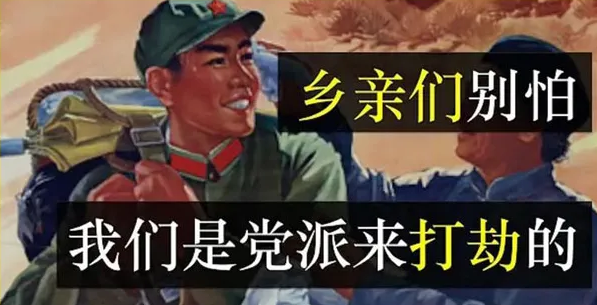
I have always called the CCP regime a bandit regime — mainland China has been ruled by bandits ever since 1949. This offends some people living on the mainland, who think I am deliberately smearing the CCP. In truth, I am merely speaking the truth. Mainland China has always been saturated with lies, so I fully understand why the truth sounds so grating to the ear. Whether the CCP is a band of bandits is not for me to decide — that is entirely determined by the CCP's own conduct, and mainland Chinese people have witnessed with their own eyes what the CCP does. If the CCP were not truly bandit in nature, who would dare say their home might not be forcibly demolished? If the CCP were not truly bandit in nature, who could guarantee their bank deposits would not be reduced to zero? If the CCP were not truly bandit in nature, who could be sure they would not be arrested at any moment, or summoned at any moment for 'tea' with the police? The fact is, the CCP is not only a band of bandits, but the most utterly conscienceless bandits in the history of human civilization. China has three thousand years of recorded civilization and countless bandits throughout that history, yet none has been as devoid of humanity as the CCP! The chained-woman case, the caged-woman case, the underground-pit woman case, the Hu Xinyu case... all of these are the most glaring footnotes to the CCP regime's utter lack of humanity, and as for the regime's bandit conduct since it seized power, the list is simply too long to record in full. Today's mainland Chinese people might well ask themselves: who truly owns any land of their own, and who truly possesses the basic rights of a human being? No one — because every right the Chinese people have has been ripped away, alive and whole, by this bandit regime.
It has now been more than 2,200 years since Qin Shi Huang first unified China, and one idea has remained fixed, unchanging to the death, in the Chinese mind: 'the victor becomes king, the loser becomes bandit.' Whoever ultimately sits on the throne can rightfully enslave the people, regardless of the means used to get there — this is the Chinese view of history. At the same time, another deeply entrenched idea persists in the Chinese mind: 'calling a deer a horse.' Whatever the person holding supreme power says becomes truth, regardless of whether it is factual or logical — this is the Chinese view of politics. Through more than two thousand years of dynastic change, right up through the CCP's usurpation of power from the Republic of China, the Chinese view of history and of politics has not changed one bit, let alone progressed. As a result, the Chinese view of history and of politics fits perfectly with the logic of bandit thinking: only the goal matters, by any means necessary; only the outcome matters, regardless of the process.
Every dynastic change before the founding of the Republic of China conformed to the historical and political logic of ancient China: overthrowing the existing regime through violence and rivers of blood, in an endless cycle repeating right up to the present — the so-called 'dynastic cycle' that everyone knows. In other words, whoever seizes power becomes the legitimate ruler. This is why every regime from the Qin Empire to the Qing Empire shared this same nature. Which emperor, after seizing power, did not proclaim his own legitimacy and orthodoxy? In other words, even if an emperor had once been a bandit or brigand who plundered homes for a living, once he took the throne he switched to 'legitimate business' and transformed himself, gloriously, into a gentleman. The regime the CCP established is nothing of the sort. Before seizing power, the CCP was a band of bandits who plundered homes; after seizing power, far from abandoning its bandit nature, it doubled down, intensifying its plunder, expanding its scope, formalizing, institutionalizing, and perfecting its plundering, all while sparing no effort to glorify its own bandit conduct. The CCP regime has therefore been a bandit regime from start to finish. To prove that the CCP regime is a bandit regime, one must find a regime of a fundamentally different nature on Chinese soil to compare it against — only through comparison can true discernment be reached. The regime of the Republic of China is the most fitting point of comparison for the CCP regime.
The Republic of China opened a new chapter in Chinese history. First, the very nature of state power changed fundamentally. Under every previous dynasty, the state was the private property of the imperial family — 'all under heaven belongs to one family.' With the Republic, state power belonged to the entire citizenry — 'all under heaven belongs to the people.' A republic, by definition, means a state of the people. This shift from empire to republic was a transformation as sweeping as heaven and earth turning over, and it was the first of its kind in three thousand years of Chinese civilization. Second, the Republic's power derived from a legitimate source. Unlike the violent, bloody methods of traditional dynastic change, the Republic's authority came through succession — the Republic fully inherited the territory, sovereignty, and armed forces of the Qing dynasty, with the Qing Emperor's Edict of Abdication standing as powerful proof of this. Many Chinese people harbor a deep misunderstanding, even a distortion, of this history, believing that Dr. Sun Yat-sen's 1911 Revolution overthrew the Qing dynasty. This is entirely at odds with historical fact. The 1911 Revolution was indeed an armed uprising aimed at overthrowing the Qing, but compared with the Taiping Rebellion, which shared the same goal, its scale and impact were negligible by comparison. Even Hong Xiuquan, who once occupied half of the Qing empire's territory, failed to overthrow the Qing dynasty — and Dr. Sun, whose forces held only a small fraction of that, overthrew it even less. The Qing dynasty's exit from the stage of history was owed to Mr. Yuan Shikai. Yuan forced the Qing court to step down while preserving the Manchu royal family, achieving a peaceful transfer of state power — itself a first in three thousand years of Chinese civilization. The Republic of China's authority thus derived from legitimate succession rather than violence, a truly unique event in Chinese history. Mr. Yuan Shikai was the Republic of China's first president, and also China's first popularly elected president — a historical fact that cannot be erased.
By the time of Generalissimo Chiang Kai-shek, the Republic of China was constrained by a particular historical environment — internal warlordism and external aggressors circling like predators — and it is true that the Republic during this period was semi-authoritarian in nature. Even so, ordinary citizens of that era enjoyed a hundred times more freedom than people living under CCP rule today. At the very least, people in the Republican era enjoyed freedom of speech; privately run newspapers were more numerous than one could count; anyone could criticize the government, and anyone could criticize President Chiang Kai-shek himself; cases of people being criminally punished for their speech during that era were exceedingly rare. In the Republican era, anyone could form a political party, any party could take part in politics and debate, and the Republic's government essentially never banned any party outright; and as for anti-government marches and rallies, these were practically everyday occurrences. Even when protests went too far, the government's countermeasures amounted to nothing more than batons and a few days in detention — nothing resembling the CCP's frenzied, brutal tactics of crushing people with tanks or mowing them down with machine guns.
By contrast, has the CCP regime, from its founding in 1949 to the present day, ever truly allowed its people freedom of speech, association, and assembly — let alone freedom of thought and belief? The CCP regime has forcibly stripped the people of even their most basic freedoms, reducing the Chinese people to mere livestock. To call such a regime a bandit regime, frankly, I personally feel is something of an insult to actual bandits. Whatever kind of bandit one is talking about, bandits are still, in the end, human beings, retaining at least a shred of humanity — they merely rob people of their property, and even bandits are said to have their own code of honor. The CCP, by contrast, has no code, no morality, no shame whatsoever. One might well ask: what bandit anywhere has ever stripped ordinary people of even their most basic freedom of speech, the way the CCP has?
Fortunately, the Republic of China continues to exist in Taiwan; otherwise, the world would truly have no way to see the CCP bandit regime's true face so clearly. Taiwan's president is elected by the people of Taiwan, one person one vote, and every citizen has the right to criticize the president. I wonder who on the mainland would dare openly criticize Xi Jinping without being charged with a crime. This alone shows that Xi Jinping was never elected by the people of the mainland. The people of Taiwan enjoy free medical services — I wonder whether ordinary people on the mainland truly receive free medical care. If it were truly free, then what was the recent 'white-haired movement' [protests by elderly citizens] all about? After retirement, ordinary Taiwanese citizens receive benefits nearly on par with government employees — I wonder whether ordinary mainland citizens' retirement benefits are on par with those of officials and employees of state-owned enterprises. And the people of Taiwan need not worry about their homes being forcibly demolished, nor do they face the headache of petitioning the government for their rights...
A simple comparison makes it plain to see: bandits have robbed the people of mainland China of all their rights — the CCP regime is a bandit regime through and through!