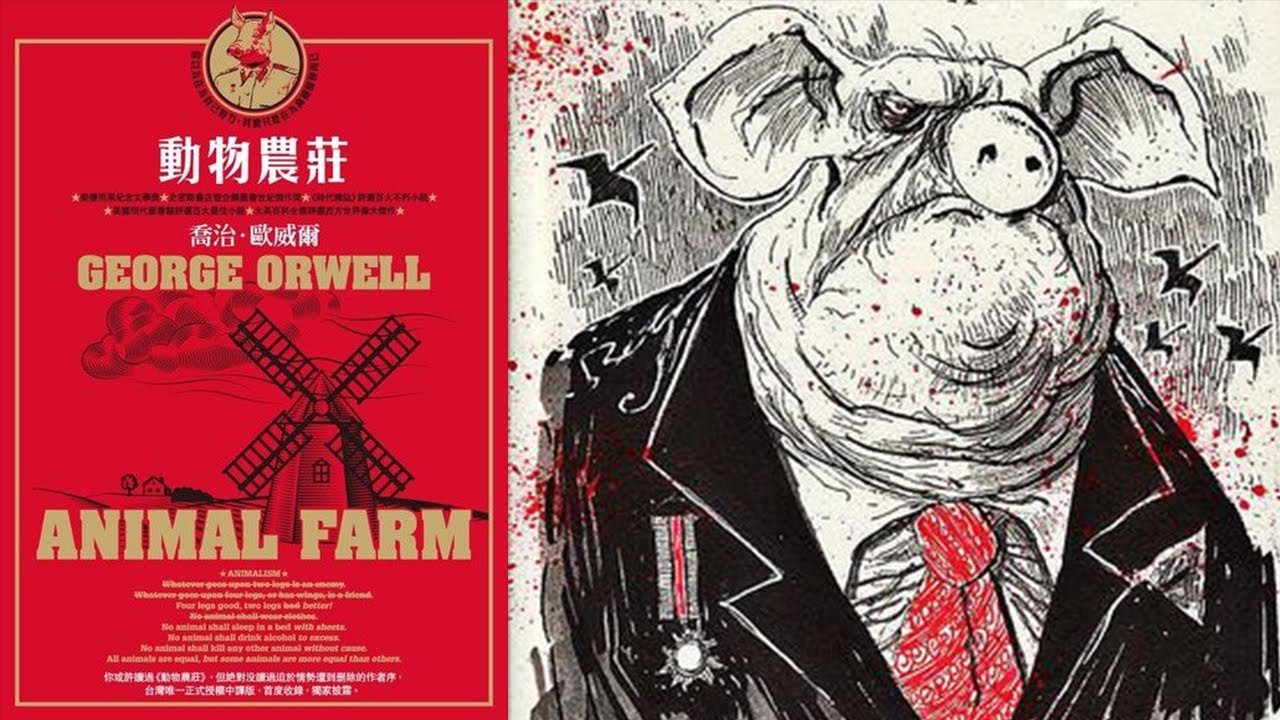
Animal Farm was first published in Britain in August 1945, right around the time World War II was coming to an end — more than 75 years ago now. I wonder if any of our viewers out there are actually older than this book?
Animal Farm received widespread acclaim after its publication and was gradually translated into languages around the world. Several new editions have appeared since then — for instance, this 50th-anniversary edition, with a pig's tail drawn on the cover; and by the 70th anniversary, an illustrated 70th-anniversary edition was released as well. This novel also happens to be one of my personal favorites.
Animal Farm was later selected by Time magazine as one of the '100 Best Novels' of all time, and there are many Chinese translations available as well. I personally prefer the 2010 Chinese edition published by Rye Field Publishing in Taiwan, because besides its fluent translation, it also includes the author's original preface — the one George Orwell had cut from the published version back in the day.
Animal Farm was actually made into an animated film in 1954 — less than ten years after the book's original publication. That said, I personally still find the novel more compelling, richer, and more profound than the film.
That's because Orwell was one of the great masters of careful, precise writing in the English-speaking world. He even proposed six rules for writing, later known as his 'Six Rules for Writing,' which are still upheld as guiding principles to this day. That's why his book far outshines the film.
Chapter One: Who Was George Orwell?
When it comes to Orwell, many of you have probably heard his name before — after all, his two novels Animal Farm and Nineteen Eighty-Four are both regarded as classic works of 'dystopian' or anti-communist literature.
But 'Orwell' is actually a pen name — his real name was Eric Blair. He was born in 1903 in India, then still under British rule, and later grew up in Britain, though his life was hardly what you'd call a story of easy success. Before becoming a writer, he worked as a colonial police officer, a private tutor, a bookshop clerk, and more, moving among the lower rungs of society — which is part of why he identified with socialism for a time and became a man of the left.
But once Stalin became the leader of the Soviet Communist Party, Orwell witnessed firsthand how brutally Stalin waged internal power struggles and purged his political rivals, and watched the Soviet Union transform into yet another totalitarian tyranny. This led Orwell to begin reflecting critically on socialism and communism, and ultimately to write Animal Farm and Nineteen Eighty-Four — two classic anti-communist, anti-totalitarian masterpieces.
Chapter Two: A Summary of Animal Farm's Plot
What we're discussing today is Animal Farm, a relatively short and accessible book. It is a classic fable-style novel that uses anthropomorphized animals to depict the social relationships within an animal community, all as an allegory for the communism of its time — that is, Stalin and the Soviet Communist Party.
But because Britain and the United States were allied with the Soviet Union during World War II, as part of the same Allied camp, publishers in both Britain and the United States were initially unwilling to publish this book. It was only after the war ended that someone finally agreed to publish it — and once it came out, it caused an immediate sensation.
As for the plot of Animal Farm, I think it's best I don't give away too much, so as not to spoil your enjoyment of reading it — after all, the plot is what makes any novel most compelling, right?
But let me offer a brief summary: the book describes a large group of animals on a farm who, one day, rise up in rebellion against the farmer and drive him out, after which the animals begin managing the farm themselves. But the farm's pigs, relying on their bit of cunning intelligence, gradually make themselves the farm's new masters, and through a series of schemes and lies, step by step turn the farm into a miniature communist totalitarian society.
I've just given you the vaguest sketch of the plot in a few sentences — I hope that made some sense. After all, the fine details of the plot and the dialogue between the characters — or rather, between the animals — are the true heart of the novel, so it's best I leave that wonderful part for you to savor for yourself.
But the writing choice I admire most in Orwell is his decision to cast the leaders of communism as 'pigs.' He chose a group of pigs to represent the communist clique — greedy, cunning, gluttonous, and lazy all at once. It's an extremely precise piece of satire, a brilliant form of subtle mockery. Just look at CCP officials today — aren't a great many of them cut from exactly this same cloth?
Chapter Three: Nine Secrets of Communism That Animal Farm Exposes
All right, what I'd like to share next is, from my own perspective, how this book depicts and critiques the totalitarian tyranny of communism. I believe Animal Farm vividly and precisely exposes at least nine secrets of communism:
Secret One: Promising a 'Beautiful Vision' to Lure People In
As we all know, when communism first emerged, it claimed it would smash class distinctions and eliminate exploitation, turning the world into a classless, oppression-free 'paradise on earth' where everyone would be equal — using slogans like these to captivate the masses.
The same thing happens in Animal Farm. At the very beginning, a pig named Old Major, on the verge of death, gathers all the animals together and tells them of a beautiful 'dream' — a dream in which every animal lives freely and happily, and in which humans are the greatest enemy standing in the way of that beautiful life.
So Old Major lays out several key principles for them, including 'all animals are equal' and 'whoever goes upon two legs is an enemy, whoever goes upon four legs, or has wings, is a friend,' and also teaches them to sing the song 'Beasts of England.' Think about it — doesn't Old Major's grand 'dream,' along with the doctrines and songs he teaches, sound remarkably similar to the Communist Party?
Secret Two: Ruling Through Lies, Deceiving the People
We know that whether it's a communist regime or a socialist one, their signature method of rule is deception — using every kind of lie to fool the people. That's because lying is the cheapest tool available: as long as the Communist Party has no moral bottom line and no conscience, it can deceive good, trusting people with lies of every kind.
Animal Farm depicts this point again and again. For instance, Old Major told the animals that humans were the enemy, so after they first drove out the farmer, the animals had nothing to do with humans at all. But later, their pig leader — a pig named Napoleon — began, purely to make money and obtain goods for his own enjoyment, conducting all sorts of trade with humans from other farms.
The pig leader Napoleon initially promised that all the fruits of the animals' labor would be shared equally among them, and that the animals would come to enjoy a better life. But later, the animals discovered that their food rations kept shrinking while their working hours kept growing longer — because the pig leaders were seizing the food for themselves.
Yet the pig leadership frequently sent out a young pig in charge of propaganda work — a role rather like the CCP's Central Propaganda Department — to read out a long production report, telling everyone how much this or that type of food output had increased, using news of 'bumper harvests' to convince everyone that life had gotten better than before. In reality, most of the food was simply monopolized by the pig leaders, while the other animals ate less and less.
Secret Three: Brainwashing Memory, Making Yesterday's Truth Today's Lie
One defining feature of communist regimes is that nothing but lies ever comes out of their mouths — lies that are constantly revised, so that what was true yesterday becomes false today. They also continually falsify history and destroy evidence, all in order to brainwash people and rewrite their memories.
This point is emphasized again and again throughout Animal Farm. At the start of the novel, after the animals drive out the farmer — that is, after their violent revolution — they write seven rules on the wall of the barn, known as the 'Seven Commandments,' which every animal must obey, including 'No animal shall sleep in a bed,' 'No animal shall drink alcohol,' 'All animals are equal,' and 'No animal shall harm another animal,' among others.
But every time the pig leaders violated one of these rules, the commandment on the wall would be quietly changed, or would simply disappear. For instance, once the pigs began imitating humans by moving into the farmhouse and sleeping in beds, the commandment was quietly altered by someone — no one knew exactly who — to read 'No animal shall sleep in a bed with sheets,' rather than the original 'No animal shall sleep in a bed.'
Later, as the pig leaders violated more and more of the commandments, in the end the 'Seven Commandments' on the wall were reduced to just a single line: 'All animals are equal, but some animals are more equal than others.' In other words, the pigs' status had risen above that of every other animal.
Think about it — isn't this remarkably similar to the Chinese Communist Party? At first, it called for revolution under slogans of 'freedom, equality, and democracy,' but once it seized power through revolution, it transformed itself into a privileged elite, unwilling to hand power back to the people, and began saying things like 'the Chinese people's quality is too poor for democracy' or 'it's better for the nation to be ruled by an elite few,' and so on.
In truth, this is simply the Communist Party, for the sake of its own interests, endlessly discarding its old lies and rolling out new ones to brainwash the masses and rewrite their memories.
Secret Four: Internal Purges and Massacres, Manufacturing Fear
Killing and bloodshed, used to manufacture fear, is the tool of rule that communist parties everywhere in the world excel at most, and it is the method they most commonly employ in the early stages of taking power. They must also periodically kill another round of people, to keep summoning that fear in people's hearts, so that no one dares resist the Communist Party and everyone remains utterly obedient to it.
The same holds true in Animal Farm. One of the original 'Seven Commandments' on the barn wall stated, 'No animal shall harm another animal.' But right after the violent revolution drove out the humans, internal conflicts and clashes broke out among the pig leaders, and Napoleon unleashed nine enormous dogs to hunt down his rival Snowball, chasing Snowball off the farm — his fate left unknown.
Later, to consolidate his power and eliminate any doubts the animals might have about him, Napoleon sent out his 'dog squad' to bite many animals to death in public, terrifying the other animals out of their wits and ensuring that none of them dared to criticize the leadership. This is the most classic of Communist Party methods: bloodshed used to consolidate power.
Secret Five: Ruthless Exactions, Stripping the People of the Fruits of Their Labor
The Communist Party declares to the people that society will abolish class exploitation, that everyone will work 'according to their ability,' and that the fruits of production will be distributed to each 'according to their needs.' But the actual result is almost always that a small privileged clique forcibly seizes and plunders the fruits of the people's labor for itself.
For instance, in Animal Farm, Old Major had originally told the hens that humans took all their eggs and sold them, denying the hens any offspring of their own. Yet once the pigs seized power, the pig leader Napoleon forced the hens to hand over every single egg to be sold to humans, even setting monthly egg quotas that each hen had to meet, with hens who disobeyed put to death. And all the money and goods gained from selling those eggs ended up entirely in the pigs' hands.
As for the various grains, vegetables, and other food the animals worked so hard to produce, the best-quality portions were all sent to the pig leaders for their own enjoyment, while the animals, like slaves, were left to eat ever-smaller rations, often of spoiled or rotten food.
Secret Six: Manufacturing Enemies to Deflect Blame
As we know, one defining feature of the Communist Party is that it always needs to manufacture one or more 'external enemies.' On the one hand, this is used to frighten the domestic population — telling people they must obey the Party in order to be safe, or else the enemy will invade. On the other hand, an external enemy is also the Communist Party's best excuse for deflecting responsibility and shifting attention away from itself. The CCP's most frequently invoked external enemies, for example, are the United States, Taiwan, and Japan.
The same thing happens in Animal Farm. In his struggle for power, the pig leader Napoleon drove out another pig, Snowball; from then on, whenever one of his policies went wrong or something he wanted to accomplish failed, Napoleon would send his underlings out to proclaim, 'This was all Snowball's doing!' This tactic of deflecting blame follows exactly the same logic as the CCP's relentless attempts to pin the blame for the virus on other countries.
Secret Seven: Revolutionaries Become Dictators — 'Paradise on Earth' Becomes an Absurd Playground for the Privileged
Looking across communist regimes throughout history and around the world, almost without exception, every revolutionary leader who called for 'pursuing freedom and equality' and 'building paradise on earth' ultimately turned into a dictator and exploiter of the very people he claimed to serve. In other words, communist leaders often wage violent revolutions to seize power under the banner of 'overthrowing the privileged and the wealthy,' only to end up becoming the new privileged and wealthy elite themselves.
Animal Farm fully illustrates this point: Old Major, who first spread the 'dream of animal equality,' was a pig; Snowball and Napoleon, who later led the call to drive out the farmer, were pigs as well. And once the animals took over the farm, Napoleon used lies, violence, and intimidation to make himself into a dictator, seizing control of every resource on the farm and holding the power of life and death over every animal there.
The pig leaders even began imitating human habits of living — wearing clothes, sleeping in beds, drinking alcohol, and even eventually walking upright on two legs like humans. This description may sound rather far-fetched, of course, but in fact Orwell was expressing, with great precision, how every communist leader ultimately becomes indistinguishable from the very oppressors of the past — even imitating those past oppressors' indulgence and excess — all while continuing to exploit the common people.
So the 'paradise on earth' the Communist Party promises will simply never come to pass. If you don't believe it, just look at China, Cuba, North Korea, and Venezuela today.
Secret Eight: The People's Circumstances Never Improve — They Only Get Worse
Nearly every communist or socialist regime in the world suffers from severe poverty, poor human rights, and a lack of freedom. Donald Trump himself has repeatedly emphasized at the UN General Assembly that communism brings nothing but suffering, and socialism brings nothing but poverty and misery.
Animal Farm is no exception. After their revolution, the animals enjoyed a few good days, eating more food than usual. But from then on, their lives grew steadily harder, their food rations shrinking and worsening, while the pig leaders and the dog guards who protected them ate well and ate their fill, all without ever having to labor or produce anything.
In the end, every animal on the farm was not only eating worse than before the revolution but was also working longer hours than before — forced to race to complete the grand windmill project designed by the pig leadership, all in the name of 'pooling all strength to accomplish great things,' leaving the animals with no time off whatsoever. This reflects the fact that, under communism, ordinary people's living conditions never improve — they only get worse.
Secret Nine: Following Communism Ends Badly
Many of you have probably noticed that, over the past several years, a great many CCP officials have been arrested, sentenced, or have committed suicide — or been 'suicided' — one after another. That's because the entity they pledged loyalty to was never a legitimate government, but rather a gangster organization operating under the signboard of a 'political party,' using its power in hand to do evil, preying on the common people and inflicting suffering on them without restraint. And as we know, there is a natural law that good and evil are always repaid in kind — which is why most CCP officials end up meeting a bad end.
But what I find truly valuable about Animal Farm is that it also illustrates another point that is easy to overlook: even someone who has never done anything wrong will still meet a bad end, simply for having devoted their loyalty to the Communist Party.
This case appears in the story of Boxer, the strongest and most submissively obedient horse on the farm. Boxer was the farm's primary laborer, shouldering all of the heaviest work himself, and every day he pushed himself to sleep less and work more, hoping to finish the windmill the pig leadership demanded as quickly as possible.
No matter what setbacks or oppression Boxer faced, he always said, 'Napoleon is always right, Napoleon is always right' — not unlike people under the CCP chanting 'Long live Chairman Mao' or 'Uphold Xi as the core.' Eventually, from sheer overwork, Boxer collapsed, coughed up blood, and could no longer work.
Unbelievably, this horse who had given his loyal, tireless devotion and enormous contribution was, under the pretense of 'sending him to the vet,' actually sold by the pig leadership to a horse slaughterhouse. The pig leaders then used the money from selling Boxer to buy a case of whiskey, and drank themselves merry.
Why did Orwell deliberately craft this particular episode? Because he perceived, with piercing insight, that even the most obscure, humble common person — the moment they believe in communism or submit to it — becomes the Communist Party's slave for life, imprisoned and controlled by the Party in spirit, in mind, and in body alike.
The Communist Party has no morality and no humanity. So even if you obey the Party absolutely and give your very life to it, once you have outlived your usefulness, the Party will not hesitate for a moment to discard you, sell you out, and wring out of you the very last drop of your remaining value.
I'd also like to add one more point: this story also demonstrates that anyone who follows or believes in the Communist Party is unlikely to come to a good end. Because the Communist Party is a gangster organization that has committed evil after evil, with no moral bottom line whatsoever — and by joining it, or identifying with it, you effectively become one of its own members.
Now, we often say that good and evil are repaid in kind, and that the Communist Party, having done so much evil, must surely face retribution someday, right? So if you happen to be one of its members, doesn't it follow that this retribution could well fall upon your own head too, that you would have to share in that reckoning?
So, I truly believe Animal Farm is an incisive, penetrating novel, yet also accessible enough that casual readers can simply enjoy the story while more discerning readers can appreciate the deeper craft behind it. And it presents all of this through an entertaining, humorous story, rather than through dry moralizing. So if you haven't read this book yet, I'd recommend picking up a copy — you might well take away even more insight and inspiration from it than I have. All right, let's recap once more — I believe Animal Farm exposes nine secrets of communism:
Secret One: Promising a 'Beautiful Vision' to Lure People In Secret Two: Ruling Through Lies, Deceiving the People Secret Three: Brainwashing Memory, Making Yesterday's Truth Today's Lie Secret Four: Internal Purges and Massacres, Manufacturing Fear Secret Five: Ruthless Exactions, Stripping the People of the Fruits of Their Labor Secret Six: Manufacturing Enemies to Deflect Blame Secret Seven: Revolutionaries Become Dictators — 'Paradise on Earth' Becomes an Absurd Playground for the Privileged Secret Eight: The People's Circumstances Never Improve — They Only Get Worse Secret Nine: Following Communism Ends Badly