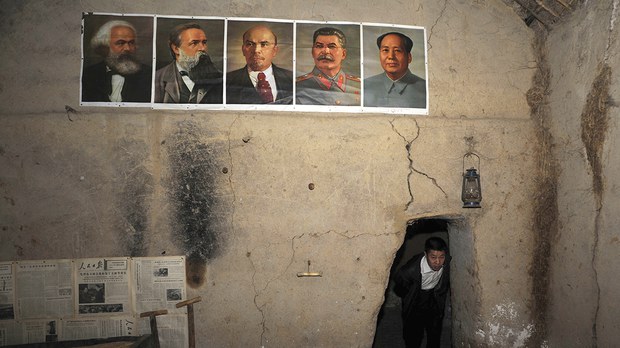
Today's classrooms are equipped with every modern audiovisual technology, lavish and grand. On the wall behind the professor hang three enormous projectors displaying course material — color images of five figures, more imposing than the ancestral tablets and portraits of any imperial dynasty. These five are unmistakably: Marx, Engels, Lenin, Mao Zedong, and Xi Jinping. Compared with the traditional 'Gang of Five,' the new 'Gang of Five' has dropped Stalin and added Xi Jinping.
Marx and Engels occupy a status in communist countries akin to towering, unassailable peaks — like the Iron Throne in the novel A Song of Ice and Fire. Although Engels was merely an appendage to Marx, the two are inseparable, forever paired together. The doctrine these two bearded men created brought profound catastrophe upon human society for more than a century afterward. Richard Pipes, the British-American expert on Soviet Russia, notes in Communism: A History that Marxism is a rigid doctrine that brooks no dissent, and that Marx's attitude toward those who disagreed with him was unmistakable — he said: 'Criticism is not a scalpel, it is a weapon. Its purpose is not merely to refute the opponent but to annihilate him.' The British historian Paul Johnson observes in Intellectuals that Marx's writings were divorced from fact, and that Das Kapital showed no real understanding of capitalism at all: 'Marx lived his entire life amid fierce verbal violence, which sometimes escalated into physical violence... There was nothing that happened under Stalin that had not already been foreshadowed in Marx's own conduct... Once Marx's power was secure, he would resort freely to violence and cruelty.' Marx carried the unmistakable air of a dictator. Someone who observed him closely said: 'The dominant feature of his character was a boundless ambition for and love of power... he was the absolute master of his party... he did everything alone, issued orders arbitrarily, and could not tolerate any dissent.'
As founder of the Soviet Union, the first communist state, Lenin ranks in status right behind Marx and Engels. Marx and Engels were mere armchair strategists — the 'First International' they founded fizzled out without effect — but Lenin waged real revolution with real guns, creating a Leviathan that exceeded even Hobbes's imagination. Although the Soviet Union has collapsed and the Russian Communist Party has almost no chance of becoming the ruling party again, the CCP regime, as heir to the Soviet legacy, still keeps Lenin in the communist pantheon. Stalin, by contrast, has been removed — just as his body was removed from Red Square in Moscow.
In the sequence of subsequent CCP leaders, there is no place for Deng Xiaoping, let alone for Jiang Zemin or Hu Jintao — Xi Jinping simply dismisses them. After Mao comes, directly, Xi Jinping, just as 'brilliant and mighty' as Mao himself, with the forty years in between vanishing without a trace. In the past, only the writings of the dead could be called 'classics'; today, the still-living Xi Jinping's 'writings' have already been elevated to the status of 'classics' — a practice indistinguishable from the way officials at every level, in the final years of the Ming dynasty, competed with one another to build 'living shrines' in honor of the eunuch chief Wei Zhongxian.
As early as 2017, the German scholar Daniel Leese noted in the preface to the Chinese edition of his book Mao Cult that, although he had ended the book on a pessimistic note predicting that the problem of personality cult might resurface in China's future politics, political events actually unfolded much faster than he had predicted. Soon after taking power, Xi Jinping began carefully orchestrating and promoting a personality cult modeled on Mao's. 'Xi Jinping's image and prestige have come to vastly overshadow those of the other Politburo Standing Committee members. The centralization of power accompanying Xi's increasingly prominent role in public security, economic reform, and the anti-corruption campaign raises the real possibility of a substantial leftward shift in China's political spectrum.'
The More Bad Books One Reads, the More Foolish One Becomes
Political education is a required course at every level of schooling in China. When CCP state media emphasize 'study,' the term carries a deliberate double meaning: 'study' as in xuexi, and 'Xi' as in Xi Jinping's own surname. On the blood-red 'Study Xi, Strong Nation' website, the content consists entirely of articles deifying Xi Jinping — praising him, for instance, for having 'reading as his greatest hobby,' while Xi in turn demands that leading cadres 'love reading, read good books, and read them well.'
The important books that Xi Jinping believes 'leading cadres should generally read' are 'the theoretical works of Marxism.' At a symposium marking the publication of Xi Jinping's Seven Years as an Educated Youth, the writer Cao Guxi recalled details of Xi's life during his years sent down to the countryside in northern Shaanxi: 'By the light of a kerosene lamp in his cave dwelling, he would read late into the night every day. As far as I know, before going to university he had already read Das Kapital cover to cover three times, filling eighteen thick notebooks with reading notes!' Xi later published several papers studying Marx's works — for instance, 'On the Contemporary Significance of the Preface to A Contribution to the Critique of Political Economy' in the Fujian Tribune (Economic and Social Edition) in 1997, and 'A Brief Discussion of the Contemporary Significance of the Theses on Feuerbach' in the Journal of the Fujian Provincial Party School in 2001. Xi's own book Up and Out of Poverty likewise repeatedly cites works such as Das Kapital and A Contribution to the Critique of Political Economy. Xi has also said: 'Whenever you feel uneasy in your heart, go study the classic texts — read the Communist Manifesto again and again.'
Setting aside the question of whether Xi Jinping actually read or understood the original texts of Marxism-Leninism, or personally wrote those dry, vacuous papers himself, the fact remains that Marx's works have long since been 'falsified' by history and science, and offer little value for serious study. The German scholar Uwe Wittstock notes in his book Marx Without the Beard that the labor theory of value Marx developed in Das Kapital is now regarded as obsolete and plays no role whatsoever in modern economics. His prediction that the proletariat in capitalist countries would sink into extreme poverty never came to pass; instead, the working class has largely become the middle class. His thesis that only the working class could serve as the agent of revolution lost all credibility after the collapse of most socialist states. His hypothesis that every contradiction in modern society stems from the core conflict between labor and capital has likewise been discredited. And his belief that historical development follows a clear goal along a fixed pattern cannot withstand serious scrutiny against the historical record at all. As a result, confidence in the predictive power of Marx's philosophy of history has been utterly extinguished.
Marx's doctrines were not merely wildly mistaken — they brought catastrophe of monstrous proportions upon humanity. According to figures published on the website of the Victims of Communism Memorial Foundation, headquartered in Washington, D.C., between 40 million and 160 million people worldwide have died under communist tyranny; the midpoint figure of 100 million is the one most widely cited. In April 2020, the organization announced it would add the global victims of the COVID-19 pandemic, which began in China in 2019, to its communist death toll, attributing the outbreak and every death resulting from it to the Chinese government. If those 100-plus million deaths were spread evenly across the more than one thousand pages of Marx's Das Kapital, that would work out to roughly 100,000 deaths per page. If each page contains roughly a thousand words, then every single word of the book has killed about a hundred people! Das Kapital can fairly be called the deadliest book in human history — far surpassing even Hitler's Mein Kampf. And yet this murderous book is still taught as a classic in Chinese university classrooms, poisoning the minds of countless young people.
Reading is a good thing, but what one reads matters far more. Reading superstitious pamphlets about spirits and demons turned people into Boxer rebels; reading Chairman Mao's Little Red Book turned people into Red Guards; reading Xi Jinping's writings turns people into zombie-like 'wolf warriors,' 'little pinks,' and 'white guards.' Marx's books lead people down the road to serfdom; Hayek's books lead people down the road to freedom. In his later years, Hayek completed The Fatal Conceit: The Errors of Socialism, in which he tore Marxism to shreds. Hayek pointed out that the socialists' fatal conceit was given, in the twentieth century, the actual opportunity to turn the Soviet Union, China, and other countries into gigantic experiments — people believed they were headed for paradise, only to find themselves plunged into a living hell. Hayek criticized socialism this way: some people, believing that the free-market economy produces economic injustice, turn to sympathize with and embrace the socialist ideal of fairness and justice. Yet a command economy is incompatible with democracy — to control the economy is to control life itself. The Taiwanese historian Lee Hsiao-feng said: 'I often tell my students, if both Taiwanese and mainland Chinese people had properly read these two books — The Constitution of Liberty and The Road to Serfdom — then neither the Chinese Nationalist Party nor the Chinese Communist Party would ever have gotten away with what they did!' One can only hope that someday, university classrooms in China will teach Hayek — and by then, China will surely be a China without the Communist Party.