
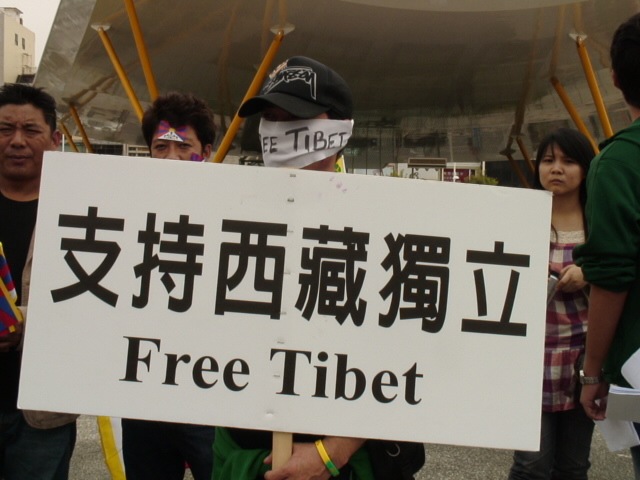
The Tibet issue has always been a subject of controversy. Not only do the Chinese governments on both sides of the Taiwan Strait and the Tibetan government-in-exile hold sharply opposing views on this issue, but Chinese people both inside and outside China also hold quite different opinions on it. These differences stem mainly from how much people know about Tibet's history and present reality, and from the differing "value standards" they apply. Discussing the Tibet issue therefore not only helps us understand Tibet's true history and present reality, but also compels us to rethink important values and the conflicts among them — human free will versus territorial unity; the people's right to choose their own form of government; and the right of national self-determination. How we weigh these values directly affects the course of the Chinese people's own progress toward freedom and democracy.
I. The Truth of Tibetan History:
Both Chinese governments across the Taiwan Strait claim that Tibet is an inseparable part of Chinese territory. The Dalai Lama, spiritual leader of the Tibetan people, and the Tibetan government-in-exile, hold that history was not so — that Tibet is an independent country.
The People's Republic of China holds that ever since the Chinese People's Liberation Army entered Tibet in 1950, Tibet has been "liberated" from a system of serfdom, and that Tibet has made tremendous progress and achieved great prosperity in the years since. The Tibetan government-in-exile, by contrast, holds that Tibetans have been enslaved and stripped of their basic human rights during these same years.
Which of these two starkly opposing views is closer to the truth?
1. An Outline of the History of Tibet-China Relations:
Let us look, based on historical records, at Tibet's relationship with China across five dynasties: the Tang, Song, Yuan, Ming, and Qing.
In 127 BCE, around the time the Han dynasty was first established, Tibet's first king, Nyatri Tsenpo, ascended the throne. Several centuries of internal warfare among rival Tibetan tribes followed.
Tibet grew powerful during China's Tang dynasty. In the seventh century, the Tibetan Tubo king Songtsen Gampo unified the various tribes into a single state and expanded its territory. The Tang court gave Princess Wencheng in marriage to Songtsen Gampo in pursuit of friendly relations between the two states. Tibetan forces even seized Chang'an (present-day Xi'an), then the capital of Tang China, at one point.
Toward the end of China's Song dynasty, Tibet, like the Song, was conquered by the powerful cavalry of Genghis Khan's Mongol empire. The Mongols went on to establish the Yuan dynasty in the Chinese heartland. In Tibet, however, Kublai Khan, founder of the Yuan, honored the great Tibetan lama Phagpa as the supreme religious teacher of the entire Mongol empire — a position equivalent to imperial preceptor — and let him govern Tibet's political and religious affairs; the Mongols did not rule Tibet directly.
After the decline of the Mongol empire, Tibet had almost no contact with Ming-dynasty China, which succeeded the Yuan.
During China's Qing dynasty, relations with Tibet were, on the whole, friendly. Qing forces entered Tibet four times at the Dalai Lama's request to repel foreign invasions and put down internal rebellions, withdrawing each time afterward. Toward the end of the Qing dynasty, Tibet suffered invasions from neighboring Nepal and from Britain. In 1909, after the deaths in succession of the Qing Guangxu Emperor and Empress Dowager Cixi, Qing forces marched into Lhasa and occupied Tibet. Two years later, the 1911 Revolution broke out, and the Qing garrison troops stationed in Tibet split into rival "royalist" and "republican" factions and turned on each other. Tibetans seized the opportunity to rise up, defeated the Qing forces, and the Thirteenth Dalai Lama declared Tibet an independent country.
In early 1950, the Chinese People's Liberation Army invaded Tibet. Facing overwhelming military force, the Tibetans sent a delegation to Beijing to sue for peace and were forced to sign the so-called "17-Point Agreement" with the Beijing regime. Its main provisions were that Beijing would promise to leave everything in Tibet unchanged, while Tibetans would allow the PLA to enter Tibet peacefully. But not long after entering Tibet, the CCP began imposing socialism, and Tibetan discontent grew. In 1959, Tibetans rose in revolt; the CCP branded it a "rebellion" and crushed it with military force. The Fourteenth Dalai Lama and nearly 100,000 Tibetans fled to India, where they established the Tibetan government-in-exile.
2. The Historical Grounds — and Historical Flaws — Behind Both Chinese Governments' Claim That Tibet Is Chinese Territory
The Chinese governments on both sides of the Taiwan Strait today claim that Tibet has been Chinese territory since ancient times, citing chiefly five grounds: first, that during China's Tang dynasty a Tibetan king married Princess Wencheng, who later wielded great influence in Tibet; second, that during China's Yuan dynasty Tibet was likewise incorporated into the Mongol empire and placed under Yuan administration; third, that Qing troops entered Tibet multiple times to act as its protector; fourth, that the title of the Fifth Dalai Lama was conferred by the Manchu Qing emperor; and fifth, that the Nationalist central government under Chiang Kai-shek once sent Wu Zhongxin, chairman of the Mongolian and Tibetan Affairs Commission, to Lhasa to preside over the Fourteenth Dalai Lama's "enthronement" ceremony (that is, the ceremony formally installing the then five-year-old Dalai Lama as Tibet's supreme political and religious leader).
From the standpoint of historical evidence and plain common sense, none of these five "grounds" actually holds together.
First, Princess Wencheng's marriage to the Tibetan king Songtsen Gampo during the Tang dynasty was simply the Tang court's way of pursuing friendly relations through marriage. To cite the bestowal of a Tang-dynasty princess more than 1,300 years ago as proof that Tibet has been connected to China, and hence Chinese territory, since ancient times, is an utterly absurd argument.
Second, Genghis Khan's Mongol cavalry invaded the Chinese heartland and established the Yuan dynasty there. Because that regime was established in territory inhabited by Han Chinese, the Chinese count the Yuan as one of the dynasties of Chinese history. But to use the fact that Tibet was likewise conquered by Genghis Khan's cavalry and incorporated into the Mongol empire as proof that Tibet was therefore part of the Yuan — and hence part of China — simply does not hold up. If this logic were valid, then today's Mongols, descendants of Genghis Khan, could equally claim sovereignty over Tibet, over the Chinese heartland, and even over most of Russia's territory, since their ancestors once conquered all of it — which would mean present-day China ought to belong to the Republic of Mongolia. By the same logic, present-day Vietnam and Korea ought likewise to be Chinese territory, since both were once conquered by China. This logic is clearly untenable.
Third, the fact that Qing troops entered Tibet on multiple occasions to help Tibetans put down rebellions and repel foreign invasions cannot serve as grounds for claiming that the Qing dynasty therefore held sovereignty over Tibet. If this logic held, then when American forces helped Kuwait repel Iraq's invasion a few years ago, did the United States thereby gain sovereignty over Kuwait? When American-led coalition forces entered Haiti to help restore Haiti's democratically elected president, Aristide, after he was overthrown by the military, did the United States thereby acquire sovereignty over Haiti?
Fourth, the claim that the title of the Fifth Dalai Lama was conferred by the Qing Shunzhi Emperor, offered as proof that Tibet was subordinate to the Qing dynasty, likewise does not accord with historical fact. The foremost authority on Tibetan history under CCP rule was Ya Hanzhang, who compiled the Biographies of the Dalai Lamas, covering the history of all fourteen Dalai Lamas to date. In the preface to that book, this historian wrote: "For the needs of the struggle, the organization asked me to write a book on Tibetan history, to be used both to refute the slanders spread by the opposition and to educate the broad masses of the Tibetan people in anti-imperialist patriotism." [1] A historian ought to be faithful to historical truth, yet he wrote this book to serve political needs. Nevertheless, even in his own book it is recorded that the title "Dalai Lama" was not bestowed upon the Fifth Dalai Lama by the Manchu Qing emperor at all, but was instead a title conferred, roughly during the Chinese Ming dynasty, by the Mongol prince Altan Khan upon the Tibetan religious leader Sonam Gyatso. [2] "Dalai" is a Mongolian word meaning "ocean," and "Lama" is a Tibetan word meaning "teacher" or "guru" — together forming the title "Dalai Lama." Tibetans subsequently recognized the two Buddhist leaders who preceded him as the first and second Dalai Lamas, counting Sonam Gyatso as the third, and the title has been used in sequence ever since. [3]
The Manchu Qing emperor did once bestow upon the Fifth Dalai Lama an honorific title of twenty-four characters, but at the very same time the Dalai Lama likewise bestowed upon the Qing emperor a whole string of honorific titles of his own. [4] Such mutual bestowal of titles was simply a way for both sides to express friendship at the time; it implied no relationship of subordination whatsoever.
Fifth, from the 1911 Revolution until 1950 — nearly forty years — Tibet was fully independent. Although this period saw a transfer of power upon the death of the Thirteenth Dalai Lama and the succession of the Fourteenth, the Tibetans never once agreed to the demand, put forward by Chiang Kai-shek's Nationalist government, that Tibet should be Chinese territory subject to Han Chinese rule. A volume jointly compiled by Beijing's China Tibetology Research Center and the Second Historical Archives of China, titled Selected Archives on the Memorial Rites for the Passing of the Thirteenth Dalai Lama and the Reincarnation and Enthronement of the Fourteenth Dalai Lama (hereafter "the Selected Archives"), collects 478 official communications, telegrams, and other documents exchanged by the Nationalist government at the time on this matter. [5] Having carefully read through all of these documents, I found that throughout this entire period the Tibetans never once consented to having Tibet placed under Chinese rule.
Both Chinese governments emphasize that the Nationalist government sent a special envoy, Wu Zhongxin, to Lhasa, where he "inspected and confirmed," on behalf of the central government, the identity of the reincarnated child, and "presided over" the Fourteenth Dalai Lama's "enthronement" ceremony — citing this as proof of Tibet's subordinate status. But the telegrams exchanged between Wu Zhongxin in Lhasa and Chiang Kai-shek, contained in the Selected Archives, reveal that the Tibetans merely allowed Wu to view the child candidate and to take part in the enthronement ceremony as a courtesy to save face for the Nationalist government. Wu Zhongxin had no actual power to decide whether the Fourteenth Dalai Lama's identity could be confirmed. Ya Hanzhang himself writes in Biographies of the Dalai Lamas: "The so-called 'inspection' was nothing more than a face-saving gesture toward the Nationalist government; in reality he had no power of veto." [6] A dispute even arose during the enthronement ceremony itself, because Wu Zhongxin had been assigned an unimportant seat. In the end, the Tibetans reluctantly agreed to give him a seat equivalent to that once held by the Qing dynasty's Amban (Imperial Resident) in Tibet. Ya Hanzhang writes of this: "The so-called 'seating' issue was likewise nothing more than a face-saving gesture toward the Nationalist government, meant only to show that Wu Zhongxin's status was at least equal to that of the Amban." [7] Wu did not, in fact, "preside over" the enthronement ceremony at all.
Nationalist-era newspapers at the time published a photograph of the Dalai Lama together with Wu Zhongxin, offered as evidence that Wu had presided over the Dalai Lama's enthronement ceremony. But Ngapoi Ngawang Jigme, currently vice chairman of the CCP's National People's Congress, stated in remarks published in Tibet Daily that this photograph was actually taken several days after the enthronement ceremony had concluded, when Wu Zhongxin went to pay a courtesy visit to the Dalai Lama. [8] In studying the documents in the Selected Archives, I found two telegrams that corroborate this point: for instance, communication No. 439 is a telegram sent to Wu Zhongxin in Lhasa by Dong Xianguang, then deputy director of the Nationalist government's Central Propaganda Department, stating that the American Associated Press wished to obtain news photographs of the Dalai Lama's enthronement ceremony for publication, and asking that, to save time, Wu send the photographs directly to a newspaper in India for forwarding to the Associated Press. [9] In his reply (communication No. 441), Wu Zhongxin stated that because the enthronement ceremony took place in the early morning, it had been "inconvenient to take photographs" — meaning he had no photographs of the enthronement scene itself. He said in the telegram that he would send the Associated Press photographs of other scenes instead. [10] That photographs were taken of other scenes, yet not a single photograph exists of Wu Zhongxin presiding over the very enthronement ceremony that the Nationalist government supposedly valued most highly — despite the nearly hundred-member "special mission" delegation present — makes the claim that Wu Zhongxin presided over the enthronement ceremony very hard to believe.
3. Tibet's Special Status as a Religious State
The Chinese governments on both sides of the Taiwan Strait hold that Tibet was never a sovereign state, citing chiefly the fact that Tibet never maintained formal diplomatic relations with other countries, and that Tibet repeatedly received Qing-dynasty Manchu imperial troops sent to suppress rebellions and repel foreign invasions.
This state of affairs arose from Tibet's special character as a religious state.
Tibet's close relationship with China developed mainly during the Manchu Qing dynasty. The relationship between the two was one of "benefactor" and "recipient of benefaction." The Qing emperor, as benefactor, used military power and lavish annual gifts of wealth to ensure that the "recipient" — the Dalai Lama — not only governed Tibet's political and religious affairs but also became the supreme spiritual leader of the state religion of the entire Qing empire. In turn, the Dalai Lama's religious influence, reaching as far as Mongolia, Xinjiang, Korea, and Burma, helped stabilize Manchu Qing rule. The two sides existed in a relationship of mutually beneficial secular-religious cooperation.
To use an analogy: the relationship between the two sides was much like that between a village and a Buddhist temple on the hillside beside it. The village headman, as secular leader, governs the village's affairs. Many villagers are Buddhist, including the headman himself, and together they honor the elder lama of the temple as their spiritual leader. The headman has no authority over the temple itself. But when bandits invade the temple, or young monks within it rebel, and the elder lama appeals to the headman for help, the headman will send village militia to drive off the threat and help restore order, withdrawing the militia once order is restored. In ordinary times, the headman also acts as "benefactor," providing food to the temple. The headman's respect and friendly relationship with the temple's elder lama earns him greater support among the village's Buddhists, reinforcing the stability of his own rule. The temple, for its part, need not maintain its own military force, because Buddhism forbids the taking of life, and it can appeal to the headman for troops in an emergency. Nor does the temple need to declare independence, since it was never under the village's jurisdiction to begin with. The relationship between the lama and the headman is one of mutual assistance and mutual benefit.
This situation also somewhat resembles the relationship between Italy and the Vatican. Although the Vatican sits within Italian territory, it is not a province of Italy and does not fall under the jurisdiction of the Italian government. Yet when someone attacks or attempts to damage this holy site where the Pope resides, Italian forces will go to its aid at the Pope's request — but they will never occupy it afterward.
The breakdown of such a relationship generally originates on the headman's side — for instance, if the temple suffers a disaster and appeals for help, but the headman ignores the plea, or if the headman himself develops designs on seizing the temple. The temple's existence rests on spiritual authority alone, with no military force behind it. If the secular village comes to disregard religious authority and instead speaks the language of raw force, the temple side is naturally the weaker party. And if the headman holds no religious belief at all, and moreover not only seizes the temple but sets out to forcibly "re-engineer" the society of the lamas and monks, then the temple is doomed to suffer greatly.
This special character of Tibet as a religious state, and its "benefactor and recipient" relationship with the Manchu Qing dynasty, is what prevented it from becoming a typical independent state maintaining formal diplomatic relations with countries around the world. And this, in turn, is one of the sources of the Chinese misconception that Tibet is Chinese territory.
4. Two Pieces of Evidence That Tibet Was Never a Province of the Chinese Empire
The protocol surrounding the Fifth Dalai Lama's visit to Beijing in 1652, at the invitation of the Manchu Qing Shunzhi Emperor, likewise reveals that Tibet was not subordinate to Manchu Qing rule. According to Ya Hanzhang's Biographies of the Dalai Lamas, before the Dalai Lama's arrival in the capital, the Qing emperor convened his Manchu and Han officials to discuss the proper protocol for welcoming him. The Manchu officials argued that, since the Dalai Lama was the empire's religious preceptor, the emperor himself ought to leave the city to greet him in person, which would help win over the Buddhist Outer Mongols. The Han officials argued that "the emperor is lord of all under heaven," and that greeting him personally would compromise his dignity. In the end, Emperor Shunzhi settled on a compromise: under the pretext of going "hunting," he traveled forty li outside the city and arranged to "encounter" the Dalai Lama "along the road." [11] In the entire history of China's imperial dynasties, one would be hard pressed to find an instance of an emperor personally leaving the capital to greet one of his own subjects — indeed, even in the late Qing, when facing a powerful envoy sent by Britain, the emperor still insisted the envoy perform the full kowtow ritual. This special protocol extended to the Dalai Lama shows clearly that Tibet was not a subordinate of the Manchu Qing dynasty.
Another clear piece of evidence is this: if Tibet had truly been subordinate to the Manchu Qing dynasty, it should have paid "tribute" to the imperial court, as subordinate provinces or vassal states did. Yet there is no historical record of any such thing — quite the opposite, in fact: it was the Manchu Qing dynasty that continually sent lavish gifts to Tibet, precisely because the Qing regarded Buddhism as its state religion and honored the Dalai Lama as its supreme spiritual leader.
5. The Main Grounds for Tibet's De Facto Independence
In modern times, Tibet maintained formal diplomatic relations only briefly, with countries such as Nepal. As a sovereign state, aside from this shortfall in formal diplomatic relations, Tibet possessed every other attribute of an independent nation. Consider these eight points:
First, Tibet's head of state, the Dalai Lama, was chosen through its own established method of succession, and Tibet had its own government institutions and cabinet. Second, Tibet had its own capital, always at Lhasa. Third, Tibet had its own body of laws. Fourth, it independently collected taxes, printed and issued its own currency, and managed its own finances. Fifth, though not large in scale, it always maintained its own army. Sixth, and more importantly, it had its own culture, its own customs, and its own Tibetan language and script, distinct from Chinese. Seventh, it occupied a natural geographic territory historically bounded by elevation. Eighth, it had a continuous history of independence.
III. The Reality of Present-Day Tibet
1. Respecting Tibetan History
Chinese people on both sides of the Taiwan Strait know very little about the true history of Tibet. Because both governments insist that Tibet is Chinese territory, any book presenting Tibet's history of independence has great difficulty getting published. On top of this, Chinese people have long carried a deep-seated attachment to the idea of "great unity" as a nation, so that the very mention of Tibet immediately triggers the reflexive response that it cannot be independent. What knowledge the Chinese people have of Tibetan history is, essentially, entirely knowledge instilled by official Chinese propaganda.
In October 1992, the People's Republic of China published a "White Paper on Human Rights in Tibet," an essay built around and quoting this directive of Deng Xiaoping's: "The fundamental question is that Tibet is part of China — right or wrong must be judged by this standard." [12]
What an outrageously domineering piece of logic — that Tibet is part of China regardless of whether that is "right" or "wrong." Sadly, this kind of thinking of Deng Xiaoping's represents the views of a great many Chinese people: that when it comes to Tibet, independence is simply not an option — regardless of the historical facts, without any inquiry into present realities, without any interest in the research of Western Tibetologists, let alone any willingness to seriously listen to the voices of the Tibetan people themselves.
2. Confronting the Reality of Tibet
Respecting history ought to be people's basic starting point when thinking about the Tibet issue. Even more important than this, however, is confronting the reality of Tibet under CCP rule, and the wishes of the majority of the Tibetan people.
If we are to assess the actual living conditions of the Tibetan people, the main criteria for measuring this should be: after 45 years of CCP rule, have Tibetans, politically, been "liberated" and become "masters of their own house," gaining freedom — or have they instead been stripped of their basic political rights? Economically, has Tibetans' right to private property been protected, making them prosperous — or has that right been stripped away, leaving them impoverished? In religion, has their freedom to choose their own faith been respected — or has religious freedom been trampled? In terms of culture and the natural environment, have Tibet's culture and natural environment been protected — or have they been destroyed? In ethnic relations, have Tibetans, as a minority people, been respected — or have they been subjected to constant discrimination?
With even a little investigation, one quickly finds that the facts are deeply painful and infuriating.
Politically, Tibetans have been entirely stripped of any right to choose their own leadership. Like the rest of mainland China, Tibet has never held a single popular election, and governments at every level rest on no foundation of popular consent whatsoever. In Tibet, ultimate power rests with the First Secretary of the CCP's Tibet Autonomous Region Party Committee. Of the seven men who have held this post since the so-called "pacification of the rebellion" in 1959 — Zhang Guohua, Zeng Yongya, Ren Rong, Yin Fatang, Wu Jinghua, Hu Jintao, and Chen Kuiyuan — all but Wu Jinghua, who is Yi, have been Han Chinese.
Like the rest of China, Tibet has no freedom of the press and no freedom of speech. Any resistance is crushed by Chinese military force. According to documents from the CCP's Tibet Military District that have since reached the West, some 87,000 Tibetans were "eliminated" in the 1959 "pacification" campaign alone. [13] According to figures compiled by the Panchen Lama, who once served as vice chairman of the CCP's National People's Congress, between 10 and 15 percent of all Tibetans were imprisoned at that time, and 40 percent of those died in custody. [14] According to Amnesty International, more than 150 instances of Tibetans marching in the streets of Lhasa, only to be violently suppressed, occurred between 1987 and 1992 alone. [15] Most notably, in the spring of 1989 — just two months before the "Tiananmen Democracy Movement" — the CCP carried out a large-scale crackdown on Tibetans in Lhasa and declared martial law. Tang Daxian, a Beijing Youth Daily reporter present in Lhasa at the time, later published an account overseas, based on his own eyewitness observations and on official CCP documents obtained through other channels, exposing the inside story of the crackdown. By his count, over 400 Tibetans were massacred at the time, more than a thousand were wounded, and over 3,000 Tibetans were arrested. [16] Other sources say that more than 40,000 Tibetans implicated in the unrest were later stripped of their urban residency status and driven out of Lhasa.
The Dalai Lama, speaking at Yale University in the United States, said that over 1.2 million Tibetans died of starvation and persecution during more than 40 years of CCP rule. [17] The Tibetan government-in-exile has compiled detailed statistics breaking down this figure: 170,000 died in prison; nearly 160,000 were executed by firing squad; 430,000 died on the battlefield; 340,000 died of starvation; and 100,000 died from forced suicide or from being beaten to death during struggle sessions. This total death toll amounts to one-sixth of the entire Tibetan population living across Tibet's three traditional regions — the "Tibet Autonomous Region" together with Ü-Tsang and Kham — meaning that one out of every six Tibetans died an unnatural death. [18] Such a death ratio is exceedingly rare in modern human history. [19]
Economically, Tibetans have been completely stripped of their right to hold private property. The CCP's campaign to force Tibetans into socialism only deepened Tibetan poverty. In 1980, CCP General Secretary Hu Yaobang inspected Tibet. Confronted with the extreme poverty of Tibetan life, an outraged Hu Yaobang told a meeting of the CCP's Tibet Autonomous Region Party Committee: "Where did all the special funds the Central Government allocated to aid Tibet go — into the Yarlung Tsangpo River?!" Shortly afterward, Ren Rong, then Party secretary of the Tibet Autonomous Region, was removed from his post and replaced by Yin Fatang. Hu Yaobang's directive on Tibet was that the region should work hard for a few years to restore Tibetans' standard of living to what it had been twenty years earlier, in 1959. Yin Fatang later wrote in an article in Red Flag magazine: "When Comrade Hu Yaobang inspected Tibet, based on the conditions there at the time, he pointed out that the actual situation in Tibet was one of poverty and backwardness." [20]
In recent years, alongside China's broader economic reforms, the living standards of the Tibetan people have improved considerably compared to when Hu Yaobang made his inspection. But according to people familiar with the real conditions in Tibet, those getting rich in Tibet today are mainly Han Chinese. This is because all economic activity there depends on "connections," with no fair competition — and it is only Han Chinese who have the connections and channels into Beijing and inland China. According to media reports, on Lhasa's busiest commercial street, the Barkhor, shops run by Han Chinese now outnumber those run by Tibetans.
In religion, the persecution Tibetans have suffered is even more severe. According to statistics from the Tibetan government-in-exile, by 1979, of the 6,259 monasteries once standing in Tibet, all but 8 had been destroyed. Of the 590,000 monks who once lived there, 110,000 were persecuted to death and 250,000 were forced to renounce their monastic vows. At the founding conference of the China Tibetology Research Center held in Beijing in 1988, the Panchen Lama said, with evident grief: "In every single Tibetan-inhabited area, one hundred percent of the monasteries were destroyed. Of the seven or eight that survived, not one remains intact."
Today, the CCP's religious persecution is not as brutal as it once was, but Tibetans still lack religious freedom. Every monastery and monk in Tibet must submit to the authority of the CCP's United Front Work Department and its Religious Affairs Management Committee. The official "Regulations on Becoming a Monk" state: "Candidates must be at least 18 years of age, must love the motherland, must love the Communist Party, and must obtain their parents' consent... After entering the monastery, they must study Marxism and come to clearly understand idealism and materialism as two opposing worldviews."
Monks who show even the slightest dissatisfaction with this stripping away of religious freedom are punished for it. Those who advocate Tibetan independence in particular are subjected to brutal suppression. According to accounts from Tibetans who personally experienced abuse in prison, Chinese police and military personnel not only used electric batons, rifle butts, iron rods, and beatings, but also resorted to such cruel methods of coercion as burning victims with cigarettes, setting dogs on them, and forcing batons into nuns' vaginas. According to one Han Chinese exile who had formerly served as a public security officer in Tibet, "in Tibet, the police employ as many as 33 different kinds of torture." [21]
In terms of culture and the natural environment, Western scholars studying the Tibet issue agree that Tibet's culture and natural resources are suffering severe destruction. The CCP regime has redrawn Tibet's map, carving off most of the territory that once made up Kham and Ü-Tsang and incorporating it into the provinces of Sichuan, Yunnan, Gansu, and Qinghai, while moving large numbers of Han Chinese settlers into these areas. Based on figures extrapolated from several rounds of China's national census, the number of Han Chinese now living across Tibet's three traditional regions has reached 7 million, already exceeding the roughly 6 million Tibetans there.
Even someone with no knowledge of the situation in Tibet, so long as they have lived under Chinese Communist rule themselves, can readily imagine just how dark CCP authoritarian rule in Tibet must be. Even as Tibetans endure enslavement under CCP authoritarianism, they must also bear the racial discrimination of Han Chinese. The prominent Chinese dissident Wei Jingsheng once wrote of how, when his parents — who had never had any contact with Tibetans — learned that his girlfriend was Tibetan, they adamantly opposed the match and threatened to disown him as their son. His father's stated reason for opposing it was: Tibetans are not human beings, but half animal. [22] Such a conclusion is the product of years of Communist Party indoctrination.
III. Four Value Questions Reflected in Chinese Opposition to the Tibetan People's Exercise of Their Own Rights
Quite a few Chinese people neither respect history nor take into account the more than forty years of suffering endured by the Tibetan people, and instead simply oppose the Tibetan people's calls for independence outright, insisting that a "greater unified" China takes precedence over everything else. That the Chinese regimes on both sides of the Taiwan Strait oppose Tibetan independence is naturally rooted in the self-interest of those in power; but there is no reason whatsoever for intellectuals on either side of the Strait to disregard the Tibetan people's right to choose independence.
1. Which Matters More: The Concept of National Unity, or the Value of Human Freedom?
Some people oppose Tibetan independence on the grounds that if Tibet were allowed to become independent, Xinjiang, Inner Mongolia, and other regions would follow suit, and the great nation of China would fall apart — and who, they ask, would bear responsibility for that?
But the question is: should our starting point for thinking about this be the "individual," or the "state"? Does the value of "unity" matter more, or does human freedom matter more? Which is the ultimate value? Put another way: which is more frightening — "disintegration," or the enslavement of the individual? We might imagine two pictures: in one, Lenin returns from the dead and, by force of arms, reunifies the fifteen countries that once made up the "Greater Soviet Empire," including Russia, restoring the USSR and reimposing Communist rule — the entire Soviet population is enslaved, but the state is unified. In the other picture, the Soviet Union has broken apart into today's fifteen countries — the "Greater Soviet Union" no longer exists, but the people have gained their freedom. Faced with these two pictures, these two ways of living, which would people choose? The Soviet peoples chose freedom, even at the cost of the breakup of the "Greater Soviet Union." Why must Chinese people insist on choosing an unfree "Greater China" instead?
Concepts like borders and nation-states have never carried ultimate value. The "Helsinki Accords," signed by European nations in 1975, included a provision stating that any change to the borders between European states, so long as it is carried out peacefully, is permissible. The core spirit of the Helsinki Accords is that borders are not eternal, and that human free will stands above values such as the nation-state and its borders. The logic here is not complicated: borders, forms of government, and social systems are all human creations, and their starting point and ultimate purpose alike are human freedom and dignity. When they come into conflict with the will of the majority, or fail to serve human needs, people ought to change them — rather than twisting human freedom to fit them.
Some say that if this logic holds, then must Guangdong, Sichuan, Shanghai, and all of China's 29 provinces, municipalities, and autonomous regions be allowed to become independent too? The problem is that the premise behind this hypothetical simply does not exist. For a region's people to demand independence, certain special conditions must generally be present — a distinct ethnicity, a distinct culture, a past history of independence, and, crucially, the wishes of the majority of the people. Independence is never demanded arbitrarily, for no reason at all. For example, after the former Soviet Union split into today's fifteen countries, Russia's territory and population far exceeded those of the other fourteen successor states, yet to this day no one has heard of the Russian people demanding to be split up further. One important reason is that Russians form a single ethnic nation with a shared culture, and there is no history in modern times of Russia being divided into separate states. And, more importantly still, the great majority of the Russian people have no wish for such a division.
This is much like how China's three northeastern provinces were once formally established as the state of "Manchukuo" under Japanese rule, yet today no one from the Northeast demands "independence" as a separate country. The claim that allowing Tibet to become independent would inevitably lead to even Guangzhou, Qingdao, and Harbin seeking independence is exactly like those who, faced with mainland Chinese refugees coming to America, cry out in alarm that unless they are sent back, all 1.2 billion people in China will flood into the United States. Both arguments use a premise that could never actually happen in order to deny a vulnerable group of people the rights that are rightfully theirs.
This Chinese tradition of valuing the "nation-state" above individual freedom and dignity runs very deep and very far back. The entire five-thousand-year history of Chinese culture is, in essence, a history that has consistently placed collective values — the monarch, the state, society — above individual freedom. Confucius, Mencius, and their intellectual descendants — the forefathers of China's scholarly tradition — painstakingly constructed a Chinese culture whose very core is the subordination of the individual to the collective.
The celebrated reform-minded intellectuals of modern China — figures like Kang Youwei, Liang Qichao, Chen Duxiu, Zhang Taiyan, and Liang Shuming — all emphasized reform and change aimed at making the nation strong, with very little discussion of individual freedom or rights. Even Yan Fu, who translated Mill's On Liberty with the deliberate intention of introducing and spreading British liberal thought among the Chinese, still treated liberalism merely as a means to enrich and strengthen the nation, rather than as an end in itself, namely freedom. And under nearly half a century of CCP rule, this notion that the value of the state outweighs that of the individual has been pushed to an extreme. Chinese people have been thoroughly steeped in this culture that prizes national strength and the primacy of national interest above all else. This same nationalist sentiment, prioritizing the interests of the state, can be seen even in the movements Chinese people on the mainland have waged in recent decades to fight for democracy and freedom. Whether it was the 1976 "April Fifth" Tiananmen movement or the "1989 Democracy Movement," the dominant theme in Tiananmen Square each time was "patriotism." The primary demand the student leaders at Tiananmen made of the government was for the authorities to recognize their movement as a patriotic one. Calls for individualism and liberalism were, by comparison, remarkably faint. Even today, amid China's vigorous economic growth, some Chinese intellectuals have put forward the notion of "neo-authoritarianism" — but the essence of this "-ism" remains the same traditional Chinese cultural thinking that places national interest above individual rights and social order above personal freedom.
What is both ironic and deeply thought-provoking is that this mode of thinking — that "national strength matters above all" — has persisted in China for five thousand years, and yet the nation has never managed to become truly strong. The fundamental reason is that Chinese people, and especially generation after generation of China's hidebound intellectuals, have inverted their values: in emphasizing national strength, they have ended up stripping individuals of their freedom and rights. National wealth and power should never be the ultimate goal. On the contrary, protecting individual freedom and dignity is precisely the value and purpose for which a state exists in the first place. National strength ought to be merely a "byproduct": only in a state of freedom do people possess imagination and creativity, only then can they create greater spiritual and material wealth, and only then, in the end, does the "fruit" of national strength ripen. For five thousand years, Chinese people have had this relationship backwards — with the result that the nation never became strong, and individual freedom was stripped away as well.
Valuing human freedom is not only the fundamental solution to the Tibet issue — it is also the key to whether the Chinese people can become truly modern people, and whether China can become a genuinely free and democratic nation.
2. Should the Decision Be Made by China's 1.2 Billion People, or Should the Choice of the Tibetan Majority Be Respected?
Some say that whether Tibet becomes independent cannot be a decision for Tibetans to make on their own — it should depend on whether the majority of the Chinese people, that is, over a billion Han Chinese, agree to it. Some phrase this more delicately, saying the decision should be made jointly by Han Chinese and Tibetans together. This "Han-majority-decides" theory, in practice, amounts to stripping Tibetans of their right to choose altogether. The logic is simple: there are over a billion Han Chinese, and only around 6 million Tibetans. Even if we assume the Han Chinese population stops growing entirely, and Tibetans grow at 3 percent annually — among the fastest population growth rates in the world — it would still take 1,500 years for the Tibetan population to equal that of the Han. This view, that the majority of Han Chinese should decide, amounts, in effect, to permanently denying Tibetans any chance of ever determining their own fate.
On the question of Tibet, respecting the decision of the "majority" means, above all, respecting the wishes of the majority of the Tibetan people. Just as "Greater China" and "unity" are not ultimate goals in themselves, independence is likewise not the single most important value at stake here. What matters most is respecting the majority of Tibetan people's right to freely choose for themselves — whether they choose independence or choose union with China.
The 1993 "plebiscite" held in the American territory of Puerto Rico, to decide whether the island should become the 51st U.S. state, is a fine example of respect for the people's right to choose. Whether the island would become part of U.S. territory was not decided by the will of the people in the other 50 states, but by a free vote of all the residents on the island itself. Had the principle of decision by the American majority been applied instead, the people of Puerto Rico would have had no room to choose at all, since the island's population is only 3 million, compared to 250 million on the U.S. mainland.
The result of this "plebiscite of self-determination" was that the majority of Puerto Ricans chose to preserve the status quo — that is, they chose not to become a U.S. state. The American government and people did not interfere with this outcome in any way, fully respecting the wishes of the local population. Under U.S. law, however, if the majority of Puerto Ricans had instead chosen union with the United States, wanting to become the 51st state, that choice would not have automatically become reality — the proposal would still have had to go through debate and approval by the U.S. Congress. Congress, as the nation's highest legislative body, represents the will of the American people; for it to review such a proposal is, in effect, for the American majority to review it. In other words: when Puerto Rico chooses independence, that decision is made unilaterally by its own majority; but when Puerto Rico chooses union with the United States, it requires the consent of the American people as well.
This is very much like marriage and family relationships. In the United States, if one spouse files for divorce, the court will accept the case and can grant the divorce without requiring both parties' consent. But if one party later wishes to remarry the other, that "reunion" requires the other party's consent. In other words, a divorce can be initiated unilaterally, while a marriage requires the consent of both parties — one side cannot simply insist on "marrying" and make it so. Family relationships work the same way: imagine a large family in which several brothers live together, and one brother wants to move out and live "independently" — that right belongs to him alone. But if that brother who moved out later wants to return and live "unified" with the rest of the family again, that requires the consent of the majority of his brothers.
Behind all these examples and analogies lies the same underlying idea: that people's right to choose deserves full respect, and that human free will should be regarded as the highest value. Human history increasingly proves that anything genuinely good, any genuinely good way of living, never needs to be forced upon others. Under conditions that allow people to choose freely, people will, in the end, inevitably choose what is good. And the very fact that they are able to choose "the good" depends on their also having the right to choose "the bad."
3. Would Tibetan Independence Threaten China's Security?
Some more pragmatically-minded Chinese people argue that Tibetan independence would threaten China's national security. Their reasoning is that China and India have fought a border war in the past, and their armies still face off across the Himalayas today; were Tibet to become independent, Indian troops and influence would move into Tibet, and without the natural barrier of the mountains, the security of China's interior would face a direct military threat.
This scenario, in fact, disregards the Tibetan people's long tradition and deep desire for peace and self-determination. Tibet has, in modern history, suffered repeated invasions by other countries and by the Qing dynasty alike, and is now under CCP authoritarian rule. What grounds are there for assuming that once Tibetans freed themselves from Chinese rule and became self-governing, they would then willingly submit to, or permit, an Indian invasion or foreign rule? The Tibetan government-in-exile and the more than 100,000 Tibetan refugees in India have now lived in exile there for 35 years, and even while residing within India's own territory, they have never come under Indian rule — the Tibetan government-in-exile and the Tibetan community it leads have remained independent throughout.
In 1987, the Dalai Lama, addressing the U.S. Congress, proposed a "Five Point Peace Plan" for resolving the Tibet issue, [23] which included transforming the Tibetan region into a demilitarized zone, a nature reserve, and a destination for tourism. Were Tibet to become a demilitarized zone, it would benefit the security of both China and India, since either side wishing to attack the other would first have to pass through Tibet — inviting resistance from Tibetans themselves as well as international condemnation. This would be far preferable to the current situation, in which Chinese and Indian troops face off with no buffer zone between them and conflict could erupt at any moment. And a demilitarized Tibet, led by the Dalai Lama — a Nobel Peace Prize laureate who advocates nonviolence — would pose a security threat to which country, exactly?
4. Could an Independent Tibet Survive Without Chinese Assistance?
Many Chinese people, when discussing Tibet, especially emphasize a point the Chinese government endlessly repeats: that Tibet was originally a backward and impoverished society under a system of serfdom, and that it is only thanks to the enormous manpower and material assistance provided by inland China over the years that Tibetans' lives have improved. Beijing's "White Paper on Human Rights in Tibet" likewise cites a great deal of official data to make this point, aiming to prove that "without the Communist Party, there would be no new Tibet."
First, the credibility of the figures in the "White Paper on Human Rights in Tibet" is itself highly questionable. Mainland China still has no freedom of speech or of the press to this day. When a set of figures is subject neither to oversight by a free press nor to open challenge from dissenting views, how much truth can we expect it to contain? Even setting this aside, and granting that these figures were entirely credible, how could any country or region possibly fail to see some progress and improvement in living standards over such a long span as forty-five years of development? Who can prove that if Tibetans governed themselves, their economic development would necessarily be worse than it is now?
Second, no one denies that the old system of serfdom in Tibet was backward. But does that justify forcibly remaking an entire foreign society by means of military occupation?
When Chinese people speak of serfdom, they often think of the film Serf, produced by the CCP in years past to expose the cruelty of Tibetan serf-owners, whose protagonist, Jampa, and his suffering became the very symbol of old Tibet. But the darkness of old Tibet has, in fact, been exaggerated by media that the CCP monopolizes — just as the CCP has exaggerated the suffering of old Chinese society, with the purpose of making people content with their present lives, however poor, while also proving the reasonableness and legitimacy of the Communist Party's current rule. Having lived for so long immersed in this singular strain of propaganda, Chinese people have, over time, come to see Tibet solely through the image of the film Serf — as though every Tibetan were Jampa — without ever pausing to consider the brutality of the CCP's forced social re-engineering of Tibet after its military occupation.
Third, just as one might ask "without the Communist Party, would there be a new China?", we might likewise ask: without the Communist Party, would there be a new Tibet? Forty-five years of tragic reality on the Chinese mainland have already shown people just how deep the suffering Communist rule has inflicted upon the Chinese people truly is. The same holds for Tibet: the Communist Party has failed to get things right there for nearly half a century — so why insist on clinging to "Party leadership" any longer? Moreover, the view that Tibetans could not survive without the help of Han Chinese is, in essence, a denigration of the wisdom, creativity, and shared humanity of the Tibetan people — at bottom, it is racial discrimination. Tibetans in India have not only built their own government-in-exile, but have also produced, through a free vote of the entire exile Tibetan community, a new constitution guaranteeing freedom of speech and of the press, as well as the right to private property. Professor Robert Thurman of Columbia University, a scholar of Tibetan studies, has observed: "The Dalai Lama has rebuilt a substantial Tibetan society in India, preserving Tibetan culture." [24] If Tibetans, living as guests in a foreign land in India, could build an independent, prosperous, and democratic society, why would that same capacity vanish the moment they truly became masters of their own house in Tibet itself? Some say Tibet has no industry, and that without Chinese help such a region could never develop. But the people of the Mongolian People's Republic are likewise a nomadic people, and haven't they managed to live on their own — indeed, since the collapse of the Soviet empire, hasn't Mongolia cast off communism and seen its people grow ever more prosperous and free? The crucial thing is simply to believe that any people, of any ethnicity, of any skin color, can shape their own future so long as they have freedom. Chinese people ought to stop always following the Communist Party's own logic, forever imagining themselves as some kind of "great savior" destined to rule over others.