
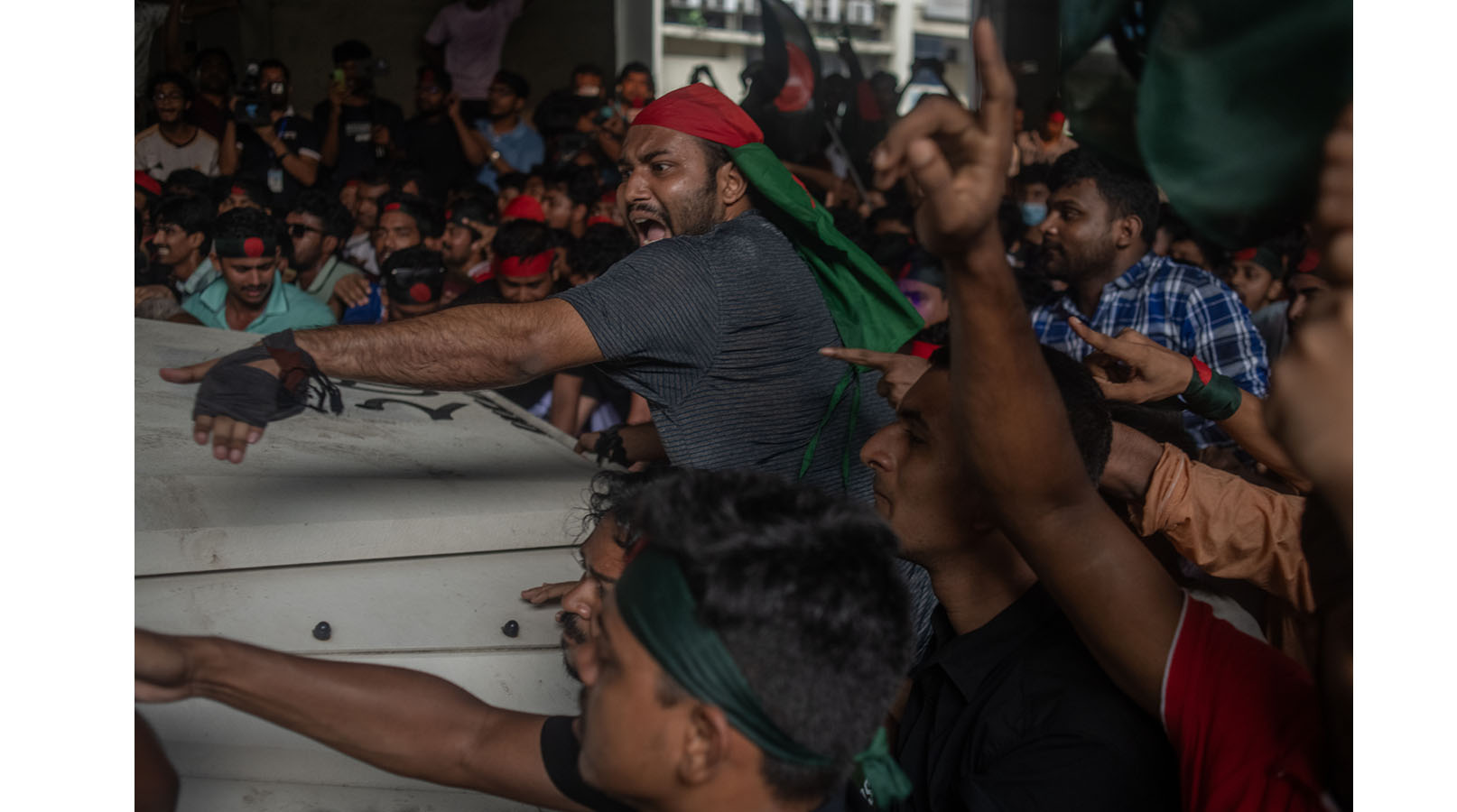
Bangladesh, a small country in South Asia, is not the kind of place whose events typically make world headlines; most people, whether in the United States or China, pay little attention to what happens there, and a fair number of Americans probably could not even locate Bangladesh on a map. American consumers, if they look closely, may notice that in recent years many of the labels on their clothes, shoes, and hats show they were made in Bangladesh. But the anti-nepotism protests that erupted in Bangladesh this past July, in how they unfolded and how they ended, hold considerable lessons and warnings for both the Chinese people and the Chinese government.
Bangladesh seems to be a country of hardship — one of the least developed countries in the world, perpetually struggling through disasters and worrying about rebuilding in their aftermath. Located on the South Asian subcontinent, Bangladesh borders the Bay of Bengal to the south, India to the east, west, and north, and Myanmar to the southeast, with a population of 170 million living on just 150,000 square kilometers of land. Its economy relies chiefly on agriculture and the garment industry; people living in Europe and America frequently buy inexpensive clothing made in Bangladesh. Bangladesh, the birthplace of the muslin trade, is today one of the world's largest garment exporters. The dominant ethnic group is Bengali, the main religion is Islam, and Bengali is the official language. In the latter half of the 19th century, this land was for a time a province of British India. During the 1947 partition of India and Pakistan, Bangladesh belonged to Pakistan, but East Pakistan declared independence in 1971, and the People's Republic of Bangladesh was formally established in 1972.
Bangladesh follows a Westminster-style parliamentary democracy, with a president as head of state and a prime minister as head of government, and parliamentary elections held every five years. From 1990 to 2014, the Bangladesh Awami League and the Bangladesh Nationalist Party (BNP) alternated in power; since 2014, the Awami League has governed alone. The world-renowned concept of "micro loans" was pioneered by the celebrated Bangladeshi economist Muhammad Yunus, who won the Nobel Peace Prize in 2006. Microcredit has had a profound impact on Bangladesh's economic development.
In 1947, the most populous province of the newly autonomous Pakistan was East Bengal, later renamed East Pakistan. In Pakistan's 1970 general election, Bengali nationalism and a democratic movement rose in East Pakistan, but Pakistan's military government refused to hand over power to the Awami League, led by Sheikh Mujibur Rahman, and instead launched a massacre of intellectuals and pro-independence Bengali civilians. In 1971, the Bangladesh Liberation War broke out; with India's assistance, the Mukti Bahini launched a successful armed uprising, seized power, and Bangladesh became South Asia's first constitutional secular state. Islam was declared the state religion in 1988, but in 2010 Bangladesh's Supreme Court reaffirmed the secular principles enshrined in the constitution.
This latest wave of protests in Bangladesh originated precisely from the consequences of that old maxim, "political power grows out of the barrel of a gun." Under Bangladesh's government job quota system, 30 percent of positions were reserved for the descendants of veterans of the 1971 Liberation War. Bangladeshi youth and university students had long demanded the abolition of this quota and hereditary system, believing that such quotas mainly benefited allies of the ruling party. It was precisely this privileged "hereditary system" that, over the past few weeks, ignited nationwide, deadly unrest across Bangladesh.
After members of the ruling Awami League attacked protesting students, the demonstrations escalated into violence. Security forces were likewise accused of taking part in suppressing the protesting students and the public. Under pressure from public outcry, Bangladesh's Supreme Court scaled back the controversial government job quota system, ordering that 93 percent of positions be awarded on merit, with the remaining 7 percent reserved for the descendants of fighters who took part in the 1971 war of independence against Pakistan. But the protests and bloodshed still did not stop. After several more days of bloody struggle, Bangladesh's Supreme Court made a further compromise, issuing a new ruling on July 21 that reduced the quota of civil service positions reserved for descendants of the nation's "founding heroes" to just 5 percent, with the remaining 95 percent of civil service positions to be filled through open, merit-based selection. It is worth noting that Bangladesh's army refused President Sheikh Hasina's order to suppress the students, thereby averting a June Fourth-style bloody crackdown.
It remains unclear exactly how many people died in this anti-quota, anti-nepotism movement led by Bangladesh's ordinary citizens and students — some estimates put the death toll in the thousands. By the time the student movement announced a conditional pause, 163 people had already died and more than 500 had been arrested. Internet access across Bangladesh has been completely cut off. People must remember that the ruling handed down by Bangladesh's Supreme Court on July 21 was a compromise between the government and the public — bought with the lives of 163 Bangladeshi university students — not a gift graciously bestowed by those in power.
The lesson this mass movement against privilege and nepotism holds for the Chinese people is that victory is possible when resistance begins even on the smallest scale, so long as it is conducted with both conviction and restraint. In truth, the "injustice" in Bangladesh pales in comparison to the privilege, favoritism, and entrenched superiority enjoyed by the CCP's vested-interest class in China — it simply isn't in the same league. At most, what the Bangladeshi government did was reserve a few extra civil service positions for the descendants of its "founding heroes." But the CCP's system of privilege, special provisioning, hereditary succession, and its practice of installing the sons and grandsons of its "red" elite into senior positions throughout the party, government, and military — along with the money and benefits its members extract through frontmen and proxies — dwarfs anything Bangladesh's "red second generation" has ever obtained, by a factor of hundreds, thousands, even tens of thousands.
What that brave Bangladeshi girl said offers a soul-stirring lesson to the entire Chinese people. She is a role model not only for Bangladeshis but for a billion Chinese and for people the world over. At this moment when people around the world are rising to overthrow tyranny, her words are an inspiring rallying cry. Thanks to the internet, people across the globe have seen what this brave Bangladeshi girl said: "I told my father: if I die a horrible death on the street today, don't let anyone grieve for it, and don't let anyone carry my body away from the road. Only after my classmates come out celebrating with victorious smiles, once victory is declared, should they go and bury my body." This kind of moral courage, resolve, and conviction also lives in the hearts of countless people who stand for justice.
The way the Bangladeshi student movement announced a conditional pause — knowing when to press forward and when to hold back, and quitting while ahead — is likewise worth learning from. Nahid Islam, a leader of "Students Against Discrimination," the main organization behind the protests, told an AFP reporter: "We will suspend our demonstrations for 48 hours," and called on the government to "lift the curfew, restore internet access, and stop attacking student demonstrators" during that period. The significance of this strategy lies in reducing bloodshed, spreading word of the protest across the globe, restoring normal order to ordinary citizens' daily lives, and winning greater support from the public and sympathy from the international community.
Bangladesh's people are poor, its education underdeveloped, and its per-capita GDP is only 2,700 dollars. If Bangladeshis can win freedom and equality through struggle, why couldn't Chinese people do the same? Some will say that the CCP is far more evil, cruel, and violent than Bangladesh's ruling party; that China's military might not refuse to carry out a crackdown the way Bangladesh's military did; that the CCP controls the internet and communication tools far more thoroughly and completely, leaving no gaps at all; that the CCP is also far more cunning and treacherous than the Bangladeshi government; and that ordinary Chinese people have all "lain flat," content to live quietly in the present moment without a thought for tomorrow, and so on and so forth.
All of these points are quite reasonable, and quite accurate. But today's era is not the same as the era of June Fourth more than thirty years ago; the degree of awakening among the Chinese people is different now too; the CCP's long record of misdeeds has been exposed to a far greater degree; the Chinese people's wisdom in how to struggle has grown as well; and now the people of Bangladesh have offered a fresh lesson. So there is still real hope for China. I remember many of my American friends asking me: where has the fighting spirit of the Chinese people gone? They have been asking this question ever since June Fourth, and I have never found it easy to answer. Perhaps it is because Chinese people are exceptionally capable of endurance — perhaps our national character carries within it seeds of sincerity, kindness, and patience. But even the kindest, most enduring people surely have a limit to how much they can bear.