
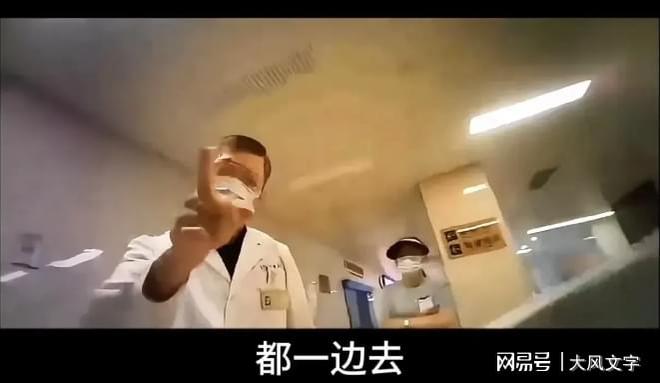
On June 13, a video went viral both inside and outside China, showing a victim's mother accusing Li Zhanfei, director of the trauma surgery department at Wuhan Tongji Hospital, of pulling her son's breathing tube under the pretext of brain-death organ donation, pressuring her to donate his organs, and thereby killing him.
The grieving mother repeatedly demanded to know why Li Zhanfei had removed the tube, and on what basis he had determined her son was brain-dead — did being brain-dead automatically mean his organs could be donated? Cornered by her questions in the hospital lobby, department director Li Zhanfei grew flustered and incoherent, and finally shouted hysterically: "Get out!"
It is clear that this is no ordinary doctor-patient dispute.
Li Zhanfei holds a doctoral degree, the title of chief physician, and the rank of professor, and is director of Tongji Hospital's flagship trauma surgery department. For "Director Li" to lose his composure so hysterically on video was a genuine loss of dignity. The grieving mother, furious, confronted him demanding accountability for her son's life, and Li Zhanfei fled the scene in disgrace.
The victim was a 28-year-old young man who went to the trauma surgery department at Wuhan Tongji Hospital for treatment of a head injury, with Li Zhanfei as his attending physician. During treatment, without obtaining family consent, Li Zhanfei removed the oxygen tube, declaring the patient beyond saving and brain-dead. He then urged the mother to donate her son's organs.
The mother said that the medical record showed her son had continued breathing spontaneously the whole time. She later discovered that his medical records — including his EKG readings — had been falsified, that the information provided to the funeral home had been falsified, and that even the statement taken for the National Health Commission's law enforcement team had been falsified.
This kind of scenario inevitably brings to mind the case reported in 2004 of He Xiuling, a 52-year-old Falun Gong practitioner in Yantai, who was tortured to death and had her kidney harvested while alive at Shandong Yuhuangding Hospital. The Epoch Times article "Have You Ever Seen a Corpse 'Cry'?" contains this passage: "...As more than ten centimeters of EKG paper printed out, the relatives saw a jagged, active waveform on it. He Xiuling's younger sister shouted loudly: 'Look! Look! He still has a heartbeat and you've already sent him here [to the morgue]!'"
"The doctor, alarmed to hear this, tore off the EKG printout; He Xiuling's relatives rushed forward to stop him and tried to wrestle the printout away from the doctor, who fled out the door still clutching the strip of paper he had seized."
Twenty years ago, Shandong's Yuhuangding Hospital seized and destroyed EKG evidence to cover up its crime of live organ harvesting and torturing Falun Gong practitioners to death; twenty years later, Wuhan's Tongji Hospital falsified an EKG to conceal the truth that a patient was declared brain-dead while his heart was still beating and he was still able to breathe. Twenty years have passed, yet the CCP's practice of falsifying records to cover up its crime of live organ harvesting has not changed at all. The only thing that has changed is that the victims have expanded from Falun Gong practitioners to ordinary members of the public, along with a new euphemism: "brain-death donation."
The mother in the video also revealed that hers was not the only family to suffer this way — in the trauma surgery department, whenever a patient's condition changed, Li Zhanfei would routinely tell the family the patient was brain-dead, and, together with Chen Weihua, a doctor from the medical affairs office, would then pressure the family into donating the patient's organs.
Tongji's trauma surgery department functions like a large-scale, comprehensive trauma emergency center, with 76 hospital beds, 10 of which are in the ICU (intensive care unit). Given the high proportion of incoming patients who can be selected for a brain-death diagnosis, the sheer scale of the department, and Director Li Zhanfei's own zeal for promoting brain-death donation, this emergency surgery department has undoubtedly supplied the hospital's own organ transplant center with a considerable number of brain-death donor organs.
More and more cases have surfaced online of patients in this hospital's ICU being successfully pressured into 'donating' — even young people who came in with nothing more than a sprained ankle or a hurt knee, or children who fell off a slide or a swing. As long as they are young and arrive with an emergency injury, once admitted, their condition somehow only worsens, treatment after treatment, until they end up in the ICU, at which point the family is told: he can't be saved, he's brain-dead, why not donate his organs? Not only would it reduce the medical bills, they're told, it would also be an act of great compassion, and so on.