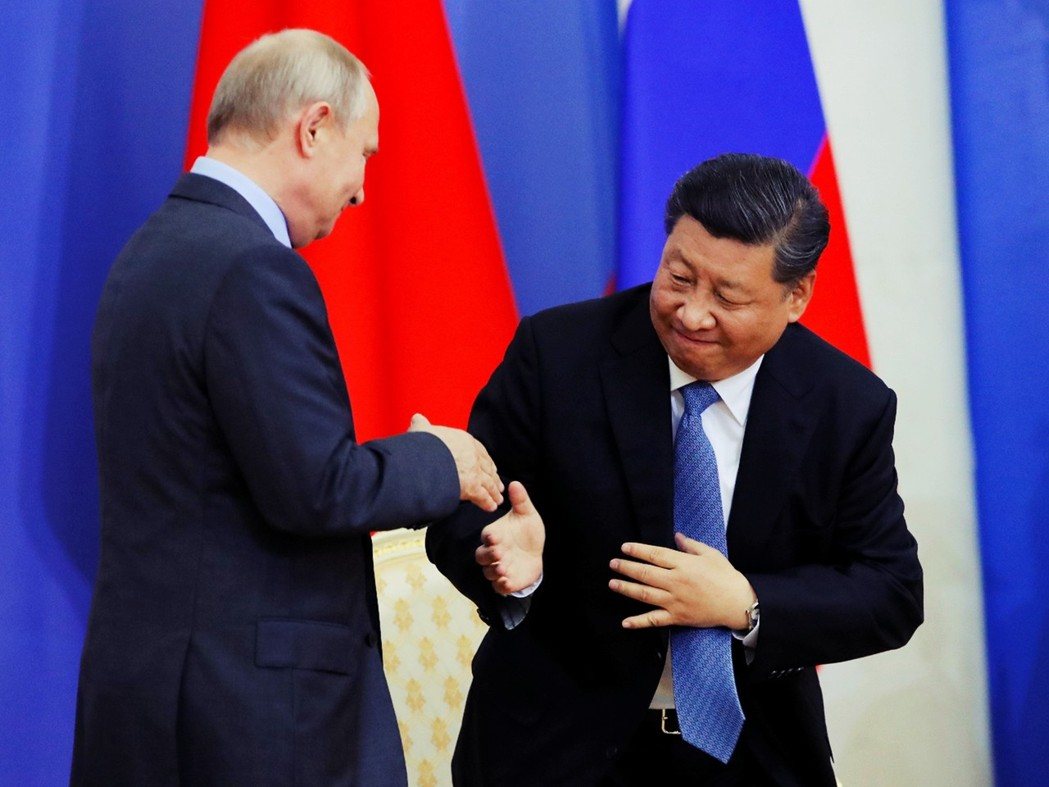
In an interview with Era TV in late August, Taiwanese President Lai Ching-te said that China's desire to annex Taiwan has nothing to do with territorial integrity and everything to do with hegemonic ambition — otherwise, he argued, China should first reclaim the territory it ceded to Russia under the Treaty of Aigun, and he added that Russia is now at its "weakest point" in memory. The remark drew intense interest from international media, which widely reported it, while China itself did not dare respond directly. It was Russia's Foreign Ministry spokesperson who answered instead, noting that the two countries had signed the Treaty of Good-Neighborliness and Friendly Cooperation and the Supplementary Agreement on the Eastern Section of the China-Russia Boundary, and that the border issue between Russia and China had been finally resolved. Russia has seized Chinese territory on a massive scale on several occasions: the 1858 Treaty of Aigun ceded more than 600,000 square kilometers of Chinese land north of the Heilongjiang (Amur) River and south of the Greater Khingan Range; the 1860 Treaty of Peking handed over 400,000 square kilometers of northeastern Chinese territory east of the Ussuri River; the 1864 Sino-Russian Protocol of Tarbagatai (Chuguchak) ceded 440,000 square kilometers in northwestern China, east and south of Lake Balkhash and north and south of Lake Zaysan; and the 1881 Treaty of Saint Petersburg (the Ili Treaty), along with several subsequent boundary protocols, ceded roughly 70,000 square kilometers west of the Khorgos River and east of Lake Zaysan in northern Xinjiang. One point deserves particular attention: after the October Revolution of 1917, Soviet Russia's foreign commissar, Lev Karakhan, issued the first Karakhan Manifesto to China in 1919, declaring that Soviet Russia "renounces all territory seized through aggression by the former Tsarist Russian government in Manchuria and elsewhere in China." The following year, a second manifesto reaffirmed this, stating that "all treaties concluded between China and any previous Russian government are null and void; Soviet Russia renounces all Chinese territory taken through aggression and all Russian concessions within China, and returns to China permanently and without compensation everything plundered from China by the Tsarist government and the Russian bourgeoisie." Yet at the time, China was mired in decades of civil war and war of resistance and had no capacity to act on this. Sun Yat-sen not only failed to recover any territory, he even allowed Soviet Red Army forces to station in Mongolia in exchange for help establishing the Whampoa Military Academy. During the 1929 Chinese Eastern Railway incident, the Chinese Communist Party, rather than helping the Republic of China abolish Soviet Russia's special privileges, raised the slogan "Defend the Soviet Union" and stirred up unrest from within. After the People's Republic of China was founded in 1949, Mao Zedong signed the Sino-Soviet Treaty of Friendship, Alliance and Mutual Assistance with Stalin the following year — and Mao did not dare raise the territorial issue at all. Deng Xiaoping refused to recognize the unequal treaties, yet after signing the Joint Declaration on the return of Hong Kong, he went on to negotiate with Soviet Russia regardless. In 1991, Jiang Zemin visited Russia, and the two countries signed the Agreement on the Eastern Section of the China-Russia Boundary, establishing a joint boundary demarcation commission. In 2005, Chinese Foreign Minister Li Zhaoxing and Russian Foreign Minister Sergey Lavrov signed, in Vladivostok, the certificate exchanging instruments of ratification for the Supplementary Agreement on the Eastern Section of the China-Russia Boundary. On September 3 this year, Chinese Vice President Han Zheng attended the Eastern Economic Forum held in Vladivostok. Meeting with Putin, Han Zheng said, "I am delighted to have been invited to Vladivostok" — and in Russian, "Vladivostok" means "Ruler of the East" or "Conqueror of the East." That Han Zheng chose to use Russia's own name for the city rather than China's, currying favor with Moscow, was surely no accident but the wish of Xi Jinping and China's "wolf warrior" foreign minister Wang Yi — a display of China's submission at the feet of its Russian "elder brother." And this came right after President Lai had raised the territorial question with China, showing that the CCP's shamelessness knows no limit whatsoever — which is exactly why the Chinese public calls the CCP the "Yellow Russians." At today's press conference held by the Taiwan Affairs Office, Taiwanese reporters ought to raise this territorial question and demand that they answer it directly.
Consistently Selling Out Chinese Territory: The "Yellow Russians"
2024-10-20