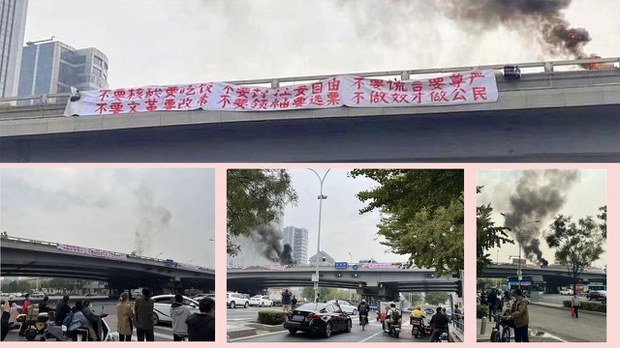
On October 13, 2022, the banners Peng Lifa hung from Sitong Bridge in Beijing marked a significant milestone in the history of modern Chinese resistance. This was not only an act of individual courage — it symbolized an era's profound reflection on authoritarian power, social oppression, and personal freedom. The message Peng Lifa conveyed carries epoch-defining historical significance within China's current political and social environment. First, Peng Lifa's protest was aimed directly at contemporary China's extreme pandemic-control policies and its political system. His banners read: "No to PCR tests, we want food; no to lockdowns, we want freedom; no to lies, we want dignity; no to Cultural Revolution, we want reform; no to a supreme leader, we want the vote; we refuse to be slaves — we want to be citizens." These words sharply exposed a core problem that has long persisted in Chinese society: the systematic violation of individual rights and social welfare under totalitarian rule. The extreme measures used to control the COVID-19 pandemic, though carried out under the banner of protecting public safety, in fact strangled ordinary life and stripped people of basic personal freedom. Peng Lifa's line "no to PCR tests, we want food" spoke directly to ordinary people's urgent need to make a living, and to how endless pandemic controls suppressed individual life. This demand represented the silent protest of hundreds of millions of ordinary people, expressing their yearning to return to normal life. Second, Peng Lifa's explicit demand of "no to Cultural Revolution, we want reform" conveyed an urgent need for historical reflection and political renewal. China endured the catastrophe of the Cultural Revolution and other historical calamities, yet society still harbors an undercurrent that could see a resurgence of Cultural-Revolution-style extreme political campaigns. This absence of historical reflection has led to a stagnation of social change and a regression of the political environment. With the brief words on his banners, Peng Lifa challenged the existing political order, calling on people to awaken by comparing history with present reality, and demanding reform to replace a rigid authoritarian system. This call was not merely an indictment of past mistakes — it was a firm pursuit of a future direction for reform. More importantly, Peng Lifa's demand of "no to a supreme leader, we want the vote; we refuse to be slaves — we want to be citizens" revealed his yearning for democracy and civil rights. This was not merely aimed at the individual dictatorship of those in power — it was a critique of the entire political system, calling for the establishment of a political order that respects citizens' rights and implements democratic elections. Under China's political system, the cult of the leader and the trend toward centralized power have grown ever more severe, and Peng Lifa's demand directly challenged this root problem of the system. The vote symbolizes not only the core of democratic government — it represents the basic channel through which ordinary citizens participate in public affairs and exercise political rights. And the cry of "we refuse to be slaves — we want to be citizens" was a powerful protest against the political apathy and submissiveness so widespread in contemporary Chinese society, calling on the Chinese people to step out of the role of passive obedience and become conscious, autonomous citizens. The reason Peng Lifa's banner protest was able to draw such wide attention and resonance lies not only in his courage, but in his willingness to puncture the hypocrisy and brute force of the current system. What he expressed touched on the core problems of Chinese society: the long-standing conflict between individual rights and collectivism, and the contradiction between the achievements of economic development and the absence of political reform. Against the backdrop of China's ever-deepening globalization, the public's demand for a higher degree of freedom, dignity, and democracy has grown ever stronger, and Peng Lifa's protest symbolized the concentrated eruption of that voice. From a historical perspective, Peng Lifa's act of protest undoubtedly carries profound significance. He represents not only one brave individual, but stands as a spokesman for countless silent others. Modern Chinese history has seen similar acts of resistance many times before; each time, that resistance became a surging current within the tide of history, driving forward society's awakening and progress. Peng Lifa's protest reminds us: although authoritarianism and oppression may hold the upper hand for a time, the pursuit of freedom, democracy, and dignity will never cease. What Peng Lifa did was not only a protest against the current political order — it was reflection on, and hope for, the future direction of China. That hope does not belong to him alone; it belongs to every Chinese citizen who yearns for freedom and pursues dignity. His act of resistance on Sitong Bridge may have been only a beginning, but it has already left a vivid footnote in history: the voice of the people must not be ignored, the rights of citizens must not be trampled, and the China of the future will inevitably move toward a more open, democratic, and just society. The protest banners on Sitong Bridge will forever be inscribed in the long river of history, a beacon awakening the civic consciousness of the Chinese people. Peng Lifa's call will surely, in the years to come, be transformed into a powerful force driving history forward.
On the Historic Significance of Peng Lifa's Sitong Bridge Protest
2024-11-11