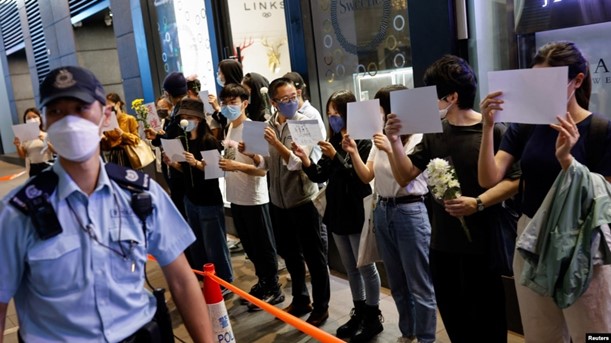
On the second anniversary of the White Paper Revolution, I find myself with boundless feelings I can hardly put into words. The young people around me and those who lived through it feel the same way; even people within official circles have nothing to say. Everyone sighs, watching the situation deteriorate day by day, feeling utterly powerless, unable to speak of it, unable to do anything about it, as if in sympathetic resonance with the cold snap gripping the Chinese mainland these past few days, able only to watch helplessly as things get worse. This is how the Chinese people feel two years after the outbreak of the White Paper Revolution, which also marked the end of pandemic control measures: the mood of the "post-revolution" moment. China is mired in a social depression unlike anything seen in decades; most people are too busy scraping by day to day to even have the energy to recall the misery of the three years of "lockdown control." Only the images of young people two years ago, on a cold autumn night, holding up blank sheets of white paper, remain deeply seared into people's minds, an indelible collective memory for a generation. In theory, even if nothing at all has changed in real life, or things have only gotten worse, the mere survival of that memory may well be the White Paper Revolution's most important legacy. On that basis, we might be able to reassess the historical significance of the White Paper Revolution, a significance that has been overlooked and distorted. Without a Republic, There Is Chaos Looking back at the three years of "dynamic zero-COVID" during the pandemic, those three years were not only a top-down, nationwide "state of emergency" (though this state of emergency was never formally declared), they were also a quiet coup by ambitious men who used the opportunity to amend the constitution and abolish the republic: after a decade of centralizing power and control, more than two thousand delegates to the National People's Congress passed, in the spring of 2022, a constitutional amendment proposal abolishing term limits on the state leadership, and in the autumn of that same year, an almost identically sized and largely overlapping body of Party delegates at the ruling party's 20th Party Congress passed amendments to the Party constitution and the congress resolution. As a result, whether viewed in practice, in law, or in theory, this series of political actions in 2022 effectively abolished the republican system that had existed since 1949, and arguably since 1912, transforming it into a totalitarian system: a modern dictatorship that, unlike traditional monarchy, rules through the mechanisms of a political party and its bureaucratic machine. It must be said that restoring, in effect, a lifelong tenure for the national leader amounts to placing one man's personal will above the sovereignty of the people, the greatest betrayal of the ruling Communist Party's founding aspirations and a century of sacrifice, and a profound reactionary reversal of the modernizing pursuit the Chinese people have carried since the 1911 Revolution. With this, China entered a "great transformation unseen in a century," and also the beginning of an age of chaos. It was against precisely this backdrop that, just one month after the 20th Party Congress concluded, the White Paper Revolution erupted during mourning for the victims of the November 24 fire in Urumqi. Within just a few days, protests spread from the streets of Shanghai and Beijing into a nationwide movement, with university students on more than 70 campuses holding up blank sheets of A4 paper in silent protest. Confronted with this sudden uprising, Beijing's leadership fell into unprecedented panic and paralysis; the ruling party's decision-making organs and its vast bureaucratic apparatus froze in place for a time, like a mind blacking out after a drunken stupor, and within a week, the "dynamic zero-COVID" policy that had been enforced for three years collapsed entirely. This absurd state of "systemic blackout" has persisted to this day, utterly different from the totalitarianism imagined by outsiders, or even by the dictators themselves. It might be called the true face exposed once the White Paper Revolution punctured the facade: a face full of rigidity, incompetence, corruption, and helplessness. This is why the various post-pandemic recovery policies have been so slow, why the economy and people's livelihoods have declined so quickly, and why every manner of chaos now seems to be surfacing as if in the final scenes of a dying age.
Take, for example, media reports on the investigation of Defense Minister Dong Jun: after the 20th Party Congress, two consecutive defense ministers were investigated for corruption. Counting the previous minister, Wei Fenghe, that makes three ministers in a row to fall, matching the succession of three ministers of justice who likewise fell from power, almost recreating the scene of the late Ming dynasty's Chongzhen era, when one minister of war after another was dismissed. These are merely the tip of the iceberg, showing how bureaucratic corruption is accelerating in the course of China's totalitarian development, and just how fierce the oligarchic power struggles above these ministerial-level officials, right around the leader himself, have become on that black-box stage of shifting factions. More importantly, the intensity and scale of this systemic corruption, far beyond anything imaginable, has already exceeded the level of corruption that served as mere "lubricant" during the reform era more than a decade ago. This is the kind of extreme corruption seen only in private-oligarchic states like Russia or Belarus, or in failed democracies like the Philippines or Mexico: political corruption originating from the very top, absolute corruption produced when a political leader faces no restraint on his power whatsoever. But in China today, this kind of corruption has been created through the gradual repudiation of reform and opening up since 2012, through repeated political declarations of "we will absolutely not reform" — it is almost a modern reenactment of Louis XIV's "L'Etat, c'est moi" under an absolutist feudal monarchy. Only with this in mind can we understand the roots of the chaos that has engulfed the country since the CCP abolished the republic in 2022: sheltered by the declaration of "we will absolutely not reform," the bureaucratic system, whether facing the White Paper Revolution or the post-pandemic recovery, has collectively adopted a stance of total inaction, self-interest, and abuse of power. As a result, the entire defense establishment, the state-owned enterprise sector, and the bureaucracy as a whole are riddled with corruption, treating the public, people's livelihoods, and public opinion with nothing but absolute predation, stinginess, and indifference. This is why domestic policy has been mired in indecision for so long: the ruling party's "Third Plenum of the 20th Central Committee" was delayed until mid-2024, and no sooner had it passed its so-called concessionary document than people realized it could already be filed away as a "historic document." And facing a sudden severe downturn since autumn, the leadership still refuses any substantive, people-centered policy adjustment, offering only internal bureaucratic reshuffling, and dares not even convene the "Fourth Plenum" on schedule. China's inner-party political life has fallen into disorder, reduced to a private state controlled by the leader and a handful of oligarchs, reduced, too, to dynastic-style political struggle between the inner court and the bureaucracy. Without a Society, People Turn on Each Other So, under this kind of political chaos, two years after the White Paper Revolution, Chinese society from top to bottom seems to have returned once again to the eve of revolution, the people once again trapped in a "zero-COVID"-like existence, merely surviving with no way out, which was exactly the motivation that drove young people to take to the streets in anger two years ago demanding freedom. Except that, two years later, the scope of that desperation is larger and more palpable: ordinary people generally can find no way to make a living and see no hope, and so chaos has begun to erupt at the level of society itself. This chaos is born of the death of the republic, and it has also, through the disintegration of society, led people to turn on one another, staging a modern-day version of cannibalism. Starting from the attack on American teachers in Jilin and the stabbing of Japanese children in Shenzhen this September, revenge-driven killings against society have intensified across the country, occurring at an alarming rate in one place after another, warning the world that Chinese society is undergoing enormous crisis and turmoil. Yet Beijing's first response has been mass screening and arrests, along with futile editorial appeals broadcast through central state media, rather than confronting and solving the underlying problem, much as it responded after the "July 5" incident of 2009, when instead of confronting the poverty of southern Xinjiang, it branded an entire ethnic group as supporters of terrorism, carried out collective suppression, and destroyed their society, subsequently attributing most of the violence that was in fact social revenge to political, separatist terrorism.
In mainstream Chinese society after the pandemic, we now see a similar but inverted wave of violence: after civil society has been gradually dismantled and eliminated, people have been left in an atomized state of every man for himself, forced to cruelly submit to a social jungle. The middle class, which had been closely tied to civil society, has also collectively sunk during the pandemic, and it is often these middle-class people, having reached a dead end, who choose mass slaughter as social revenge, a form of collective suicide bound up with the destruction of society itself, exposing their predicament, rather than choosing, as Foxconn workers did a decade earlier, or as lower-class people facing similar pressure after the pandemic have done, individual suicide to end their own suffering. This is a form of people turning on one another after the disappearance of society, its cruelty in no way inferior to the cannibalism of the Great Famine era. But viewed through the lens of the White Paper Revolution, this social deterioration is less a result of economic decline than of the absence of society itself. Even from the limited number of individual cases, one can see that the sinking middle class not only receives no help from society, but is swiftly abandoned by it after failure. This is the psychological root of why some ultimately choose to run their vehicles into crowds of innocent people. In this sense, looking again at those brave young people and middle-aged citizens of the White Paper Revolution, when they mourned victims far away, when they cried out for freedom, what they demonstrated was the very existence of civil society, defending Chinese society and defending China's republican institutions. Considering the contrast between their nonviolent protest and the violence of the dictators they faced, no one should doubt that their courage was in no way inferior to that of Cai E, who launched the National Protection War 110 years earlier. In this sense, from what they did, and from our own memories, on this day two years ago, people can still see, amid the chaos of China's dying age, the last remaining hope.