
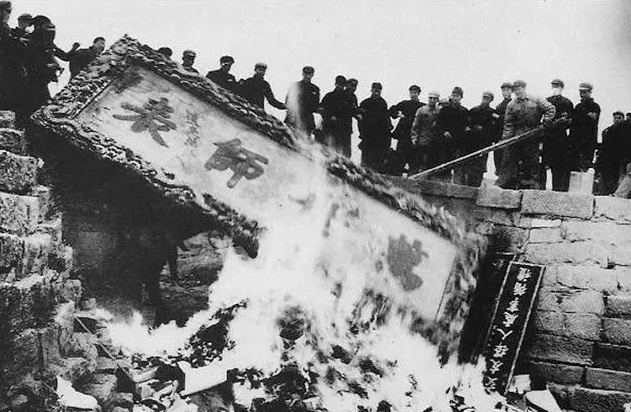
Burning books and burying scholars alive did not begin with the Mao Zedong dynasty, but the Mao Zedong dynasty carried this cruel work to its very peak. After the despotic tyrant Qin Shi Huang annexed the six rival states, he burned the writings of the Hundred Schools and buried scholars alive — which is why the phrase ‘burning books and burying scholars’ has been used ever since to condemn Qin Shi Huang's cruelty, a phrase that has continued to circulate among the common people to this day.
The Chinese people have long taken pride in the thought of the Hundred Schools of philosophy, all of which flourished before the Qin dynasty; their ideas truly had unique and penetrating insight, and these schools of thought were constantly debating one another, each displaying its own particular strengths — what is called ‘the Hundred Schools contending’ refers precisely to this era. This era was the golden age of Chinese thought in politics, philosophy, and outlook on life; the high tide of culture burst into brilliant bloom and bore fruit. That is why any discussion of Chinese thought must trace back to the philosophers of the pre-Qin era, whose ideas have continued to shape Chinese culture ever since. Chinese culture is the crystallization of the mutual confluence and cross-fertilization of these various schools of thought. After the Qin, though some dynasties honored Confucianism above other schools, honoring Confucianism did not mean treating other schools of thought as criminal. At the same time, Confucian thought itself was never pure, but was mixed together with elements of the other schools. Because throughout Chinese history, no one had ever elevated a single school of thought to the status of religion, to be believed to the point of superstition.
Why did pre-Qin thought reach such heights, blossoming like a hundred flowers in full bloom? Because there existed a free environment. By a free environment, I mean that these thinkers could think freely, unconstrained by their circumstances, unconstrained by any officially prescribed doctrine handed down by a ruler. Moreover, they served as teachers to kings, so that if one state did not tolerate or respect them, they could simply go to another. At the same time, the various states were competing for power, and each sought out men of thought and vision to help plan their strategy. And so thought shone brightly, blooming like a garden of a thousand flowers. Once Qin Shi Huang unified the six states and brought all under Heaven to order, he trusted in himself, embraced the Legalists' method of rule through harsh laws and severe punishments, and so he suppressed the Hundred Schools, burned their books, gathered the scholars at Xianyang, and buried a great many of them alive. This became something the Chinese people have condemned with contempt ever since. After the Han dynasty, once the empire had become unified under Heaven, scholars no longer had a free environment; emperors handled matters of thought in a way that favored whatever suited their own interests and demoted whatever did not, but this still fell short of true thought control — and even where something like thought control did exist, it never came close to the content or degree of modern thought control. Modern Communist thought control, by contrast, has reached the point of extinguishing culture altogether.
When I use the phrase ‘burning books and burying scholars’ as my title, I take only its ugliest connotation. As for degree, the Communist Party's control over thought, while it too burns books, goes further and washes people's brains as well; while it too buries scholars, it does not simply put them to death but subjects them to cruel torment and degradation until a person's very soul and flesh are ground to pieces. This is the most brutal era in history, without precedent.
Once the Communist Party seized power, during land reform, all the books hidden away in the countryside — especially those in the libraries of landlord households — were burned by the cadres. In the cities, too, ordinary residents grew afraid, believing that with the change of dynasty, old books all carried the poisonous sin of the old era; and so books were burned, sold to paper mills to be pulped, or sold to street vendors to wrap peanuts — many of these books were rare old editions. This state of affairs continued for three or four years, until ancient Chinese books nearly vanished from existence! The Communist Party was pleased to see this happening, and indeed took the lead itself in burning the books of the old era.
The books the Communist Party wished to burn were targeted under the pretext that they were ‘poisonous’ or ‘harmful to the revolutionary regime.’ After seizing power, it conducted a thorough inspection of all of China's past publications in order to sort out which ones were harmful to the revolutionary regime and which contained ‘poison.’ Naturally, the results of this inspection found a great many books did not suit their taste.
Let me give a few examples to illustrate.
The Commercial Press and Zhonghua Book Company had, for decades, held respected positions in China's publishing world and had published a great many books and journals. It is estimated that by 1950, the Commercial Press held more than 8,800 titles in stock; after inspection, 86 percent were judged to have problems in their thinking, viewpoint, or content, and only 14 percent barely passed muster — most of these being technical books — while the rest were turned into waste paper. Zhonghua Book Company held more than 13,000 titles, of which, after inspection, only some 2,000-odd remained, most of them physics, chemistry, and mathematics textbooks along with Chinese medical texts; its Shanghai head office alone sold 337 tons of old books as waste paper.
Libraries across the country also carried out inspections and drew up lists of banned books. A small portion of the banned books were simply sealed away, while the majority were consigned to the flames. My own book, On the State, published in 1935, could still be found in the Beijing Library as late as 1951, but by 1952 it had disappeared.
Book burning by the Communist Party occurred everywhere. For example, the Hunan provincial government, in Xiangtan county, confiscated a collection of more than 17,000 crates of famous literary and artistic works assembled by Wang Renqiu, and burned them on the spot. Likewise, in 1953 the Guangdong provincial government assembled more than 300,000 volumes in Shantou and burned them on the spot as well. Such incidents occurred in every province and county. In Beijing alone, I personally witnessed vast quantities of rare old editions turned into waste paper and Western books pulped, though I never witnessed a book burning in front of Tiananmen itself.
Book burning, in the anxious hearts of the Chinese people living under Communist rule, is really a small matter — a cultural calamity, to be sure, but still something external to the person. It is the ‘burying of scholars’ that is the truly grave matter, for it concerns the very survival of a great many people. I use the term ‘burying scholars’ only for its meaning, not to suggest that the Communist Party ever literally buried intellectuals alive in broad daylight in front of Tiananmen. But I can testify that the torment, persecution, and execution the Communist Party has inflicted on intellectuals has, in its cruelty, exceeded even being buried alive. So the phrase ‘burying scholars’ does not, in fact, fully capture the extent of what has happened.
If the Communist Party had simply killed off all intellectuals outright, the matter would in fact be quite simple. But the Communist Party did not do this — instead, it exploited intellectuals even as it tormented and slaughtered them, which makes the matter far more complicated, and the torment and humiliation intellectuals have suffered utterly beyond imagining.
The Communist Party itself understood that, though it had won the realm by force, its own knowledge and manpower were limited, and it could not build the new state on its own — it had no choice but to make use of intellectuals. As Lenin once said: ‘We can (and must) begin building socialism not with people of imaginary talent, specially bred for the purpose, but with the people that capitalism has left us. This is, of course, very difficult, but any other way of approaching this task would simply not be worth considering — mere reckless adventurism.’ [7] After the Chinese Communist Party seized power, it made use of a number of intellectuals on one hand, granting them status; in 1956 Zhou Enlai even proclaimed the slogan of a ‘united front of workers, peasants, and intellectuals,’ and constantly worked to correct the so-called ‘six don'ts’ applied to senior intellectuals. This was all a matter of exploiting them for use.
But the Communist Party also guards against intellectuals, because although intellectuals do not form a class of their own, they possess the weapon of knowledge — they are the mouthpiece of the masses, the strategists of the ambitious. For this reason, the Communist Party also hates intellectuals. And so its method, whenever it cannot make full use of them, is simply to suppress and attack them.
How, then, does the Communist Party make intellectuals serve its purposes? Through thought reform, through the unification of thought. Those willing to obey the Communist Party the way a dog obeys its master are made use of by the Party — and indeed, it has already made use of vast numbers of intellectuals in this way. Those who refuse to obey, and for whom thought reform proves ineffective, are simply eliminated, along with their knowledge. This is the Communist Party's method of ‘burying scholars.’ Large numbers of intellectuals were put to death on charges of counterrevolution; others were sent to labor reform camps, squeezed for the last drop of their blood.
Most of the intellectuals who were made use of, and every one of those sent to labor reform, suffered the same kind of pain. Because they possessed knowledge, because they could clearly distinguish right from wrong, living under a regime of extreme dictatorship, cruelty, and inhumanity, their hearts could never truly submit. The Communist Party, knowing this full well, tormented them by every means to force outward submission; and even those whose hearts never submitted still had to mouth the lies the Communist Party taught them, becoming accomplices to its inhuman, merciless cruelty. How deep and heavy this suffering must be! And beyond this, the Communist Party's endless campaigns and endless surveillance forced every individual into endless self-examination and self-criticism. Fear lodged constantly in their hearts. Intellectuals living under such conditions were, in effect, simply waiting to die. They wasted their lives, wasted their intelligence, and did violence to their own conscience — a depth of suffering that people living in the free world cannot fully understand or appreciate.
Living under such conditions, there was no freedom of thought, no freedom of speech, not even the freedom to remain silent. Take, for example, the trap Mao Zedong laid with his slogans ‘let a hundred schools of thought contend’ and ‘let a hundred flowers bloom.’ Under Communist rule, everyone knew perfectly well that these slogans were false, yet no one could refuse to speak up; if you did not speak, you were seen as backward, harboring hidden resentment or a heavy burden of guilt; and once you did speak, you had to display an enthusiastic, seemingly sincere attitude as well. Naturally, some people, unable to help themselves, let slip a little of what had built up inside them — and this in turn became grounds for their own condemnation, followed swiftly by attack and reckoning. After the period of open speech came the Anti-Rightist Campaign, did it not? Large numbers of intellectuals were once again brought to the brink of being ‘buried alive.’
The Communist Party constantly says that it must educate the workers, peasants, and intellectuals — but their foundation is shallow, and it will take a long time; developing its own intellectuals and ‘red experts’ will take ten, twenty, even thirty years. For now, it still has to make use of the existing intellectuals — which means that, having already persecuted and killed off a portion of them, it still uses the whip, the shackles, starvation, and every other method to force the remaining intellectuals to work for it. These people, having watched their fellow professionals, friends, classmates, and colleagues tormented to death in great numbers, or reduced to a state of living death, and living under the whip themselves, faced a Communist Party that always regarded them with hostility and distrust. These people lived and worked under constant fear and oppression.
Scientific and technical personnel and university professors who worked for the Communist Party, training its future talent, had their own fate predetermined to decline — because no small number of such people met tragic ends, whether through open persecution or covert harm. During thought reform, for instance, many were imprisoned; during the campaign to suppress counterrevolutionaries, professors at every institution of higher learning and technical personnel at every enterprise were loaded into prison vans — at every school, at least twenty or thirty people were falsely charged with crimes out of thin air. In the Anti-Rightist struggle that followed the period of open speech, large numbers of professors, scholars, newspaper editors, technical personnel, writers, and theater directors and actors were branded bourgeois Rightists, and the punishments they suffered ranged from execution, imprisonment, and labor reform to dismissal from office and forced self-reflection. In reality, once branded a Rightist, one's political life was over, and mere survival became difficult. Regardless of the specific level of punishment, there was little difference in the toll on a person's life. Though people were not always killed outright, in reality most died slowly through prolonged torment and suffering — a fate crueler even than ‘burying scholars alive.’
The Communist Party drove a whole class of enslaved writers with the whip, repeatedly forcing them to experience the lives of workers, peasants, and soldiers. After 1953, writers were continually sent down to the countryside, and more recently millions of cadres and students with no prospect of further schooling have likewise been sent down to the countryside to receive the practical education of peasant life and undergo ‘thought reform’ — in plain language, forced labor.
Writers, after experiencing this life, still found themselves unable to write anything worthwhile. The Communist Party's intent in sending them to collective farms, factories, and army camps was for them to experience collective life — to experience ‘the upright, sincere, resolute, fearless, self-disciplined, self-sacrificing solidarity of heroic comrades; the working class's fervent loyalty to socialist construction; the peasant class's excitement over collectivization; the revolutionary soldier's love for the Party and the motherland; and a lively, warm, affectionate collectivist way of life.’ Yet after all this experience, the writers could not find, on the farms, in the factories, or in the barracks, anything resembling what the Communist Party had described and demanded. Wherever they went, they found only coldness, deadness, and mutual suspicion and surveillance. Everyone looked after themselves alone, practicing self-protection. Peasants, workers, and soldiers may, in themselves, possess qualities of uprightness, sincerity, resolve, fearlessness, self-discipline, self-sacrifice, and heroism — but under the terror and pressure of Communist rule, these fine virtues simply could not manifest themselves. What manifested instead was hypocrisy, cowardice, timidity, selfishness, self-interest, and small-mindedness. The writers set out with heavy hearts and returned utterly dispirited. Unable to write anything genuine, when forced to produce something to satisfy their official assignment, they too resorted to the Party's stock formulas, fabricating false heroes and false model figures. The stories were untrue; the characters had no blood, no flesh, no soul. Written into books, adapted into plays, performed on stage, filmed for the screen, and impressed upon the masses — all of it was Party formula, propaganda no better than a quack's plaster. And so, in these eight or nine years, not a single readable novel, a single watchable play, or a single work of real artistic value has appeared.
Slaves cannot create a new culture, and nothing worth singing or weeping over can be drawn from the lives of slaves. If there were ever a way to draw on the tragedy of enslaved lives as a subject to warn the world, that possibility does exist — but the Communist Party forbids anyone from writing or publishing such a thing. Under Communist rule, who would be foolish enough to stake his own head on writing about the life of a slave under Communist rule? If anyone dared attempt such a work, before he had written even a thousand words, the author's head would already be hanging from a tree.
In the nine years of Communist rule over the mainland, the result has been moral degeneration and cultural catastrophe. This degeneration and catastrophe has not been confined to the ordinary people alone — it has spread to the Communist Party itself, and for society as a whole it is a genuine tragedy. But however much communism and the arbitrary conduct of those who carry it out have brought this misfortune upon society, they have not managed to root out conscience and moral capacity from the human heart; most people, while outwardly submitting to Communist violence, continue to struggle against it inwardly. And the Communist Party's own deceit and dishonesty, its false benevolence and false righteousness, its cruelty and lack of grace, have only deepened the people's own self-confidence and their disgust toward it. Meanwhile, the Communist Party itself, ever since seizing power, has climbed onto the throne of a privileged class, and every fine word it once spoke has gone entirely unfulfilled. Those at the top have grown extravagant and corrupt, lording it over others. Lower-level cadres, though they too share in the spoils, no longer enjoy the comradely relationship of the days of ‘conquering the realm together,’ and instead a bureaucratic relationship of superior over subordinate has taken hold. The old vigor and idealism have faded; the goal of the revolution has become nothing but the enjoyment of a privileged class, and what was once conscious discipline has become the ruler's whip. If some Communists once genuinely harbored a lofty ideal, that ideal has now become an illusion. And so, under this bureaucratic order, we see currying favor with the powerful, scheming for personal advantage, arrogance from above met with sycophancy from below; petty maneuvering rather than a devotion to truth, deference to raw power rather than principle; concern for advantage rather than right and wrong; deceit rather than good faith — and so on. The Communist Party's whole theory of collectivist morality has become not merely an empty promise but an outright mockery of itself. Even some Communists who retain a sense of right and wrong feel this sorrow — for example, the veteran Party member Hua Gang was thrown in prison simply for saying, ‘The atmosphere in Beijing has become intolerable.’ More recently, some Party members who criticized the Party's own conduct and administrative errors have been branded bourgeois Rightists — men such as Zhejiang provincial governor Sha Wenhan and Chen Yi, head of the Cultural Department of the PLA's General Political Department, were purged simply for voicing their discontent. The Communist Party faces a moral crisis from within its own ranks. As for cultural impoverishment, it is the same both inside and outside the Party — indeed, especially inside the Party, where everyone must watch their every move with the utmost caution, leaving no one the presence of mind to think or create, since everyone knows that creative work is itself the wellspring of ideological crime. Everyone thinks this way, and everyone acts accordingly. Only a privileged few, well-fed men like Mao Zedong and Liu Shaoqi, ‘attending to all the myriad affairs of state’ and directing everything, enjoy such freedom — but since they are hardly omniscient geniuses, nor do they have so much time to spare for creative work, whatever they occasionally produce is likewise nonsense. Is it any wonder, then, that culture has withered away?