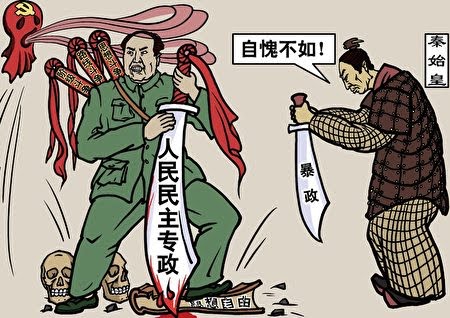
Politically, the communist party flies the banner of "proletarian democracy," but in reality, the working people have no right to elect their leaders and no right to oversee the ruling party. Ordinary citizens have no right to stand for election; participating in an election means only passively casting a vote, and only those the communist party has already selected are allowed to run for office. Politically speaking, laborers are deaf and mute. The Communist Party believes itself eternally correct, claiming to represent the fundamental interests of humanity and the people. The people, therefore, have only the duty to study and learn. If you dare to voice an opinion, you have thereby denied the Party's "eternal correctness," and for that you deserve to be killed. The communist party eliminates every competitor and severs the throat of every dissenter. The CCP has destroyed civil society, wiping out the freedom of the press, freedom of association, and freedom of election that had already existed by the late Qing dynasty. Even the grassroots self-governing organizations that the imperial era had once tolerated have been utterly destroyed, and even religious organizations have been forcibly subjected to "re-education" to make them "belong to the Party." What the communist party has truly liberated is only itself; the vast mass of workers, peasants, merchants, intellectuals, and everyone else has, in reality, been reduced to a new form of slavery. Ordinary people not only lack freedom of speech, they lack even the most basic guarantee of human rights — at any moment they may be denounced in a struggle session, arrested, imprisoned, sent to labor reform, or even killed, starved to death, or shot. Wang Cheng points out that the CCP's rise to power has set China back a thousand years behind civilized society. Before the French Revolution, Louis XIV established an "absolute monarchy," which was already more backward than a "constitutional monarchy." Yet the very system the CCP has practiced since the day it seized power is precisely this "absolute monarchy." The government's control over society is like "the relationship between a spider and its web." Eight hundred years ago, in 1215, during England's Magna Carta movement, the nobility and the king struggled over power, and the nobility won. Today, when China's [nominal] legislature and the Central Politburo disagree, the legislature must still submit to the leadership of the Party Central Committee. China's current Party-imperial system is even more backward than England was in the era of the Magna Carta. The CCP's political system is, at its core, a dictatorial, party-imperial system. Deng Xiaoping once told Jiang Zemin: "While Mao was alive, Mao had the final say; while I am alive, I have the final say; the day you have the final say, I'll finally be at ease." This means that as the core of the first generation of collective leadership, Mao Zedong held ultimate decision-making power, right or wrong, and that power was held for life, until Mao's death. Once Mao was gone, Deng had the final say; once Deng was gone, only then did Jiang hold ultimate decision-making power. Mainland China's 1982 constitution even stipulates that the chairman of the Central Military Commission holds final decision-making authority. As a result, the Military Commission's power knows no bounds; it operates as a total black box, answerable neither to the Standing Committee of the National People's Congress, nor ever reporting its work to the Central Committee, the Party Congress, or the National People's Congress, nor subject to any oversight by the Chinese government — personnel decisions are made entirely by a handful of military strongmen. It has become an independent kingdom that transcends the constitution and overrides everything else. On the surface, the Party commands the gun; in reality, it is the chairman of the Military Commission who wields the gun to command the Party, and then controls the entire population through the Party. This is precisely why Deng Xiaoping was able to "rule from behind the curtain" for so many years simply by holding the title of chairman of the Central Military Commission. As Zi Zhongyun put it on November 16, 2012: "[China] hasn't progressed in a hundred years — at the top it's still Empress Dowager Cixi, and at the bottom it's still the Boxers." This is because the CCP is, at its core, a military organization, and the CCP's government is a military government. The essential nature of a military organization is that "every action obeys orders" — which is exactly why the whole nation was told to "learn from the People's Liberation Army," so that "every action would obey the orders of one's superiors." As a result, the Chinese people have been all but trained into a nation of Boxers. In a system like this, there can only be dictators and robots (or cogs in a machine) — there can be no freedom or democracy, and any attempt to compete with the communist party on equal footing will be branded "subversion." The CCP regime is even more backward than the Qing dynasty. In the late Qing period, there was still privately run journalism and free elections. In 1792, 53 percent of the Manchu Qing government's top officials were Manchu, Mongol, and other ethnic minorities, while 43 percent were Han Chinese; at the middle level the split was roughly 50-50, while at the county level nearly 90 percent of officials were Han Chinese. From this we can see that although the Manchu Qing regime was authoritarian, it still shared power, distributing a great deal of authority to Han Chinese and to other ethnic minorities. The Communist Party regime, by contrast, rules as one single, undivided authority, gripping every ounce of power tightly in its own hands, relying on the state's machinery of violence and Party-controlled media to impose all-encompassing, totalitarian, terroristic rule over the entire population. The communist regime is therefore even more authoritarian and cruel than the Manchu Qing regime ever was. The CCP regime is more backward still compared to the Republic of China era. Yao Lifa points out that citizens of the Republic of China had both the right to vote and the right to stand for election, and could run for seats in the national parliament, provincial assemblies, and county assemblies. Before 1949, mainland China even held direct elections for township heads. After 1949, citizens' right to stand for election was quietly stripped away by the communist party. Candidates are all designated by the Party in advance, and China's elections have thus become notorious as nothing more than sham elections. Djilas pointed out: "The communist party is the most brutal group of people in human history — a clique that is the most shameless, the most base, and the most unscrupulous of all." The communist party never seeks out genuine talent; it does nothing but find every possible way to crush and destroy talented people, while giving free rein to servile lackeys and thugs. It also recruits, in large numbers, hooligans and petty criminals from the fringes of society, along with flatterers and sycophants willing to curry favor through slander, all the better to manipulate them into doing its dirty work. Under communist rule, the more evil and servile a person is, the more easily he climbs to high position; those who ultimately come out on top under the communist party are, without exception, the most thick-skinned, black-hearted, and utterly inhuman among the population, and it is they who end up holding power. The CCP practices the most reactionary, most rotten, and most backward system of cadre appointment in all of human history — cadres answer only to their superiors, never to those below them. The CCP's officialdom is nothing but a den of corruption built entirely on flattery and nepotism; officials are not formally hereditary, yet in practice succession works even more smoothly than hereditary rule ever could — the "princelings" run rampant across officialdom, so much so that even someone as intellectually limited as Mao Xinyu can still land himself the rank of general, and in some counties and cities, local officialdom is all but monopolized by a handful of families. The CCP's tyranny has caused corruption to run rampant, driving the steady deterioration and collapse of social justice and order, until, in the end, officials and criminal gangs collude openly, organized crime runs wild, and modern-day slavery spreads everywhere! In early 2016, the elder scholar Zi Zhongyun said: "In recent years, [China's] trend toward barbarism has grown ever more severe — just look at what people post online, the language a certain segment of people uses, and the caliber of the people society now holds in esteem, both growing ever lower... There exist forces pushing society toward fascism, and they are now quite widespread."
The Communist Party's Political Monopoly on Power Turns People Base and Savage
2024-09-01