
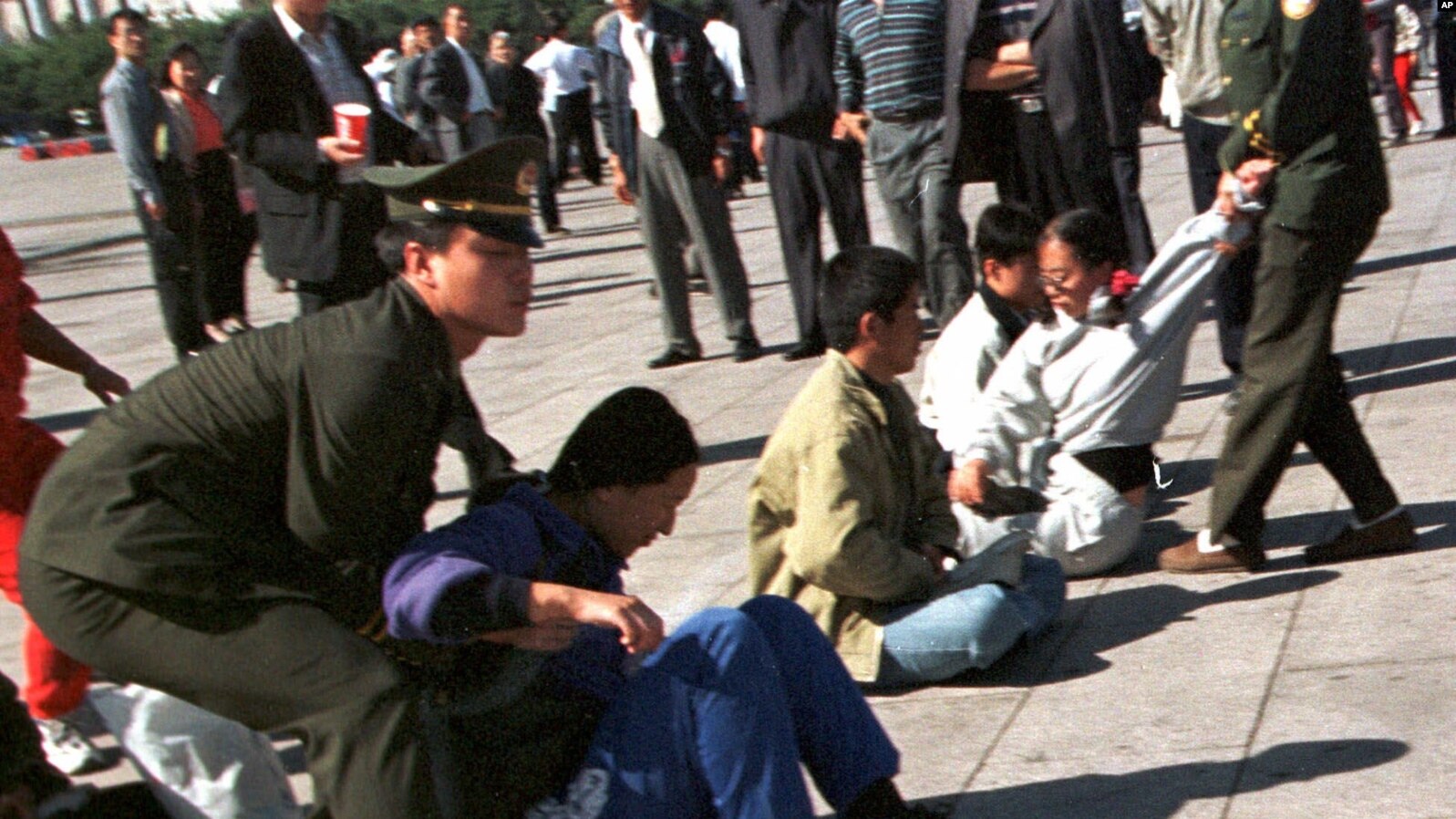
Beginning on July 22, 1999, Falun Gong was banned in China. People were prohibited from openly practicing Falun Gong, distributing Falun Gong materials, or organizing protests against the government's ban. Within days, police confiscated and destroyed 1.5 million Falun Gong books, videotapes, and discs, and shut down every Falun Gong-related website in mainland China. In the first week of the crackdown alone, at least 5,000 Falun Gong practitioners were arrested and had their homes raided, while another 1,200 government officials were detained and required to study Communist Party documents and publicly renounce Falun Gong.
In February and March of 2000, fifteen detained Falun Gong practitioners died in custody. On April 19, 2000, Xinhua News Agency announced that a total of 84 Falun Gong members had been sentenced.
A 2004 United Nations report found that hundreds of thousands of Falun Gong practitioners were believed to have been detained without due process, and that those in custody were subjected to forced labor, the abusive administration of psychiatric drugs, torture, and forced ideological remolding by the Chinese government.
In December 2005, Human Rights Watch cited accounts from former detainees of the labor camp system indicating that Falun Gong practitioners made up the largest group held in China's labor camps (laojiao) and prison facilities, and that they were often subjected to the longest periods of detention and the worst treatment.
In 2008, the U.S. State Department and the Congressional-Executive Commission on China cited foreign observers' estimates that more than half of the people held in China's reeducation-through-labor camps were Falun Gong practitioners.
The Case of Tan Yongjie
According to a July 2001 Associated Press report, Tan Yongjie, who had been tortured in China, made his way to the United States after a harrowing journey and was treated for burns at Park Plaza Hospital in Houston before being discharged. Tan was a factory worker from Bao'an County, Guangdong Province, who began practicing Falun Gong in June 1998. After the Chinese government's 1999 crackdown on Falun Gong, he was detained multiple times. On April 25, 2001, he was arrested again for distributing leaflets calling on the government to end the crackdown; he was severely beaten and, without trial, sent to a labor camp in Boluo County (as transliterated), where he was handcuffed and hung up for more than five hours. On June 2, 2001, he was tied to a post and burned on the legs thirteen times with a red-hot iron rod in an effort to force him to renounce Falun Gong. In an interview with the World Journal, Tan recounted that on June 2, 2001, three guards beat him and tried to force him to write a statement of repentance; he refused to speak. “In the end, one guard tied me to a post while another heated a rusty iron rod on an electric stove until it was red-hot, then burned my thighs and calves with it, all while repeatedly asking, 'Are you still going to practice or not?'” Tan screamed and shook in agony, and the guards dragged him outside like a dog before locking him in a small isolation cell. “Afterward, the guards saw that I could barely walk and was in too much pain to sleep, so they assumed I couldn't possibly escape and assigned me to watch over an orchard. The orchard was vast, and I slipped away when no one was watching.” After fleeing the orchard, Tan hitched a ride on a truck into Hong Kong, then on June 10 stowed away in a cargo container on a freighter; after a two-week voyage at sea, he entered the United States illegally in California on the 24th.