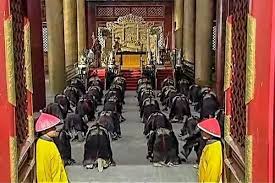
On November 19, 2024, the Hong Kong High Court found 45 pro-democracy figures guilty of "conspiracy to subvert state power," sentencing them to terms ranging from four to ten years. One of the defendants, Gwyneth Ho, wrote on Facebook that the defendants' "unforgivable" act of subversion consisted of trying to win a legislative majority in order to exercise the right to veto the annual budget. By that logic, every democracy in the world would face an attempted subversion of state power every four to six years. Yet in an Orwellian, 1984-style reality, democratization—or even merely calling for it—is treated as equivalent to subverting state power. In mainland China, a new offense—"inciting subversion of state power"—appeared in the 1997 Criminal Law of the People's Republic of China, defined as "inciting the subversion of state power and the overthrow of the socialist system through rumor-mongering, slander, or other means." To this day, numerous pro-democracy activists and human rights lawyers have been detained and imprisoned under this charge. Whether it is mainland China's crime of "inciting subversion of state power" (shortened to "incitement to subvert") or Hong Kong's National Security Law offense of "conspiracy to subvert state power" (shortened to "conspiracy to subvert"), both define "subverting state power" as a crime. I cannot help but ask: what exactly is subversion of state power? What actions constitute it? And why is it a crime at all in both the mainland and Hong Kong? As Ho asked: every four years the United States holds a presidential election—did Trump's leading the Republican Party to a change of power count as subverting state power? When South Koreans rallied in Seoul demanding President Yoon Suk-yeol step down, was that subversion of state power? When Taiwan's pan-Blue media criticize the Lai Ching-te government every day, is that subversion of state power? Why is it that conduct considered a legitimate civil right in democracies is treated as an unforgivable crime in China? Of course, one could simply say that democracies have no such crime as "subverting state power" at all—it is a hallmark of authoritarian regimes. And since the CCP is a dictatorship, it can enact all manner of laws under various pretexts, fabricating charges at will to violate citizens' rights. But the more important question is this: what comes to mind for Chinese people when they hear "subverting state power"? When they hear that so-and-so has been convicted of "subverting state power," do they actually believe that person is guilty? Behind this lies an old habit of mind. Many Chinese people instinctively associate "subverting state power" with overthrowing the imperial court or the emperor. In ancient times, rebellion and treason were of course grave crimes. So in the Chinese subconscious, "subverting state power" has become a genuine crime in its own right, allowing the CCP to wield the club of "subversion of state power" to suppress dissidents at will. Why is it that in modern democracies, subverting state power is not a crime, and no such offense even exists? Because state power is, by its very nature, an institution meant to serve the people. Its creation depends on the consent of the people, its authority is a power the people have delegated, and its legitimacy derives from the people's support. In a modern state, the people are the masters of the nation, and voting in elections and reshaping the government are legitimate civil rights. But in ancient China, the emperor and the imperial court were the masters of the state, and overthrowing the court was an unpardonable crime. In China today, state power itself has become the master of the nation—which is why subverting state power has become a crime. In fact, both "the state" and "the people" are modern terms. In ancient China there was no "state" and no "people"—only "the imperial court" and "the commoners." Today, China has adopted the modern vocabulary, calling the CCP the "Chinese government" and the commoners the "Chinese people." Yet the relationship between this Chinese government and the Chinese people is not the relationship between a modern government and its people at all—it is indistinguishable from the relationship between the ancient court and its subjects. In its social system and mode of thinking, China remains stuck in antiquity. We need to tell the Chinese people: the master of China is not state power—it is you. State power is an institution meant to serve you, and the right to overturn it is a right that rightfully belongs to you. Because today you are no longer the "commoners" of old, and today's government should no longer be the imperial court of old. The imperial court stood above the commoners; a government stands beneath the people.
The Imperial Court and the Commoners, the Government and the People
2024-12-08